Understand what grows chest muscle
If you want a chest workout for muscle mass that actually works, you need more than a random list of exercises. Your chest grows when you give it:
- Enough volume
- Enough effort per set
- Enough time to recover
Research on hypertrophy suggests you can build muscle with a wide range of intensities, roughly 30% to 90% of your one rep max, as long as you take sets close to failure and progress over time through more weight or more reps. Analysis from Barbell Medicine in 2024 notes that training volume and effort near failure are the big drivers of hypertrophy, not one magic weight or rep range.
For chest specifically, your pectoralis major has three main regions:
- Upper chest (clavicular head)
- Middle chest (sternal head)
- Lower chest (abdominal head)
A good chest workout for muscle mass does not just hammer flat bench. You target each region with angles and movements that match the direction of the muscle fibers.
Set your chest training targets
Before you think about sets and reps, it helps to know what you are working toward.
Weekly volume and exercise count
For intermediate lifters focused on muscle size, current recommendations suggest:
- About 4 to 6 chest exercises per week
- Roughly 3 to 4 different exercises per chest workout
- Enough total sets to challenge you without wrecking your recovery
You can split this across two sessions in the week, which keeps fatigue manageable while still giving your chest a strong growth signal.
Intensity and effort
Across your chest workouts you should:
- Work in a rep range of about 6 to 15 reps for most sets
- Use loads anywhere from about 30% to 90% of your one rep max
- Take sets close to failure, where you could do at most 0 to 3 more reps with good form
As long as you keep adding a little weight, a few reps, or an extra set over time, you create progressive overload, which is essential for new muscle.
Target the full chest in one workout
You can build a balanced chest by choosing exercises that hit upper, middle, and lower fibers and also bring your arm across your body to squeeze the chest.
Key movements for mid chest mass
For the middle portion of your chest, strong options include:
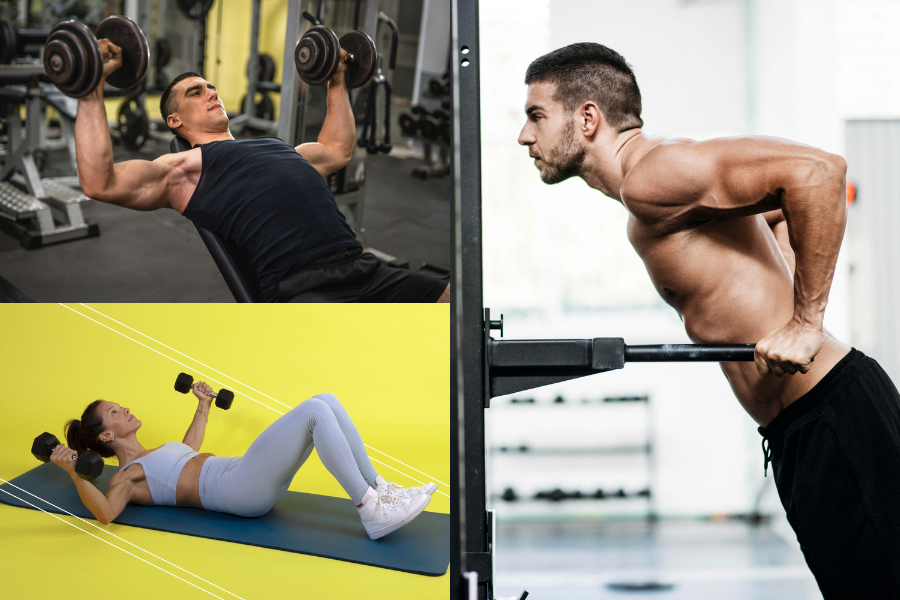
- Barbell or dumbbell bench press for heavy overload
- Horizontal cable crossovers to work across the midline
- One arm dumbbell bench presses to increase adduction and fix imbalances
- Dumbbell pullovers for a deep stretch and chest squeeze
The dumbbell bench press stands out in 2024 research as one of the best choices for chest strength and mass at about 3 to 4 sets of 6 to 8 reps. Using dumbbells lets you move through a larger range of motion and may reduce injury risk compared with a bar, while still giving you similar muscle activation.
Focus on upper chest size
You grow your upper chest by pressing on an incline and pulling resistance from low to high:
- Incline bench press (around 15 to 30 degrees) for overload
- Low to high cable crossovers to follow the fiber direction
- Upper chest cable “upper cut” style movements for a tight top contraction
- Lean back cable presses that push forward rather than straight up to keep tension on the upper fibers
Build out the lower chest
For lower chest development, choose exercises that follow the downward fiber angle:
- Weighted dips for heavy overload
- High to low cable crossovers to move across the midline
- Jackhammer pushdowns using elbow position to emphasize lower fibers
- Standing cable press variations that travel slightly downward
Mixing these with your mid and upper chest work gives you a complete chest workout for muscle mass instead of a flat, one dimensional look.
Follow this 28 day chest mass plan
You can put the science into practice with a simple 28 day plan that alternates between two focused sessions. This structure combines German volume style loading, high effort push ups, and stretch focused work to drive hypertrophy.
You will cycle between:
- Session 1: Heavy bench plus intense push up variations
- Session 2: Stretch, pump, and expansion focused work
Allow 2 full rest days between each session so your chest can recover and grow.
Session 1: Heavy press and push ups
Use this workout to overload your chest and create a large growth stimulus.
- Barbell bench press
- 10 sets of 6 reps
- Rest 60 seconds between sets
- Choose a weight that feels challenging but lets you complete all sets with good form
- Focus on:
- Engaging your glutes and abs to keep your body stable
- Lowering the bar under control
- Squeezing your chest hard at the top of each rep
- Reverse grip push ups
- 1 set of 60 seconds of work
- Rest 90 seconds
- Incline push ups
- 1 set of 60 seconds of work
- Rest 90 seconds
- Clap push ups or explosive push ups
- 1 set of 60 seconds of work
- Rest 90 seconds
For the push up variations, count total reps during the work period and try to beat your numbers in later sessions. These moves increase blood flow, time under tension, and muscular endurance, all of which support muscle hypertrophy.
Session 2: Stretch and expand the chest
This session emphasizes deep stretches and high repetition work to create more muscle fiber recruitment and a strong pump.
- Pectoral stretch
- Use a doorway or wall
- Hold the stretch for as long as prescribed in your plan or until you feel a strong but manageable stretch
- Do this before and after your working sets to improve range of motion
- 45 degree incline dumbbell chest press
- 4 sets of 12 reps
- Rest 60 seconds between sets
- Keep the bench around 15 to 30 degrees if your shoulders are sensitive
- Lower the dumbbells slowly and press up with control
- Flat dumbbell flyes
- 3 sets of 12 reps
- Rest 60 seconds between sets
- Use a light to moderate weight and prioritize a gentle stretch with soft elbows
- Bring the dumbbells together above your chest and squeeze
- Dumbbell incline flyes
- 3 sets of 12 reps
- Rest 60 seconds between sets
- Focus on the upper chest by keeping tension at the top portion of the movement
- Dips
- 4 sets of 12 reps
- Rest 60 seconds between sets
- Slightly lean forward to emphasize your chest rather than your triceps
Repeat this two session rotation for 28 days, always keeping 2 rest days between each workout. Across the month you will accumulate substantial training volume while protecting your recovery.
Use dumbbells to maximize hypertrophy
If you prefer dumbbells or you train in a smaller gym, you can still run a chest workout for muscle mass that hits every region of your pecs.
Why dumbbells work so well
Research in 2024 highlights that the dumbbell bench press:
- Produces muscle activation and range of motion similar to the barbell bench press
- Adds a bit more stability demand, which can improve coordination
- Lets each arm move independently so you can address strength imbalances
Compared to barbells, dumbbells give you a greater range of motion and more freedom in your wrist and elbow path. That extra stretch and control can be especially helpful for hypertrophy.
Sample dumbbell focused chest session
You can structure a dumbbell session this way:
- Dumbbell bench press
- 3 to 4 sets of 6 to 8 reps
- Heavy, near failure by the last set
- Incline dumbbell press at 15 to 30 degrees
- 3 sets of 8 to 12 reps
- Dumbbell flyes (flat or incline)
- 3 sets of 10 to 15 reps
- Crush grip dumbbell press
- 3 sets of 10 to 12 reps pressing two dumbbells together to increase chest activation
- Dumbbell pullovers
- 2 to 3 sets of 10 to 12 reps with a focus on stretch and controlled squeeze
For beginners, 2 to 3 different dumbbell chest exercises per session with lighter weights and a variety of rep ranges is usually enough. Avoid locking yourself into heavy low rep work too soon. Building a base of volume and good technique supports long term growth and reduces injury risk.
Add unilateral work to fix imbalances
Unilateral dumbbell exercises like a half bench single arm press help you:
- Correct left to right strength differences
- Engage your core and glutes for better stability
- Improve pressing technique on each side
Include 2 to 3 sets per side after your main pressing work, staying within a moderate rep range.
Train chest effectively at home
If you do not have access to a gym, you can still follow the same principles with bodyweight and minimal equipment.
Home friendly chest variations
Use these at home to keep your chest workout for muscle mass progressing:
- Hands elevated push ups to reduce load while you build strength
- Typewriter push ups to increase time under tension side to side
- Band resisted push ups to make the top of the movement harder
You can cycle these just like gym exercises: several sets near failure, 2 to 3 times per week, with small progressions each week in reps or band tension.
Avoid common chest training mistakes
A well designed plan can still fail if you overlook a few basics.
Doing too much volume too soon
Higher training volume is linked to greater muscle growth as long as you can recover from it. If you pile on sets and exercises you cannot recover from, your performance drops and your progress stalls. Start at the lower end of recommended sets and only increase when you are consistently hitting your targets.
Ignoring recovery
You stimulate growth in the gym, but you build muscle when you rest. The 28 day program above uses 2 rest days between each chest workout so you can actually adapt to the training.
Pay attention to:
- Soreness that does not fade between sessions
- Dropping bar speeds and rep counts
- Joint pain instead of muscle fatigue
These are signs you might need to reduce volume or intensity for a week.
Skipping full range of motion
Muscle hypertrophy benefits from loading the muscle through a large range of motion. Cut your reps short and you limit the stimulus. Instead:
- Lower the weight under control
- Go to a comfortable but solid depth that stretches your chest
- Finish each rep by squeezing your chest at the top
Whether you use a barbell, dumbbells, cables, or bodyweight, this attention to range and tension helps drive growth.
Put it all together
To maximize your chest gains with a chest workout for muscle mass, you need to:
- Train all regions of your chest with smart exercise choices
- Use a wide but intentional intensity range, from about 30% to 90% of your one rep max
- Take sets near failure rather than chasing only heavy singles
- Accumulate enough weekly volume without sacrificing recovery
- Progress steadily with small increases in weight, reps, or sets
Start with the 28 day two session plan, adjust the dumbbell or home variations to match your equipment, and track your lifts. Over the next few weeks you should notice stronger presses, fuller pecs, and a chest that actually reflects the effort you put into your training.
About the Author