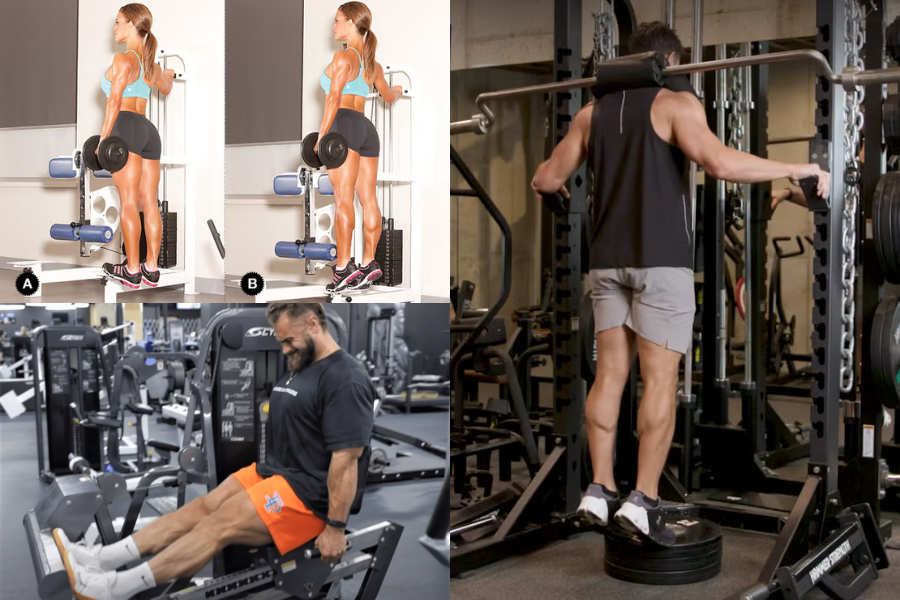
Barbell calf raises are one of the most effective ways to build thick, powerful calves with free weights. Because you can load the movement heavily and train through a deep stretch, barbell calf raises are ideal if your bodyweight or machine calf raises are no longer enough for real growth.
Below, you will learn how to set up barbell calf raises, use them in workouts for mass, and progress safely without wrecking your ankles or lower back.
Understand what barbell calf raises train
Barbell calf raises mainly target your gastrocnemius muscle, the big diamond-shaped muscle you see when someone flexes their calves. This muscle has two heads that start at the femur and join into the Achilles tendon, and it plays a big role in explosive movements like sprinting and jumping.
You also get help from the soleus, a deeper calf muscle that works hard any time you perform calf raises. Straight-leg variations, like standing barbell calf raises, emphasize the gastrocnemius more. Bent-knee variations, like seated dumbbell calf raises, shift more stress to the soleus, which is why a combination of both is best for full calf development according to experts cited from the Cleveland Clinic and University of South Carolina in a 2024 Lose It! article.
When you perform standing barbell calf raises correctly, you do not just train the calves in isolation. You also engage your quadriceps, hamstrings, glutes, and even your lower back as you stabilize the weight and maintain posture. Done regularly, this can help your overall leg strength and support better mobility and stability as you age.
Set up for standing barbell calf raises
A good setup is what keeps this exercise effective and safe. You can do standing barbell calf raises inside a rack or in an open area if you can safely get the bar on and off your back.
Start with these basics:
- Place the bar slightly below shoulder height in a rack.
- Stand under the bar and set it on your upper traps, then step back the same way you would for a back squat.
- Position your feet about shoulder-width apart with toes pointed straight ahead.
- Keep your chest up and your core gently braced.
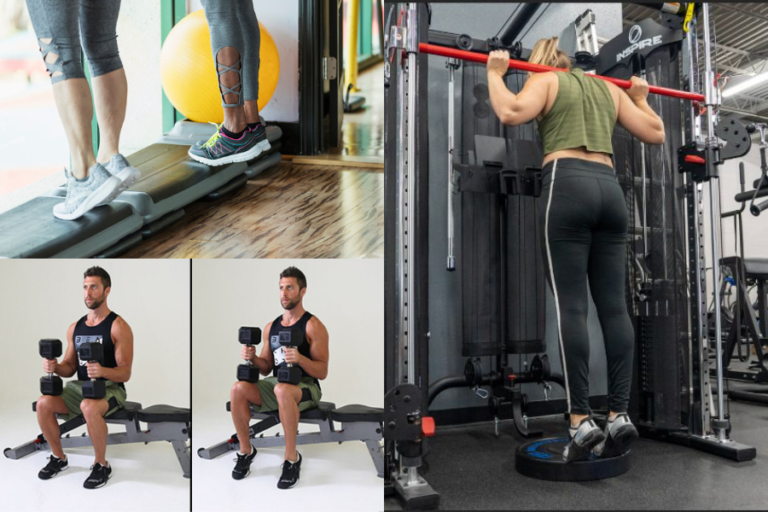
You can perform barbell calf raises on flat ground, or you can stand with the balls of your feet on a small block or weight plates. Using a block allows more extension and a deeper stretch, which increases the range of motion and can make the exercise more effective for muscle growth. If your balance feels shaky at first, start without the block and add it later once you feel more confident under the bar.
Use proper form for growth and safety
Rushing calf raises is one of the fastest ways to turn a muscle-building exercise into a tendon-driven bounce. For size, you want the opposite: slow, deliberate reps that keep tension on the muscle.
Here is how to perform a standing barbell calf raise with good form:
- Start with your heels flat on the floor or slightly below floor level if you are on a block.
- Push through the balls of your feet to lift your heels as high as you can.
- At the top, squeeze your calves hard and hold for 1 to 2 seconds.
- Lower your heels slowly, taking 2 to 3 seconds to return to the starting position.
- Pause briefly at the bottom to avoid bouncing, then repeat.
Exercise specialists, including Jared Meacham, PhD, note that slow, controlled reps with a pause at both the bottom and top improve muscle activation and hypertrophy because they prevent you from relying on the Achilles tendon’s stretch reflex. Fast, bouncy reps often end up training the tendon more than the muscle fibers.
Regular, steady breathing helps too. Exhale as you lift your heels and squeeze, inhale as you lower them. It sounds simple but consistent breathing keeps you more stable under heavier loads.
Form rule of thumb: If you cannot pause at the bottom and hold a hard squeeze at the top, the weight is too heavy for effective calf growth.
Adjust foot position to target different areas
You can adjust your stance slightly to shift emphasis to different parts of the gastrocnemius. Research highlighted by Shawn Arent, PhD, suggests that simple changes in foot angle help you hit each head more effectively.
Use these variations occasionally to fully develop your calves:
- Toes forward: This hits both heads of the gastrocnemius fairly evenly and is your default stance.
- Toes slightly inward: This emphasizes the outer, or lateral, head of the gastrocnemius.
- Toes slightly outward: This places more focus on the inner, or medial, head.
You do not need to overcomplicate this. Rotate foot angles every few weeks or use one foot position per set. The key is to keep your knees locked or only slightly soft so the calf is doing the majority of the work and to avoid letting your knees drift forward into a squat.
Choose the right weight and reps for mass
To build calf size, the load and rep range matter just as much as your technique. Using a weight that is too heavy shortens your range of motion and eliminates the top squeeze, while going too light never challenges the muscles enough.
An effective guideline is to pick a weight that allows you to complete 8 to 15 controlled reps with a full stretch and a strong contraction at the top. Experts recommend using a mix of rep ranges for calf growth:
- Heavier weight with lower reps, around 8 to 12 per set
- Lighter weight with higher reps, around 15 to 20 per set
Shawn Arent, PhD, notes that rotating between these ranges helps challenge both the fatigue resistant soleus and the gastrocnemius for better overall development.
You can also use strength standards as reference points. As of 2026 data from the lifting community, the average one rep max for barbell calf raises is about 262 pounds for an intermediate male lifter and 165 pounds for an intermediate female lifter. For beginners, aiming for a one rep max of roughly 86 pounds for men and 37 pounds for women is already considered impressive compared with the general population.
You do not need to test your one rep max often for this exercise. Instead, use those numbers as context while you build strength in the 8 to 15 rep range.
Program barbell calf raises for mass
How you place barbell calf raises in your week has a big impact on results. The calves are used in walking, running, and daily movement, so they can handle more frequency than many other muscle groups, as long as you respect recovery.
A practical approach for most people who care about calf mass is:
- Train calves 3 times per week
- Perform 3 working sets of barbell calf raises per session
- Aim for 8 to 15 reps per set, with 30 to 45 seconds of rest
One recommendation for size is to combine standing barbell calf raises with seated calf raises in the same session or across the week. Standing variations primarily target the gastrocnemius, while seated versions emphasize the soleus, which helps create fuller, thicker calves from the side and back.
A simple weekly structure might look like this:
- Day 1: Standing barbell calf raises, 3 sets of 8 to 12 reps.
- Day 2: Seated calf raises or seated dumbbell calf raises, 3 sets of 12 to 15 reps.
- Day 3: Standing barbell calf raises on a block, 3 sets of 10 to 15 reps focusing on stretch and squeeze.
Many lifters notice a clear difference in calf size and definition within about 4 weeks when they keep this level of consistency, use a full range of motion, and keep progression gradual.
Use variations to keep making progress
If you are consistent with standard barbell calf raises, you can add simple variations to keep your muscles challenged.
Single leg standing calf raises are a powerful option for building strength and improving balance. By training one leg at a time, you increase the load per side and improve control at the ankle. Single leg movements also increase the range of motion at the ankle joint and improve body control in everyday activities.
You can also adjust the equipment if barbell setup is not ideal. Seated dumbbell calf raises, where you rest dumbbells on your thighs, are excellent if you struggle with balance during standing exercises or if you want to emphasize the soleus more. Weighted calf raises in general let you add progressive resistance over time, which is key for hypertrophy.
If you find that your barbell calf raises start to feel easy with a given weight and rep range, add a bit more weight, increase the number of reps, or slow the tempo to keep tension high. The important part is that you still reach fatigue within your planned rep range and maintain your full range of motion.
Pay attention to technique, recovery, and results
Barbell calf raises produce a deep burn in the lower legs and contribute significantly to muscular hypertrophy when you push close to fatigue. Because your calves are involved in a lot of daily activity, they often respond well to higher training frequencies like 3 times per week, and some people can handle 4 to 5 sessions focused on calves. However, the risk of overuse and tendon irritation goes up as you add more volume.
To stay on the safe side:
- Keep your reps controlled and avoid bouncing at the bottom.
- Use a weight that lets you perform a full stretch at the bottom and a hard contraction at the top.
- Rest 30 to 45 seconds between sets to maintain quality.
- Increase volume or weight gradually from week to week.
Good form and progressive overload combined with adequate rest and nutrition are what lead to noticeable improvements in leg strength and calf size. Over time, you will not just see rounder, more defined calves, you will likely feel more stable in movements that involve running, jumping, and change of direction.
If you are new to barbell work or have a history of ankle, knee, or lower back issues, consider checking in with a coach or a qualified professional before loading this exercise heavily. With the right setup and patience, barbell calf raises can become one of your most productive tools for building calf mass.
About the Author