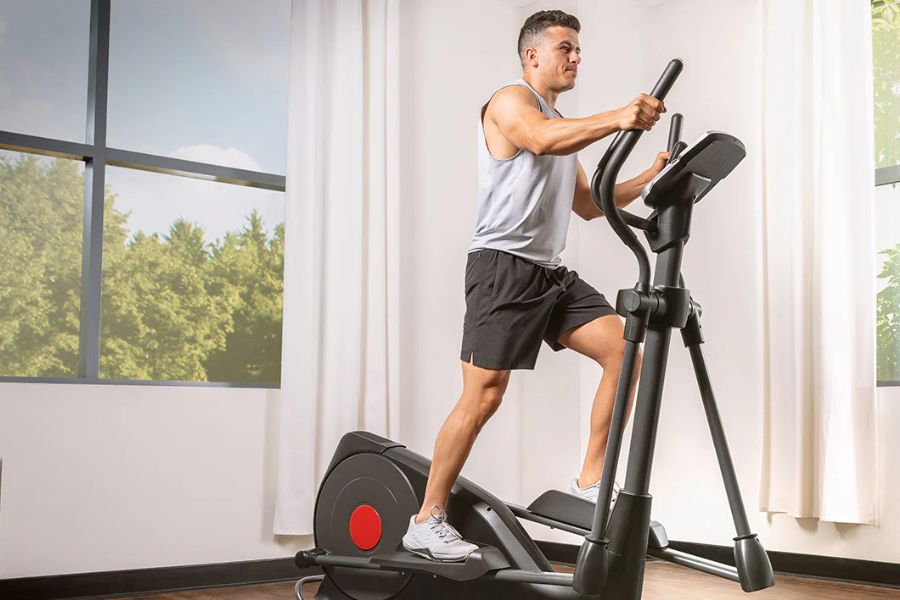
An elliptical workout for seniors can be one of the simplest ways to protect your joints, improve your heart health, and build strength in one session. You stay in place, your feet never leave the pedals, and you still get a full body workout that supports your balance and everyday activities.
If you are looking for low impact exercise that helps you lose weight and improve your health without pounding your knees and hips, the elliptical is worth a closer look.
Understand why ellipticals suit seniors
Elliptical trainers are designed to mimic walking or jogging, but with your feet gliding instead of striking the ground. That small difference makes a big impact on how your joints feel.
The smooth, weight bearing motion lets you strengthen bones and muscles without the harsh impact of running. Verywell Fit notes that elliptical training is easier on knees and hips than treadmill walking or running, while still conditioning your heart and lower body and providing the kind of weight bearing exercise that helps lower your risk of osteoporosis (Verywell Fit).
Unlike a bike that focuses mostly on your legs, an elliptical usually includes moving handlebars so you can use both your upper and lower body. According to a senior focused elliptical program, this full body movement can engage about 80% of your muscles, including your legs, arms, and core, and that supports better coordination, balance, and reduced fall risk (Space Cycle).
See the health benefits you can expect
Even short, regular sessions on an elliptical add up quickly. You get cardio, strength, and balance work in one routine, which is especially helpful if you prefer to keep your workouts simple.
Support your heart and circulation
Cardiovascular health is one of the biggest wins of an elliptical workout for seniors. Fitscope Studio explains that elliptical workouts can improve heart and lung strength, support more efficient blood flow, and help reduce blood pressure and cholesterol levels, which lowers your risk of heart disease (Fitscope Studio).
The predictable, controlled movement also makes it easier for you to stay in a safe intensity zone. This is useful if you monitor your heart rate or take medications that affect how your heart responds to exercise.
Build muscle and burn calories
With the right resistance, your elliptical workout doubles as strength training. Fitscope Studio notes that ellipticals can target your glutes, quads, arms, back, and core, helping you burn calories more efficiently and reduce body fat (Fitscope Studio).
Because you are working several major muscle groups at once, your body uses more energy than it would with a short walk at the same pace. Over time, this can support healthy weight loss or help prevent weight gain.
Protect joints while improving bone density
If you live with arthritis or sensitive joints, you may worry that exercise will make things worse. The elliptical offers a joint friendly compromise. Its gliding motion creates a feeling of weightlessness for your knees and hips, which Avoids the repeated joint stress that comes with running or stair climbing (Fitscope Studio).
At the same time, elliptical training still counts as weight bearing exercise. Verywell Fit points out that this kind of movement helps build stronger bones, muscles, and connective tissue, which can reduce your risk of osteoporosis and help you maintain physical function as you age (Verywell Fit).
Improve balance and everyday confidence
Every time you stand upright and move on the elliptical, you are asking your core, back, and leg muscles to work together. Over time, that teamwork improves your balance and coordination, which can reduce your risk of falls.
TRUE Fitness notes that elliptical training strengthens the lower body, upper body, and core in ways that support functional fitness for daily tasks, and that this strength is key for balance and fall prevention in older adults (TRUE Fitness). Holding the handlebars while you move gives you extra stability while you build that strength.
Think of each workout as a quiet investment in your independence, helping you move confidently through your day, from climbing stairs to carrying groceries.
Choose the right elliptical for your needs
You do not need the most expensive machine to get a safe, effective elliptical workout for seniors, but a few features matter more than others.
Prioritize stability and comfort
Look for an elliptical with a wide, non slip base and sturdy frame so you feel secure when you step on and off. The senior elliptical program from Space Cycle recommends a wide, stable base, ergonomic handles, adjustable resistance, and padded pedals to keep you comfortable and safe during exercise (Space Cycle).
BarBend also highlights the importance of stride length that matches your height, general machine stability, and adequate weight capacity, often around 300 pounds or more, for durability and support (BarBend). If you are between about 5’3″ and 6’0″, a stride length of around 20 inches is often recommended.
Consider special designs for joint or mobility issues
If you have significant knee pain or difficulty standing for long periods, a seated or recumbent cross trainer might suit you better. CNET identifies the Teeter FreeStep LT3 Recumbent Cross Trainer and Elliptical as particularly helpful for knee pain, since it lets you pedal in a reclined, seated position that reduces stress on your joints and back (CNET).
For very small spaces or for workouts while seated in a chair, under desk style ellipticals such as the Cubii Move and Cubii Total Body Smart Seated Elliptical can be useful. These compact machines are lightweight, quiet, and allow you to work your legs, and in some models your upper body too, while sitting (BarBend, CNET).
Look for senior friendly features
Some models are designed specifically with seniors in mind. HARISON notes that its HR 304 and HR 305 ellipticals require no assembly, include easy to use remote controls, and feature anti slip pedals and a stable frame, which can be ideal if you have arthritis or are returning to exercise after surgery (Harison Fitness).
These models are also designed to operate very quietly, for example the HR 305 runs under 15 decibels, so you can exercise early in the morning or late at night without disturbing anyone in your home (Harison Fitness).
Start with a safe beginner routine
Once you have access to an elliptical, start gently. Your goal is not to prove anything in a single session, it is to build a routine you can repeat comfortably.
Verywell Fit suggests that beginners, including seniors, start with shorter workouts of about 10 minutes to avoid soreness and injury (Verywell Fit). You can then gradually increase the length and intensity as your endurance improves.
Sample 20 minute beginner elliptical workout
Use this as a guideline and adjust the times or intensity based on how you feel. If you are brand new to exercise or have health concerns, talk with your doctor before you begin.
-
Warm up, 3 to 5 minutes
Set the resistance low. Move at a comfortable pace that gently raises your heart rate. You should be able to talk easily. Focus on getting used to the motion and posture. -
Main set, 10 to 12 minutes
Increase the resistance slightly so you feel you are working, but you can still hold a conversation. Verywell Fit recommends staying at a moderate effort, roughly a 4 to 6 on a 1 to 10 perceived exertion scale, where 1 is very light and 10 is maximum effort (Verywell Fit).
You can stay at one steady pace or try gentle intervals, for example:
- 1 minute slightly faster
- 2 minutes easier recovery
Repeat this pattern 3 or 4 times.
-
Cool down, 3 to 5 minutes
Lower the resistance and slow your pace. Let your breathing return almost to normal by the end. When you step off, take a moment to steady yourself and notice how your body feels. -
Stretch, 3 to 5 minutes
Off the machine, gently stretch your calves, thighs, hips, and chest. Slow stretching after you finish helps maintain flexibility and may reduce stiffness.
The Space Cycle senior elliptical program suggests that many older adults do well with 20 to 30 minute sessions, three times per week, including a warm up, moderate resistance in the middle, and a cool down at the end (Space Cycle). HARISON offers similar guidance, recommending 10 to 15 minute sessions 3 to 4 times per week to start, then gradually increasing to 20 to 30 minutes if you feel comfortable (Harison Fitness).
Keep your workouts safe and enjoyable
A few simple habits help you get the benefits of an elliptical workout for seniors while avoiding common discomforts.
Listen to your body and your doctor
If you have severe joint damage, a recent surgery, or significant heart or lung issues, talk to your doctor or physical therapist before starting. HARISON advises that seniors with severe joint problems or recent surgery should seek medical guidance first, while those with mild to moderate joint pain can still benefit from the low impact elliptical motion that reduces joint pressure (Harison Fitness).
During your workout, stop and rest if you feel sharp pain, chest discomfort, unusual shortness of breath, or dizziness. Slight muscle fatigue is normal, but intense pain is a signal to ease up or stop.
Use posture and resistance to your advantage
Stand tall, keep your shoulders relaxed, and hold the handlebars lightly. Do not lean on the handles or hunch forward. This protects your back and encourages your core to support you.
Start with low resistance and a small incline, especially if you are coming back from a break or are new to cardio. CNET notes that adjustable resistance and incline let you keep your workout low intensity and joint friendly while still challenging your muscles and cardiovascular endurance as you progress (CNET).
Add simple strength and flexibility work
To get the most from your elliptical routine, pair it with light strength training and stretching on the days you are not on the machine. The senior elliptical program from Space Cycle recommends complementary muscle strengthening and stretching exercises to boost strength, improve flexibility, and prevent injury, and it emphasizes the importance of warming up, hydrating, and cooling down properly (Space Cycle).
You can keep this as simple as a few bodyweight exercises such as chair squats, gentle wall push ups, and seated marches, followed by short stretches for your major muscle groups.
Turn it into a long term habit
The real transformation from an elliptical workout for seniors comes from consistency. A few thoughtful strategies can help you keep going.
- Schedule your workouts like appointments, for example, Monday, Wednesday, and Friday mornings.
- Keep everything you need nearby, such as a water bottle, towel, and sturdy shoes.
- Track your sessions in a notebook or calendar so you can see your progress.
- Vary your workouts by changing the resistance slightly or adding a song or two to your favorite playlist.
Elliptical machines offer a low impact, full body workout that fits easily into most routines. They protect your joints, strengthen your muscles, and support your heart, all while helping you move more confidently in your daily life.
If you have access to an elliptical, try a simple 10 minute session this week. Notice how you feel afterward, and let that small win be the first step toward stronger, steadier days ahead.
About the Author