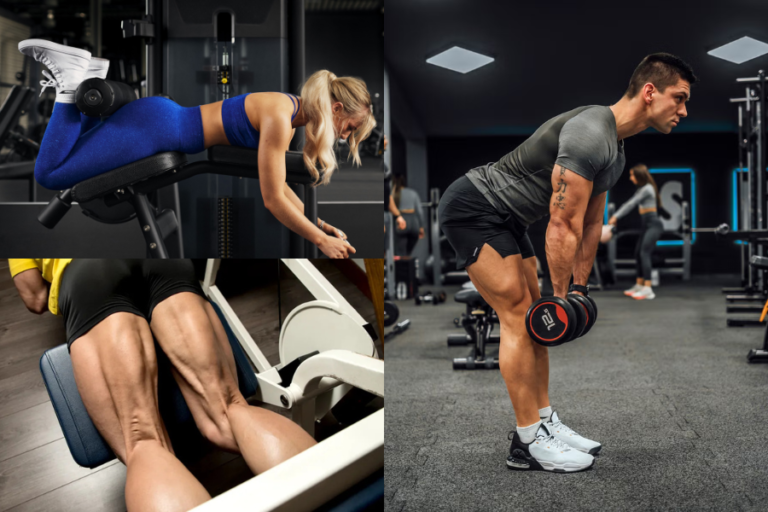
A solid calf workout can do more than fill out your jeans. Strong calves support your knees and ankles, improve your sprint speed and jump height, and help prevent lower leg injuries. When you build your training around smart calf workouts for men, you get a mix of size, strength, and athletic power instead of just a quick burn.
Below, you will learn how your calves work, which exercises actually grow them, and how to put everything into a simple weekly plan.
Understand your calf muscles
If you want bigger and stronger calves, it helps to know what you are actually training. Your calf muscles are not just one lump of muscle at the back of your lower leg. They are a group of muscles that all play a different role in how you move.
Main calf muscles
Your calves are built mainly from:
-
Gastrocnemius
This is the visible, diamond shaped muscle you see when you flex. It crosses both the knee and ankle, helps with knee flexion and ankle plantar flexion, and is heavily involved in running and jumping. -
Soleus
This sits underneath the gastrocnemius and does a lot of work when you stand, walk, and maintain posture. Training the soleus can literally push the gastrocnemius outward, which helps your calves look thicker and more developed. -
Plantaris
A smaller muscle that assists the other two with movement and stability.
These muscles connect your knee and ankle joints, so they support knee flexion and extension as well as ankle movement. That is why stronger calves can help you sprint, change direction, swim, and jump more effectively, as shown in research on athletes including young male basketball players.
Why calves can be hard to grow
Calf muscles are notoriously stubborn. Genetics matter a lot, and many men feel like their calves lag behind the rest of their body. You also use your calves all day when you walk, so they are highly conditioned and need more targeted stimulus to grow.
Research suggests that calves contain a high proportion of slow twitch fibers, which respond well to higher training volume and lighter loads as long as you work close to failure. A 2020 paper by Brad Schoenfeld found that muscle growth can occur across a wide range of loads, provided that the effort is high, so you are not limited to heavy weights as long as you train hard.
The good news is that with a smart approach, you can still build bigger, stronger, and more functional calves even if your genetics are not ideal.
Key training principles for calf size and strength
Before you choose specific calf workouts for men, it helps to understand the basic rules that make your training effective.
Use a full range of motion
Most people rush through calf raises with tiny bounces. That short range does not load the muscle where it grows best.
For size and strength, you should:
- Lower your heel as far as comfortably possible to feel a deep stretch
- Pause for up to 2 seconds in that stretched position
- Drive up hard onto your toes and briefly squeeze at the top
This deep, sometimes painful stretch not only stimulates hypertrophy, it can also help reduce injury risk over time by improving ankle mobility. Just start with low volume because this style of training can cause intense delayed onset muscle soreness in the beginning.
Mix heavy, moderate, and light rep ranges
Your calves respond well to a variety of rep ranges:
- Heavy: 5 to 10 reps per set
- Moderate: 10 to 20 reps per set
- Light: 20 to 30 reps per set
A practical guideline is to spend about half your weekly calf sets in the moderate range and split the rest between heavy and light work. This mix trains both strength and endurance oriented fibers and helps you grow size while still building power.
Train both straight leg and bent leg positions
To fully develop your calves, you need to hit both the gastrocnemius and the soleus. Studies show that plantar flexion with bent knees selectively activates the soleus, while straight leg work emphasizes the gastrocnemius.
In practice, that means you should:
- Include straight leg movements like standing or leg press calf raises
- Include bent leg movements like seated calf raises
Balancing these positions is key for both aesthetics and performance.
Train often, but manage volume
Because your calves recover relatively quickly and do not rely heavily on large assisting muscles, you can train them more frequently than bigger muscle groups.
A good starting point is:
- Frequency: 3 to 6 times per week
- Exercises per session: 1 to 3 calf movements
- Different exercises per week: 2 to 4 choices in rotation
Calves also respond well to higher total weekly sets. For many men, that means working up to 18 to 24 sets per week, spread across your sessions, as long as joints and tendons feel good.
Between sets, rest just long enough to feel ready again. Often 1 to 3 minutes is plenty, and sometimes even less, since the local recovery of calves is fast.
Best calf exercises for men
You do not need a long list of fancy movements. A handful of well executed exercises, done consistently, will cover most of what you need for size and strength.
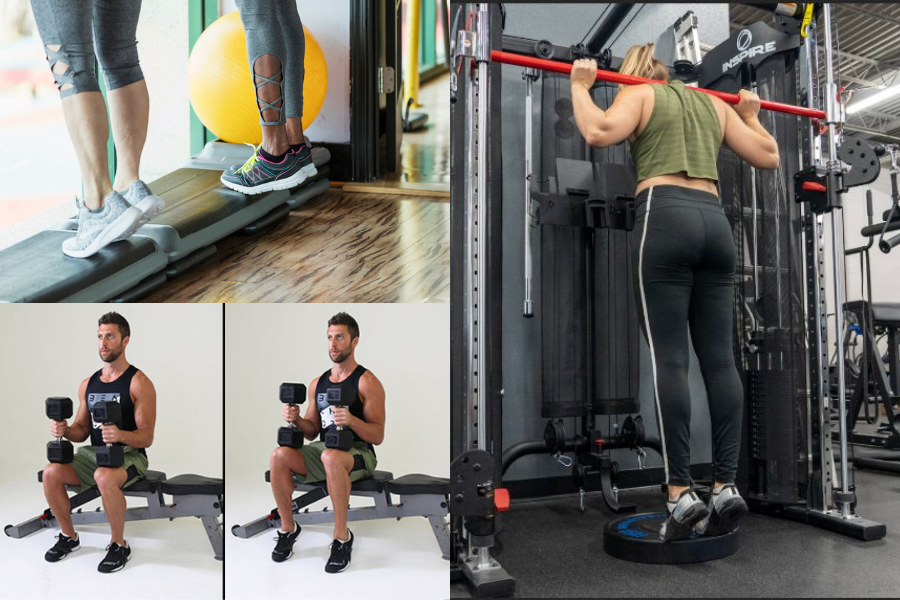
Standing calf raise
Standing calf raises target the gastrocnemius and are one of the best all round calf builders.
How to do it
- Stand on a step or wedge with the balls of your feet on the edge and heels hanging off.
- Keep your legs straight or only slightly bent.
- Slowly lower your heels as far as you can to feel a deep stretch. Pause for 1 to 2 seconds.
- Push through the balls of your feet to rise onto your toes. Squeeze at the top.
You can use a machine, hold dumbbells, or do them with body weight if you are new to training.
Seated calf raise
The seated calf raise is your primary exercise for the soleus since your knees are bent.
How to do it
- Sit with your knees bent at roughly 90 degrees and the balls of your feet on a block or step.
- Place weight on your thighs, either through a machine pad or dumbbells on your lap.
- Lower your heels toward the floor for a full stretch and pause for 2 seconds.
- Drive your heels up, lifting the weight as high as you can, and briefly hold at the top.
A common approach is 3 sets of 8 to 15 controlled reps, focusing on a slow lowering phase.
Single leg calf raise
Single leg work increases intensity by placing all your weight on one side and also helps correct imbalances between left and right calves.
You can do these:
- On a step or block with body weight or holding dumbbells
- On a leg press machine with just one foot on the plate
On the leg press, keep the range of motion large and add a 2 second pause at the top and bottom for 3 sets of about 12 to 20 reps. This is especially useful if you play sports like basketball where calf symmetry and ankle stability really matter.
Eccentric calf raise
Eccentric, or lowering focused, calf raises are excellent for strength, muscle growth, and tendon resilience.
To try them:
- Use both legs to rise up onto your toes.
- Shift your weight to one leg at the top.
- Slowly lower on that single leg for 3 to 4 seconds.
- Repeat using both legs to raise again.
You can apply this method to standing or seated calf variations to increase time under tension.
Leg press calf raise
If heavy standing calf raises bother your lower back, the leg press version is a good alternative. It lets you use significant load without compressing your spine.
Place the balls of your feet low on the platform, keep your legs mostly straight, and move through a full stretch and contraction on every rep.
Add plyometrics and conditioning
Calf workouts for men should not only focus on slow, controlled lifts. Explosive movements build the kind of power you see in athletes and help your calves function in real life.
Jump rope
Jump rope is a simple way to blend cardio, fat burning, and calf training. It reinforces quick, springy plantar flexion and can help you develop more explosive lower body power.
You can:
- Use it as a warm up
- Finish your leg day with it
- Turn it into a stand alone conditioning session
A straightforward protocol is 30 seconds of jumping, then 30 seconds of rest, repeated for 3 to 4 rounds. Over time, you can extend the work periods or add more rounds.
Sprints, jumps, and agility drills
Sprint workouts, hill runs, and simple jumping drills create high tension, spontaneous contractions in your calves that replicate how professional athletes develop their lower legs. This kind of natural overload often beats endless light calf raises.
You can also incorporate dynamic drills such as hurdle movements or lateral hops to build calf strength along with quickness and stability.
Sample weekly calf workouts for men
Putting everything together, here is a simple way to structure your week for both size and strength. Adjust sets and loads based on your experience, and remember to move with control and full range on every rep.
Aim for 2 dedicated calf sessions plus extra calf work at the end of other lower body days. Start low, then gradually add sets or weight as your calves adapt.
Workout A: Strength and stretch focus
-
Standing calf raise
-
4 sets of 6 to 8 heavy reps
-
2 second pause in the bottom stretch
-
Seated calf raise
-
3 sets of 10 to 15 reps
-
Single leg eccentric calf raise on a step
-
2 sets of 8 slow lowering reps per leg
Rest 1 to 3 minutes between sets. Use challenging weights, but keep technique precise.
Workout B: Volume and power focus
-
Leg press calf raise
-
3 sets of 12 to 20 reps
-
Pause for 2 seconds at the deepest stretch
-
Single leg calf raise (body weight or light load)
-
3 sets of 15 to 20 reps per leg
-
Jump rope intervals
-
30 seconds on, 30 seconds off, 3 to 4 rounds
You can place Workout A earlier in the week and Workout B later, then add 2 or 3 light sets of calf raises after your other leg sessions for extra volume if recovery feels good.
Technique tips and safety basics
Calf training looks simple, but details matter. Small tweaks can be the difference between steady progress and nagging tendon pain.
-
Use slow lowering phases
Emphasize the eccentric portion of each rep to increase muscle tension and growth stimulus. This is especially important for seated raises where you target the soleus. -
Vary your foot position
Rotating your toes can change which parts of the gastrocnemius you stress more. One study suggested doing 2 sets with feet forward, 1 set slightly inward, and 1 set slightly outward to cover different heads of the muscle. -
Respect soreness and progression
Calf DOMS can be intense when you first push the range of motion and stretch. Start with a few sets per session, then increase load or volume by roughly 10 to 15 percent every couple of weeks if everything feels good. -
Keep alignment tight
Move slowly enough that your ankles, knees, and hips stay stacked where they should be. If you are new to strength training or have a history of lower leg issues, it is wise to check your technique with a trainer or physical therapist.
Simple calf stretch routine
Improving calf and ankle flexibility helps you achieve the deep stretch that grows muscle and it also supports everyday movement.
You can add these after your workouts:
- Straight leg calf stretch against a wall
Step one foot back, keep the heel down and knee straight, then lean forward. - Bent knee calf and ankle stretch
From the same position, bend the back knee while keeping the heel down to focus more on the soleus and ankle mobility.
Hold each stretch for 20 to 30 seconds per side and repeat once or twice.
Bringing it all together
If your calves have been stuck for years, the solution is not more random sets. It is a focused approach that respects how this muscle group actually works.
When you:
- Train both gastrocnemius and soleus with straight leg and bent leg movements
- Use full range of motion with deep, controlled stretches
- Mix heavy, moderate, and high rep sets
- Add explosive work such as jump rope and sprints
- Progress slowly but consistently
you give your calves every reason to grow in both size and strength.
Start with one or two of the workouts above this week. Pay attention to how your calves feel, adjust the volume if soreness is overwhelming, and build from there. With a little patience and a lot of quality reps, you will notice more powerful push off when you run and a fuller shape in your lower legs when you look in the mirror.
About the Author