A strong set of calves does more than fill out the back of your legs. With the right calf workouts at home, you improve balance, ankle stability, jumping ability, and running strength without touching a single machine or weight. You can do everything in this guide using your own body weight and a small amount of floor space.
Below, you will find a mix of strength, power, and stretching moves so you can build size and durability in your calves right where you are.
Understand your calf muscles
Before you start any calf workouts at home, it helps to know what you are training.
Your calves are mainly two muscles working together:
- The gastrocnemius, the larger, visible muscle that creates the rounded shape. It helps you lift your heel and push off when you walk, run, or jump.
- The soleus, a deeper muscle that sits underneath. It supports the lower leg and ankle, and helps you stay upright when you stand.
These muscles connect into the Achilles tendon, which is a common source of pain for runners. Strong, flexible calves help protect this area, support smooth walking and running, and can even improve your speed and gait, as highlighted by physiotherapist Liz Tough in a June 2023 article for Runner’s World UK.
Why calf workouts at home matter
Your calves handle every step you take, so neglecting them can show up in surprising ways. Weak or tight calves can contribute to knee instability, ankle sprains, and strains around the Achilles. On the other hand, targeted calf training improves balance, stability, and power in everyday movements like walking stairs, standing from a chair, or carrying groceries.
Because calves are a relatively small muscle group that recovers quickly, you can train them more often than heavy compound lifts. Short, frequent calf workouts at home can fit around your schedule and still lead to noticeable changes in strength and shape.
How to get more from bodyweight calf work
You do not need heavy weights to make calf training effective. A few simple tweaks can dramatically increase how much your calves are challenged.
Use a deep stretch position
Research suggests that training your calves from a deeper stretch, where your toes are pulled up toward your shins, can boost muscle growth by more than 40 percent. The stretch places more mechanical tension on the muscle fibers, which encourages hypertrophy.
At home, you can do this by:
- Standing on a stair, step, or sturdy book so your heels can drop below the level of your toes
- Lowering slowly into that stretched position before pushing up
If you do not have a step, you can still simulate a stretch by slightly pulling your toes toward your shins at the bottom of each rep instead of relaxing.
Focus on standing variations
Standing calf raises tend to build more visible calf size than seated versions. A 12 week study found that standing raises increased growth in the gastrocnemius and overall calf muscles more than seated raises did. When you stand with straight legs, the gastrocnemius works harder, which is exactly what gives the calves their rounded shape.
Seated and bent knee options are still useful, especially for the soleus, but if your main goal is appearance, prioritize standing work.
Increase volume and frequency
Because your calves recover quickly, you can train them 3 to 5 times per week. You do not need long sessions. Think of short blocks such as:
- 3 to 4 sets of 15 to 25 reps of a calf exercise
- A few minutes of jumping or plyometrics
- Quick stretching at the end
Gradually increase reps, time under tension, or difficulty as the moves get easier.
Foundational strength moves you can do anywhere
Start with these simple, effective exercises. You can progress them as you get stronger.
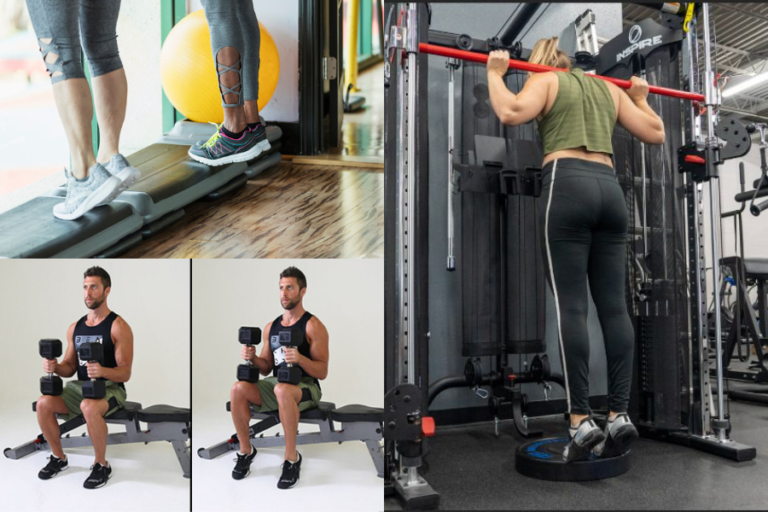
Basic standing calf raises
This is your foundation for all calf workouts at home.
- Stand tall with feet hip width apart, hands lightly on a wall or chair for balance if needed.
- Press through the balls of your feet to lift your heels as high as possible.
- Pause briefly at the top for a strong squeeze in your calves.
- Lower slowly, aiming to control the descent for 2 to 3 seconds.
If possible, perform them on a step so your heels can drop below your toes at the bottom for that deeper stretch.
You can make this harder over time by:
- Doing single leg calf raises
- Slowing the lowering phase even more
- Pausing in the stretched position before pushing back up
1½ calf raises for extra burn
The 1½ rep method keeps your calves under tension longer.
- Rise all the way up onto your toes.
- Lower halfway down, then push back up to the top.
- Finally lower fully into the stretch position.
That counts as one repetition. You can pair 1½ reps with a small step and different toe positions, such as forward, slightly out, and slightly in, to emphasize different fibers within the calves.
Single leg step raises
Single leg work is excellent for strength, balance, and flexibility.
- Stand on a step or sturdy ledge on one foot, with the ball of your foot on the edge and heel hanging off.
- Hold a wall or rail for balance if needed.
- Lower your heel slowly until you feel a stretch.
- Push through the ball of your foot to raise your heel as high as you can.
- Squeeze at the top for 1 to 2 seconds before repeating.
Because you are working one leg at a time, this variation tends to feel more intense. It also helps you spot and fix left to right strength differences.
Calf launchers
Calf launchers are a powerful option that target both the gastrocnemius and the soleus throughout a full range of motion.
- Start in a short lunge stance with your back heel raised and front knee bent.
- Bend both knees to load the calves, especially the soleus.
- As you straighten your back knee and extend your ankle, drive your heel upward.
- Move in a smooth, controlled rhythm, focusing on a strong push through the ball of your back foot.
The bent knee portion emphasizes the soleus, while the straightening phase brings the gastrocnemius in more. You can stay in a continuous flow for a set amount of time, such as 30 to 45 seconds per side.
Add power and athleticism with plyometrics
Once your basic strength is in place, you can layer in low impact jumping to make your calves more explosive. These moves do not require equipment, just enough room around you.
Sprinter calf raises and jumps
Sprinter style movements mimic the push off you use when you accelerate in a run.
For sprinter calf raises:
- Stand in a staggered stance with one foot slightly in front of the other.
- Shift your weight mostly onto the back leg.
- Drive up onto the ball of the back foot as if pushing off into a sprint.
- Lower with control and repeat, then switch sides.
For sprinter calf jumps, use the same stance but add a gentle hop as you drive up, landing softly and immediately going into the next rep. This introduces a plyometric element that builds power.
Jump rope and jump squats
Classic jumping moves are simple and effective for your calves and your cardiovascular fitness.
If you have a jump rope:
- Start by jumping with both feet for 1 minute.
- Rest, then repeat for 2 to 3 rounds.
- Over time, work up to 3 minutes of continuous jumping.
If you do not have a rope, you can mimic the motion by making small repeated jumps in place while circling your hands as if turning a rope.
Jump squats are another option. From a bodyweight squat, drive up through your feet into a small jump and land softly, immediately bending your knees to absorb the impact. Keep the jumps controlled rather than high and aim for consistent rhythm.
Support your calves with full leg moves
Some leg exercises that you already know also train your calves quite well. Including them in your routine gives your calves extra stimulus while building overall lower body strength.
Lunge pulses
Lunge pulses are a simple variation that lights up your calves.
- Step into a forward lunge with your front knee over your ankle and your back heel raised.
- Keep your chest up and gaze straight ahead.
- From this position, pulse up and down a few inches without fully standing up or dropping too low.
Your calves on both legs work hard to stabilize you, especially the back leg. Focus on steady breathing and controlled movement rather than speed.
Mountain climbers and high knee drills
Mountain climbers, which include an explosive jumping or switching motion, strengthen your calves along with your core and other leg muscles. Start in a high plank and alternate driving your knees toward your chest, lightly hopping your feet as you switch.
High knee runs in place, butt kickers, and seal jumps are other at home options that challenge your calves through repeated quick contacts with the floor. Keep the movements bouncy and light to avoid pounding your joints.
Do not skip stretching and mobility
Calf strength is only half the story. Flexible, mobile calves are less prone to injury and feel better on every run or walk.
Dynamic warm up before activity
Before running or a more intense session, use dynamic stretches to warm up your calves and the Achilles tendon. This might include:
- Gentle ankle circles
- Walking calf raises, where you rise onto your toes with each step
- Slow, controlled bouncing in a standing calf stretch position
Dynamic work prepares the muscle and helps you avoid straining cold tissue.
Static stretches after training
After your calf workouts at home, spend a few minutes with static stretches to lengthen tight areas and restore muscle length. You can try:
- A standing calf stretch against a wall, with one leg back and heel down as you lean forward
- A seated stretch using a resistance band or towel looped around the ball of your foot as you gently pull your toes toward you
Holding each stretch for 20 to 30 seconds helps realign soft tissue and supports recovery. If your calves feel persistently tight, swollen, or bruised, or if pain lingers after running, it is a sign to rest, use the RICE method, and talk with a physiotherapist for tailored rehabilitation advice.
Sample 6 minute at home calf finisher
You can plug this quick routine onto the end of your regular workout 3 times per week:
- 1 minute of basic standing calf raises, feet forward
- 1 minute of 1½ calf raises on a step, toes pointing slightly outward
- 1 minute of 1½ calf raises on a step, toes pointing slightly inward
- 1 minute of single leg step raises on the right leg
- 1 minute of single leg step raises on the left leg
- 1 minute of sprinter calf raises, switching legs every 5 reps
Move steadily, shake out your legs briefly between moves if you need to, and keep your balance by lightly holding a wall or chair.
If your ankles feel wobbly, use a wall or an exercise ball for balance support at first. As your stability improves, you can gradually rely less on your hands.
With consistent practice, these short calf workouts at home will build strength, shape, and resilience you will feel every time you walk, climb stairs, or pick up your running pace. Start with one or two exercises today and build from there as your calves adapt.
About the Author