A strong hamstring workout with dumbbells can completely change how your lower body looks and feels. With just a pair of dumbbells and a bit of floor space, you can build powerful hamstrings, protect your knees and back, and improve how you move in everyday life.
Below, you will find clear form cues, exercise options, and simple routines so you can start training confidently, even if you do not have access to a leg curl or squat rack.
Understand your hamstrings first
Your hamstrings are a group of three muscles at the back of your upper leg: the biceps femoris, semitendinosus, and semimembranosus. They help you bend your knees and extend your hips, which means they are involved every time you walk, run, squat, or get up from a chair.
When you train your hamstrings with dumbbells, you do more than build the backs of your thighs. You also challenge your glutes, quads, calves, and lower back, which leads to better overall lower body strength and stability.
Strong hamstrings can help you:
- Reduce the risk of knee and hamstring strains
- Improve athletic performance in running and jumping
- Support heavy squats and deadlifts
- Maintain better posture and hip alignment
If your hamstrings feel tight and weak, you are not alone. The good news is that consistent dumbbell work can fix that.
Why choose a hamstring workout with dumbbells
You might assume you need machines for serious leg training, but a hamstring workout with dumbbells can be just as effective for building muscle and strength.
Here is why dumbbells work so well:
- They allow a natural range of motion that can feel kinder on your joints.
- You can train unilaterally, one leg at a time, to fix strength imbalances.
- They are ideal for home workouts since they do not take up much space.
- Despite being lighter than big machines, they can put maximum stress on the leg muscles when you use proper form and controlled tempo.
You can also adjust difficulty easily. Slow down the lowering phase, use single-leg variations, or pair dumbbells with bands as you get stronger.
Key form cues for safe hamstring training
Hamstrings respond best to controlled movement and good positioning. They also take a long time to recover, so you want to avoid careless reps that overload your joints instead of the muscle.
Learn the hip hinge
Many of the best hamstring exercises use a hip hinge pattern. That means you bend at the hips, not the lower back.
When you hinge:
- Soften your knees slightly.
- Push your hips back, as if you are closing a car door with your glutes.
- Keep your spine long and neutral, avoid rounding or over arching.
- Let the dumbbells travel close to your legs.
This pattern is the foundation of Romanian deadlifts and good mornings, two of your main hamstring builders.
Know the difference between good fatigue and bad pain
During a set, you should feel a deep, steady burn in the hamstrings and glutes. That is normal muscle fatigue and a sign that you are engaging the right areas.
Sharp, sudden, or pinching pain is different. If you feel that in your knees, hips, or back, stop the set, reduce the weight, and check your form. If pain persists, you should consult a professional before continuing.
Core dumbbell exercises for your hamstrings
Use the exercises below as building blocks for your hamstring workout with dumbbells. Start with bodyweight or very light weights if you are new, then progress as your control improves.
1. Dumbbell Romanian deadlift (RDL)
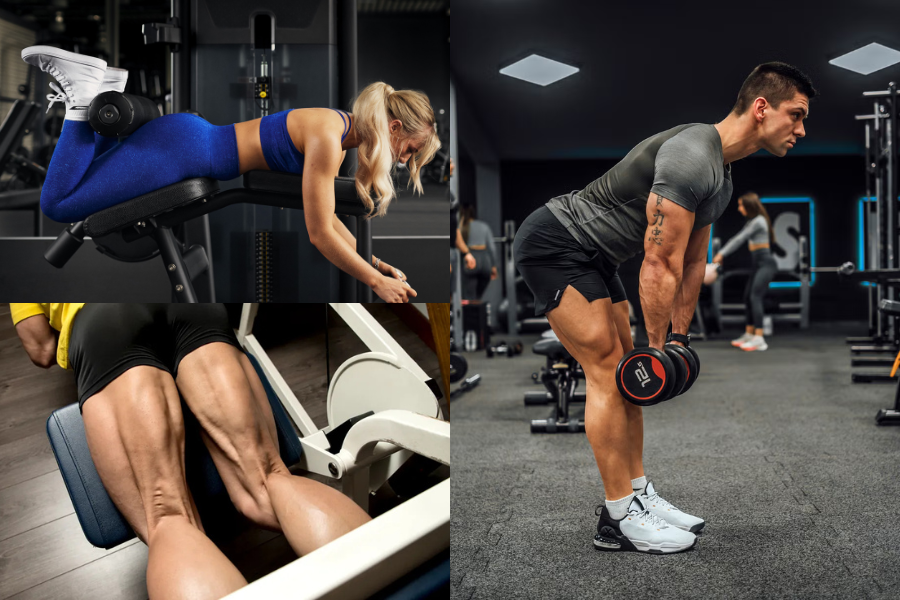
The dumbbell Romanian deadlift is one of the best ways to load your hamstrings through a hip hinge and hip extension. It is often easier to learn than the barbell version, and holding the weight at your sides can reduce strain on your lower back.
How to do it:
- Stand tall with a dumbbell in each hand, arms straight, feet hip width apart.
- Soften your knees slightly.
- Push your hips back while you slide the dumbbells down the front of your legs, keeping them close.
- Stop when you feel a strong stretch in the hamstrings, usually just below knee level or mid shin.
- Press your feet into the floor and drive your hips forward to return to standing.
Key cues:
- Hinge at the hips, not the spine.
- Keep a slight knee bend, do not lock the knees. Locking them limits your range of motion and can stress the joints.
- Maintain a neutral back and avoid rounding.
- Move slowly, especially on the way down, to maximize hamstring activation.
Programming tip: Aim for 3 to 4 sets of 6 to 8 reps for strength, as suggested in Gymshark’s hamstring guide updated in 2024.
If grip strength is your limiting factor, wrist straps can help you go heavier so your hamstrings get the stimulus they need without your hands giving up first.
2. Dumbbell stiff leg deadlift
The stiff leg deadlift looks similar to an RDL but uses less knee bend. This increases the stretch and time under tension through the hamstrings, which is great for muscle growth, but it can also increase spinal loading for some people.
Form notes:
- Start like a Romanian deadlift, but keep your knees just slightly softer than straight.
- Hinge and lower the dumbbells while maintaining that nearly straight knee position.
- Only go as low as you can while keeping your back neutral.
If you have a history of lower back discomfort, you may find the Romanian deadlift more comfortable and still highly effective.
3. Single leg Romanian deadlift
Single leg RDLs give you all the benefits of a hip hinge plus unilateral training. They help you correct side to side imbalances, improve balance, and challenge your stability.
How to do it:
- Hold one dumbbell in the hand opposite your working leg.
- Stand on your working leg and soften the knee slightly.
- Hinge at the hip while letting the free leg extend behind you as a counterbalance.
- Lower the dumbbell toward the floor, staying close to your leg, then drive through your heel to stand tall again.
Focus on moving slowly and controlling your balance. According to Gymshark, single leg Romanian deadlifts are among the best exercises for targeting the biceps femoris and building one leg at a time.
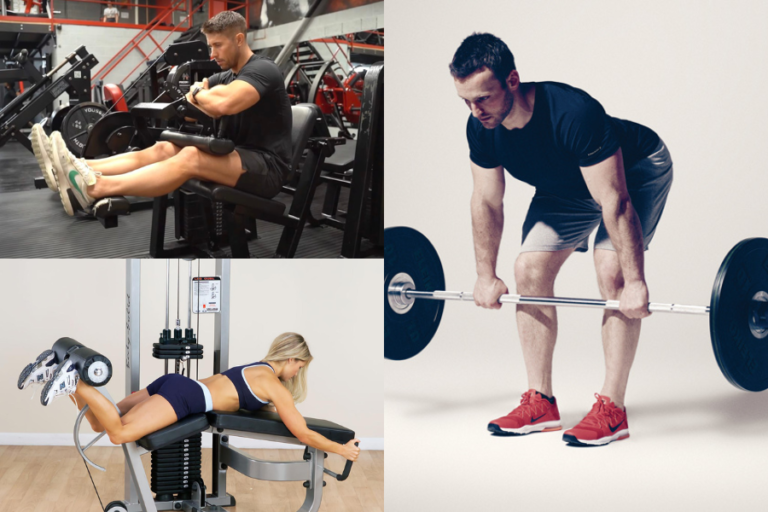
4. Dumbbell leg curl on the floor or bench
If you want hamstring isolation, the dumbbell leg curl is your go to. You do not need a leg curl machine, only a dumbbell and a bench or mat.
Steps:
- Lie face down on a bench or mat.
- Place a light dumbbell between your feet and squeeze firmly so it does not slip.
- Start with your legs straight, then slowly curl your heels toward your glutes.
- Pause briefly at the top, then lower the dumbbell with control.
This move targets all three heads of the hamstrings and also trains the muscles around your knee for better stability. Since you are working against gravity with a long lever, start with a light weight and focus on smooth movement.
You can progress this by:
- Using a heavier dumbbell.
- Curling one leg at a time to address imbalances.
- Pairing it with a hip bridge for a hamstring and glute combo.
5. Bulgarian split squat
While often thought of as a quad exercise, the Bulgarian split squat can load your posterior chain heavily when you use a slightly forward torso lean and sit into your hips.
How to do it:
- Stand about two feet in front of a bench or sturdy chair.
- Place the top of one foot behind you on the bench.
- Hold dumbbells by your sides.
- Lower your back knee toward the floor while bending your front knee and leaning slightly forward.
- Drive through your front heel to return to standing.
Gymshark highlights Bulgarian split squats as a valuable unilateral exercise for developing stronger legs and building your hamstrings and glutes.
6. Glute bridge or hip thrust with dumbbell
Glute bridges and hip thrusts emphasize your glutes, but your hamstrings work hard as synergists, especially when you keep your heels pressed into the floor.
Basic setup:
- Lie on your back with knees bent and feet flat.
- Place a dumbbell across your hips and hold it in place.
- Brace your core and squeeze your glutes to lift your hips until your body forms a straight line from shoulders to knees.
- Lower with control and repeat.
To intensify the hamstring involvement, try placing your feet slightly farther from your hips or elevating your upper back on a bench for hip thrusts.
Sample hamstring workouts with dumbbells
Use these simple templates to build a hamstring workout with dumbbells that matches your level. Rest 60 to 90 seconds between sets, a bit longer if you are going heavy.
Always warm up first with 5 to 10 minutes of light cardio and dynamic leg swings, then finish with gentle hamstring stretches such as hamstring scoops, hamstring flossing, and standing hamstring stretches to support flexibility and performance.
Beginner routine
If you are new to strength training or coming back from a break, start here:
- Dumbbell Romanian deadlift
- 3 sets of 10 to 12 reps, light to moderate weight
- Glute bridge with dumbbell
- 3 sets of 12 reps
- Dumbbell leg curl on the floor
- 3 sets of 10 to 12 reps, very controlled tempo
Focus on learning the hinge, feeling the hamstrings stretch and contract, and finishing each rep without rushing.
Intermediate routine
Once you feel confident with basic hinging patterns:
- Dumbbell Romanian deadlift
- 4 sets of 8 reps, moderate to heavy
- Single leg Romanian deadlift
- 3 sets of 6 to 8 reps per leg
- Dumbbell leg curl on a bench
- 3 sets of 12 to 15 reps
- Bulgarian split squat
- 3 sets of 8 to 10 reps per leg
You can increase the challenge by slowing the lowering phase to 3 seconds per rep on RDLs and leg curls.
Advanced routine
If you already train consistently and want a serious hamstring session:
- Dumbbell Romanian deadlift
- 4 sets of 6 to 8 reps, heavier weight, focus on perfect form
- Stiff leg dumbbell deadlift
- 3 sets of 8 to 10 reps
- Single leg Romanian deadlift
- 3 sets of 6 reps per side
- Dumbbell leg curl, single leg
- 3 sets of 10 reps per leg
- Hip thrust with dumbbell
- 3 sets of 10 to 12 reps
Keep your motion controlled throughout. A careful, measured pace keeps tension on the hamstrings and lowers injury risk, which is especially important because hamstrings recover slowly and can be prone to strains if you overload them too quickly.
Progress, recovery, and flexibility
To keep seeing progress from your hamstring workout with dumbbells, you need three things: progressive overload, smart recovery, and regular flexibility work.
- Progressive overload: Gradually increase weight, reps, or time under tension. For example, add 5 pounds to your RDL when you can complete all sets with clean form.
- Recovery: Train hamstrings 1 or 2 times per week, leaving at least 48 hours between hard sessions.
- Flexibility: Add hamstring scoops, flossing drills, or standing hamstring stretches at the end of your workouts to maintain mobility and reduce tightness.
If you are a beginner, start with lighter weights and a manageable number of repetitions to test your current level, then slowly increase as movements feel more natural.
Putting it all together
You do not need a packed gym or specialized machines to build strong, athletic legs. With a well designed hamstring workout with dumbbells, you can:
- Strengthen the back of your legs
- Support your knees and lower back
- Improve balance and coordination
- Feel more powerful in daily life and sports
Pick one of the routines above, schedule it into your week, and commit to four weeks of consistent training. Notice how your hamstrings feel during walks, stairs, and runs. When you are ready, you can add weight or try new variations, but the foundation will always be the same: controlled movement, good form, and steady progress.
About the Author