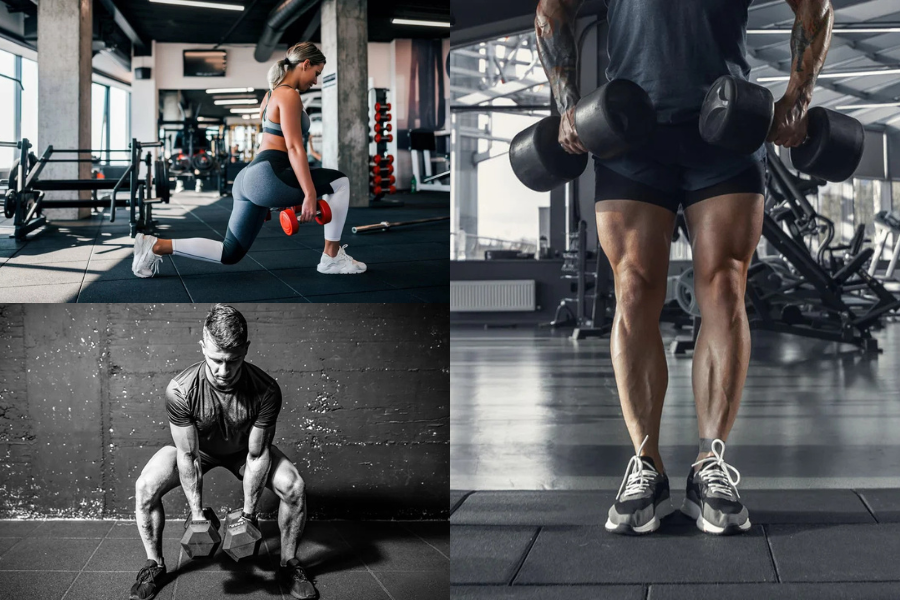
A quad workout without weights can be just as effective as a gym session if you focus on form, control, and smart progression. Your own body weight provides plenty of resistance, especially when you use single-leg movements, slow tempos, and strategic holds.
Below, you will find how your quadriceps work, the best bodyweight quad exercises to do at home, and a simple workout plan you can start today.
Understand your quads and why they matter
Your quadriceps are the large muscles on the front of your thighs. They straighten your knees and help stabilize your hips, which means you use them every time you walk, climb stairs, squat down to pick something up, or get out of a chair.
Strong quads support your knees, improve balance, and boost performance in running and jumping. Regular quad strengthening can also reduce your risk of knee injuries and make daily movements feel easier over time.
Benefits of quad workouts without weights
Training your quads without weights is not just convenient. It can also be very effective if you are consistent.
When you focus on bodyweight quad exercises you can:
- Strengthen your quads, hamstrings, and glutes without any equipment
- Improve knee stability and lower your risk of knee pain or injury
- Build functional lower body strength that carries over to everyday life
- Train at home, outdoors, or while traveling with minimal space
Bodyweight exercises such as squats, lunges, and jump squats can build muscle and strength when you perform them consistently and with proper form, especially if you use progressive overload by adding reps, slowing the tempo, or choosing harder variations over time.
Key form tips to protect your knees
Since your quads work directly over your knees, form matters. Poor technique can cause discomfort, especially if you move too fast or skip warm ups.
Keep these guidelines in mind during any quad workout without weights:
- Align your knees with your toes and avoid letting them collapse inward
- Keep your chest lifted and your core gently braced to support your spine
- Sit your hips back slightly during squats and lunges to share the load with your glutes
- Avoid forcing your knees far past your toes if that causes discomfort
- Warm up with light movements like marching in place, leg swings, or gentle air squats
If you ever feel sharp pain in your knees, pause, reset your form, or reduce the range of motion.
Best quad exercises without weights
You can build a complete quad workout without weights using a mix of compound and isolation movements. Many effective exercises rely only on body weight and a small amount of floor space.
1. Bodyweight squats
Bodyweight squats are one of the most effective lower body exercises you can do. They primarily target your quadriceps but also work your hamstrings, glutes, core, and spinal erectors.
To perform a bodyweight squat:
- Stand with your feet about hip to shoulder width apart.
- Turn your toes slightly outward if that feels more natural for your hips.
- Bend your knees and push your hips back as if you are sitting into a chair.
- Keep your chest lifted and your weight spread across your full foot, not just the toes.
- Lower until your thighs are at least parallel to the floor, or stop a bit higher if you are a beginner.
- Press through your feet to stand back up and fully extend your legs.
If you are new to squats, reduce the depth to make the exercise easier. Over time, work toward a deeper squat with control. You can increase difficulty by slowing the lowering phase or pausing at the bottom for two or three seconds.
2. Walking or stationary lunges
Lunges build your quads one leg at a time, which helps correct strength imbalances and improves balance.
To perform a basic lunge:
- Stand tall with your feet hip width apart.
- Step one foot forward and bend both knees, lowering until your back knee moves toward the floor.
- Keep your front knee stacked over your ankle, not collapsing inward.
- Push through your front heel to return to standing.
You can perform alternating forward lunges in place or walk across a room if you have more space. Aim for smooth, controlled steps rather than rushing your reps.
3. Step ups
Step ups are simple and highly effective for quad strength and knee stability. You only need a stable chair, bench, or step that is about knee height or slightly lower.
To perform a step up:
- Place one foot firmly on the step.
- Lean slightly forward and press through your entire foot to lift your body up.
- Bring your other foot to meet the first one on top of the step.
- Step back down with control and repeat.
Keep your working knee aligned with your toes and avoid bouncing off the back leg. You can increase the challenge by using a higher step, slowing your tempo, or pausing at the top.
4. Bulgarian split squats
Bulgarian split squats are a powerful single leg exercise that heavily targets the quads. They require balance and control, so start near a wall or sturdy object for support if needed.
To perform a Bulgarian split squat:
- Stand about two feet in front of a chair, bench, or couch.
- Place the top of one foot on the surface behind you.
- Bend your front knee and lower your hips straight down.
- Keep your chest up and your front knee aligned with your toes.
- When your front thigh is around parallel to the floor, press through your front heel to return to standing.
This move challenges strength, stability, and mobility at once. Lower the range of motion if you feel strain in your knee or hip. Over time, you can progress deeper and slower.
5. Lateral lunges
Lateral lunges train your quads through a side to side pattern, which helps your hips and knees stay strong in daily life and sports.
To perform a lateral lunge:
- Stand tall with your feet together.
- Step out to the side with one leg and bend that knee, keeping the other leg straight.
- Push your hips back slightly and keep your toes pointing mostly forward.
- Press through your bent leg to return to the starting position.
Focus on feeling the work in the outer hip and quad of the bending leg. Keep your chest lifted and avoid rounding your back as you lower.
6. Squat jumps and box jumps
Once you are comfortable with basic squats and lunges, you can add explosive movements to build power. Squat jumps and box jumps train your quads to produce force quickly, which supports athletic performance.
For a squat jump:
- Perform a regular squat.
- From the bottom, drive through your feet and jump straight up.
- Land softly with your knees slightly bent and immediately lower into the next squat.
For a box jump, stand in front of a sturdy box or step, lower into a partial squat, then jump onto the box and land softly with bent knees. Step back down rather than jumping off if your knees are sensitive.
Use low volume and focus on quality rather than quantity for these explosive moves.
7. Reverse lunges
Reverse lunges are often easier on the knees than forward lunges because your weight stays more centered over the front leg.
To perform a reverse lunge:
- Stand tall with your feet hip width apart.
- Step one leg back and bend both knees.
- Lower until your front thigh is around parallel to the floor, keeping your front knee over your ankle.
- Push through your front heel to bring your back foot forward and return to standing.
Keep your torso upright and your front knee aligned. Start with smaller steps if you find yourself losing balance.
8. Single leg raises
Single leg raises specifically target the rectus femoris, the quad muscle that crosses the hip joint, along with your hip flexors and core.
To perform a single leg raise:
- Lie on your back with one leg straight and the other knee bent, foot flat on the floor.
- Brace your core gently.
- Lift the straight leg to the height of the bent knee while keeping the knee straight.
- Lower it slowly without letting it drop.
Move with control and avoid arching your lower back as you lift the leg. You should feel the front of your thigh working.
9. Wall sits
Wall sits build muscular endurance in your quads through an isometric hold.
To perform a wall sit:
- Stand with your back against a wall.
- Walk your feet forward and slide your back down until your knees form about a 90 degree angle.
- Keep your knees aligned with your toes and your weight in your heels.
- Hold this position for 30 to 60 seconds, or as long as you can with good form.
If a full 90 degree bend feels too intense at first, slide a little higher on the wall. Over time, work toward deeper positions and longer holds.
10. Single leg squats and pistol squats
Single leg squats, also called pistol squats when performed to full depth, are challenging quad exercises without weights that demand strength, mobility, and balance.
If you are a beginner, do not rush to full pistol squats. Start with assisted variations:
- Use a chair or countertop for light support with your hands
- Squat down to a box or chair and stand back up
- Work within a partial range of motion until your control improves
You should only attempt full pistol squats after you are comfortable with bodyweight squats, lunges, and split squats. Quality matters more than depth.
Sample quad workout without weights
Here is a balanced routine that targets your quads, challenges your balance, and builds strength without equipment. Adjust reps or sets based on your current fitness level.
- Bodyweight squats: 3 sets of 15 to 20 reps
- Reverse lunges: 3 sets of 10 to 12 reps per leg
- Step ups: 3 sets of 12 to 15 reps per leg
- Wall sits: 3 sets of 30 to 60 seconds
- Single leg squats or assisted single leg squats: 3 sets of 5 to 8 reps per leg
Rest 45 to 75 seconds between sets. If you are a beginner, start with the lower end of the rep range and fewer sets. As you feel stronger, you can add another set, increase the reps, or slow down the lowering phase to increase time under tension.
A helpful rule: once an exercise feels easy, change only one variable at a time, either reps, tempo, range of motion, or exercise difficulty.
How to progress and keep improving
To keep building muscle and strength from a quad workout without weights, you need progressive overload. Since you are not adding dumbbells or barbells, you will adjust other levers.
You can progress by:
- Increasing rep ranges within each set
- Adding one more set for key exercises, up to what you can recover from
- Slowing the lowering phase to three or four seconds
- Pausing at the bottom of squats or lunges for isometric holds
- Advancing to more challenging variations like Bulgarian split squats or pistol squat progressions
If you want extra resistance later, you can add household items such as a backpack filled with books. This allows you to continue building strength even with limited access to formal equipment.
Adapting the workout for beginners
If you are just starting or returning after a break, simplify your quad workout without weights so that you can build confidence and protect your joints.
You can:
- Use a chair behind you for assisted squats and to guide depth
- Hold a countertop or wall lightly during lunges and split squats
- Work within a smaller range of motion and increase depth gradually
- Focus on two or three core movements per session rather than many exercises
The key is consistency. Two or three focused sessions per week can make a clear difference in how stable and strong your legs feel.
Putting it all together
You do not need machines or heavy weights to build strong, functional quads. With deliberate bodyweight exercises like squats, lunges, step ups, and wall sits, you can challenge your muscles, protect your knees, and support everything from daily tasks to sports.
Choose two or three exercises from the list above and try them today. Pay close attention to form, start with a manageable number of reps, and give yourself time to progress. Over the next few weeks, you will likely notice climbing stairs feels easier, your balance improves, and your legs feel more powerful, all from a simple quad workout without weights.
About the Author