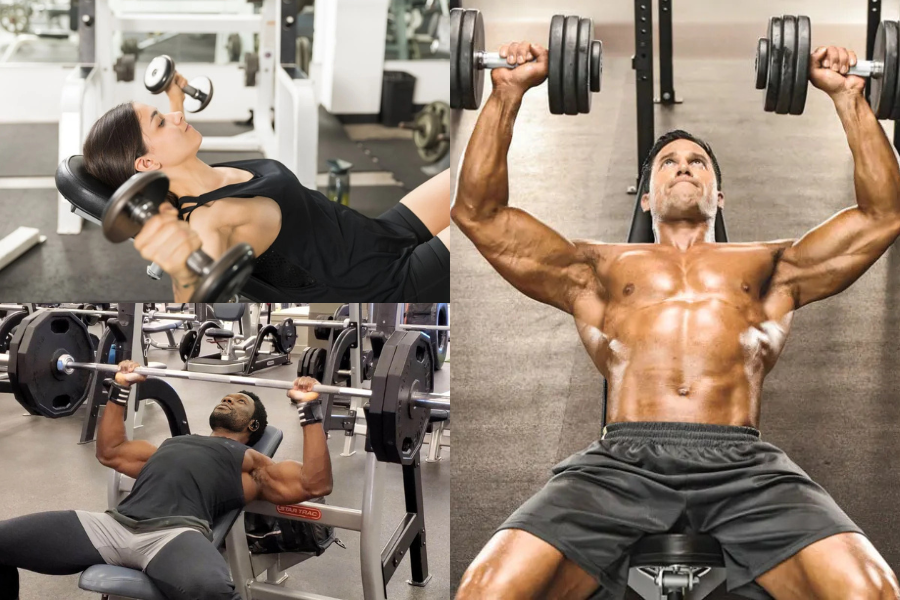
Understand what the inner chest really is
When you look for inner chest exercises, you are usually trying to fill in that “gap” near your sternum and make your chest look fuller. It helps to start with what is actually happening under the skin.
Your inner chest is not a separate muscle. It is part of the pectoralis major, mainly the sternocostal head that attaches along your breastbone. You cannot isolate the inner chest in the same way you might work biceps separately from triceps.
What you can do is emphasize the movement this area is responsible for: adduction, which means bringing your arms toward or across the midline of your body. Exercises that challenge you hardest when your hands come together or cross your midline are the ones that help bring out inner chest detail over time.
You will get the best results when you:
- Train your whole chest while emphasizing adduction
- Include both incline and flat pressing for upper and mid chest
- Use fly-style movements that keep tension as your arms come together
- Focus on form and tension instead of chasing the heaviest possible weight
Build a safe foundation first
Before you jump into inner chest exercises, you want your setup and habits to protect your shoulders and let your chest do the work. That means warm ups, posture, and smart progression.
Warm up your chest and shoulders
Going straight into heavy presses with cold muscles limits your range of motion and increases injury risk.
Try this quick warm up sequence:
- 3 to 5 minutes of light cardio such as walking or cycling
- Arm circles: 2 sets of 15 forward and 15 backward
- Scapular push ups: 2 sets of 10 reps
- Light band pull aparts: 2 sets of 15 reps
This primes your shoulders and upper back so you can stabilize better during pressing and fly movements. Not properly warming up can compromise inner chest activation and your overall gains.
Set your posture and shoulder position
HSS physical therapist Anil Nandkumar, DPT, notes that good posture and a well rounded strength routine help prevent tightness and injury in chest muscles that are used constantly in daily life such as phone and laptop use as of June 2024.
During pressing and flys:
- Retract your shoulders by gently pinching your shoulder blades together
- Keep your shoulder blades “grounded” into the bench or stable against your ribcage
- Maintain a slight arch in your upper back, not an exaggerated bridge
This setup improves force generation and helps you feel the tension where you want it, in your pecs, including the inner region.
Progress push ups before heavy presses
If you are newer to strength training or returning after a break, modified push ups are a low risk way to build chest strength and learn control. HSS experts recommend starting with easier variations before classic push ups to reduce pain and form issues.
Work through this progression at your own pace:
- Wall push ups
- Incline push ups on a sturdy bench or countertop
- Knee push ups on the floor
- Full push ups
Build to 3 sets of 10 solid reps at each level before moving on.
Focus on form, not ego lifting
For inner chest exercises to work, the limiting factor should be your chest, not your shoulders, elbows, or ego. Overreliance on heavy barbell bench pressing can:
- Overdevelop the lower pecs compared with the upper chest
- Create a “droopy” look instead of a lifted, squared off chest
- Increase the risk of shoulder, elbow, wrist strains, and pec tears
Free weights like dumbbells and barbells encourage full muscle engagement and were heavily used by lifters who built classic chest physiques such as Arnold Schwarzenegger. However, using mostly machines or only chasing heavy barbell numbers can limit development in some regions, including the inner chest.
To keep your training productive:
- Choose loads that let you control every inch of the rep
- Stop 1 to 2 reps shy of technical failure in most sets
- Use a full but comfortable range of motion
- Avoid bouncing the weight or using momentum
The mind muscle connection is especially important for the inner chest. Think about squeezing your pecs together when your hands approach each other or cross your midline, and keep that tension through the whole movement.
Use the best inner chest exercises
You cannot truly isolate the inner chest, but you can choose exercises that emphasize adduction and upper chest work. Below are some of the most effective inner chest exercises you can build into your routine.
1. Dumbbell bench press
The dumbbell bench press lets your hands move slightly inward as you press, which encourages inner chest engagement.
How to do it
- Lie on a flat bench with a dumbbell in each hand, feet planted.
- Retract your shoulder blades and keep them tight to the bench.
- Start with the dumbbells just outside your chest, elbows at about 45 degrees from your torso.
- Press up and slightly inward, as if tracing a narrow triangle with your hands above your chest.
- Stop just short of locking out so tension stays on your pecs, then lower with control.
Why it helps your inner chest
That subtle “in and up” path encourages adduction at the top, which helps challenge the fibers closer to the sternum. It also builds stability since each arm works independently.
Suggested sets and reps
- 3 to 4 sets of 6 to 10 reps
Use a weight that feels challenging, but does not force your elbows to flare out or your lower back to hyperextend.
2. Incline dumbbell bench press
Your upper chest is naturally thinner than your lower chest. If you undertrain this area, your torso can look less balanced and less “lifted.” Incline work helps fill in the upper and inner chest and ties your pecs into your shoulders and traps more smoothly.
How to do it
- Set your bench to a low to moderate incline, roughly 30 degrees.
- Lie back with dumbbells held just outside your upper chest.
- Retract your shoulder blades and keep your chest “proud.”
- Press the weights up and slightly toward each other above your face or upper chest.
- Lower until you feel a stretch in the upper chest, not strain in the front of your shoulders.
Why it helps your inner chest
Incline pressing emphasizes the clavicular head of the pecs. This upper region contributes significantly to that filled in look by the collarbones and the top of the sternum.
Suggested sets and reps
- 3 sets of 6 to 10 reps
Prioritize incline movements early in your workout to address a lagging upper chest.
3. Close grip incline bench press
Bringing your hands closer together on an incline bench press increases shoulder flexion and brings more attention to the upper and inner chest, while still involving the triceps.
How to do it
- Set the bench to a 30 degree incline.
- Grip the bar just inside shoulder width, not so narrow that your wrists feel cramped.
- Retract and “pack” your shoulders into the bench.
- Lower the bar toward your upper chest under control.
- Press up, keeping your elbows roughly under your wrists and finishing with the bar above your upper chest.
Why it helps your inner chest
The closer grip and incline angle together emphasize the clavicular head and encourage you to press in a path that keeps tension closer to the center of the chest.
Suggested sets and reps
- 3 to 4 sets of 6 to 8 reps
Use a load that you can control for the full range of motion. Avoid bouncing the bar off your chest.
4. High to low cable fly
Cable fly variations are some of the most useful inner chest exercises because cables keep constant tension on the pecs, even when your hands meet.
High to low flys in particular help you train the lower and inner portions by guiding your arms in a sweeping arc.
How to do it
- Set the pulleys above head height.
- Stand slightly in front of the cable station with a handle in each hand.
- Step one foot forward for balance and soften your knees.
- With a slight bend in your elbows, pull the handles down and together in front of your lower chest or upper abs.
- Think about hugging a wide tree, then squeezing your chest as your hands meet.
- Slowly return to the start, keeping tension the whole time.
Why it helps your inner chest
The direction of pull and the cable resistance keep your chest working hardest as your hands come together, which is exactly when the inner region is most involved.
Suggested sets and reps
- 3 sets of 10 to 12 reps
Focus on deliberate, smooth movement. This is not a power exercise, it is a tension exercise.
5. Standard cable fly and cable crossover
Both standard cable flys and cable crossovers are excellent for training adduction, the key movement for inner chest development.
Standard standing cable fly
- Set the pulleys at about chest height
- Step out, brace your core, and bring your hands together in front of your sternum
- Keep elbows softly bent and fixed throughout the movement
Cable crossover with back support
Some setups allow a bench or back support between the stacks. Lying or sitting with support can protect your shoulders while you still get the benefits of cables. According to a June 2023 guide on chest workouts, both these cable variations effectively train the adduction needed for inner pec development with 3 sets of 10 to 12 reps.
Suggested sets and reps
- 3 sets of 10 to 12 reps for either version
Think about crossing your hands slightly at the end for an extra squeeze, but do not yank or jerk the handles.
6. T bench fly
The T bench fly is a fly variation that lets you use slightly heavier weights while better protecting your shoulders. It is especially useful when you want to focus on the adduction pattern crucial for the inner chest.
How to do it
- Lie on a bench with your hips near the end so your torso and legs form a T shape with the bench.
- Hold dumbbells above your chest, palms facing each other.
- Keep a soft bend in your elbows and open your arms out wide until you feel a stretch across your chest.
- Bring the weights back up in a wide arc, focusing on bringing your upper arms toward the midline, not just your hands.
According to a June 2023 workout guide, the T bench fly works well at about 3 sets of 10 to 12 reps while targeting the adduction pattern needed for inner chest work.
7. Single arm cable chest fly
Single arm chest flys add a rotational component and increase the challenge as your hand crosses your midline. This can help target the upper inner chest while being relatively kind to your shoulder joint compared with heavy dumbbell flys.
How to do it
- Set a cable handle at roughly chest height.
- Stand side on to the machine, cable in the hand farthest from the stack.
- Step out until there is tension at the starting position, arm slightly bent.
- Bring your hand across your body in a wide arc, finishing just in front of or slightly across your sternum.
- Control the return and keep your torso facing forward to resist rotation.
These are often paired with single arm presses for extra volume. Single arm flys are recommended as a way to increase hypertrophy and endurance in the upper inner chest while keeping shoulder stress manageable.
Suggested sets and reps
- 3 sets of 10 to 12 reps per side
Focus on smooth, controlled motion and a strong squeeze at the end of each rep.
8. Hex press and pinch plate press
Both the hex press and pinch plate press use a neutral grip with your hands close together. This close position increases the need for inner chest fibers to work while reducing stress on the shoulder joint.
Hex press
- Lie on a flat bench with two dumbbells pressed together over your chest.
- Keep your palms facing each other so the inner heads of the dumbbells touch.
- Lower the “locked together” dumbbells to your chest while maintaining contact between them.
- Press straight up, actively squeezing the dumbbells into each other the entire time.
Pinch plate press
- Stand or lie on a bench holding two smooth plates together between your hands.
- Press the plates straight out from your chest, keeping constant inward pressure.
- Do not lock out completely so tension stays on the pecs.
These neutral grip presses are highlighted as good options for inner chest training if you have shoulder issues or limited mobility, since they lessen stress on the joint while encouraging inner chest activation.
Suggested sets and reps
- 3 sets of 8 to 12 reps
Use moderate weight and prioritize the squeeze between your hands over the load on the bar.
9. Weighted and modified push ups
Weighted push ups belong on any list of effective inner chest exercises because you can easily adjust your hand position, path of motion, and loading. They also build stability that carries over to your barbell and dumbbell work.
How to do it
- Set up in a plank with hands slightly wider than shoulder width.
- Rotate your hands just a touch inward to encourage chest involvement.
- Lower your chest between your hands, elbows at roughly 30 to 45 degrees from your torso.
- Push back up, thinking about pushing the floor away and squeezing your chest.
Once regular push ups feel easy, you can:
- Add a weight plate or sandbag on your upper back
- Use push up handles to increase range of motion
- Elevate your feet slightly to emphasize the upper chest
If needed, use the easier progressions mentioned earlier such as wall or incline push ups until your form is solid and pain free.
Plan your inner chest workout
You will see better results when you pair your favorite inner chest exercises with smart structure. A mix of heavier compound lifts and lighter isolation moves works well, as suggested by a 2023 inner chest workout guide that recommends heavier sets of 3 to 8 reps for big lifts and 8 to 12 reps for fly style movements.
Here is an example chest session you can adapt:
Example inner chest focused workout
- Incline dumbbell bench press
- 3 sets of 6 to 8 reps
- Close grip incline bench press
- 3 sets of 6 to 8 reps
- Dumbbell bench press
- 3 sets of 8 to 10 reps
- High to low cable fly
- 3 sets of 10 to 12 reps
- Single arm cable chest fly
- 2 to 3 sets of 10 to 12 reps per side
- Hex press or pinch plate press
- 2 sets of 10 to 12 reps as a finisher
Rest 60 to 90 seconds between hypertrophy sets and 2 minutes between your heavier compound presses.
Add intensity in a controlled way
Once your form is consistent and you feel the inner chest working, you can use simple intensity techniques to challenge the muscles without losing control. For example:
- Drop sets: perform a set to near failure, reduce the weight, and continue for more reps
- Pauses: hold the stretch position of a fly or the bottom of a press for 1 to 2 seconds
- Slow negatives: lower the weight over 3 to 4 seconds while keeping tension
Use these sparingly, such as on the last set of one or two exercises, especially with fly movements. The goal is more tension in the chest, not more strain on your joints.
Balance training with recovery and mobility
Inner chest exercises will only translate to size and shape changes if you recover well and keep your chest tissues healthy. Overuse without care can lead to tightness and more serious issues like tendonitis, thoracic outlet syndrome, or even tears of the pectoralis major tendon, all highlighted as potential risks of poor training habits and overuse of the chest as of June 2024.
Include simple chest stretches
To counteract tightness from training and daily life, add stretches at the end of your session or on rest days. HSS experts recommend:
-
Doorway stretch
-
Stand in a doorway with your forearms on the frame
-
Step forward gently until you feel a stretch across your chest
-
Hold for 20 to 30 seconds, 2 to 3 times
-
Foam roller chest stretch
-
Lie lengthwise on a foam roller so your spine is supported
-
Let your arms fall out to the sides in a T or goalpost position
-
Breathe and relax into the stretch for 1 to 2 minutes
These help open up the front of your body and may reduce the chance of chronic tightness turning into more serious problems.
Watch your weekly volume
Your chest needs time to adapt. If you are pushing hard on inner chest exercises and heavy presses several times a week without enough rest, nagging aches can show up quickly.
As a simple guideline:
- 10 to 20 total working sets per week for the chest works well for most people
- Split that across 2 or 3 sessions rather than cramming it into one day
- If your joints are sore instead of your muscles, reduce volume or intensity and check your form
What to expect from inner chest training
Genetics influence how your inner chest looks, including how close your pecs sit to your sternum and how deep any “gap” appears. You cannot change your bone structure or muscle insertion points, but you can:
- Add muscle across the whole pec, which reduces the appearance of a gap
- Improve the thickness of the upper and inner chest with targeted work
- Build strength that carries over to presses, push ups, and daily tasks
A 2023 inner chest training guide notes that focused inner chest work can sometimes reduce or even appear to eliminate an inner chest gap for some people, even though the underlying genetics do not change. That happens because more muscle mass fills in the area and changes how the chest looks from the front.
If you consistently:
- Prioritize form and the mind muscle connection
- Use a blend of pressing and fly style inner chest exercises
- Progress your loads and reps gradually
- Give yourself enough recovery
You will start to notice a fuller, more balanced chest over time.
Key takeaways
- Inner chest exercises do not isolate a separate muscle, they emphasize adduction, the movement that brings your arms toward or across your midline.
- Free weight pressing such as dumbbell and incline variations, plus close grip work, lay the foundation for size and strength.
- Fly style movements with cables and dumbbells, especially high to low flys, T bench flys, and single arm flys, are essential for inner chest emphasis.
- Neutral grip presses like the hex press and pinch plate press are joint friendly ways to target the inner chest.
- Warm up thoroughly, retract your shoulders, and avoid ego lifting so the chest, not your joints, does the work.
- Stretch your chest and monitor training volume to avoid tightness and overuse injuries.
- Genetics play a role, but consistent, smart training can noticeably improve inner chest thickness and overall chest shape.
Start by adding one or two of these inner chest focused movements to your next chest workout. Pay attention to how each one feels, then adjust your routine over the next few weeks so the exercises that give you the strongest chest squeeze get the most of your time and energy.
About the Author