A hamstring workout with resistance bands is one of the simplest ways to build stronger, more resilient legs without relying on heavy machines or a full gym setup. With a few bands, a bit of floor space, and good technique, you can target your hamstrings, glutes, and lower back effectively at home, outdoors, or while traveling.
Below, you will find a straightforward routine, detailed exercise instructions, and tips to adjust the difficulty so the workout grows with you.
Why train your hamstrings with bands
Your hamstrings do more than help you bend your knees. They stabilize your hips, support your lower back, and power movements like walking, running, and climbing stairs. When these muscles are weak, you are more likely to feel tightness, knee discomfort, or lower back strain.
A hamstring workout with resistance bands offers a few clear benefits:
- Bands provide constant tension that increases as they stretch, so your muscles have to keep working through the entire range of motion. This can improve muscle activation and control.
- You can easily adjust resistance by switching to a heavier band or moving farther from the anchor point, which supports progressive overload and long-term strength gains.
- Bands are lightweight and portable, so you can stay consistent with your hamstring training anywhere you go.
According to a guide updated in July 2023, resistance bands can effectively build hamstring strength and size when you use them regularly and increase tension over time, for example by moving from bands that provide around 20 to 35 pounds of resistance to bands in the 30 to 60 pound range as you get stronger.
Key hamstring band exercises to know
You have several useful options when you build a hamstring workout with resistance bands. Each exercise emphasizes a slightly different part of the muscle group and surrounding areas.
Banded hamstring curls
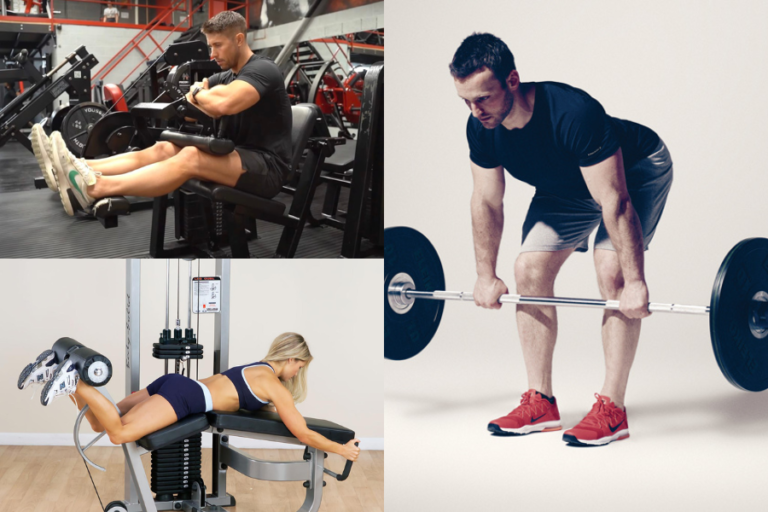
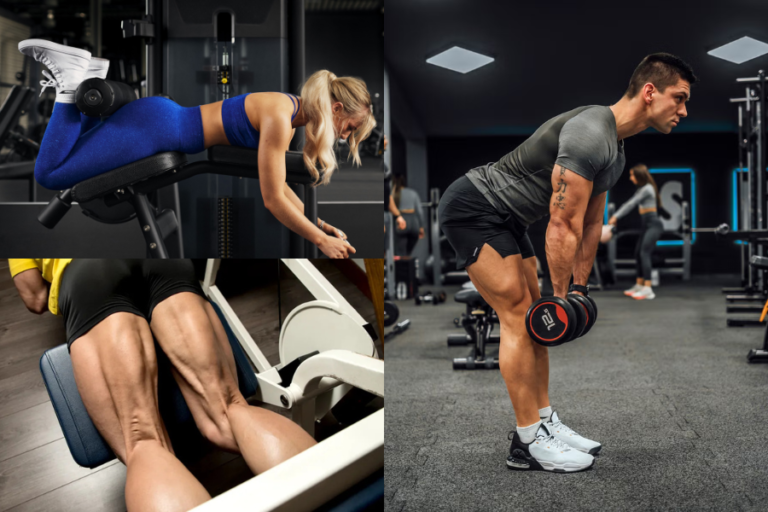
Banded hamstring curls isolate the back of your thighs in a similar way to a leg curl machine, just without the bulky equipment. You can perform them lying on your stomach or standing.
In a lying curl, you anchor the band to a sturdy object, loop it around your ankles, and lie face down. You then bend your knees to bring your heels toward your glutes. Compared to a machine, the band usually offers a bit less maximum resistance, but it creates more instability. That instability encourages your hamstrings and supporting muscles to work harder to control the movement, which can help make them more resilient.
This exercise is especially helpful if you are returning from an injury, or if you do not have access to gym equipment. It is not the most efficient option for building large amounts of muscle mass, but it is very useful for strength, control, and general fitness.
Loop band Romanian deadlift
The Loop Band Romanian Deadlift is often ranked as one of the most effective hamstring exercises you can do with a band. You stand on a long loop band, hold the other end in your hands, and hinge at the hips while keeping a slight bend in your knees. As you stand back up, the band resists your hip extension.
This variation targets your hamstrings, glutes, and lower back and also helps improve flexibility and posture. Because the resistance is greatest at the top of the movement when you are standing tall, your hips and hamstrings have to work hard to lock out the rep. Many people also find that banded RDLs are easier on the lower back than heavy barbell versions, which makes them a smart choice if you want strength without as much spinal loading.
Loop band good morning
Loop Band Good Mornings look similar to RDLs but are usually done with the band looped under your feet and around your upper back or shoulders. You hinge forward at the hips and then return to standing.
This exercise strengthens your hamstrings, glutes, and spinal erectors. Because the band increases tension as you straighten up, you get an extra challenge at the top where your hips fully extend. That top range is where many people are weakest, so consistent practice here can pay off in daily activities like lifting boxes or standing from a chair.
Mini loop band glute bridge
In the Mini Loop Band Glute Bridge, you place a small band just above your knees, lie on your back with your feet flat, and lift your hips. The band tries to pull your knees inward, so you push them slightly out as you bridge.
This movement trains your hamstrings and glutes at the same time. The band above the knees forces your hip muscles to work harder, which often leads to better overall activation and stability in the lower body. You can also try single-leg glute bridges to increase difficulty and further challenge each hamstring separately.
Bodyweight kneeling banded deadlift
The Bodyweight Kneeling Banded Deadlift is a modified deadlift that you perform from a kneeling position. You anchor the band under your knees or feet, hold the other end at your hips or chest, and extend your hips forward to rise tall on your knees.
This variation reduces the balance demands of standing deadlifts and can feel more accessible if you are new to strength training or have limited mobility. You still target your glutes, hamstrings, and lower back, just with a shorter range of motion and less stress on your joints. It is a useful stepping stone toward more advanced hip hinge patterns.
Standing loop band hamstring curl
In the Standing Loop Band Hamstring Curl, you anchor the band low behind you and loop it around one ankle. While standing tall and holding onto something stable for balance, you bend your knee to bring your heel toward your glutes, then slowly lower.
This exercise isolates the hamstrings on one leg at a time and also challenges your balance and core stability because you are standing on the other leg. It is suitable for most fitness levels and is easy to make harder by stepping farther away from the anchor or using a heavier band.
How to perform banded hamstring curls safely
Banded hamstring curls are often the centerpiece of a hamstring workout with resistance bands, so it helps to dial in your form.
- Anchor the band securely near the floor behind you. Make sure it cannot slip or loosen.
- Loop the band around your ankles or just above your heels.
- Lie flat on your stomach with your hips pressed into the floor. If you are standing, keep your torso tall and your knees close together.
- Flex the foot of the working leg so your toes pull toward your shin. This can help you feel the hamstring more and protect your knee.
- Curl your heel toward your glutes in a controlled motion. Pause briefly at the top.
- Lower your leg slowly, keeping tension in the band throughout the movement.
Try to keep your hips still instead of letting them lift or twist. Use a steady tempo for both the lifting and lowering phases, rather than rushing the way down. This will help your hamstrings handle the band tension more effectively and can reduce your risk of strain.
If you feel discomfort in your knees, switch to a lighter band, shorten the range of motion slightly, or try lying curls instead of standing for a while.
Sample hamstring workout with resistance bands
You can build a complete hamstring workout with resistance bands using just a handful of the exercises above. The routine below is adapted from a July 2023 guide and is designed to train your hamstrings, glutes, and lower back in one balanced session.
Aim to perform this routine twice per week, with at least 48 hours of rest between sessions, so your muscles have time to recover and grow.
- Band Romanian deadlifts
- Sets: 3 to 4
- Reps: 8 to 15
- Focus on a smooth hip hinge and full hip extension at the top.
- Single-leg glute bridges (with or without mini loop band)
- Sets: 3
- Reps: 12 to 20 per leg
- Keep your hips level and squeeze your glutes at the top of each rep.
- Banded hamstring marches
- Sets: 3
- Reps: 8 to 10 per leg
- Wrap the band around your feet and march in place while standing or lying on your back. Keep tension in the band the whole time.
- Lying hamstring curls
- Sets: 2 to 3
- Reps: To near failure, while maintaining good form
- Choose a band that challenges you but does not force you to swing or jerk the movement.
Rest for about 90 to 150 seconds between sets, especially after the more demanding compound moves like band RDLs and glute bridges. If you are newer to resistance training, start at the lower end of the set and rep ranges and gradually build up.
Choosing and progressing your bands
To get the most from your hamstring workout with resistance bands, you will want a small range of band resistances so you can progress over time.
If you are a beginner, you might start with lighter bands that provide roughly 20 to 35 pounds of resistance. As your strength improves, you can move up to medium and heavy bands in the 30 to 60 pound range for many hamstring-focused movements.
Fabric hip bands and long loop bands that are designed for strength training are good choices because they tend to be more durable and less likely to roll or snap compared to very thin bands. A quality hip band can add effective resistance to glute bridges, donkey kicks, and hamstring marches, while a sturdy long band can cover Romanian deadlifts, good mornings, curls, and deadlift variations.
If an exercise starts to feel too easy, you have a few simple options to increase the challenge:
- Use a thicker or heavier band.
- Step farther from the anchor point to create more stretch.
- Slow down the lowering phase to increase time under tension.
- Add an extra set, or add a few more reps within the suggested range.
You do not need to change everything at once. Make one small adjustment, track how it feels for a week or two, and then adjust again as needed.
Putting it all together
A simple hamstring workout with resistance bands can fit easily into your existing routine. You might pair it with an upper body workout on alternating days, or use it as a lower body session when you cannot make it to the gym.
If you want to get started today, try this:
- Choose one hip hinge exercise, like the Loop Band Romanian Deadlift.
- Add one bridge variation, like the Mini Loop Band Glute Bridge.
- Finish with a banded hamstring curl to isolate the muscles and build endurance.
Move slowly, focus on feeling your hamstrings do the work, and give yourself time to progress. With consistent practice and gradually heavier bands, you will build stronger, more stable hamstrings that support you in your workouts and your everyday life.
About the Author