
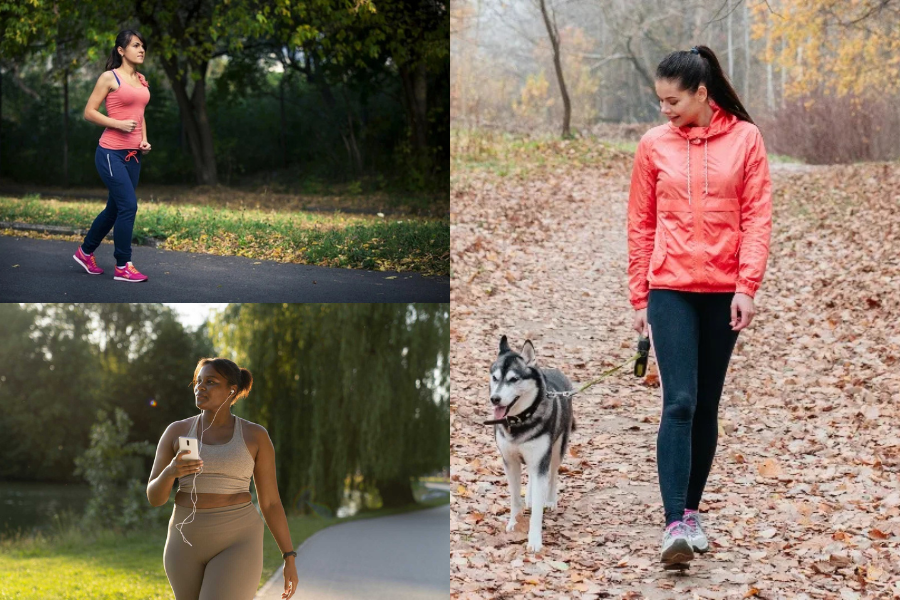
Why walking workouts work for weight loss
If you are looking for simple, sustainable walking workouts for weight loss, you are on the right track. Walking is low impact, easy to start, and surprisingly powerful when you use the right pace, duration, and weekly plan.
Experts recommend treating walking as real cardio, not just casual steps between errands. For weight loss, the American College of Sports Medicine suggests at least 250 minutes per week of moderate intensity walking, which is more than the 150 minutes per week aimed at general health (AARP).
Walking helps you lose weight and improve health because it:
- Burns calories and body fat, especially with longer or brisk sessions
- Strengthens your heart and improves blood pressure
- Lowers stress and cortisol levels, which can reduce belly fat (EatingWell)
- Supports better sleep and energy, so you are more active overall
To get the most from walking, you will want to pay attention to intensity and structure, not just how many minutes you move.
Understand walking intensity and fat burn
Before you jump into a plan, it helps to know what “counts” as an effective walking workout.
Use the talk test for brisk walking
Brisk walking is where the real weight loss benefits start. A simple way to know if you are in the right zone is the talk test:
- You can talk in short sentences
- You cannot comfortably hold a long conversation
- Singing feels difficult
This level of effort lines up with moderate intensity activity and is recommended for effective fat burning by exercise physiologists and public health guidelines (AARP, Medical News Today).
Aim for the fat burning heart rate zone
You burn some fat at almost any intensity, but walking in the right heart rate range makes your workouts more efficient.
Guidance from sports medicine experts suggests aiming for about 60 to 70 percent of your maximum heart rate for at least 30 minutes if weight loss is your goal (GQ). In this range, your body tends to rely more on fat as fuel, especially after the first 20 minutes of continuous movement.
You can monitor this with:
- A fitness watch or heart rate monitor
- A simple pulse check on your wrist or neck
- The combination of heart rate and the talk test
Know how speed and incline affect calories
Your calorie burn depends on several factors, including your weight, pace, terrain, and time spent walking. A few key points from research:
- Walking slowly is light intensity, with a MET value of about 2.0, which means it uses roughly twice the energy of resting (Calculator.net)
- Walking at 3 to 4 mph, often called power walking, is an effective pace for weight management and better body composition (TODAY)
- Uphill walking or walking on an incline raises intensity and calorie burn more than flat ground (Medical News Today)
- Longer walks burn more calories, but a faster or hillier walk in the same time burns more than an easy stroll (Calculator.net)
You do not need to obsess over exact numbers, but knowing these basics helps you design walking workouts that move the needle.
Set realistic walking and weight loss goals
Walking can absolutely support weight loss, but it is most effective when you combine it with realistic goals and a supportive routine.
Choose a weekly time or step target
For weight loss, most experts converge around these targets:
- 150 to 300 minutes per week of moderate intensity activity for overall health
- At least 250 minutes per week of moderate intensity walking specifically for weight loss (AARP)
- Around 30 to 60 minutes of walking on most days, for a total of 150 to 300 minutes weekly (Verywell Fit, EatingWell)
If you prefer counting steps:
- 7,000 to 8,000 steps per day offers strong health benefits
- Around 10,000 steps per day is often linked with noticeable weight loss (Omni Calculator)
- Some experts suggest 10,000 to 20,000 steps per day for significant weight loss results, especially if you are using walking as your main workout (GQ)
You do not need to hit these numbers on day one. Aim to progress steadily instead.
Combine walking with simple lifestyle changes
According to exercise scientists, walking alone helps, but you will see better weight loss if you combine it with:
- A nutritious, calorie-aware diet
- Consistent physical activity
- Adequate rest and good sleep
- Stress management habits (AARP)
Small changes, like swapping sugary drinks for water and adding more vegetables and lean protein, can make your walking workouts much more effective (Crunch).
Build a beginner friendly walking plan
If you are new to walking workouts for weight loss, think of the first weeks as your “foundation” phase. Your main job is to get consistent, not perfect.
Week 1: Start with comfortable consistency
Use this as a gentle on-ramp. If any day feels too hard, slow your pace or trim five minutes.
Goal: 20 to 30 minutes of walking most days
Pace: Easy to moderate, you can talk comfortably
Sample schedule:
- Day 1: 20 minute easy walk
- Day 2: 20 minute walk with 2 short brisk bursts, 1 minute brisk, 2 minutes easy, repeated twice
- Day 3: Rest or light activity such as stretching or a slow 10 minute stroll
- Day 4: 25 minute walk at a steady, comfortable pace
- Day 5: 20 minute walk with a few gentle hills or stairs if available
- Day 6: 25 to 30 minute easy walk
- Day 7: Rest or active recovery, yoga, gentle stretching, or a relaxed walk
Including recovery days early on helps your body adapt and reduces injury risk (Verywell Fit).
Week 2: Introduce brisk walking intervals
Once you feel comfortable with regular walks, add intervals to increase fat burning and cardiovascular fitness.
Research shows that alternating faster and slower efforts can improve strength and aerobic capacity more than steady walking alone (GQ).
Goal: 25 to 35 minutes most days
Pace: Mix easy and brisk intervals
Sample schedule:
- Day 1: 5 minute warm up, then 6 cycles of 1 minute brisk + 2 minutes easy, 5 minute cool down
- Day 2: 30 minute steady walk at a “challenging but sustainable” pace
- Day 3: Rest or light active recovery
- Day 4: 5 minute warm up, then 4 cycles of 2 minutes brisk + 3 minutes easy, 5 minute cool down
- Day 5: 25 minute easy walk on mostly flat terrain
- Day 6: 30 to 35 minute walk with one or two hills or stair sections
- Day 7: Rest or a gentle 15 minute stroll
Try not to sprint during the brisk sections. You want a strong pace where you are breathing harder but still in control.
Week 3 and beyond: Gradually increase challenge
From here, you can progress by slightly increasing:
- Total weekly minutes, up to about 20 percent more time every two weeks
- The number of brisk intervals
- The steepness or length of hills
Experts suggest raising your walking time gradually, by no more than around 20 percent every couple of weeks, to avoid overuse injuries (AARP).
A simple rule is to change just one thing at a time, such as adding five minutes to two of your walks, or choosing a hillier route on one day per week.
Try effective walking workout formats
Once you have a base, you can mix and match different walking workouts for weight loss to keep your routine interesting and effective.
Interval walking for faster results
Interval walking alternates higher and lower intensity segments. This style has been shown to improve fitness and fat burning more than steady state walking in some studies (GQ).
You might try:
30 minute interval walk
- 5 minutes easy warm up
- 1 minute brisk, 2 minutes easy, repeat 8 times
- 5 minutes cool down
Or, for a shorter session:
20 minute beginner interval walk
- 5 minutes easy
- 30 seconds brisk, 90 seconds easy, repeat 6 to 8 times
- 3 to 5 minutes easy cool down
You can adjust the work and rest periods based on your current fitness.
Hill or incline walking to boost calorie burn
Walking uphill or using a treadmill incline significantly increases intensity and calorie expenditure, often without needing to move much faster (Medical News Today). One study found that walking at a 12 percent incline at 3 mph for 30 minutes burned more fat than a moderate effort run (GQ).
Try this hill workout once or twice a week:
25 to 30 minute hill walk
- 5 minutes flat, easy pace
- 2 minutes uphill or at 5 to 8 percent incline, moderate to brisk
- 3 minutes flat, easy recovery
- Repeat the 2 up / 3 flat pattern 4 to 5 times
- 5 minutes flat, easy cool down
If you do not have hills, use stairs or a treadmill incline.
Power walking for time efficient workouts
Power walking means walking at a strong, continuous pace, usually around 3 to 4 mph, with noticeable arm swing and an upright posture (TODAY).
If you are short on time, try:
- 15 minutes power walking in the morning
- 15 minutes power walking in the evening
Studies show that two shorter walks per day can be more effective for weight loss than one longer walk, especially for people carrying extra weight (AARP, Medical News Today).
Multiple short walks through the day
If you struggle to find a 30 or 60 minute block, you can still hit your goals with “walking snacks.”
Guidelines suggest you can combine two to four 15 minute brisk walks to reach at least 30 minutes of daily activity (Verywell Fit). Trainers also recommend breaking up walks into 10 minute chunks if that is all you can manage at first (EatingWell).
For example:
- 10 minutes after breakfast
- 10 minutes at lunch
- 10 to 15 minutes after dinner
The key is consistency and keeping most of those minutes at a brisk pace.
Add strength training and extras for better results
Walking will carry you a long way, but combining it with strength work and a few smart tweaks can accelerate your progress.
Include strength training twice per week
Public health guidelines recommend strength training at least two days per week, and research shows that pairing resistance training with nutrition changes helps increase lean body mass while reducing body fat (Verywell Fit).
You can fit this into your week by:
- Doing a 15 to 20 minute bodyweight routine after two of your walks
- Alternating walking days with simple strength workouts at home
Focus on basic moves that support your walking, such as:
- Squats or chair sits
- Lunges or step ups
- Glute bridges
- Planks or side planks
- Light dumbbell or resistance band rows and presses
Stronger muscles will help you walk faster and farther with less effort, and they increase your daily calorie burn.
Consider gentle progressions like weighted vests
Once you have a strong base, you can make your walks more demanding without changing your route by adding resistance. For example, wearing a light weighted vest increases difficulty and calorie burn. A small 2024 trial also found that adding weight during light exercise reduced bone loss in postmenopausal women with low bone density (Medical News Today).
Keep it safe by:
- Starting with a very light vest
- Keeping the weight evenly distributed
- Listening to your joints and backing off if anything feels off
You do not need extra weight to lose weight, but it can be a helpful tool later on.
Use walking to tackle belly and visceral fat
If you are especially concerned about belly fat, you are not alone. The good news is that walking can help.
Trainers note that consistent walking increases daily calorie expenditure enough to reduce visceral fat, the deep abdominal fat linked with higher health risks, even without major diet changes (EatingWell). Walking also:
- Improves insulin sensitivity, so your body uses blood sugar better rather than storing it as fat
- Lowers cortisol levels, which are tied to visceral fat storage
- Supports better sleep, another key factor in abdominal fat regulation (EatingWell)
You do not need special “belly fat walks.” The same consistent, brisk walking plan that burns calories overall will also help reduce abdominal fat over time.
Make your walking routine sustainable
The best walking workouts for weight loss are the ones you actually keep doing. A few simple habits can make your routine feel easier to stick with.
Mix up your routes and terrains
Changing where and how you walk keeps your mind engaged and your body challenged. You can:
- Alternate between flat paths and hilly routes
- Use trails, sidewalks, and indoor tracks or treadmills
- Swap in stairs at work or at home when you can
Walking uphill or using steps regularly boosts intensity and calorie burn without adding more time (Medical News Today).
Respect rest and recovery days
Even though walking is low impact, your body still needs breaks. Recovery days let your muscles repair and your energy rebound, which actually helps you make progress faster.
Experts emphasize the importance of having both full rest days and lighter active recovery days in a walking plan for weight loss (Verywell Fit). You might:
- Take one or two days per week completely off from structured workouts
- Use one day for gentle stretching, yoga, or a very light walk
If you feel unusually tired, sore, or run down, add another easy day.
Adjust for sleep, stress, and schedule
Other lifestyle factors can affect how many calories you burn and how well your body responds to walking. For example, poor diet, inadequate sleep, and high stress can all reduce calorie expenditure and slow progress (Calculator.net).
You do not have to overhaul your life, but these small shifts help:
- Aim for a consistent bedtime and wake time
- Take a 5 minute walk when stress spikes, instead of turning to snacks
- Keep a water bottle handy during and after your walks
Over time, these habits support a healthier metabolism and make your workouts feel more rewarding.
Key takeaways for your walking plan
To put it all together, here is how to use walking workouts for weight loss and health in a realistic way:
- Treat walking as real cardio, not an afterthought
- Aim for at least 150 minutes per week to start, and work toward 250 minutes or more of moderate intensity walking for weight loss
- Use the talk test or heart rate to stay in a brisk, but manageable zone
- Mix steady walks, intervals, and hill or incline sessions for variety and better results
- Break walks into shorter chunks if long sessions do not fit your schedule
- Add strength training two days a week to build lean muscle and support your joints
- Combine walking with a nutritious diet, good sleep, and stress management
You do not need perfect conditions or complicated gear to get started. Lace up a pair of comfortable shoes, choose a simple route, and begin with the amount of time that feels doable today. Then keep walking, one week at a time, and let your results build from there.
About the Author










10 thoughts on “Discover Powerful Walking Workouts for Weight Loss and Health”
Comments are closed.