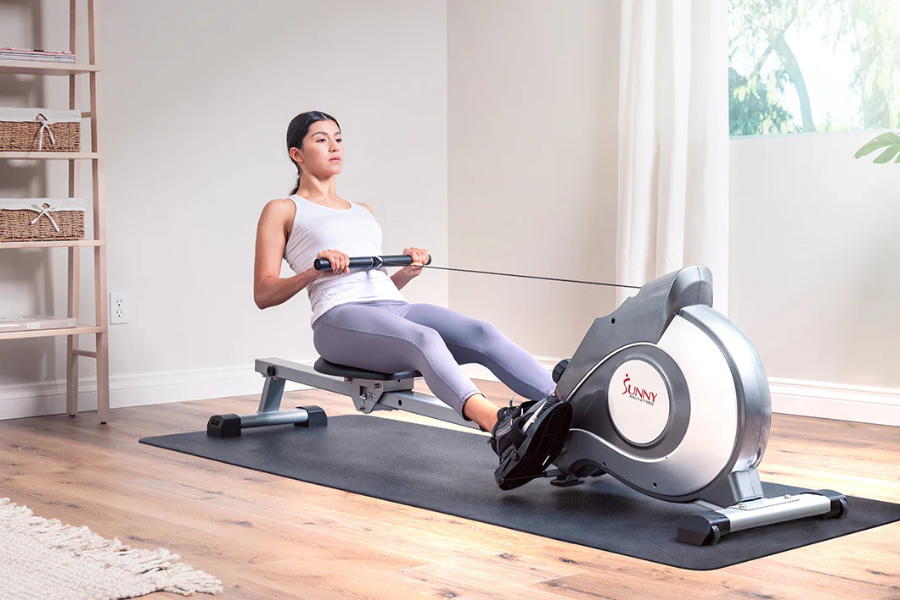
Rowing workouts can be one of the best rowing workouts for weight loss because they burn a high number of calories, work nearly every major muscle group, and stay gentle on your joints. If you are looking for a routine that helps you lose weight and improves your overall fitness without pounding your knees and ankles, a rowing machine is worth your attention.
Below, you will learn why rowing is so effective for fat loss, how to row correctly, and several of the best rowing workouts for weight loss whether you are a beginner or more advanced.
Why rowing works so well for weight loss
Rowing is often described as a full body workout, and in this case that description is accurate. Each stroke uses your legs, glutes, core, back, and arms. Some estimates suggest you engage roughly 86% of your muscles during a rowing session, which means you burn a lot of energy in a short time (Fit & Well).
Rowing also combines cardio and strength in one movement. You work against the resistance of a flywheel or water tank, so your muscles have to push and pull with every stroke while your heart rate climbs, similar to lifting weights and jogging at the same time (Garage Gym Reviews). This combination:
- Increases your calorie burn during the workout
- Helps you maintain or build muscle while losing fat
- Improves cardiovascular health and endurance
Another advantage is that rowing is low impact. Unlike running, your feet stay in contact with the machine, which reduces joint stress. This makes it easier to work at higher intensities if you have sensitive knees or hips (PureGym).
To actually lose weight, you still need a calorie deficit, so pairing your rowing workouts with a calorie controlled diet will give you the best results (Healthline).
Mastering rowing technique for better results
Good rowing form lets you work harder, avoid injury, and get more out of every minute on the machine. If you are newer to rowing, spend some time here before you worry about speed or resistance.
The basic rowing stroke
Think of each stroke as a smooth sequence, not four separate movements. A simple way to remember it is: legs, body, arms, then reverse.
-
The catch
Sit tall with a neutral spine, shoulders relaxed. Bend your knees and slide forward on the seat until your shins are vertical. Your arms are extended, and you are leaning slightly forward from the hips. -
The drive
Push through your heels and straighten your legs first. Your legs should do most of the work. As your legs near full extension, lean your torso back slightly, about 45 degrees, while keeping your core engaged. Finally, pull the handle to just under your ribs, keeping elbows close to your sides (Fit & Well). -
The finish
Legs are straight, torso is slightly reclined, handle is close to your body. Your shoulders stay relaxed, not hunched. -
The recovery
Reverse the order smoothly. Extend your arms first, then hinge forward from the hips, then bend your knees and slide back to the catch. The recovery should take a little longer than the drive so your movement feels controlled rather than jerky.
Proper form also includes keeping a straight but relaxed back, using full range of motion, and maintaining a smooth rhythm even as intensity rises (RP3 Rowing).
How rowing supports healthy fat loss
You burn calories during every rowing session, but the way you structure your workout can change how your body responds.
Steady moderate rowing, where you hold a sustainable pace and keep your heart rate at roughly 60 to 70 percent of your maximum, helps your body use fat as a fuel source and builds your aerobic base. Sessions in the 20 to 35 minute range at this intensity can burn roughly 200 to 300 calories for an average person, and up to around 400 for heavier individuals (RowingMachineWorkouts).
High intensity interval training, or HIIT, alternates hard efforts with easy rowing. This style can burn more calories in less time and increases your post workout calorie burn, sometimes called the afterburn effect (The Fitness Outlet). HIIT rowing workouts can also improve your cardiovascular conditioning and endurance more quickly than moderate exercise alone (Garage Gym Reviews).
For fat loss, a mix of both steady and interval sessions often works best. You create a calorie deficit through consistent training and smart nutrition, and your body loses fat from your whole body rather than only from one area like the belly (RowingMachineWorkouts).
Best rowing workouts for beginners
If you are new to rowing or coming back after a break, your priorities are technique and consistency. Start with manageable workouts that build the habit and protect your joints.
Easy 20 minute technique builder
This beginner workout focuses on moderate effort and good form. Healthline suggests beginners row about 20 minutes at a moderate intensity 3 days per week to build a foundation (Healthline).
- Warm up, 5 minutes
- Row very lightly.
- Focus on the order of the stroke: legs, body, arms, then arms, body, legs on the way back.
- Main set, 12 minutes
- Row at a pace where you can still speak in short phrases, but your breathing is heavier than normal.
- Keep your stroke rate in a moderate range, around 20 to 24 strokes per minute.
- Every 3 minutes, check your posture and reset your form if you feel yourself slouching.
- Cool down, 3 minutes
- Gradually slow your pace.
- Finish with gentle stretching for your hips, hamstrings, and upper back.
Starter intervals for weight loss
Once you feel comfortable with the movement, you can add a simple interval workout. The Fitness Outlet suggests a 20 minute beginner interval plan structured like this (The Fitness Outlet):
- Warm up, 5 minutes easy rowing.
- Intervals, 10 to 15 minutes total:
- 30 seconds hard rowing at about 24 to 26 strokes per minute.
- 90 seconds light recovery rowing.
- Repeat 8 to 10 times.
- Cool down, 3 to 5 minutes easy rowing plus stretching.
In the hard segments, your breathing should be heavy and talking should feel difficult, but you can still maintain good form. If your technique breaks down, reduce your effort slightly.
Intermediate rowing workouts for faster fat loss
If you already row a few days a week and can hold 20 to 30 minutes comfortably, you are ready for more structure. Moderate to advanced intervals and slightly longer sessions can speed up your progress.
25 minute 1 to 1 intervals
For intermediate exercisers, the Fitness Outlet recommends a 25 minute workout with equal work and rest (The Fitness Outlet):
- Warm up, 5 minutes easy rowing.
- Intervals, 15 minutes:
- 1 minute hard rowing at 28 to 30 strokes per minute.
- 1 minute easy rowing.
- Repeat 10 to 12 rounds.
- Cool down, 5 minutes light rowing and stretching.
This format teaches you to sustain higher efforts and improves your aerobic capacity so later sessions feel easier.
Pyramid intervals for variety
Pyramid intervals gradually increase work time, then taper back down. RP3 Rowing suggests using simple intervals first and then trying more complex formats like pyramids as you progress (RP3 Rowing).
Try this 30 minute pyramid:
- Warm up, 5 minutes.
- Pyramid set, 20 minutes total, all at a moderate to hard pace:
- 1 minute hard, 1 minute easy
- 2 minutes hard, 2 minutes easy
- 3 minutes hard, 3 minutes easy
- 2 minutes hard, 2 minutes easy
- 1 minute hard, 1 minute easy
- Cool down, 5 minutes.
Use a stroke rate around 24 to 28 strokes per minute during the hard blocks and 18 to 20 during the easy ones.
Advanced HIIT rowing workouts for maximum calorie burn
If you have at least six months of consistent rowing under your belt, you can safely include more intense HIIT sessions. Healthline recommends that advanced rowers use interval based HIIT workouts at least 5 days per week to boost exercise capacity and support weight loss, as long as you recover well and avoid overtraining (Healthline).
Short, intense HIIT sessions
HIIT rowing lets you burn a lot of calories in less time than you would with moderate steady rowing. Gym reviews and fitness writers note that a 20 minute HIIT rowing workout can effectively raise your heart rate for weight loss and fitness, and that HIIT sessions should be limited to a few times per week to prevent overtraining (Garage Gym Reviews).
Here is a classic 20 minute HIIT structure:
- Warm up, 5 minutes, building gradually from very easy to moderate.
- Intervals, about 10 minutes total:
- 40 seconds at near maximum effort, stroke rate 28 to 32.
- 80 seconds light rowing.
- Repeat 6 to 8 times.
- Cool down, 5 minutes easy rowing and stretching.
This 1 to 2 work to rest structure matches guidelines from RP3 Rowing, which suggest 20 to 40 seconds of maximum effort followed by 40 to 80 seconds of active recovery for fat burning and afterburn benefits (RP3 Rowing).
Tabata style row for a quick burn
If you are short on time and already experienced, you can try a Tabata style workout. PureGym notes that a Tabata rowing session can be just 9 minutes and still be very effective, since it alternates 20 seconds of intense work with 10 seconds of rest (PureGym).
A simple Tabata plan:
- Warm up for 5 minutes.
- Perform 8 rounds of:
- 20 seconds all out rowing.
- 10 seconds complete rest or very light rowing.
- Cool down for 3 to 5 minutes.
Because the work periods are so intense, limit this style of training to one or two times per week and only if your technique stays strong under fatigue. Beginners should not start with Tabata. RP3 Rowing also recommends working up to Tabata intervals after mastering simpler structures (RP3 Rowing).
As a guideline, many coaches recommend no more than three HIIT rowing workouts per week so that you can recover and keep improving over time rather than burning out (Garage Gym Reviews).
How often to row for weight loss
To see meaningful changes in your weight and fitness, you need both frequency and progression.
- If you are a beginner, aim for about 3 days per week of 20 minute moderate sessions focused on technique, as suggested by Healthline (Healthline).
- As you move into intermediate territory, 4 sessions per week that mix intervals and longer steady rows can increase calorie burn and capacity (Healthline).
- Advanced exercisers may work up to 5 days per week with a blend of HIIT and moderate sessions, making sure that the hardest workouts are separated by easier days.
Plans like 4 week or 30 day rowing routines often schedule 4 workouts per week, with rest days built in for recovery. One example is a routine that rotates HIIT days, medium duration intervals, and longer steady workouts, which helps you burn fat while avoiding overuse injuries (RowingMachineWorkouts, Fit & Well).
Small tweaks that increase your results
Once your basic program is in place, a few changes can make your rowing sessions even more effective for weight loss.
First, adjust your stroke rate and resistance sensibly. Moderate stroke rates around 20 to 26 strokes per minute allow you to maintain good form while still burning a lot of calories, especially in 20 to 35 minute workouts (RowingMachineWorkouts). You do not need extremely high resistance to work hard. Focus more on strong, consistent strokes than on turning the damper to the highest setting.
Second, consider pairing rowing with other exercises for some sessions. For example, some workouts combine intervals on the rower with movements like pushups or core work in between rowing bouts. This approach raises intensity and keeps your heart rate up without greatly extending total workout time (Healthline).
Finally, pay attention to your nutrition and recovery. Eating a balanced diet that keeps you in a modest calorie deficit, drinking enough water, and getting enough sleep will support your training and help your body lose fat while maintaining muscle. Some coaches suggest a higher carb meal a few hours before a tough rowing session and a light carb, high protein snack afterward to help with energy and recovery (Fit & Well).
Putting it all together
Rowing can be one of the best rowing workouts for weight loss because it gives you a total body workout, engages your muscles and heart at the same time, and remains gentle on your joints. You can start with simple 20 minute sessions focused on technique, progress to intervals as your fitness improves, and eventually incorporate short HIIT or Tabata style workouts once you are experienced.
Choose one workout from the beginner section for your next gym visit and commit to repeating it three times this week. As you become more comfortable on the rower, gradually add in an interval day or increase your total weekly minutes. With consistent effort, smart progressions, and supportive eating habits, you will turn your rowing sessions into a reliable tool for long term weight loss and better health.
About the Author