Why your hamstrings matter
When you think about lower body strength, you might picture squats and lunges that target your quads and glutes. Your hamstrings, the big muscles that run down the back of your thighs, often get less attention. Yet they do a lot of the work every time you walk, run, jump, or stand up from a chair.
Your hamstrings are a group of three muscles that run from your hip to your knee. Trainers Kristina Earnest and Roxie Jones note that they are critical for everyday activities like walking, running, jumping, and standing up, as well as athletic moves like squats and lunges. Strong hamstrings help you:
- Push off the ground when you sprint
- Control your descent when you sit or squat
- Protect your knees and hips from strain
- Support your lower back when you bend forward
Physical therapist Jared Hoffmann explains that your hamstrings are vital for controlling knee bending and hip extension, which means they are involved in almost every step you take. When you strengthen them, you not only gain power, you also help prevent poor posture and lower back pain.
Benefits of a hamstring workout for women
A targeted hamstring workout for women is about more than getting defined legs. It supports how your whole body moves and feels.
Everyday movement feels easier
When your hamstrings are strong, everyday tasks feel lighter. Climbing stairs, carrying groceries, standing up from the couch, or picking something up off the floor all depend on your hamstrings working with your glutes and core. Hoffmann notes that strong hamstrings help stabilize your back during forward bending and protect your hips, knees, and lower back from stress.
Better performance in workouts and sports
If you enjoy running, cycling, lifting, or HIIT, powerful hamstrings are a huge advantage. They help you:
- Run faster and brake more efficiently
- Push harder in squats and lunges
- Generate more power in jumps and sprints
Surrey Physio highlights that hamstring strength plays a major role in movements like running, jumping, and squatting, and that improving their strength can enhance performance and reduce injury risk.
Lower risk of injury and imbalance
Many women spend a lot of time training quads and glutes, but not as much time on hamstrings. Over time this creates muscle imbalances, which can show up as:
- Tight hips and hamstrings
- Knee discomfort
- Lower back soreness
By training your hamstrings consistently, you help balance the front and back of your legs. Physical therapists Taylor Pfeifer and Theresa Shoemaker explain that strong and flexible hamstrings support better posture, mobility, and balance, and help prevent muscle imbalances that lead to injury, especially if you sit a lot or do intense leg workouts.
How often to train your hamstrings
You do not need a complicated schedule to see results. Most women do well with:
- Strength training: 1 to 2 focused hamstring workouts per week
- Stretching: 2 to 3 short sessions per week, or a few minutes daily
Experts recommend at least twice weekly hamstring work to maximize strength and size gains, ideally starting your leg day with compound moves like deadlifts and finishing with isolation moves like curls.
If you are newer to strength training, begin with one hamstring-focused session per week and add a second once you feel comfortable with the movements.
Warm up before your hamstring workout
A good warmup prepares your muscles and joints so your hamstring workout for women feels smoother and safer.
Spend 5 to 8 minutes on:
-
Light cardio
Walk, cycle, or march in place until you feel slightly warm. -
Dynamic leg moves
- Walking lunges
- Leg swings front to back
- Gentle butt kicks
Pfeifer and Shoemaker recommend using dynamic stretches like leg swings or walking lunges before workouts to increase blood flow and muscle temperature, which helps reduce the risk of strains.
At‑home hamstring workout for women
You can build strong hamstrings without a gym membership. This simple circuit uses basic equipment like dumbbells, a kettlebell, or a resistance band. Choose 3 or 4 exercises, perform 10 to 12 reps of each, then repeat the circuit for 3 rounds. Aim for 15 to 20 minutes total.
1. Good mornings
Good mornings are a classic hip-hinge movement that teach you to load your hamstrings safely.
How to do them:
- Stand with your feet hip width apart, knees soft.
- Hold a broomstick, light bar, or dumbbells across your upper back, not on your neck.
- Brace your core and keep your back flat.
- Hinge at your hips, sending them back while your torso leans forward.
- Stop when you feel a strong stretch in the backs of your thighs, then return to standing.
Good mornings are one of the most effective at-home hamstring exercises. Trainers often recommend them with very light weight at first so you can learn the motion and feel your hamstrings working instead of your lower back.
2. Glute bridges
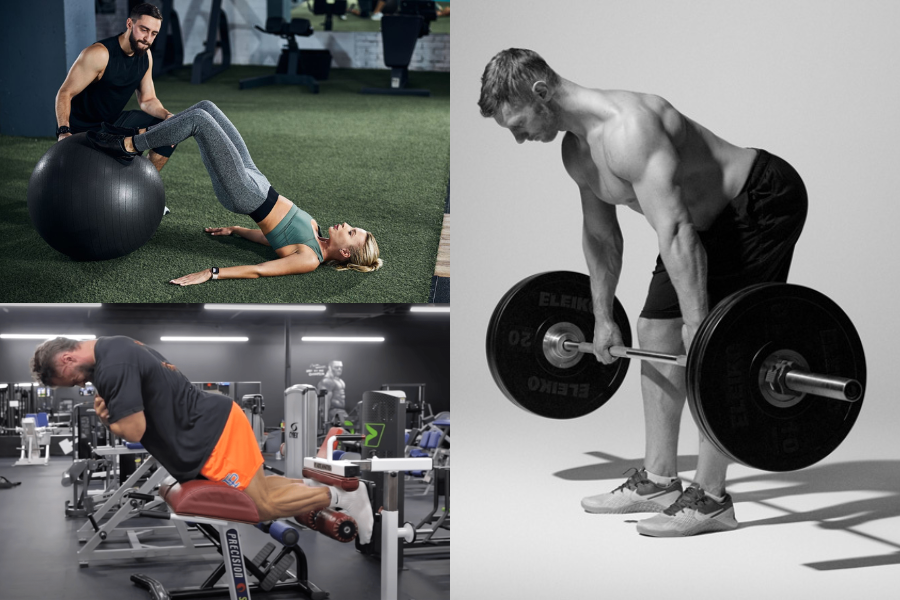
Glute bridges target your hamstrings and glutes while teaching you to engage your core.
How to do them:
- Lie on your back with knees bent and feet flat on the floor, hip width apart.
- Press your lower back gently into the floor.
- Drive through your heels and lift your hips until your body forms a straight line from shoulders to knees.
- Squeeze your glutes at the top for 1 to 2 seconds, then slowly lower.
You can make bridges harder by placing a weight on your hips or lifting one leg to perform single-leg bridges. Surrey Physio notes that single-leg bridges also work your abs and lower back and help maintain good posture.
3. Kettlebell swings
Kettlebell swings are a powerful way to train your hamstrings, glutes, and cardiovascular system at the same time.
How to do them:
- Stand with your feet slightly wider than hip width, kettlebell on the floor in front of you.
- Hinge at the hips, grab the handle with both hands, and hike it back between your legs.
- Drive your hips forward quickly to swing the kettlebell up to chest height.
- Let it swing back between your legs, maintaining control and a flat back.
Research cited by Gymshark shows that kettlebell swings are among the best exercises for activating the biceps femoris, one of the primary hamstring muscles.
4. Single‑leg Romanian deadlifts
Single-leg Romanian deadlifts challenge your balance and hit each hamstring individually.
How to do them:
- Stand tall with a dumbbell or kettlebell in your right hand, right foot on the floor, left foot slightly behind you.
- Shift your weight to your right leg.
- Hinge at your hips, letting your left leg extend behind you as your torso leans forward.
- Keep your back flat and the weight close to your shin.
- Stop when your torso is roughly parallel to the floor, then drive through your heel to stand back up.
If balancing is tough, you can keep your back foot lightly touching the floor like a kickstand. Gymshark notes that single-leg Romanian deadlifts are one of the top moves for activating the hamstrings, especially the biceps femoris.
5. Fitball or towel leg curls
If you do not have a leg curl machine, you can still mimic the motion at home.
Option A: Fitball curls
- Lie on your back with your calves and heels on a stability ball.
- Lift your hips so your body forms a straight line.
- Bend your knees and pull the ball toward your glutes.
- Slowly extend your legs to roll the ball back out.
Option B: Towel curls
- Lie on your back with both feet on a small towel on a smooth floor.
- Lift your hips into a bridge.
- Slide your heels away from your body to straighten your legs.
- Pull them back in, keeping your hips off the floor.
Both variations closely mimic a machine hamstring curl and focus on bending the knee under control.
Sample 20‑minute hamstring circuit
You can use this quick structure on a lower body day or as a standalone workout.
- Good mornings, 12 reps
- Glute bridges, 12 reps
- Single-leg Romanian deadlifts, 10 reps each leg
- Kettlebell swings, 15 reps
Rest 45 to 60 seconds, then repeat for 3 total rounds. Choose weights that feel challenging in the last 3 reps while still allowing you to maintain good form. Many women and bodybuilders undertrain hamstrings by not giving them enough volume or intensity, so think about gradually increasing your weights or reps over time to keep progressing.
Gym‑based hamstring exercises to try
If you have access to a gym, you can add more resistance and variety to your hamstring workout for women.
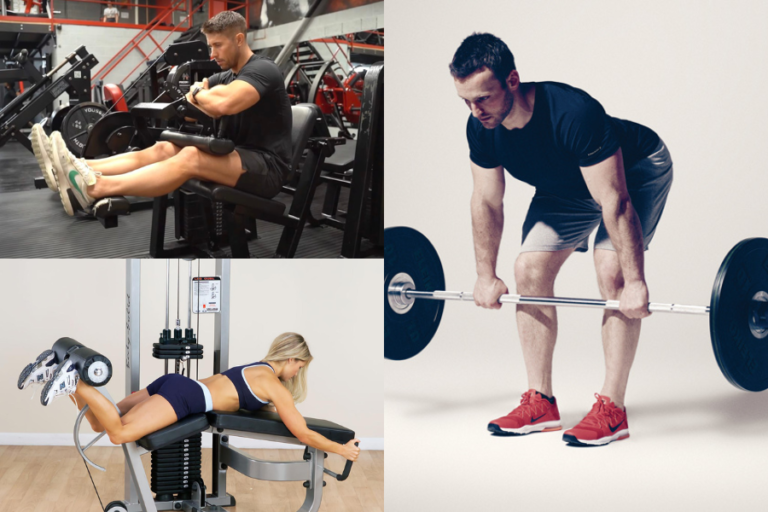
Conventional or Romanian deadlifts
Deadlifts and Romanian deadlifts are powerful compound lifts that train your hamstrings, glutes, and back.
- Conventional deadlift: Start with the bar on the floor, push through your legs and hips to stand tall.
- Romanian deadlift: Start from standing, lower the bar by hinging at the hips and stop around mid shin, then stand back up.
A typical starting point is 3 sets of 8 to 10 reps with a moderate weight, focusing on a controlled tempo and full range of motion. Surrey Physio suggests 3 sets of 10 to 12 Romanian deadlifts to effectively activate your hamstrings.
Hamstring curl machines
Hamstring curl machines isolate the back of your thighs so you can feel a strong contraction.
You might use:
- Seated leg curl machine
- Prone (lying) leg curl machine
- Standing single-leg curl machine
Gymshark recommends 4 sets of lying leg curls and 4 sets of seated leg curls as part of a high volume hamstring routine, stressing the importance of slow, controlled reps and full stretches and contractions for growth.
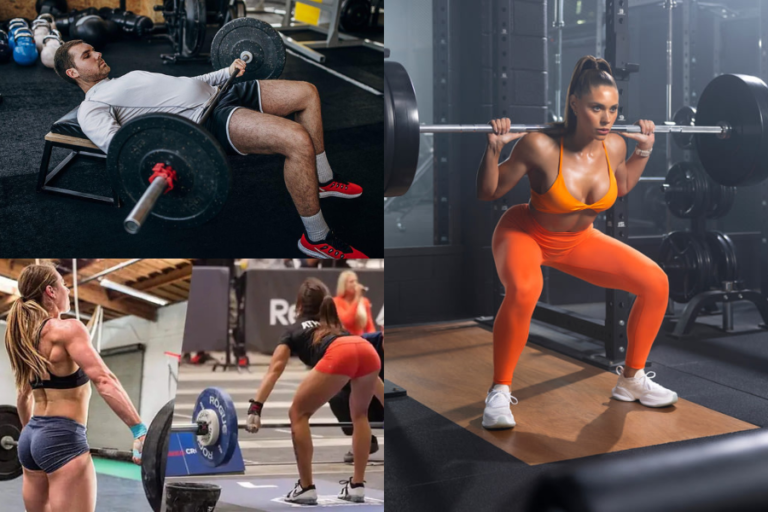
Hip thrusts and heavy bridges
Barbell hip thrusts and barbell glute bridges allow you to load your glutes and hamstrings heavily.
- Sit with your upper back against a bench, barbell across your hips.
- Plant your feet so your knees are bent at roughly 90 degrees.
- Drive your hips up, squeezing your glutes and hamstrings at the top.
- Lower with control.
Because these moves are stable, you can usually handle more weight, which supports progressive overload over time.
Stretching and recovery for healthy hamstrings
Strength is only half the story. Stretching your hamstrings keeps them happy and functional, especially if you sit a lot or do intense workouts.
Therapists note that tight hamstrings often come from prolonged sitting, quad dominance, or intense running and weightlifting without proper warmup or cooldown. Regular stretching improves range of motion and everyday movements like squats, lunges, and hip hinges.
Simple hamstring stretch routine
Aim to stretch your hamstrings 2 to 3 times per week, or spend about 10 minutes per day combining dynamic and static stretches.
Two easy options:
- Seated hamstring stretch
- Sit on the floor with one leg extended and the other bent.
- Hinge forward from your hips toward your toes without rounding your back.
- Hold 15 to 30 seconds, then switch legs.
- Standing hamstring stretch
- Place one heel on a low surface like a step.
- Keep your back straight and gently lean forward until you feel a stretch behind your thigh.
- Hold 15 to 30 seconds per side.
Peloton experts also recommend using props like yoga blocks and straps to help you find better alignment and make stretches more accessible, especially if you feel very tight at first.
You can also add foam rolling or the occasional warm bath to ease tension, but trainers caution that soaking cannot replace stretching because your legs often stay in a shortened position in the tub.
How to keep progressing safely
To keep seeing results from your hamstring workout for women, focus on three simple habits:
-
Progressive overload
Gradually increase one variable at a time, such as reps, sets, or weight. Over weeks and months, this steady progression is what builds stronger hamstrings. -
Form over ego
Engage your core and glutes, move through a full range of motion, and avoid rushing your reps. If you feel more in your lower back than the backs of your thighs, lower the weight and adjust your form. -
Listen to your body
Soreness is normal, sharp pain is not. If you are unsure about an exercise, consult a trainer or physical therapist for a quick form check and a customized program.
Start by adding just one or two of these exercises to your next lower body day. As they become more familiar, you can build them into a full routine that makes your legs stronger, your posture better, and your everyday movements easier.
About the Author