A strong set of quadriceps does more than power you through squats at the gym. Your quads help you walk, climb stairs, stand up from a chair, and protect your knees from everyday wear and tear. The good news is that you can build serious strength with quad exercises at home, often using just your body weight.
Below, you will find a simple, practical guide to working your quads in your living room, plus tips to stay safe and get more from every rep.
Why your quads matter
Your quadriceps are the large muscles on the front of your thighs. They straighten your knee, support your hips, and help stabilize your kneecap. When they are weak or imbalanced, your knees and lower back often end up taking more strain than they should.
Regular quad exercises at home can help you:
- Reduce stress on your knees
- Improve kneecap stability
- Boost performance in running, jumping, and other sports
- Make daily tasks, like carrying groceries or climbing stairs, feel easier
You do not need special equipment to get started. Many effective moves use your own body weight, and you can scale the difficulty up or down as you progress.
How to warm up before quad workouts
Before you jump into squats and lunges, take 5 to 10 minutes to prepare your muscles and joints. A proper warmup increases blood flow, wakes up your nervous system, and reduces injury risk.
You can try a simple sequence like this:
- March in place or walk around your home for 2 minutes.
- Do 20 to 30 seconds each of gentle bodyweight squats, alternating knee lifts, and leg swings.
- Finish with a few slow lunges, focusing on balance and control.
Once your legs feel warm and your heart rate is slightly elevated, you are ready to start your quad session.
Form basics for safe quad training
Quad exercises are only effective if you perform them with control and a full range of motion. Cutting reps short or leaning too far forward can reduce quad activation and put more pressure on your lower back.
Keep these form checks in mind:
- Aim to bend your knees so your thighs reach at least parallel to your calves in squats and similar movements, which helps you fully engage the quads, as highlighted in a 2026 Muscle & Fitness article.
- Keep your chest lifted and your core gently braced to avoid collapsing forward.
- Let your knees track in line with your toes instead of caving inward.
- Choose a moderate resistance so you can move through a complete rep without bouncing or rushing.
If you use external weight, avoid going so heavy that you start doing half reps. Lighter weight with full range and control will challenge your quads more and keep your joints happier.
Best bodyweight quad exercises at home
These foundational exercises build strength, stability, and confidence. Start with 2 sets of 10 to 12 repetitions for each move, resting 30 to 60 seconds between sets. As these become easier, you can add a third set or increase reps.
1. Bodyweight squats
Stand with your feet about hip to shoulder width apart and toes slightly turned out. Sit your hips down and back as if you are lowering into a chair, then stand back up.
Focus on:
- Keeping your weight balanced through your midfoot and heel
- Bending your knees until your thighs are at least parallel to the floor
- Avoiding excessive forward lean, which shifts the work away from your quads and into your back
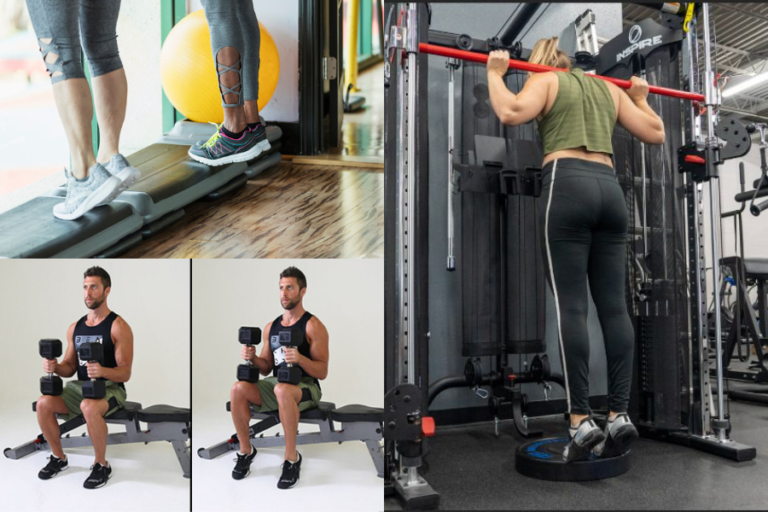
To increase quad activation, you can place your heels on small weight plates or a sturdy book. Elevating your heels increases your shin angle and encourages your quads to do more of the work, especially if your ankle mobility is limited.
2. Walking lunges
From a standing position, step one foot forward and lower your back knee toward the floor. Push through your front heel to stand and bring your back leg forward into the next lunge.
Key points:
- Keep your torso upright and your front knee stacked above your ankle
- Aim for slow, steady steps, not speed
- Take smaller steps if you feel wobbly at first
Lunges challenge your balance and single leg strength, which helps even out side to side differences.
3. Reverse lunges
Reverse lunges are often easier on the knees than forward lunges. Start tall, step one leg back, lower into a lunge, then push through your front heel to return to standing.
This version places a bit more emphasis on the front leg and allows you to control the depth more easily. If forward lunges occasionally bother your knees, try reverse lunges instead.
4. Step ups
Use a stable bench, low chair, or sturdy step. Place one foot fully on the surface, press through your heel, and stand up on top. Slowly lower back down and repeat on the same leg, then switch.
To keep this quad focused:
- Choose a step height that lets you reach about a 90 degree bend in your knee
- Avoid pushing off too much with the lower leg
- Move slowly on the way down to strengthen control
As you get stronger, you can hold a backpack or dumbbells to increase resistance.
5. Bulgarian split squats
Also known as rear foot elevated split squats, this is a strong quad builder once you are comfortable with regular lunges.
Stand about two feet in front of a low chair or couch. Place the top of one foot on the surface behind you. Bend your front knee to lower your hips straight down, then press through the front heel to stand.
For better quad activation:
- Keep most of your weight on your front leg
- Stay upright rather than leaning far forward
- Use a smaller step out distance to angle your shin forward slightly
This move can be intense even with body weight, so start with lower reps if needed and build up gradually.
6. Lateral lunges
Step one leg out to the side and bend that knee while keeping the other leg straight. Sit your hips back slightly and keep your chest up, then push off the bent leg to return to the center.
Lateral lunges work your quads while also challenging your hips and inner thighs. Training side to side movement helps you feel more stable in sports and daily life, not just in straight lines.
Heel elevation for extra quad emphasis
If your ankles feel tight or your torso keeps tipping forward in squats and lunges, try elevating your heels on weight plates, a wedge, or lifting shoes. This simple tweak increases your forward shin angle and shifts more tension onto the quadriceps.
When you do this, it is smart to:
- Reduce the weight you use, because your quads will be working harder
- Move slowly, especially on the way down
- Pause for 2 to 3 seconds at the bottom to build more strength and control
With lighter loads and focused technique, you can often get better quad growth than with heavy, rushed reps.
How to target all parts of the quads
Your quadriceps include several muscles, such as the vastus lateralis, rectus femoris, vastus intermedius, and vastus medialis. You might see advice online to move your feet forward on a leg press or change your stance width to hit a specific part of the quad. Much of this has been debunked, so you do not need to overcomplicate your setup.
What helps more is:
- Training through a full range of motion
- Using a variety of squat and lunge angles over time
- Including at least one movement that isolates knee extension, such as leg extensions or sissy squats, to better target the rectus femoris, which regular squats and leg presses do not stimulate as effectively
If you have a home leg extension machine, you can use it. If not, a carefully performed bodyweight sissy squat against a wall or support can offer a similar knee extension focus. Move cautiously with these, since they place a lot of tension around the knee joint.
When and how to add equipment
You can make excellent progress with bodyweight only. If you have access to equipment at home, such as a Smith machine or a hack squat, you can add these for more focused quad work.
Machine based exercises provide back support and extra stability. This lets you push your quads harder with less fatigue in your lower back. If you use them, apply the same principles: full range of motion, controlled reps, and moderate weight before going heavy.
Dumbbells, kettlebells, or a barbell can also be used to load squats, lunges, and split squats. Hold the weight close to your body to stay balanced and protect your back.
How hard you should push each set
To build muscle and strength, you need to challenge your quads enough that they are close to fatigue by the end of each set. Aim to finish most sets within about 3 reps of muscular failure. In other words, you should feel that you could possibly squeeze out one to three more good reps, but not ten.
For home workouts, that often means:
- Higher rep ranges, such as 12 to 20 reps per set
- Shorter rest times between sets if you do not have heavy weights
- Occasionally pairing exercises back to back, for example a set of squats followed immediately by lunges
Leg training is uncomfortable at times simply because the quads are large muscles with strong blood flow. Expect some burning and heavy breathing, but stop if you feel sharp pain or joint discomfort.
A sample quad workout you can try
Here is a simple routine you can do 1 to 3 times per week. Adjust the sets and reps based on your current fitness level.
Always warm up for 5 to 10 minutes before starting.
- Bodyweight squats: 3 sets of 12 to 15 reps
- Reverse lunges: 3 sets of 10 reps per leg
- Step ups: 2 to 3 sets of 10 reps per leg
- Bulgarian split squats: 2 sets of 8 to 10 reps per leg
- Lateral lunges: 2 sets of 10 reps per side
Rest 30 to 60 seconds between sets. As this gets easier, you can add another set to one or two exercises, elevate your heels for added quad emphasis, or hold light weights.
Putting it all together
With a little space and consistency, you can build stronger quads at home without a full gym. Focus on solid technique, full range of motion, and gradually increasing your effort over time. Your knees, hips, and daily energy will benefit.
You do not need to overhaul your entire routine at once. Start by adding one or two of these quad exercises at home to your next workout, pay attention to how your legs feel, and build from there.
About the Author