Understand the long head of your triceps
If you want bigger, stronger arms, long head tricep exercises deserve a central spot in your workouts. The long head is the largest part of your triceps and it gives your upper arm most of its thickness when your arm rests at your side.
Anatomy in simple terms:
- Your triceps have three parts, or heads
- The long head sits on the inside of your arm, closest to your body
- Unlike the other two heads, it starts at your shoulder blade and runs down to your elbow
Because it crosses the shoulder joint, the long head helps with:
- Straightening your elbow
- Bringing your arm back or down toward your body
- Stabilizing your shoulder when you press or hold weight overhead
When you train it correctly, you not only add size to your upper arm, you also support shoulder stability and boost pressing strength for moves like the bench press and overhead press.
How to target the long head effectively
To get the most out of long head tricep exercises, you need to work this muscle through its full range of motion.
You do this with two main categories of movement:
-
Stretch-focused moves
These put your arms overhead so the long head is fully stretched.
Examples: overhead triceps extensions, skull crushers, French press.
Training muscles in a stretched position is linked to greater growth in many programs and guides, including recent triceps guides from Legion Athletics and Kettlebell Kings. -
Full contraction moves
These pull your arm down and slightly behind your body so the long head can contract hard.
Examples: kickbacks, drag-style pushdowns, straight arm pulldowns.
A few key form points:
- Grip width and hand angle affect comfort, not which triceps head you work. Turning your palms up or down does not magically shift tension to a different head. All three heads work during elbow extension.
- Use a full, controlled range of motion. Cutting reps short or swinging the weight shifts work away from the triceps.
- Protect your shoulders and elbows by keeping your upper arm fairly stable and choosing loads you can control.
Best long head tricep exercises
You do not need every exercise in existence. A handful of staples, done consistently, will give you noticeable results.
Close grip bench press
This is one of the best long head tricep exercises because it lets you lift heavy while training all three triceps heads plus your chest and shoulders.
How to do it
- Lie on a flat bench and grip the bar with hands just inside shoulder width.
- Unrack the bar and hold it above your chest with straight arms.
- Lower the bar slowly to your lower chest or upper ribcage, keeping elbows close to your sides.
- Press the bar back up, focusing on driving through your triceps.
Tips
- Use a grip that feels strong and does not strain your wrists.
- Keep your upper arms at about a 45 degree angle to your torso.
- Start with 3 to 4 sets of 6 to 10 reps.
Skull crushers (lying triceps extensions)
Skull crushers are powerful for the long head because your arms move into an overhead position, which puts the muscle on stretch.
How to do it
- Lie on a flat bench with an EZ bar or dumbbells held above your chest, arms straight.
- Keeping your upper arms still and angled slightly back, bend your elbows and lower the weight toward your forehead or just behind your head.
- Pause when you feel a deep but comfortable stretch in your triceps.
- Extend your elbows and return to the starting position.
Tips
- Do not let your elbows flare out excessively, keep them roughly in line with your shoulders.
- Move slowly, especially near the bottom of the movement.
- Use 3 sets of 8 to 12 reps.
Overhead dumbbell triceps extension
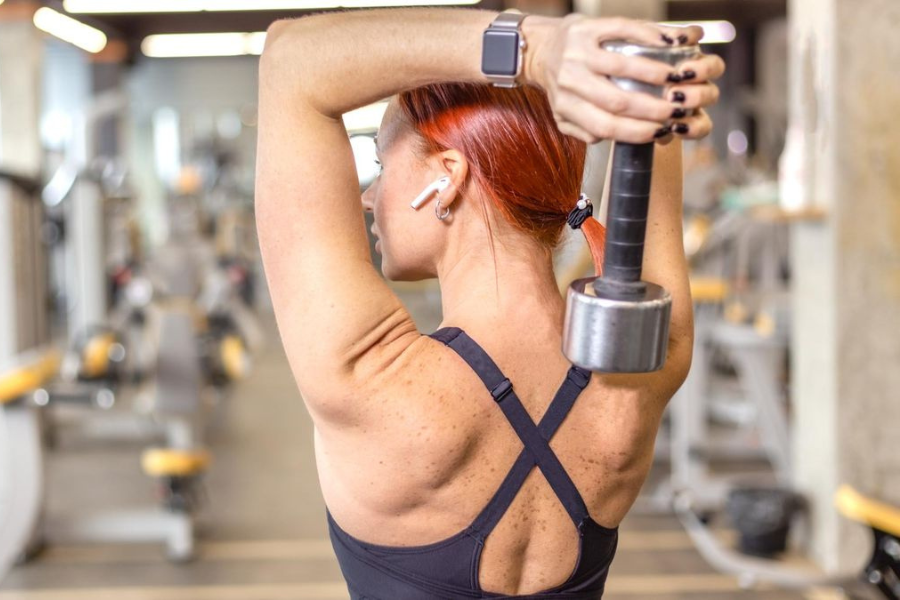
Overhead dumbbell extensions are widely recommended as a go to for the long head because they work it in its fully stretched position.
How to do it
- Sit or stand tall, holding one dumbbell or two lighter dumbbells.
- Press the weight overhead with arms straight.
- Keeping your upper arms close to your head, bend your elbows and lower the weight behind your head.
- Once you feel a strong stretch, extend your elbows to raise the weight back up.
Tips
- Choose a weight that allows you to keep your ribs down and avoid overarching your lower back.
- Keep your elbows pointing forward as much as your mobility allows.
- Aim for 3 to 4 sets of 8 to 12 reps.
Guides from Kettlebell Kings and Generation Iron both highlight overhead work as a key driver of long head growth and shoulder stability, especially when done with control and a full range of motion.
French press (seated or standing)
The French press is another overhead extension, often done with an EZ bar. It is very similar to the overhead dumbbell extension but can feel more stable for some people.
How to do it
- Sit or stand with an EZ bar held overhead, arms straight.
- Keeping your upper arms mostly vertical, bend your elbows and lower the bar behind your head.
- Stop when you reach a comfortable stretch, without shifting the stress to your shoulders or elbows.
- Extend your arms to return to the top, but do not lock out aggressively.
Tips
- Do not swing your upper arms, keep them fixed.
- Control the descent so the weight does not pull your elbows apart.
- Use moderate loads for 3 sets of 10 to 12 reps.
Rope or straight bar tricep pushdowns
Cable pushdowns are not purely a long head move, but they let you dial in tension and add volume safely.
The straight bar attachment is often mentioned as placing more stress on the long head during press downs, while the rope can be more comfortable on your wrists.
How to do it
- Attach a straight bar or rope to a high pulley and stand facing the stack.
- Grip the attachment and start with elbows bent at about 90 degrees, pinned to your sides.
- Push the bar or rope down until your arms are straight and your triceps are fully contracted.
- Slowly let the weight come back up under control.
Tips
- Do not lean your whole body over the cable to move the weight.
- At the bottom, think of pulling your hands slightly back behind your hips for a stronger contraction.
- Try 3 sets of 10 to 15 reps.
Dumbbell triceps kickbacks
Kickbacks shine when you perform them strictly and focus on squeezing the triceps hard at the top. They emphasize full contraction of the long head by bringing your arm back behind your body.
How to do it
- Brace one knee and hand on a bench or hinge at the hips with both feet on the floor.
- Hold a dumbbell with your working arm and bring your upper arm in line with your torso, elbow bent.
- Keeping your upper arm fixed, extend your elbow and “kick” the weight back until your arm is straight and slightly behind your body.
- Pause and squeeze, then lower slowly.
Tips
- Keep the weight moderate so you can avoid swinging.
- Think small, strict movement rather than big, jerky reps.
- Use higher reps, such as 2 to 3 sets of 12 to 15.
Straight arm pulldowns
Straight arm pulldowns work your lats and long head together because your arms move from overhead to your sides and slightly behind your body.
How to do it
- Attach a straight bar to a high pulley. Stand facing the stack with a slight forward lean.
- Grip the bar with straight arms in front of you at about eye or forehead level.
- Keeping your elbows nearly locked, pull the bar down in an arc to your thighs.
- At the bottom, your arms should be by your sides or slightly behind your hips.
- Slowly return to the start.
Tips
- Keep your shoulders away from your ears.
- Use this as a lighter accessory move for 2 to 3 sets of 12 to 15 reps.
Dips and diamond push ups
Bodyweight staples like dips and diamond push ups also train all three heads of the triceps.
- Dips: Keep a slightly more upright torso if you want to lean on your triceps instead of your chest. Adding weight over time makes them very effective for strength and size, even though they do not fully stretch the long head.
- Diamond push ups: Place your hands close together under your chest and keep your elbows near your body. These are a good option if you train at home.
Sets, reps, and weekly structure
For long head tricep exercises, you can think in terms of two main goals: strength and muscle growth.
From the research:
- Heavier work, such as close grip bench press, often falls in the 6 to 10 rep range
- Isolation work, such as kickbacks and many cable moves, tends to sit in the 10 to 15 rep range
A practical guideline:
- Hypertrophy focus
- 3 to 4 sets of 8 to 12 reps for main long head moves like overhead extensions and skull crushers
- 2 to 3 sets of 12 to 15 reps for lighter isolation moves like kickbacks or rope pushdowns
Weekly frequency:
- Train triceps about 2 to 3 times per week
- Include at least two long head focused exercises in each session, for example:
- One stretch focused overhead movement
- One contraction focused or heavier compound movement
Remember that your triceps already work hard during pressing workouts. You may not need a large number of extra sets, especially if you do a lot of benching or overhead pressing.
Sample long head tricep workout
You can plug this into an upper body or push day.
Option A: Gym based
- Close grip bench press
- 3 sets of 6 to 8 reps
- Overhead dumbbell triceps extension
- 3 sets of 8 to 12 reps
- Straight bar cable pushdowns
- 3 sets of 10 to 12 reps
- Dumbbell triceps kickbacks
- 2 sets of 12 to 15 reps
Option B: Minimal equipment or home
- Diamond push ups
- 3 sets close to, but not at, failure
- Bench or chair dips
- 3 sets of 8 to 12 reps
- Overhead triceps extension with a single dumbbell or band
- 3 sets of 10 to 15 reps
Adjust the volume based on how your elbows and shoulders feel and how much pressing you already do.
Technique tips to protect your joints
Long head tricep exercises are very effective, but overhead work and heavy loading can bother your elbows or shoulders if you rush.
Keep these points in mind:
-
Control the eccentric
Lower the weight slowly, especially on skull crushers, French presses, and overhead extensions. This protects your joints and keeps tension on the muscle. -
Limit elbow flare
When your arms are overhead, let your elbows move just enough to stay comfortable, but do not let them splay out excessively. -
Avoid locking out aggressively
At the top of each rep, straighten your arms, pause briefly, then return. Snapping into lockout shifts stress from muscle to joint. -
Use slightly lighter loads for overhead work
Heavier is not always better, especially if you feel strain in your shoulders or elbows.
Guides such as those from Generation Iron emphasize minimizing elbow flare and keeping the stress on the triceps, not the joints, particularly for French presses and overhead extensions.
Common mistakes and how to fix them
You can avoid a lot of frustration by watching for these frequent errors:
-
Skipping the overhead work
If you only do pushdowns and dips, you are not fully taking advantage of the long head’s potential. Add at least one overhead extension in each triceps session. -
Short range of motion
Stopping halfway on extensions or pushdowns cheats the muscle. Aim for a deep stretch and a full squeeze on each rep. -
Using momentum
Swinging the weight or letting your shoulders and torso do the work reduces triceps activation. Slow down and feel the muscle. -
Overtraining
Piling long head tricep exercises on top of heavy pressing without rest can lead to sore elbows and stalled progress. Include rest days and adjust volume if your joints feel beat up. -
Ignoring nutrition and recovery
Research based guides note that even with smart programming, you still need a solid diet and sleep for visible growth.
How long until you see results
If you follow a thoughtful program that includes long head tricep exercises, focus on full range of motion, and eat enough protein and calories, you can usually expect noticeable changes within a couple of months.
Some sources suggest:
- Visible improvements in 6 to 8 weeks with good training and nutrition
- More dramatic changes in 12 weeks or longer if you are consistent and progressive with your loads
If your form is loose, your sessions are irregular, or your diet is lacking, progress can drag out for many months.
Putting it all together
To maximize your gains from long head tricep exercises, structure your training around a few clear principles:
- Pick 1 overhead stretch move and 1 contraction or compound move each session
- Use mostly 8 to 12 reps for growth, plus some heavier sets on big presses
- Train triceps 2 to 3 times per week without neglecting rest
- Focus on control, joint friendly technique, and full range of motion
Start by adding just one dedicated long head exercise to your next upper body workout, such as an overhead dumbbell extension or skull crusher. Pay attention to how your triceps feel and progress your weights gradually. Over time, those small changes add up to thicker arms, stronger presses, and more stable shoulders.
About the Author