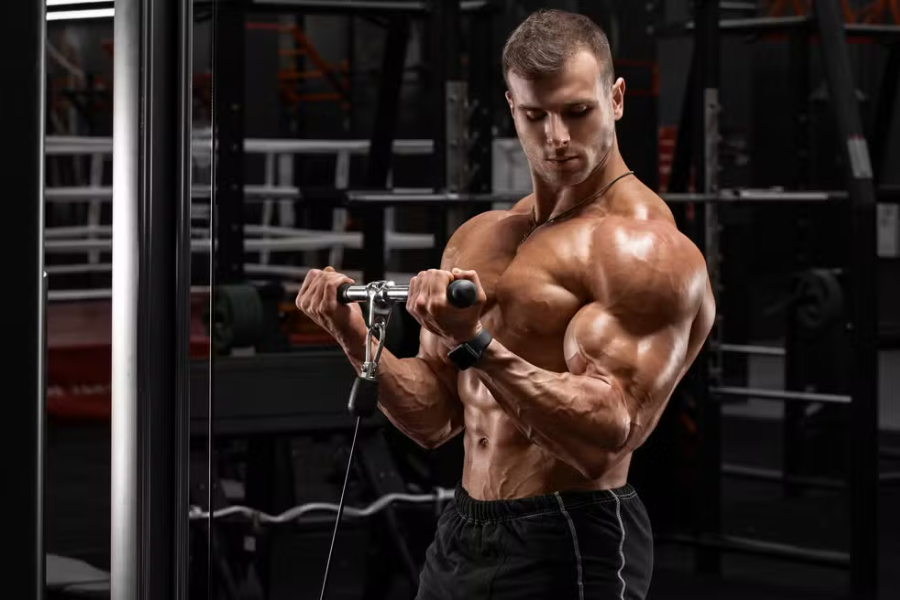
Why cable bicep exercises work so well
If you want toned arms and better definition, cable bicep exercises are a smart place to start. Cables keep steady tension on your biceps through the whole curl, which can help you build muscle more efficiently than with free weights alone.
Cable bicep curls primarily work your biceps brachii, brachialis, and brachioradialis. You also get help from your shoulders, forearms, upper back, and core for stabilization. A 2014 study by the American Council on Exercise ranked the cable curl as the second best exercise for biceps activation, tying with the chin-up and just behind the concentration curl.
Compared with dumbbells, cable machines:
- Maintain more constant tension, especially at the bottom of the curl
- Offer a smoother, more controlled range of motion
- Let you easily change angles, grips, and attachments to hit the muscle differently
You will get the most out of your arm training when you mix cable bicep exercises with classic dumbbell curls, so your biceps are challenged through their full range of motion.
How to set up cable bicep curls
Before you dive into specific variations, it helps to nail the basic setup you will use in most cable bicep exercises.
- Set the pulley to the lowest position for standard curls.
- Attach a straight bar, EZ bar, or rope attachment.
- Stand facing the machine with your feet about hip-width apart.
- Grab the attachment with an underhand grip.
- Step back slightly so there is light tension on the cable even with your arms straight.
- Keep your elbows close to your sides and your shoulders relaxed.
From here, the key rule is simple: only your forearms move. Your upper arms should stay in place so the biceps do the work, not your shoulders or lower back.
Basic cable biceps curl
The standard cable biceps curl is your foundation. It is one of the best starter cable bicep exercises for strength and muscle tone.
Muscles worked
- Primary: biceps brachii
- Secondary: brachialis, brachioradialis, forearms, and stabilizers in your shoulders and core
Step-by-step form
- Stand tall with your core braced and chest up.
- Hold the straight bar with an underhand grip, hands about shoulder-width apart.
- Start with your arms fully extended and the cable slightly pulling forward.
- Keeping your elbows pinned to your sides, curl the bar toward your shoulders.
- Squeeze your biceps hard at the top, then pause for 1 second.
- Slowly lower the bar back to the starting position, keeping control the entire way.
- Stop just before the weight stack touches so you maintain tension.
Sets, reps, and tips
- For toning and muscle growth:
- 3 to 4 sets of 8 to 12 reps at a moderate weight
- Focus cues:
- Think about “pulling” with your biceps, not your wrists
- Do not let your shoulders roll forward or your back arch
- Control the lowering phase, instead of letting the weight drop
A 2021 study in Sports (Basel) suggests that 8 to 12 reps at moderate weight is ideal for hypertrophy, while heavy sets of 1 to 5 reps focus more on strength gains.
Rope hammer curl on cables
Cable rope hammer curls are great if you want thicker arms and stronger forearms. They use a neutral, palms-facing grip that targets slightly different muscles than the standard curl.
Why this move matters
With the rope attachment and hammer grip, you will emphasize:
- Brachialis
- Brachioradialis
- Biceps brachii
These muscles help create that “full” arm look, even when your arms are relaxed by your sides.
How to do cable rope hammer curls
- Attach a rope handle to a low pulley.
- Stand facing the stack and grab the rope with a neutral grip, thumbs pointing up.
- Start with your arms straight and elbows close to your body.
- Curl the rope toward your shoulders, keeping your palms facing each other.
- At the top, separate the rope slightly to increase the squeeze in your biceps and forearms.
- Lower slowly back to the start under control.
Sets and technique tips
- 3 to 4 sets of 10 to 15 reps
- Use a controlled tempo and avoid swinging the weight
- Focus on feeling tension in your forearms and the outer part of your biceps
Hammer curls are useful if your wrists feel uncomfortable in a fully supinated grip or if you want improved grip strength to carry over into other pulls.
Preacher curl on cables
Cable preacher curls lock your upper arms in place, which makes it harder to cheat and easier to lock onto your biceps.
Benefits for beginners
- Your arms are stabilized on the preacher bench
- The cable provides steady tension throughout the range of motion
- You can really feel the biceps shorten and lengthen
Because the bench supports your arms, this is one of the more beginner-friendly cable bicep exercises.
How to perform cable preacher curls
- Set a low pulley in front of a preacher curl bench.
- Attach a straight or EZ bar.
- Sit on the bench and place the back of your upper arms on the pad.
- Grab the bar with an underhand grip, hands shoulder-width apart.
- Start with your elbows slightly bent, not fully locked out.
- Curl the bar upward until your forearms are vertical.
- Squeeze the biceps at the top, then lower slowly until you feel a stretch in your biceps.
Programming and pointers
- 3 sets of 10 to 12 controlled reps
- Keep your chest on the pad to prevent swinging
- Do not bounce at the bottom, pause briefly before curling back up
Preacher curls are especially good at emphasizing the lower portion of the biceps and can help you build that “full” look near the elbow.
Single arm cable bicep curl
If one arm is stronger or more defined than the other, single arm cable curls can help even things out. Training one arm at a time also makes you stabilize more through your core.
Why include unilateral curls
- Correct strength imbalances between left and right arms
- Improve mind-muscle connection on the weaker side
- Engage your core for extra stability
How to do single arm cable curls
- Attach a single D-handle to a low pulley.
- Stand sideways to the machine so the working arm is closest to the pulley.
- Grab the handle with an underhand grip and step back slightly.
- Keep your elbow glued to your side and your wrist straight.
- Curl the handle toward your shoulder without moving your upper arm.
- Pause briefly at the top, then lower under control.
- Complete all reps on one side, then switch arms.
Sets and tips
- 3 sets of 10 to 12 reps per arm
- Focus on smooth and even reps from side to side
- If one arm is weaker, start with that side and match the reps on your stronger side
Unilateral work like this is often recommended for balanced development and can be especially helpful if you notice one bicep taking over in barbell or dumbbell curls.
Overhead (high pulley) cable curl
High cable bicep curls, sometimes called overhead cable curls, train your biceps in their fully shortened position. That creates a strong peak contraction and a noticeable muscle pump.
What this variation targets
- Inner head of the biceps brachii
- Brachialis
- Brachioradialis
Holding your arms out or slightly up to the sides also challenges your shoulders and upper back to stabilize.
Step-by-step overhead cable curl
- Set two pulleys at or slightly above shoulder height on a cable station.
- Attach single handles to each side.
- Stand in the center, grab both handles with an underhand grip, and step forward.
- Raise your arms so your upper arms are roughly parallel with the floor and your elbows slightly behind your shoulders.
- From this position, curl your hands toward your ears or temples.
- Squeeze your biceps hard at the peak, then slowly extend your arms back out.
Programming and form tips
- 2 to 3 sets of 12 to 15 reps
- Use lighter weight and focus on the squeeze at the top
- Keep your shoulders down instead of shrugging toward your ears
Since this move is demanding, it works well toward the end of your workout to finish off your biceps.
Reverse grip cable curl
Reverse grip cable curls shift more emphasis to the brachioradialis, an often overlooked muscle that adds thickness to your forearms and upper arms.
Why reverse curls help your arm shape
With a pronated (palms down) grip, you still hit the biceps, but you:
- Hit the brachioradialis more directly
- Build forearm strength and size
- Support a fuller, more balanced look from elbow to wrist
How to perform reverse cable curls
- Attach a straight bar or EZ bar to a low pulley.
- Grab the bar with an overhand grip, hands shoulder-width apart.
- Stand tall with your elbows close to your sides.
- Curl the bar toward your shoulders, keeping your wrists straight.
- Squeeze at the top, then lower slowly back to the starting position.
Sets and technique
- 2 to 3 sets of 10 to 15 reps
- Do not let your wrists bend backward, keep them neutral
- Use a lighter weight than standard curls, since the grip is more challenging
Reverse curls are a simple way to support wrist health and grip strength, which carry over into many other lifts.
How often to do cable bicep workouts
You can build and tone your biceps with consistent cable work without spending hours at the gym. A simple guideline from current resistance training research is:
- Train biceps 2 times per week for most people
- Use 3 to 5 sets per exercise, depending on your recovery and experience level
- Keep most of your sets in the 8 to 15 rep range for muscle growth and endurance
One 2021 study in Sports (Basel) recommends 1 to 5 heavy reps for strength, 8 to 12 for hypertrophy, and higher reps for endurance, all with 3 to 5 sets per exercise.
If you are a beginner, starting with:
- 2 bicep-focused days per week
- 2 to 3 exercises per session
- About 6 to 9 total sets per workout
is usually enough to see progress as long as you recover well and eat to support your training.
Sample cable bicep routine for toned arms
Here is a simple workout that fits into most upper body or pull days. Adjust the weight so the final 2 reps of each set feel challenging but doable with good form.
Workout A: Cable biceps focus
- Cable biceps curl
- 3 sets of 8 to 12 reps
- Rope hammer curl
- 3 sets of 10 to 12 reps
- Single arm cable curl
- 2 sets of 10 to 12 reps per arm
Workout B: Shape and peak emphasis
- Preacher cable curl
- 3 sets of 10 to 12 reps
- Overhead cable curl
- 2 to 3 sets of 12 to 15 reps
- Reverse grip cable curl
- 2 sets of 12 to 15 reps
Alternate these two workouts during the week or slip one into your normal routine along with your back and shoulder training.
Technique, safety, and common mistakes
Cable bicep exercises can feel smoother than dumbbells, but you still need proper form to protect your joints and get results.
Key technique rules
- Move only at the elbow during curls
- Keep your shoulders relaxed, not rolling forward or rocking backward
- Stand tall with your core slightly braced
- Use a weight you can control for the full rep range
Fitness coaches often recommend lighter weight and higher reps for cable curls, such as 3 to 4 sets of 12 to 15 reps, especially at the end of your workout, to “finish” the biceps once heavier free weight curls are done.
Avoid these common mistakes
- Swinging the weight: If you rely on momentum, you take tension off the biceps and increase injury risk.
- Shrugging your shoulders: This shifts work into your traps and can strain your neck.
- Half reps: Unless you are doing them on purpose, aim for a full stretch and full squeeze most of the time.
- Chasing weight over form: Heavier stacks do not matter if you cannot control the movement.
If any exercise feels uncomfortable in your elbows or shoulders, reduce the weight, slow down the movement, or choose another variation that feels better on your joints.
Putting it all together
Cable bicep exercises give you controlled resistance, consistent tension, and plenty of ways to adjust angles and grips. That makes them ideal if you are just getting started with strength training as well as if you already lift and want better definition.
To recap:
- Use cable curls to keep steady tension on your biceps
- Mix standard curls with hammer, preacher, single arm, overhead, and reverse curls for complete development
- Train in the 8 to 15 rep range most of the time, 2 times per week
- Focus on smooth, controlled motion rather than piling on weight
Pick one or two of the exercises above for your next workout and notice how your biceps feel during the set and the next day. With a bit of consistency, you will start to see and feel the difference in your arm strength and shape.
About the Author