Understand what builds bicep definition
If you want bicep workouts for definition, it helps to know what you are actually shaping. Your biceps are made up of two main heads:
- The long head, which creates that noticeable bicep peak
- The short head, which adds width to your upper arm
According to a 2024 guide from Gymshark, working both heads with different grips and arm positions is essential for well rounded, defined biceps, not just bigger ones. You also have helper muscles like the brachialis and brachioradialis that sit underneath and around the biceps and add to overall arm shape.
In simple terms, you get better definition when you:
- Train both heads of the biceps, not just one
- Use a mix of angles, grips, and rep ranges
- Train consistently, 2 to 3 times per week, while allowing recovery
Plan your bicep definition routine
You do not need a long, complicated program. You do need a simple plan you can repeat and progress.
Weekly training frequency
Guides from Gymshark and RP Strength report that training biceps 2 to 3 times per week is more effective for hypertrophy and definition than just once, leading to greater weekly muscle gains when volume is managed.
Aim for:
- 2 to 3 bicep focused sessions per week
- 1 to 3 exercises per session, depending on your overall program
- A total of 2 to 5 different bicep exercises per week, rotated over time
Sets, reps, and rest
For definition, you want enough volume to grow muscle, but not so much that you wear your arms out and stall progress.
You can use this as a baseline:
- Sets per exercise: 3 to 4
- Total sets per session: Up to about 10 working sets for biceps
- Reps per set: Mostly 8 to 12, with some heavier and some lighter sets for variety
- Rest between sets: About 30 seconds to 2 minutes, depending on how heavy you go
RP Strength suggests using a mix of rep ranges for best results:
- Heavy: 5 to 10 reps
- Moderate: 10 to 20 reps
- Light: 20 to 30 reps
You can keep roughly half of your work in that moderate range, where you feel a strong mind muscle connection without losing your form.
Exercise selection guidelines
When you choose exercises for bicep definition:
- Include at least one long head focused movement
- Include at least one short head focused movement
- Add one compound or “all in one” movement like chin ups or barbell curls if you have the strength and equipment
You will see some of these options in the workouts below.
Try this gym based definition workout
If you have access to a gym or a basic home setup with dumbbells, barbell, and cables, you can use this bicep workout for definition 2 times per week.
Perform this workout after back training if possible, so your pulling muscles are already warmed up.
Exercise 1: EZ bar curl (overall mass and balance)
EZ bar curls are a classic choice for building both size and definition. The semi supinated grip is easier on your wrists and lets you load the bar more effectively. Gymshark notes that a close grip can focus more on the inner bicep and the long head, while a wider grip shifts attention slightly toward the short head.
How to do it:
- Stand tall and grip the EZ bar with palms facing up.
- Keep elbows close to your sides.
- Curl the bar toward your shoulders, squeezing your biceps.
- Lower under control until your arms are nearly straight.
Start with:
- 3 to 4 sets of 8 to 12 reps
- 60 to 90 seconds rest between sets
Exercise 2: Hammer curl (long head and brachialis)
Hammer curls use a neutral grip, palms facing each other. This position targets the long head of the biceps and strongly recruits the brachialis and brachioradialis, which helps fill out your upper arm.
How to do it:
- Hold a dumbbell in each hand at your sides, palms facing inward.
- Keep your elbows fixed by your ribs.
- Curl the weights up without swinging your torso.
- Pause briefly at the top, then lower slowly.
Programming idea:
- 3 sets of 10 to 15 reps
- Focus on smooth, controlled movement and a full stretch
If you have cables, you can perform hammer curls with a rope attachment to maintain steadier tension throughout the range of motion.
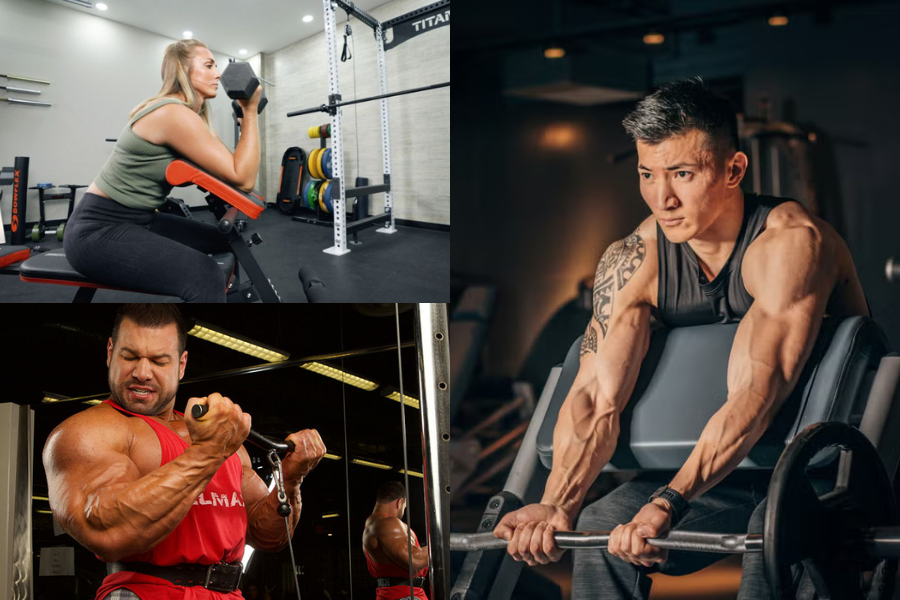
Exercise 3: Preacher curl or concentration curl (peak and isolation)
Preacher curls lock your upper arm into position so your biceps do most of the work, which is ideal when your goal is definition. Research notes that this position helps target the peak of the biceps for a more muscular look.
If you do not have a preacher bench, concentration curls are an excellent substitute and have been rated highly in several studies for isolating the biceps and enhancing mind muscle connection.
How to do preacher curls:
- Sit at the preacher bench and place the back of your upper arm on the pad.
- Hold an EZ bar or dumbbell with your palm facing up.
- Curl the weight toward your shoulder.
- Lower slowly until your arm is nearly straight, feeling a deep stretch.
How to do concentration curls:
- Sit on a bench with your feet wide.
- Rest the back of your upper arm against the inside of your thigh.
- Curl a dumbbell up toward your shoulder.
- Pause and squeeze at the top, then lower with control.
Programming idea:
- 3 sets of 8 to 12 reps on each arm
- Focus on slow negatives, about 2 to 3 seconds down
Exercise 4: High cable bicep curl (short head and shape)
The high cable bicep curl places your arms out in a “T” shape, with the cables pulling from above. Gymshark highlights that this externally rotated position emphasizes the short head of the biceps, similar to a front double biceps pose.
How to do it:
- Set the cables at the highest point on each tower.
- Stand in the center and grab both handles, arms out to the sides at shoulder height.
- Keep your upper arms stable and curl your hands toward your ears.
- Squeeze at peak contraction, then slowly return to the starting position.
Programming idea:
- 3 sets of 10 to 15 reps
- Use moderate weight and focus on constant tension
You can place this exercise at the end of your workout to “polish” the shape of your biceps when they are already fatigued.
Try this focused at home bicep workout
If you do not have access to a gym, you can still follow effective bicep workouts for definition at home. You can use dumbbells, resistance bands, or even household items like a backpack.
Exercise 1: Chin ups or band assisted chin ups
Chin ups are a powerful bodyweight move that train your biceps, upper back, and shoulders at once. They are especially useful when you do not have a full set of weights.
How to do it:
- Grab a bar with an underhand grip, hands about shoulder width apart.
- Start from a dead hang with arms straight.
- Pull your chest toward the bar by driving your elbows down and back.
- Lower with control until your arms are fully extended again.
If full chin ups are not yet possible, loop a resistance band around the bar for assistance or perform negative reps by jumping to the top and lowering as slowly as you can.
Programming idea:
- 3 sets of as many good form reps as you can
- Rest 90 seconds between sets
Exercise 2: Dumbbell or backpack bicep curls
If you have dumbbells, you can perform standard curls. If not, fill a backpack with books or other heavy items and use that as your weight.
How to do it:
- Stand tall and hold a dumbbell or backpack with both hands (or one dumbbell per hand).
- Keep your elbows by your sides.
- Curl the weight up while keeping your wrists straight.
- Lower all the way down to feel a full stretch.
Programming idea:
- 3 to 4 sets of 10 to 15 reps
- Use a controlled tempo, avoid swinging
Exercise 3: Hammer curls or cross body curls
At home, hammer curls are still one of your best tools for long head and brachialis development. You can also turn them into cross body curls, curling the weight toward the opposite shoulder to change the angle slightly.
How to do it:
- Hold a dumbbell in each hand at your sides with palms facing inward.
- Curl one weight toward the opposite shoulder.
- Lower and repeat on the other side.
Programming idea:
- 3 sets of 12 reps per arm
- Keep your torso still and elbows close to your body
Exercise 4: High rep band curls or “21s”
To finish your home bicep workout with a strong pump, you can use resistance bands or try the classic “21s” method mentioned in the research. This involves 21 total reps broken into three segments:
- 7 reps from the bottom to halfway up
- 7 reps from halfway to the top
- 7 full range reps
This structure hits your biceps through different portions of the range of motion and is a simple way to increase tension and fatigue without needing heavy weights.
Programming idea:
- 2 rounds of 21s with about 60 seconds rest between rounds
Use advanced techniques for faster definition
Once you have a solid base and your form is consistent, you can add intensity techniques to get more out of shorter sessions.
Mix angles and strength curves
Different curl variations challenge the biceps hardest at different points in the movement. Research suggests that using this mix can improve full range stimulation:
- Barbell or EZ bar curls: most tension in the middle of the range
- Incline dumbbell curls: more tension in the stretched position at the bottom
- Banded curls: greater tension near the top of the movement
You can rotate these through your week so you spend time training the biceps where they are strongest, weakest, and in between.
Add strategic intensity techniques
You do not need to use all of these at once. Choose one technique for a given session:
- Drop sets: Finish your last set of curls, reduce the weight, and keep going to near failure.
- Antagonist focus: During incline curls, gently squeeze your triceps at the bottom to encourage a full stretch and better activation when you start the next rep.
- Burn sets: Lighten the weight and perform higher reps, around 20 to 30, to increase fatigue and vascularity, which can help your biceps look more defined when body fat levels are lower.
An example:
- Last set of hammer curls, perform 10 solid reps
- Immediately drop to a lighter weight and perform as many as you can with good form
Monitor total volume and recovery
It can be tempting to keep adding more sets, but more volume is not always better. The Power Muscle Burn style workout structure in the research recommends not exceeding about 10 total bicep sets in a single workout to avoid overtraining.
Watch for signs that you might be overdoing it:
- Persistent soreness that does not fade between sessions
- Stagnant or decreasing strength
- Elbow or wrist discomfort
If you notice these, pull back on volume or frequency for a week and focus on quality reps.
Form tips to protect your joints
Good technique is not just about safety. It is also how you make sure your effort goes into the muscle you are trying to train.
Prioritize full range of motion
RP Strength emphasizes that bicep exercises are most effective when you use a full range of motion:
- Lower until your arms are nearly straight to get a deep stretch
- Curl until your biceps are fully contracted without shrugging your shoulders
This is especially important for exercises like incline curls, where the stretch at the bottom can be a strong growth signal.
Keep tension on the muscle
A few small adjustments keep the work where you want it:
- Avoid swinging your body or using your hips to start the movement
- Keep your elbows either fixed at your sides or in the same position throughout the set
- Move with control on both the way up and the way down
You can think of each rep as having three parts: lift, squeeze, and slowly lower.
Support your wrists when needed
Heavier curls, especially with straight bars, can be tough on your wrists. The research notes that wrist wraps can help by improving stability and reducing strain. You may also find that an EZ bar grip feels more natural than a straight bar if you are prone to wrist discomfort.
Put it all together
To turn these ideas into a simple action plan, you can follow this structure for the next 6 to 8 weeks.
Sample two day bicep definition plan
Day A (gym focused)
- EZ bar curls, 4 sets of 8 to 12 reps
- Hammer curls, 3 sets of 10 to 15 reps
- Preacher or concentration curls, 3 sets of 8 to 12 reps
- Optional finisher: High cable curls, 2 to 3 sets of 12 to 15 reps
Day B (home or lighter session)
- Chin ups, 3 sets to near failure
- Dumbbell or backpack curls, 3 sets of 10 to 15 reps
- Cross body hammer curls, 3 sets of 12 reps per arm
- Band curls or 21s, 2 rounds
Space these days at least 48 hours apart. For example, you might train biceps on Monday and Thursday.
Progress gradually
Every week or two, try one of the following:
- Add a small amount of weight to at least one exercise
- Add 1 or 2 reps to one or two sets
- Improve control by slowing your lowering phase
As your form stays tight and your strength climbs, your biceps will respond with more shape and definition, especially when paired with sensible nutrition and overall strength training.
You can start with just one of the workouts today, pay close attention to how your biceps feel during each set, and adjust weights so you finish each set feeling challenged but not sloppy. Over a few consistent weeks, those small, focused sessions will start to show up as visible changes in your arms.
About the Author