Understand why your glutes matter
If you are looking for the best glute exercises, you are really looking for more than just a stronger butt. Your glute muscles are the largest muscle group in your body, and when you train them well you support almost every movement you do in a day.
According to guides from Healthline and Planet Fitness, your glutes help you with:
- Lifting and carrying heavy objects
- Walking, running, and climbing stairs
- Standing up from a chair and staying upright when you sit for long periods
- Stabilizing your hips, knees, and lower back for better posture and fewer injuries
The gluteal muscles are actually three muscles working together:
- Gluteus maximus: the largest muscle that gives your butt its shape and drives hip extension, for example when you stand up or push off to run.
- Gluteus medius: runs along the side of your hip and controls hip abduction and stability, which keeps your pelvis level when you walk or balance on one leg.
- Gluteus minimus: sits underneath the other two and helps with hip rotation and pelvic stability.
Stronger glutes can help you:
- Improve posture and alignment
- Boost athletic performance in running, jumping, and lifting
- Reduce the risk of knee, hip, and lower back injuries
- Move more efficiently in everyday life
You do not need a gym membership or heavy weights to get these benefits. Recent guides from Healthline, Gymshark, Peloton, and Planet Fitness all highlight effective bodyweight glute exercises you can do at home with little or no equipment.
Plan your glute training
Before you jump into the 10 best glute exercises, it helps to have a simple plan. You will see better results if you train with intention instead of just picking random moves.
Set realistic expectations
If you are a beginner, you can see noticeable changes in your glute strength and shape in about six weeks of consistent training two times per week, according to both Healthline and Gymshark. That might show up as:
- Walking upstairs more easily
- Feeling more stable on one leg
- Less lower back fatigue when you sit or stand for long periods
Glute growth and strength gains take time, so think in terms of months, not days. Your goal is steady, repeatable progress.
Follow basic training guidelines
Beginner-friendly guidelines from Planet Fitness and Gymshark line up around a few simple rules:
- Frequency: 2 to 3 glute focused sessions per week
- Rest: at least 1 full day of rest between hard glute days
- Sets and reps: start with 2 to 3 sets of 8 to 15 reps per exercise
- Tempo: move with control, especially on the way down
- Progressive overload: increase difficulty over time with more reps, slower tempo, longer holds, or shorter rest
You do not have to add weight right away. Gymshark stresses that you can create progressive overload with just bodyweight by adjusting reps, tempo, and rest, and still get muscle and strength gains at home.
Always warm up first
A short warm up will help you get more out of the best glute exercises and reduce your injury risk.
Most guides recommend:
- 5 to 10 minutes of light cardio
- Power walking
- Easy jogging
- Cycling at low resistance
- Glute activation drills to wake up the muscles before heavier work. Peloton instructors and physical therapists recommend moves such as:
- Hip thrusts
- Step ups
- Banded lateral walks
- Fire hydrants
A good warm up should feel light to moderate, not exhausting. You want your glutes ready to fire, not fried before you begin.
Use progressive overload for results
To turn the best glute exercises into real progress, you need some form of progressive overload. That simply means you ask your muscles to do a bit more over time.
According to Gymshark, you can progress bodyweight glute work by:
- Adding reps, for example going from 10 to 15
- Slowing the tempo, for example 3 seconds down and 1 second up
- Adding isometric holds, for example pausing at the top of a hip thrust
- Reducing rest between sets
- Moving from two-legged to single-leg variations
You can pick one variable at a time and change it once a week or once every other week. That is enough to keep you adapting.
A simple pattern you can follow:
- Week 1 to 2: Learn the movements and focus on form.
- Week 3 to 4: Add reps or slow down the tempo.
- Week 5 to 6: Introduce holds or single-leg versions for some exercises.
Keep a quick note on your phone or in a notebook so you see your progress clearly.
The 10 best glute exercises
These 10 exercises target all three glute muscles and cover both two leg and single leg patterns. You can mix them into full body sessions or build a dedicated lower body day around them.
For each move, you will see:
- Primary muscles worked
- Why it is among the best glute exercises
- How to do it
- Beginner sets and reps
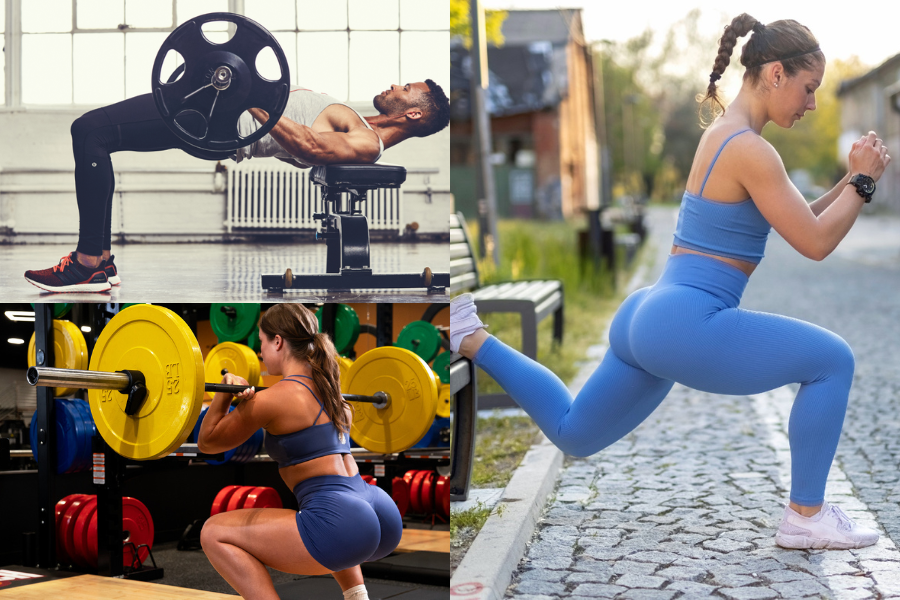
1. Hip thrust
Targets: Gluteus maximus, gluteus medius, gluteus minimus, hamstrings, core
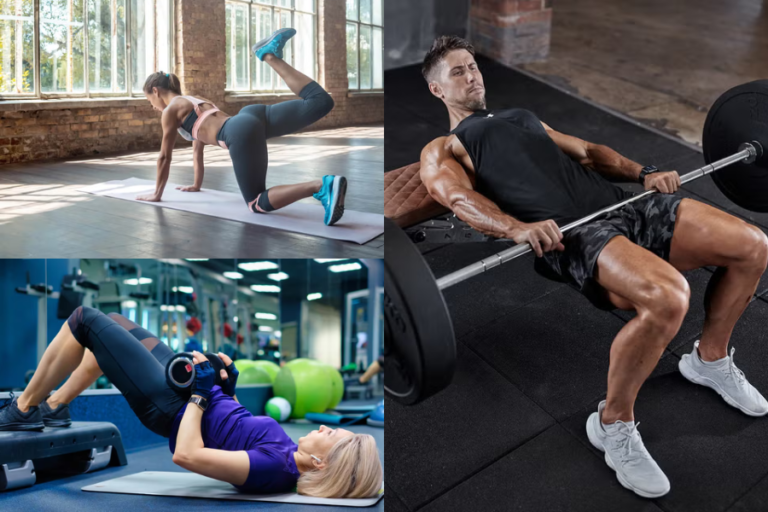
Hip thrusts are often called one of the best lower body strength moves for glute recruitment. Peloton instructors and physical therapists recommend them as a key glute activation and strength exercise, because they drive your hips through a full extension, which is the main job of the gluteus maximus.
How to do it
- Sit on the floor with your upper back resting against a sturdy bench, couch, or step. Bend your knees so your feet are flat on the floor, hip width apart.
- Brace your core and press through your heels.
- Squeeze your glutes to lift your hips until your body forms a straight line from shoulders to knees.
- Pause for 1 to 2 seconds at the top, keeping your ribs down and chin tucked slightly.
- Lower your hips back down with control.
Starter plan: 2 to 3 sets of 10 to 15 reps with a 1 to 2 second hold at the top.
When this feels easy, you can elevate your feet or progress to a single leg hip thrust for more challenge.
2. Glute bridge
Targets: Entire gluteal region, hamstrings, lower back, abs
Supine bridges are a staple for glute engagement. Cleveland Clinic notes that bridges effectively train your glutes along with your core and lower back, and you can increase difficulty by holding a small weight on your belly as you get stronger.
Glute bridges are also one of the beginner friendly moves featured in Planet Fitness and Healthline guides.
How to do it
- Lie on your back with your knees bent and feet flat on the floor, hip width apart.
- Place your arms by your sides with palms down.
- Brace your core, then press through your heels and squeeze your glutes to lift your hips off the floor.
- Stop when your body forms a straight line from shoulders to knees. Do not over arch your lower back.
- Hold for 1 to 2 seconds, then lower slowly until your glutes lightly touch the floor. Repeat.
Starter plan: 2 to 3 sets of 12 to 15 reps.
To progress, you can:
- Add a pause at the top for 3 to 5 seconds
- Move to a single leg glute bridge
- Place your feet on a wall, as in a wall single leg glute bridge, to increase tension on the gluteus maximus
3. Squat
Targets: Gluteus maximus, hamstrings, quadriceps, core
Squats show up in nearly every list of best glute exercises. Healthline calls squats a gold standard for glute training and recommends performing them slowly and with controlled form to really load the glutes.
Gymshark also features air squats as one of its key bodyweight glute moves.
How to do it
- Stand with your feet about shoulder width apart and toes slightly turned out.
- Brace your core and keep your chest tall.
- Push your hips back as if you are sitting into a chair, then bend your knees to lower down.
- Keep your knees tracking over your toes, not collapsing inward.
- Stop when your thighs are at least parallel to the floor, or as low as your mobility allows without pain.
- Press through your heels and mid foot to stand back up, squeezing your glutes at the top.
Starter plan: 2 to 3 sets of 10 to 15 controlled reps.
Focus on a 3 second lower, brief pause at the bottom, then stand up with intent. Slow, clean reps will load your glutes more than fast, shallow ones.
4. Split squat
Targets: Gluteus maximus, gluteus medius, quadriceps, hamstrings, core
Split squats and their cousins, Bulgarian split squats, are powerful unilateral moves. They feature heavily in Gymshark and Planet Fitness beginner routines as a way to build single leg strength, stability, and balance.
How to do it
- Stand tall and take a long step forward so you are in a staggered stance, feet about hip width apart.
- Keep your torso upright and your core braced.
- Bend both knees to lower your body straight down. Your front knee should track over your toes, and your back knee should move toward the floor.
- Stop just before your back knee touches the floor or when you feel a strong but comfortable stretch.
- Press through the heel of your front foot to rise back to the starting position.
Starter plan: 2 sets of 8 to 12 reps per leg.
If you feel wobbly, hold a wall or chair for support. As you get stronger, you can elevate the back foot on a step or bench for a Bulgarian split squat, which increases the challenge on the front leg glutes.
5. Lunge
Targets: Gluteus maximus, gluteus medius, quadriceps, hamstrings, calves
Forward and reverse lunges are among the 12 best beginner glute exercises in the Planet Fitness guide. They demand strength, stability, and control in each leg and engage the gluteus medius and minimus to keep your hips steady.
How to do a reverse lunge
Reverse lunges are often easier on your knees than forward lunges, so they are a good starting point.
- Stand tall with your feet hip width apart.
- Take a step back with your right foot, landing on the ball of your foot.
- Bend both knees until your back knee moves toward the floor and your front thigh is about parallel to the ground.
- Keep your chest lifted, core engaged, and front knee tracking over your toes.
- Press through the heel of your front foot to drive back up and return to standing.
- Repeat on the other side.
Starter plan: 2 to 3 sets of 8 to 10 reps per leg.
Once you are comfortable, you can mix in:
- Forward lunges
- Walking lunges
- Curtsy lunges, which specifically challenge the gluteus medius and minimus with a crossover motion
6. Curtsy lunge
Targets: Gluteus medius, gluteus minimus, gluteus maximus, inner thighs
The curtsy lunge is highlighted in several guides as a top move for targeting the gluteus medius and minimus. The crossover motion puts unique demand on your hip abductors and lateral stabilizers, which makes it a key exercise for rounded glute development and hip control.
How to do it
- Stand with your feet hip width apart.
- Step your right leg back and diagonally behind your left leg, as if you are doing a small curtsy.
- Bend both knees to lower your body. Your front knee should track in line with your toes, and your weight should stay centered over your front heel.
- You should feel the work in the side of your front hip and glutes.
- Press through your front foot to return to standing.
- Repeat on the other side.
Starter plan: 2 sets of 8 to 10 reps per leg.
Move slowly and keep your step reasonably small at first. You can deepen the crossover as your balance and hip stability improve.
7. Step up
Targets: Gluteus maximus, gluteus medius, gluteus minimus, hamstrings, quads, calves
Peloton experts note that step ups are one of the best glute activation and strength movements because they light up all three glute muscles plus the hamstrings and quads. They translate directly to real life tasks like climbing stairs or hiking.
How to do it
- Stand facing a sturdy bench, box, or step that is roughly knee height or lower when you are starting out.
- Place your right foot firmly on the step.
- Lean slightly forward at the hips, brace your core, and press through your right heel to lift your body up onto the step.
- Bring your left foot up to meet your right foot at the top.
- Step back down with control, leading with the left foot.
- Complete all reps on one side, then switch legs.
Starter plan: 2 to 3 sets of 8 to 10 reps per leg.
If a full step feels too high, start with a lower surface. Focus on pushing through the working leg instead of bouncing off your back foot.
8. Fire hydrant
Targets: Gluteus medius, gluteus minimus, hip rotators, core
Fire hydrants show up in several expert lists as a high intensity glute medius and minimus exercise. Peloton and Cleveland Clinic note that they strengthen hip movement and increase range of motion, but you need to control fatigue and maintain proper form to protect your lower back and hips.
How to do it
- Start on all fours with your hands under your shoulders and knees under your hips.
- Brace your core and keep your back flat.
- Keeping your knee bent at 90 degrees, lift your right leg out to the side until your thigh is roughly parallel to the floor.
- Do not twist your hips or rotate your torso. The movement should come from the hip joint.
- Pause at the top, then lower your knee back to the starting position with control.
Starter plan: 2 sets of 10 to 15 reps per leg.
If you feel your lower back doing the work, reduce your range of motion and focus on bracing your core harder. Later, you can add a light resistance band above your knees to increase difficulty.
9. Banded lateral walk
Targets: Gluteus medius, gluteus minimus, gluteus maximus, hips
Banded lateral walks are a favorite for targeting the side glutes. Research cited in Peloton’s glute activation guide notes that placing the band around your ankles or feet increases activation of the gluteus medius, maximus, and minimus during side stepping.
If you have ever felt your hips wobble when you run or squat, this move helps strengthen the muscles that control that motion.
How to do it
- Place a small loop resistance band around your ankles or just above your feet. If that is too hard at first, start with the band above your knees.
- Stand with your feet hip width apart and slightly bend your knees into an athletic stance.
- Keeping constant tension on the band, step your right foot to the side.
- Follow with your left foot, returning to hip width stance without letting the band go slack.
- Take 8 to 10 steps in one direction, then reverse.
Starter plan: 2 rounds of 8 to 10 steps each direction.
Keep your steps small and controlled so your hips do the work instead of your lower back. You can use this as part of your warm up before heavier glute exercises.
10. Single leg Romanian deadlift (RDL)
Targets: Gluteus maximus, gluteus medius, hamstrings, core
Single leg RDLs are highlighted by Gymshark and Peloton as a top bodyweight glute exercise. They are especially effective at emphasizing the gluteus medius and minimus, since these muscles must work hard to stabilize your pelvis on one leg.
How to do it
- Stand tall with your feet hip width apart. Shift your weight onto your right leg and slightly soften the knee.
- Hinge at your hips, sending your left leg straight back as your torso leans forward.
- Keep your back flat and your hips square to the floor.
- Reach your hands toward the floor or your shin. You should feel a strong stretch in your right hamstring and glutes.
- Press through your right foot and squeeze your glutes to return to standing.
- Stay balanced and move slowly.
Starter plan: 2 sets of 8 to 10 reps per leg.
If balance is tough, tap your back foot on the floor behind you for light support or hold onto a wall with one hand. Over time, you can add weight in the opposite hand of the working leg for more challenge.
Put the exercises into a sample workout
You do not need to use all 10 best glute exercises every time. You will get more from 5 or 6 focused moves done well than from trying to cram in everything.
Here is a simple two day structure you can rotate through each week.
Day A: Strength and stability
- Warm up
- 5 to 10 minutes of power walking or light jogging
- 1 set of 10 glute bridges
- 1 set of 10 banded lateral walks each direction
-
Main work
-
Hip thrust: 3 sets of 10 to 12 reps
-
Squat: 3 sets of 10 to 12 reps
-
Step up: 2 sets of 8 to 10 reps per leg
-
Fire hydrant: 2 sets of 12 to 15 reps per leg
-
Cool down
- Gentle stretching for hips and hamstrings
- Light walk for 3 to 5 minutes
Day B: Single leg and lateral focus
- Warm up
- 5 to 10 minutes of light cardio
- 1 set of 10 glute bridges
- 1 set of 8 curtsy lunges per side
-
Main work
-
Split squat: 3 sets of 8 to 10 reps per leg
-
Single leg RDL: 2 to 3 sets of 8 to 10 reps per leg
-
Curtsy lunge: 2 sets of 8 to 10 reps per leg
-
Banded lateral walk: 2 rounds of 10 steps each direction
-
Cool down
- Hip flexor stretch
- Glute stretch such as figure four pose
You can do:
- Day A on Monday
- Day B on Thursday
This schedule gives you at least one rest day between sessions, which matches Planet Fitness recommendations to prevent overtraining and support recovery.
Progress safely and avoid common mistakes
The best glute exercises only help you if you perform them consistently and with solid form. A few key points will keep you on track.
Focus on form over load
Early on, your main goals are:
- Smooth, controlled movements
- No sharp pain in your knees, hips, or lower back
- Stable alignment, especially in single leg exercises
Mistakes to watch out for:
- Knees collapsing inward during squats and lunges
- Over arching your lower back during bridges and hip thrusts
- Rushing through reps, which often shifts work away from the glutes
Use a mirror or record a short video from the side and front. You will spot small form issues that you can correct on your next set.
Train all three glute muscles
It is easy to only train the gluteus maximus with heavy hip extension moves. For balanced glute development and better hip stability, you need to work the gluteus medius and minimus too.
You cover all three when you include:
- Hip extension moves like hip thrusts, bridges, and RDLs
- Lateral and rotational moves like fire hydrants, banded lateral walks, and curtsy lunges
- Single leg patterns like split squats and step ups
This mix mirrors what experts from Gymshark, Planet Fitness, and Peloton recommend for well rounded glute training.
Allow enough recovery
Your glutes are large muscles and they need time to recover and grow stronger. Planet Fitness suggests 2 to 3 glute sessions per week with at least one day of rest between.
To support recovery, you can:
- Sleep 7 to 9 hours per night when possible
- Include low intensity walking or light cycling on off days
- Add gentle stretching or mobility work for your hips and hamstrings
- Eat enough protein and overall calories to fuel muscle repair
If your soreness is so intense that you cannot move through your regular range of motion, give yourself an extra rest day before your next hard glute session.
Turn glute training into a lasting habit
You do not have to overhaul your entire fitness routine to benefit from the best glute exercises. Instead, you can fold them into what you already do.
Here are a few simple ways to make the work stick:
-
Attach glute work to existing habits
-
After a run or ride, add 2 moves such as hip thrusts and banded lateral walks.
-
On days when you already train upper body, finish with 10 minutes of glutes.
-
Start smaller than you think you need
-
Begin with 2 sessions per week of 20 to 25 minutes.
-
Once that feels routine, add a third day or a bit more volume.
-
Track one or two key metrics
-
Total weekly sets for glutes
-
Reps or tempo for a focus move like hip thrusts or squats
-
Review progress every 4 to 6 weeks
-
Are you lifting more cleanly or with better control
-
Do stairs feel easier
-
Is your posture more relaxed when you stand or sit
Your glutes power your everyday life as much as your workouts. When you treat glute training as a regular investment instead of a quick fix, you will feel the difference in every step, lift, and stride.
About the Author