Understand what makes a “best” bicep exercise
If you are searching for the best bicep exercises, you probably want more than a quick pump. You want real size, strength, and definition that shows when you roll up your sleeves.
Your biceps are not just one simple muscle. To build impressive arms, you need exercises that target:
- The long head of the biceps (adds peak)
- The short head of the biceps (adds thickness from the front)
- The brachialis (sits under the biceps and pushes it up)
- The brachioradialis (a key forearm muscle that completes the look)
Guides from Gymshark and Bodybuilding.com point out that the best bicep workouts for mass include a mix of movements that hit all of these areas, not just basic curls. You will see those ideas woven through the exercises below.
Before you add everything at once, think of this list as a menu. You will build your bicep workouts from it, rotating exercises over time so you keep progressing.
Warm up your biceps the smart way
A quick warm up prepares your elbows and shoulders, increases blood flow, and helps your mind focus on good form before you move heavy weight.
Simple bicep warm up sequence
You can run through this 5 to 8 minute routine before your main workout:
-
Banded chin ups or assisted chin ups
Light resistance only. Focus on smooth pulls and full extension to wake up your back and biceps. -
Rotational dumbbell curls
Use very light dumbbells. Start with palms facing your thighs, then rotate to palms up as you curl. This gently moves your wrists and elbows through a full range. -
Inverted plank hold
Sit on the floor with hands behind you, fingers pointing away. Lift your hips and hold. You will feel the front of your arms and shoulders engage. -
Straight arm behind the back stretch
Stand tall, clasp your hands behind you, and gently lift them away from your body to stretch your biceps and shoulders.
Aim for about 10 controlled reps per warm up exercise, plus 15 to 30 seconds for the plank and stretch. You should feel warm, never exhausted.
Train your biceps often enough to grow
Frequency matters just as much as finding the best bicep exercises. Research summarized by Gymshark notes that training your biceps two to three times per week produces about 3.1% more hypertrophy, week by week, than just once a week, as long as you recover properly.
A simple approach is to:
- Work biceps directly 2 times per week
- Include them indirectly with pulling exercises such as rows and chin ups
- Allow at least 48 hours between hard bicep sessions
Daily bicep sessions are not recommended. Your muscles grow when you rest, not while you are curling.
Use barbell curls as your mass builder
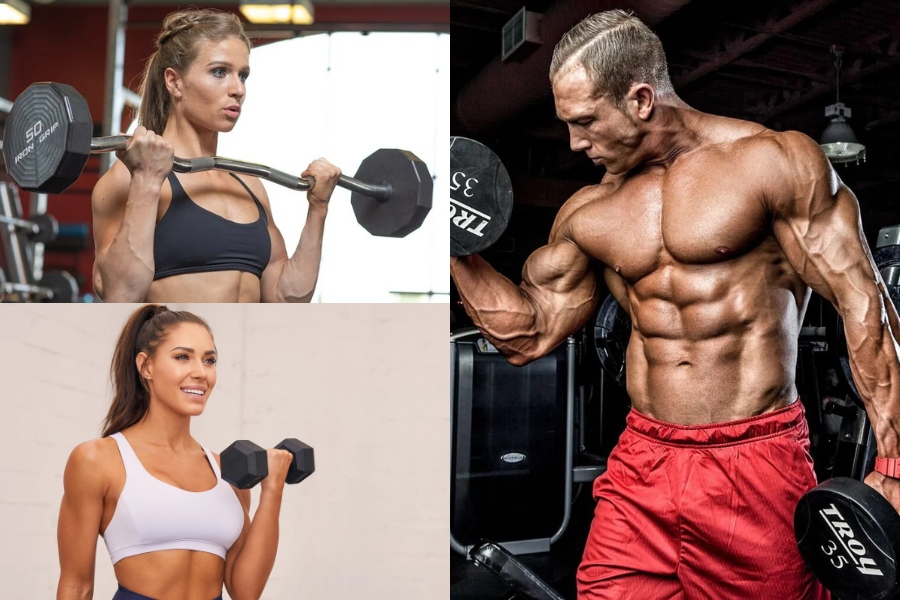
If you only picked one movement, the classic barbell or EZ bar curl is often recommended as the single best bicep exercise for mass. Guides on Bodybuilding.com highlight this lift because it:
- Loads your biceps heavily
- Works both the long and short heads
- Allows grip variations to shift emphasis slightly
- Engages the brachialis and brachioradialis as supporting muscles
How to do standing barbell curls
- Stand tall with feet shoulder width apart.
- Hold a barbell with an underhand grip, hands just outside hip width.
- Keep your elbows close to your sides and your chest up.
- Curl the bar toward your shoulders in a smooth arc.
- Squeeze your biceps at the top without letting your shoulders roll forward.
- Lower the bar under control until your arms are straight again.
Keep the movement strict. If you find yourself swinging your hips or throwing your shoulders back, the weight is too heavy.
When and how to use barbell curls
- Place them early in your bicep workout.
- Use heavier sets in the 5 to 8 rep range, or a 5 x 5 structure as suggested by Bodybuilding.com, to build strength and size.
- Rest 90 to 120 seconds between sets.
You can use a straight bar or an EZ bar. An EZ bar with a semi supinated grip typically feels easier on your wrists and still strongly activates your biceps and forearms.
Add EZ bar curls to protect your wrists
EZ bar curls are a great option if straight bar curls bother your wrists. The angled grip lets you hold the bar in a more natural position, which can reduce joint strain while still hitting your biceps hard.
Why EZ bar curls belong in your routine
According to strength guides, EZ bar curls:
- Use a semi supinated grip that many lifters find more comfortable
- Activate the biceps, brachialis, and brachioradialis slightly more than a standard straight bar curl for some people
- Offer narrow and wide grips to emphasize different biceps heads
In general:
- A closer grip tends to emphasize the long head
- A wider grip can shift more tension to the short head
You can cycle grip widths week by week to keep your arms progressing.
Include dumbbell curls for balance and control
Dumbbell curls give each arm its own weight, which:
- Helps fix strength and size imbalances
- Allows a more natural arm path
- Lets you slightly rotate your wrists to find a comfortable groove
Bodybuilding.com highlights dumbbell curls as especially valuable because of their versatility and the ability to emphasize the eccentric phase, or the lowering part of each rep, for more muscle growth potential.
Seated dumbbell curls for strict form
If you tend to cheat on standing curls, try the seated version:
- Sit on a bench with your back supported, feet flat.
- Hold a dumbbell in each hand with arms hanging straight down.
- Keep your upper arms still as you curl the weights up.
- Pause at the top, then lower the dumbbells slowly.
This setup makes it harder to use momentum, so your biceps work harder.
Make the negative count
When your biceps are getting tired, focus on a slow eccentric:
- Count “one” on the way up
- Count “three” or “four” on the way down
This controlled lowering can produce higher forces than the lifting part, which may translate into greater hypertrophy over time.
Use hammer curls to hit brachialis and forearms
Hammer curls rank among the best bicep exercises for overall arm thickness because they do more than build the visible biceps. They strongly recruit:
- The brachialis under your biceps
- The brachioradialis in your forearms
Guides from Gymshark note that hammer curls primarily emphasize the long head of the biceps and the surrounding muscles, which helps create balanced strength and appearance.
How to do hammer curls
- Stand tall holding dumbbells at your sides, palms facing your thighs.
- Keep your elbows by your sides and your chest lifted.
- Curl the weights up while keeping your palms facing each other.
- Pause at the top, then lower slowly.
Avoid swinging the weights or letting your elbows drift forward. Control is more important than load here.
Cable rope hammer curls
You can also perform hammer curls with a rope attachment on a low cable:
- The cable provides continuous tension
- The rope encourages a natural neutral grip
- You can add short isometric holds at the top to increase fatigue
Bodybuilding.com suggests using these mid or late in the workout for 8 to 12 reps per set.
Add concentration curls for peak and mind muscle connection
Concentration curls are a classic bodybuilding move that truly earns their reputation. Multiple sources highlight them as one of the most effective short head targeting bicep exercises, largely because you can focus intensely on the muscle as it works.
How to do concentration curls
- Sit on a bench with your knees apart.
- Hold a dumbbell in one hand and rest that elbow on the inner thigh of the same leg.
- Let the dumbbell hang straight down with your palm facing inward.
- Curl the weight toward your shoulder, rotating your palm up as you lift.
- Squeeze the biceps hard at the top, then lower slowly.
Keep your torso stable and avoid shrugging your shoulder. Your bicep should do nearly all the work.
Because this is a strict isolation movement, you will usually use lighter weight and slightly higher reps. Gymshark suggests placing concentration curls later in the workout after heavier compound lifts such as barbell curls or chin ups.
Use preacher and single arm curls to fix imbalances
Preacher curls and their single arm variations are excellent if you struggle with technique or have one arm that looks or feels weaker.
Why preacher curls help
- Your upper arms are supported on a pad, which limits cheating.
- The setup lengthens your biceps at the bottom of the movement, providing a strong stretch.
- You can focus on smooth, full range reps.
Single arm preacher curls also let you:
- Address left to right strength differences
- Focus your mind on one bicep at a time
- Maintain strict form, since it is harder to swing
When you do these, use a weight that lets you control both the bottom stretch and the top squeeze. Fast, bouncing reps defeat the purpose.
Use chin ups to train back and biceps together
You might not think of chin ups when you list the best bicep exercises, but you should. With an underhand grip, chin ups strongly engage your biceps along with your back.
Bodybuilding.com notes that chin ups activate the biceps significantly more than standard pull ups, making them a powerful choice when you want to hit both back and arms at once.
How to make chin ups work for you
- Use a shoulder width, underhand (palms facing you) grip.
- Start from a dead hang with straight arms.
- Pull your chest toward the bar, not your chin.
- Lower yourself under control until your arms are straight again.
If full bodyweight chin ups are hard:
- Use an assisted machine or resistance band
- Try negative only reps by jumping or stepping to the top and lowering slowly
If bodyweight is easy:
- Add weight with a belt or a dumbbell between your feet
- Do 3 to 4 sets of 8 to 12 controlled reps as a back and bicep staple
Try cables for constant tension
Cable curls are a strong addition when you want to keep your biceps under tension through the entire range of motion. Unlike free weights, there is no easy “rest” at the top or bottom.
Bodybuilding.com recommends using cable curls heavy for 6 to 10 reps near the start of your workout or lighter for 8 to 12 reps near the end.
Low double hand cable curl
A popular variation described in 2024 guidance is the low double hand cable curl:
- Set the cable pulley at the lowest position.
- Grab the handle with both hands.
- Stand facing the machine with a slight lean back.
- Curl the handle toward your chest or to about a 45 degree angle from your body.
- Squeeze your biceps fully before lowering with control.
Cables are especially helpful if you struggle to feel your biceps working with dumbbells, since the resistance is smooth and consistent.
Sample beginner bicep workout plan
If you are newer to strength training, you do not need every exercise at once. Start with a simple structure you can follow for 4 to 6 weeks.
Beginner routine (2 days per week)
Perform this workout twice a week, with at least one rest day between sessions:
- Standing barbell or EZ bar curls
- 3 sets of 10 to 12 reps
- Around 70 to 85 percent of the heaviest weight you can handle for one rep
- Rest 60 to 90 seconds
- Hammer curls
- 3 sets of 10 to 12 reps
- Control the movement, no swinging
- Seated dumbbell curls
- 3 sets of 10 to 12 reps
- Focus on form and full range of motion
Stick with these for 4 to 6 weeks. Each week, try to:
- Add a small amount of weight, or
- Add 1 or 2 reps per set, while keeping your form solid
After this phase, you can rotate in concentration curls, preacher curls, and cable curls to keep your progress moving.
Listen to your elbows and shoulders
Hard training is good. Ignoring pain is not. Pay attention to how your joints feel during and after your bicep sessions.
Signs you may need to back off
- Sharp pain at the front of your shoulder or near your elbow
- A sudden “pop” followed by weakness
- A large, unusual bump near the elbow when you flex
Guidance from rehabilitation sources notes that if you see a pronounced bulge near your elbow during a light curl, it might indicate a more serious biceps tear that needs professional evaluation and physical therapy.
For mild irritation, lighter therapeutic work can help, such as:
- Light eccentric shoulder flexion with a 3 to 5 pound weight, focusing on slowly lowering your straight arm from in front of you to your side
- Wall biceps stretch by placing your arm in an L shape against a doorway or corner and gently rotating your body away
- Gentle bicep curls with very light weights through a pain free range
Common rehab advice is to perform about 3 sets of 10 of these lighter exercises once per day, allowing only mild discomfort and stopping if pain becomes sharp.
If you are unsure, always err on the side of caution and consult a medical or physical therapy professional.
Putting it all together
You do not have to chase every new curl variation you see online. To get real results from the best bicep exercises, focus on a core set of movements and train them consistently:
- Use barbell or EZ bar curls as your heavy foundation.
- Add dumbbell curls and hammer curls to balance your arms and hit the brachialis and forearms.
- Use concentration curls and preacher curls to isolate the biceps and fix imbalances.
- Include chin ups and cable curls to combine compound strength with constant tension.
- Train your biceps two to three times per week, not every day, and give them time to recover.
Start by picking three or four of these exercises that fit your current level. Stick with them for a month, track your reps and weights, and adjust gradually. With steady effort and smart exercise choices, your sleeves will start to feel tighter before you know it.
About the Author