Why a strong back matters for women
A consistent back workout for women does much more than sculpt definition. Strong lats, traps, and spinal muscles help you lift heavy loads, support your posture, and build muscular endurance, especially if you spend hours sitting each day, according to certified trainer Colleen Conlon, CPT, as reported by Women’s Health in 2026.
Targeting the muscles that support your spine can also ease discomfort from large breasts, repetitive lifting, prolonged sitting, or even protective hairstyles that pull on your neck and upper back, notes athletic trainer Vanessa Abrams in the same Women’s Health report.
The good news: you can build a stronger, more resilient back right at home with a few square feet of floor space and minimal equipment.
Understand your back muscles
You do not need an anatomy degree, but a quick mental map helps you choose smart exercises.
Key muscle groups you are training
- Trapezius (traps)
Runs from your neck across your upper back. Helps you shrug, stabilize your shoulders, and hold your posture. - Rhomboids and rear deltoids
Sit between and behind your shoulder blades. Help pull your shoulders back instead of rounding forward. - Latissimus dorsi (lats)
Large muscles along the sides of your back. Important for pulling movements and creating that “V” shape. - Erector spinae
Long muscles that run along your spine. Support spinal alignment and protect your lower back. - Core teammates
Your back works with your abs and glutes to stabilize your spine. A strong core is key for a healthy back as you age and can lower your risk of falls and lower back pain.
When you choose a back workout for women, aim to hit all of these areas over the course of the week, not just one trouble spot.
Benefits of at‑home back workouts
Everyday benefits you will feel
Regular back training at home can help you:
- Reduce back pain and injury risk
A weak back is one of the most common causes of pain and injury. Strengthening those muscles supports your spine so daily tasks feel easier and safer. - Improve posture at your desk
Sedentary work is tough on your back. A 2019 study found that 75% of call center employees who sit most of the day experience chronic or acute back pain. Strong back muscles help counteract the forward slump and ease tension. - Boost performance in other workouts
Back strength improves your pull exercises, deadlifts, and even your squats because your spine is better supported. - Support better breathing and stress control
Back exercises can improve how the muscles around your ribs and spine function, which in turn supports better breathing. More efficient breathing is linked to lower stress, better emotion control, and sharper focus. - Enhance long‑term spine health
Women are more prone to spine-related issues like lower back pain and spinal osteoarthritis, especially after menopause. Training your back now is a long‑term investment in mobility and comfort.
How to structure your home back workout
Your back muscles tend to fatigue faster than some other muscle groups, so a mix of reps and sets matters.
Basic training guidelines
Use these simple rules when you build a back workout for women at home:
- Frequency: 2 to 3 back-focused sessions per week, with at least one day of rest between.
- Order of exercises: Start with multi-joint “compound” moves like rows or deadlifts, then move to smaller isolation exercises like reverse flies. This way your bigger back muscles work hard before your arms get tired.
- Reps and sets:
- To build strength and tone, aim for 8 to 12 reps for most exercises.
- Perform 2 to 3 sets of each move, resting 45 to 90 seconds between sets.
- Intensity: Choose a weight or variation that brings you close to muscular fatigue by the last few reps. You should feel challenged but still able to keep good form.
- Progressive overload: Over time, increase weight, repetitions, or sets slowly to keep improving. Avoid jumping to very heavy loads too quickly to reduce injury risk.
Safety and form tips
Proper technique protects your spine and makes every rep count:
- Keep your back in a neutral, straight line, not rounded, during lifts, planks, and push‑up style moves.
- Avoid swinging weights. Move with control.
- If you feel sharp pain, stop the exercise and reassess your form or scale back the difficulty.
- If you already have back issues, consider getting guidance from a chiropractor or physical therapist before starting new exercises to avoid injury, as many experts recommend.
Warm up before you train
A few minutes of movement prepares your muscles and joints so your back workout feels smoother and safer.
Simple pre‑workout warm‑up
Spend 5 to 7 minutes on:
- Arm circles: 10 to 15 circles forward and backward.
- Dynamic band pull‑aparts: If you have a band, gently pull it across your chest to wake up your upper back.
- Cat‑cow stretches: On hands and knees, alternate arching and rounding your spine.
- Thoracic spine rotations: Kneel on all fours and rotate one arm toward the ceiling, then under your body.
Skip long static stretches at the very beginning, since static holds are not recommended before lifting. Save those for your cooldown when your muscles are warm.
Best back workout for women at home (15‑minute plan)
If you want a quick and effective back workout for women that fits into a busy day, you can follow a 15‑minute circuit recommended by Women’s Health.
Here is how to structure it:
- Choose five back exercises from the list below.
- Perform 8 to 10 reps of each exercise.
- Use free weights of 10 pounds or less or your bodyweight.
- Move from one exercise to the next with minimal rest.
- Rest 60 to 90 seconds after the circuit and repeat 1 to 3 times, depending on your fitness level.
Exercise menu: minimal‑equipment and bodyweight moves
You can mix and match from these options based on what you have at home.
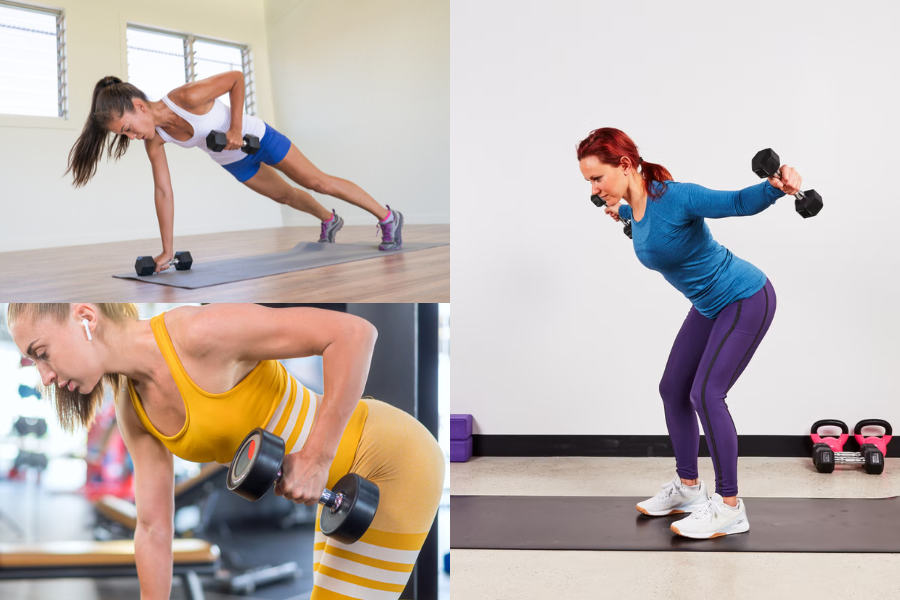
1. Bent‑over dumbbell row
Targets: Lats, rhomboids, mid‑back, biceps, core
How to do it:
- Hold a pair of dumbbells at your sides.
- Hinge at your hips with a slight knee bend, keep your back flat and chest open.
- Let the weights hang straight down under your shoulders.
- Pull the weights toward your lower ribs, squeezing your shoulder blades together.
- Lower back down with control.
Tips:
Think of leading with your elbows, not your hands. Do not round your spine.
2. Single‑arm bent‑over row
Targets: Lats, rhomboids, upper and mid‑back
How to do it:
- Place one hand and knee on a sturdy chair, bench, or couch.
- Hold a dumbbell in your free hand, arm straight down.
- Pull the weight up toward your hip, keeping your elbow close to your body.
- Squeeze your shoulder blade at the top.
- Lower with control and repeat, then switch sides.
Tip: Imagine tucking your shoulder blade into your back pocket as you pull.
3. Reverse fly
Targets: Rear deltoids, upper back, posture muscles
How to do it:
- Stand with feet hip‑width apart, holding light dumbbells.
- Hinge forward at your hips with a flat back.
- With a slight bend in your elbows, raise your arms out to the sides until they are in line with your shoulders.
- Pause for a second, then lower slowly.
Tip: Avoid shrugging your shoulders toward your ears. Focus on the muscles between your shoulder blades.
4. Renegade row
Targets: Lats, mid‑back, core, shoulders
How to do it:
- Start in a high plank with a dumbbell under each hand.
- Keep your body in a straight line from head to heels.
- Row one dumbbell up toward your ribcage while balancing on the other hand and your toes.
- Lower and switch sides.
Make it easier: Perform from your knees or remove the weights and just focus on the pulling motion.
5. Superman hold
Targets: Lower back, glutes, hamstrings, abs
The superman is a beginner‑friendly, equipment‑free move that you can do anywhere.
- Lie face down on a mat with arms extended in front of you.
- Engage your core and squeeze your glutes.
- Lift your arms, chest, and legs a few inches off the floor.
- Hold for 2 to 5 seconds, then lower slowly.
Tip: Think long through your fingertips and toes rather than yanking your chest high.
6. Reverse snow angel
Targets: Upper back, rear shoulders, mid‑back
How to do it:
- Lie face down with arms at your sides, palms facing the floor.
- Lift your chest slightly off the ground.
- Sweep your arms outward and overhead as if you were making a snow angel, then return to your sides.
Keep your neck long and gaze down so you do not strain your neck.
7. Plank with shoulder tap
Targets: Core, shoulders, upper back stability
How to do it:
- Start in a high plank.
- Keeping your hips as still as possible, tap your right hand to your left shoulder.
- Place it back down, then tap left hand to right shoulder.
- Alternate taps for 10 to 20 total reps.
This move trains your back and core to resist rotation, which is key for everyday stability.
No‑equipment back workout for beginners
If you do not have weights or bands yet, you can still train your back effectively.
Sample bodyweight routine
Perform this circuit 2 to 3 times per week:
- Superman hold
3 sets of 10 to 12 reps or 20 to 30 second holds - Reverse snow angels
3 sets of 10 to 12 reps - Plank
2 to 3 sets of 20 to 40 seconds - Quadruped “bird dog”
- On hands and knees, extend opposite arm and leg, pause, then switch sides
- 3 sets of 8 to 10 reps per side
Rest 30 to 60 seconds between sets. Focus on slow, controlled movement and steady breathing.
Back workout with basic equipment
If you have dumbbells, a kettlebell, or resistance bands, you can build a more varied back workout for women without leaving home.
Beginner friendly routine (2 to 3 times per week)
- Lat pull‑down alternative with band
2 sets of 8 to 10 reps
Attach a resistance band overhead and pull it down toward your chest, mimicking a gym lat pull‑down. - One‑arm dumbbell row
2 sets of 8 to 10 reps per side - Seated band row
2 sets of 8 to 10 reps
Sit with legs extended, wrap a band around your feet, and pull toward your waist. - Plank
2 sets of 30 seconds
Rest 60 to 90 seconds between sets.
Intermediate routine for strength and tone
Once you feel comfortable, increase volume and complexity:
- Band pullover or cable pullover alternative
3 sets of 10 to 12 reps - High row with band or machine substitute
3 sets of 10 to 12 reps - Bent‑over row (dumbbell or kettlebell)
3 sets of 10 to 12 reps - Assisted pull‑ups with a band or sturdy bar
3 sets of as many quality reps as you can manage - Reverse fly
3 sets of 10 to 12 reps - Plank or side plank
2 to 3 sets of 30 to 45 seconds
Rest 45 to 60 seconds between sets to keep intensity up while maintaining form.
Combine back and biceps for efficiency
Many back exercises naturally engage your biceps because both are involved in “pull” movements. Combining back and biceps in the same session is an efficient way to train:
- Start with your back compound lifts like rows or pull‑ups.
- Add 1 or 2 short biceps isolation moves at the end, such as curls, if you choose.
- You may find you need less direct biceps work than you expect because your back training already challenges them.
This approach saves time and helps you avoid overtraining smaller muscles.
Stretch and cool down after your workout
Finishing your back workout with a short cooldown helps reduce stiffness and supports recovery.
Simple post‑workout stretching
Spend 5 to 10 minutes on:
- Child’s pose for your lower back.
- Kneeling hip flexor stretch to ease tension that can pull on your lumbar spine.
- Hamstring stretch since tight hamstrings often contribute to back discomfort.
- Chest opener against a doorway to balance all your pulling work.
Full‑body stretching that pays special attention to your hips and hamstrings can reduce your risk of back pain. Just remember that static stretching is best at the end of your workout, not at the beginning.
Common mistakes to avoid
As you build your at‑home back routine, watch out for these habits:
- Overdoing crunches without balancing your back
Crunches can tighten your hip flexors, which pull your lower spine forward and may trigger back pain, according to research discussed by Spine and Wellness Centers of America in 2026. Balance ab work with back extensions, glute bridges, and hip stretches. - Lifting weights that are too heavy too soon
This often leads to rounded backs and strained muscles. Build up gradually and prioritize form. - Holding your breath
Exhale as you exert effort, inhale as you return to the starting position. - Skipping warm‑ups and cooldowns
Going from your desk straight into heavy pulling can shock tight muscles. A few minutes of prep goes a long way.
How to keep seeing progress
Back transformation can feel slow, especially since many women naturally store more body fat in the upper back and around the bra line. That does not mean your training is not working.
To keep moving forward:
- Track what you lift and aim to increase weight, reps, or sets slowly over time.
- Mix up your exercises so you train all major back muscles, not just the ones you can see in the mirror.
- Pair strength training with general movement, such as walking and light cardio, to support overall health.
Even small, consistent sessions at home can make a noticeable difference in how you stand, move, and feel. Start with one or two of the exercises above today, build them into your weekly routine, and let your stronger back support everything else you do.
About the Author