Understand what makes an advanced bicep workout
If you already lift regularly and want to build bigger, stronger arms, an advanced bicep workout does more than just add extra curls. It targets all parts of your biceps and supporting muscles, and it challenges every function of the joint.
For truly advanced bicep training, you need to hit:
- Both heads of the biceps brachii
- Long head, contributes more to the outer “peak”
- Short head, fills out the inner portion of the arm
- The brachialis, sits under the biceps and helps push them up visually
- The brachioradialis, runs down into your forearm and adds thickness
You also want to train all three key biceps functions:
- Elbow flexion, bending your arm
- Supination, turning your palm from facing in or down to facing up
- Some shoulder flexion, lifting your arm slightly in front of you while the elbow bends
An effective advanced bicep workout weaves these elements together. You vary grip, angle, and resistance so the biceps work hard at every point in the range of motion, and you mix in intensity techniques that go beyond simple straight sets.
Key principles for advanced bicep training
Before you jump into a heavy routine, it helps to know how to structure your training so you get more growth, not just more fatigue.
Train often enough, but not daily
Research indicates that training your biceps 2 to 3 times per week leads to greater muscle hypertrophy, around 3.1% more progress week over week, compared to once a week sessions as of February 2024. At the same time, training biceps every day is discouraged because they are relatively small muscles that need recovery to grow.
A good starting point:
- Frequency: 2 to 3 biceps-focused sessions per week
- Weekly exercise variety: 2 to 5 different biceps movements across the week
- Exercises per session: 1 to 3 carefully chosen exercises
This lets you hit the muscle often while keeping volume and fatigue under control.
Choose smart rep ranges
For advanced hypertrophy training, aim to spread your sets across heavy, moderate, and light rep ranges rather than sticking to just one style.
A useful breakdown:
- About 50% of working sets in the moderate range, 10 to 20 reps
- The rest split evenly between:
- Heavy, 5 to 10 reps
- Light, 20 to 30 reps
This mix lets you build strength, practice good form, and create plenty of stimulus for growth without burning out your joints.
Use full range of motion
Full range of motion is especially important in an advanced bicep workout. You want:
- A deep stretch at the bottom of the curl, arms close to straight
- A strong squeeze near the top without letting the elbows drift forward too far
Working in a shortened range, or bouncing through the middle, leaves size and strength on the table and can increase injury risk over time.
Add variety without getting random
Your biceps respond best when you challenge them from different angles and grips. That means rotating through categories of curls over several training blocks, rather than doing the same standing dumbbell curl every session.
Useful categories include:
- Standard supinated curls (palms up)
- Hammer curls (neutral grip)
- Preacher or supported curls
- Cable curls
- Chin ups and other compound pulls
According to a science-based guide by Dr. Mike Israetel and RP Strength in 2024, selecting up to five categories and rotating through them over multiple mesocycles is an effective strategy for complete biceps development.
Common mistakes that stall advanced bicep gains
As you push harder, it is easy to slip into habits that limit progress or increase injury risk. A few pitfalls are especially common in advanced bicep workouts.
Cheating too early in the set
Using a bit of body English, or “cheat reps,” can be an effective advanced technique. You use momentum to help lift a heavier weight, then focus on a very slow, controlled negative to create more muscle damage.
The problem is when you start cheating on the first few reps. Swinging your arms, leaning back, or driving with your hips too soon shifts tension off the biceps and onto your shoulders and lower back. You end up lifting heavy but not stressing the muscle you are trying to grow.
Reserve cheating for the last 1 to 3 reps after you reach strict form failure.
Overtraining a small muscle group
Your biceps are not as large as your lats or quads, so giving them the same number of hard sets can backfire. Overtraining can stop progress or even reverse gains.
Watch for:
- Persistent soreness that does not improve between sessions
- Declining strength or pump over several workouts
- Elbow or shoulder discomfort that builds up over time
If any of this sounds familiar, pull back the volume, but keep the intensity of your working sets high.
Rushing the contraction and negative
Many lifters chase heavy weights or only count reps, which leads to:
- Fast, momentum driven curls
- Little to no squeeze at the top
- Dropping the weight rather than controlling it down
This skips the hardest, most productive part of the exercise. Emphasizing the contraction and the lowering phase increases muscle activation and growth stimulus.
A simple fix: use a 1 to 2 second lift, 1 second squeeze at the top, and 2 to 3 second lowering phase on most of your working sets.
Relying on a single curl variation
Even if you are strict with your form, doing only standing barbell curls or only dumbbell curls every session does not fully tax the different fibers in your biceps.
Adding variety with:
- Different grip widths on bars
- Incline and preacher positions
- Hammer and cross body movements
- Cables and bodyweight pulls like chin ups
helps you overload the muscle in multiple ways and avoid plateaus.
Key exercises for an advanced bicep workout
To build mass and strength, you want a mix of compound movements, isolation curls, and some higher intensity techniques. Below are the core exercises you can plug into your routine and rotate over time.
Weighted chin ups and variations
Chin ups are one of the best advanced compound exercises for biceps. Using a supinated grip, palms facing you, lets you load both the long and short heads depending on grip width.
You can scale chin ups by:
- Adding weight with a belt or backpack
- Using resistance bands or an assisted chin up machine
- Performing negative only reps if you cannot yet do full bodyweight reps
Combining weighted chin ups with “peak contraction” chin ups, where you hold and squeeze at the top, is an effective way to overload all three biceps functions while also building grip strength.
Cheat curl into barbell drag curl
For a heavy, long head focused movement, pair:
- Cheat Curl, use a slight body swing to move a challenging weight up
- Barbell Drag Curl, immediately after, keep elbows close to your body and drag the bar up along your torso
This mechanical drop set emphasizes:
- Eccentric overload from the heavy cheat curls
- Long head activation with a supinated grip
- A hard squeeze in the shortened range using drag curls
Keep your core tight to avoid excessive leaning and protect your lower back.
Dumbbell biceps curl trifecta
This advanced sequence hits all major players in one extended set:
- Supinated cross body curl
- Target: long head
- Curl across your body toward the opposite shoulder with your palm up
- Pronated cross body curl
- Target: brachialis
- Start with your palm facing down or slightly in, curl across the body
- No money curl
- Target: short head and external shoulder rotation
- Elbows pinned to your sides, forearms rotated outward like you are showing empty hands
Alternate through these three variations for a total of 24 reps, for example 8 reps of each. You will feel a deep burn across the biceps and upper forearm.
Concentration curls for short head focus
Concentration curls consistently rank among the best short head bicep exercises, particularly for isolation and mind muscle connection as of February 2024. Studies show they are highly effective for biceps activation and are ideal when your goal is hypertrophy.
How to use them:
- Place your elbow on the inside of your thigh, slightly in front of your knee
- Let the arm hang and fully straighten at the bottom
- Curl the weight up without swinging, focusing on squeezing the inner biceps
- Perform 3 sets of 8 to 12 reps after your heavier compound lifts
Because you are seated and supported, it is easier to avoid cheating and really hone in on the muscle.
Hammer curls for long head and forearms
Hammer curls use a neutral grip, palms facing each other. This variation:
- Targets the long head of the biceps
- Heavily recruits the brachialis and brachioradialis
- Builds thickness from your biceps down into your forearms
You can adjust emphasis by how you hold the dumbbell:
- Hand closer to the top of the dumbbell, slightly more biceps
- Hand closer to the bottom of the dumbbell, more forearm and lower biceps near the elbow
A simple template is 3 sets of 8 to 12 reps, either both arms together or alternating.
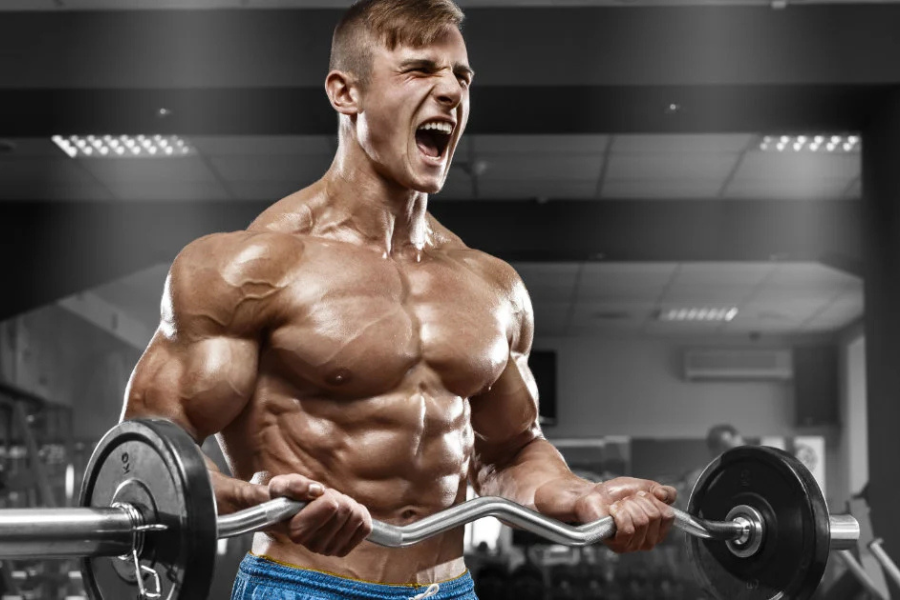
EZ bar curls with grip width changes
EZ bar curls let you take a semi supinated grip that is friendly on the wrists but still lights up the biceps, brachialis, and brachioradialis. Grip width makes a difference:
- Narrow grip, emphasizes the outer portion, often associated with the long head
- Wide grip, emphasizes the inner portion, often associated with the short head
You can even superset narrow and wide grips in the same workout to intensify the pump and hit the muscle from two angles.
Keep your elbows slightly in front of your hips, brace your core and glutes for stability, and control the negative.
Preacher and cable variations for isolation
Isolating the biceps by limiting momentum is especially useful once you are already strong on standard curls.
Two advanced options are:
-
Single arm preacher curls
-
Sit sideways on the preacher bench
-
Rest the working arm fully on the pad
-
Curl without letting your shoulder roll forward
This setup reduces body movement and increases biceps engagement. -
Lying cable curls
-
Lie on your back or stomach with the cable set low
-
Brace your upper arms against the floor or bench
-
Curl without letting your elbows drift
This removes the ability to swing and increases contraction intensity.
Both options work well later in your workout when you want to finish the biceps with strict, controlled reps.
Sample advanced bicep workout for mass
Below is a template you can use 1 to 2 times per week. Adjust sets and reps based on your recovery and experience level.
Day A: Heavy and moderate focus
- Weighted chin ups
- 3 to 4 sets of 5 to 8 reps
- Supinated grip, shoulder width
- Add weight if you can complete all sets with good form
- Cheat curl into barbell drag curl (mechanical drop set)
- 3 rounds
- Cheat curls: 6 to 8 heavy reps
- Immediately followed by drag curls: 8 to 10 strict reps
- Rest 2 to 3 minutes between rounds
- Hammer curls
- 3 sets of 8 to 12 reps
- Neutral grip, keep elbows close to your sides
- Concentration curls
- 2 to 3 sets of 10 to 15 reps
- Light to moderate weight with a strong squeeze
Day B: Volume and isolation focus
- Chin ups (bodyweight or assisted)
- 3 sets close to technical failure
- Use a mix of grip widths over time to vary emphasis
- Dumbbell biceps curl trifecta
- 3 rounds of 24 total reps
- 8 reps supinated cross body
- 8 reps pronated cross body
- 8 reps no money curl
- Rest 60 to 90 seconds between rounds
- EZ bar curls, narrow to wide grip superset
- 3 supersets
- Narrow grip: 8 to 10 reps
- Immediately widen grip: 8 to 10 reps
- Rest 2 minutes between supersets
- Single arm preacher curls or lying cable curls
- 2 to 3 sets of 12 to 20 reps
- Focus on constant tension and a full stretch
You can alternate these two sessions across the week, for example:
- Monday: Day A
- Thursday: Day B
This gives you two advanced bicep workouts per week with different emphasis, while hitting the muscle multiple times and from different angles.
Advanced techniques to increase intensity
Once you are comfortable with the exercises, you can layer in advanced training methods to get more from the same session length.
Drop sets and down sets
- Drop sets: Perform a set to near failure, reduce the weight by 20 to 30 percent, then continue immediately without resting.
- Down sets: After heavy work, perform one or two lighter sets with higher reps to get extra volume at lower joint stress.
These work particularly well with:
- EZ bar curls
- Hammer curls
- Cable curls
because they are easy to adjust quickly.
Giant sets and myoreps
- Giant sets: String several exercises together, often 3 or more, for a high total rep count and an intense pump.
- Myoreps: Do one hard set close to failure, then several mini sets of a few reps with very short rests.
For biceps, you might combine:
- Chin ups
- EZ bar curls
- Hammer curls
- Concentration curls
into a single giant set, or use myoreps on a cable curl at the end of your workout when you are already warm.
Occlusion and blood flow restriction
Using blood flow restriction bands tied above the biceps limits venous return while keeping arterial blood flow. This causes blood to pool in the muscle, intensifying the pump and burn, and can promote muscle growth and strength gains when used correctly.
Keep in mind:
- Use very light loads, often 20 to 30 percent of your max
- Limit occlusion sets to short periods
- Release the bands between exercises or extended series
Because blood flow restriction is an advanced technique, it is best used sparingly and with proper guidance, especially if you have any medical concerns.
Technique tips to get more from every rep
Even in an advanced bicep workout, small details in form can make a big difference in results.
Brace your core and avoid leaning back
Keeping your core tight during heavy dumbbell or barbell curls helps you:
- Maintain power through your midsection
- Avoid excessive backward lean
- Keep stress where you want it, on the biceps, not the lower back
If you notice your body shifting or your lower back arching as the set goes on, reduce the weight or end the set.
Keep tension in your grip and wrists
Rather than treating your hands as passive hooks, actively squeeze the dumbbell or bar:
- At the top of the curl, slightly turn your wrist inward toward your body
- Maintain that squeeze during the lowering phase
This increases activation throughout the biceps, especially in the bottom half of the movement.
Do not mix hammer and supinated curls mid rep
A common mistake is twisting the dumbbell halfway up, starting with a neutral grip and turning the palm up too early. This skips the hardest part of the movement and reduces biceps activation.
Instead:
- Perform pure hammer curls with a neutral grip for the full rep
- Or perform pure supinated curls, turning the wrist at the top only if you want a stronger short head contraction
Separating the variations makes each one more effective.
How to progress your advanced bicep workout
To keep growing, you need a clear way to track progress and gradually increase demands.
Try focusing on one of these at a time:
- More reps at the same weight within your target range
- Slightly heavier weights with the same reps and form
- Shorter rest periods while maintaining performance
- More total weekly sets, added slowly over several weeks
Plan to rotate major exercises or change grip angles every 6 to 8 weeks. This keeps your training fresh and ensures you eventually challenge all fibers of the biceps, brachialis, and brachioradialis.
Start by picking one or two of the advanced techniques from this guide and applying them to your current routine. Once those feel natural, layer in a new exercise or method. Over time, your advanced bicep workout will not just be harder, it will be smarter, and your progress will reflect that.
About the Author