Why focus on a dumbbell tricep workout at home
If you want stronger, more defined arms without a gym membership, a simple dumbbell tricep workout is one of the most efficient ways to get there. Your triceps sit on the back of your upper arm and make up a large share of your overall arm size. They are responsible for straightening your elbow and helping stabilize your shoulder during pressing and overhead movements, as highlighted in a June 2024 feature from Men’s Health UK.
By training your triceps with dumbbells at home, you can:
- Build noticeable arm definition
- Support everyday pushing and lifting tasks
- Improve joint stability in your elbows and shoulders
- Boost performance in push ups, bench presses, and overhead lifts
You only need a pair of dumbbells, a bit of floor space, and 20 to 25 minutes a couple of times per week to complete this dumbbell tricep workout.
Understand your triceps in simple terms
Before you start lifting, it helps to know what you are actually working.
The three heads of the triceps
Your triceps brachii has three parts, or “heads,” that work together to extend your elbow and help with shoulder stability:
- Long head
Runs from your shoulder down the back of your arm and plays a big role in overall arm size. - Lateral head
Sits on the outside of your arm and often creates that “horseshoe” shape when flexed. - Medial head
Lies deeper under the other two and helps with control and stability.
These three heads work in opposition to your biceps when you bend and straighten your arm, as explained in Men’s Health UK’s June 2024 triceps article.
Why dumbbells work so well
Dumbbells are especially effective for tricep training because they:
- Allow a large range of motion
- Force stabilizing muscles to work harder
- Make it easy to train one arm at a time to correct imbalances
- Are portable, so you can work out practically anywhere
These benefits were underlined in a 2024 dumbbell tricep workout guide by Men’s Health UK.
How to set up for this at home workout
You can complete this dumbbell tricep workout in a living room, bedroom, or home office.
What you need
- 1 pair of light to moderate dumbbells
- A sturdy bench, box, or chair for support
- A mat or soft surface for floor moves
- Water and a towel
If you have more than one pair of dumbbells, choose a lighter set for isolation exercises like kickbacks and a slightly heavier set for pressing movements.
Warm up your upper body
Take 3 to 5 minutes to prepare your joints and muscles. You can try:
- 20 to 30 seconds of arm circles in each direction
- 10 shoulder rolls forward and backward
- 10 to 15 gentle wall push ups
- 10 bodyweight squats to increase blood flow
You should feel warm but not tired before you start your first tricep set.
Your simple dumbbell tricep workout plan
This at home routine strings together several dumbbell tricep exercises so you hit the muscles from different angles. You can complete it two or three times per week, ideally after bigger moves like push ups or bench presses, which is similar to how Peloton experts recommend structuring upper body workouts.
Workout structure
- Exercises: 5 key dumbbell tricep moves
- Sets: 2 to 3 sets per exercise
- Reps: 10 to 12 reps per set
- Rest: 45 to 60 seconds between sets
If you are new to strength training, start with 2 sets. If you already work out regularly, aim for 3.
Exercise 1: Dumbbell tricep kickback
Tricep kickbacks are a classic dumbbell tricep workout move that really zeroes in on the back of your arms. They primarily target the long head of the triceps and also hit the lateral and medial heads.
How to do dumbbell tricep kickbacks
You can perform this movement one arm at a time with a bench for support.
- Place your left hand and left knee on a bench or sturdy chair. Keep your right foot on the floor.
- Hold a dumbbell in your right hand with your palm facing in toward your body.
- Hinge forward at your hips, keep your back flat, and tuck your chin slightly so your neck lines up with your spine.
- Bend your right elbow to about 90 degrees with your upper arm close to your side. This is your starting position.
- Keeping your upper arm stationary, straighten your elbow and “kick” the dumbbell straight back until your arm is fully extended behind you.
- Squeeze your triceps at the top, then slowly bend your elbow and return to the starting position with control.
- Complete your reps on one side, then switch arms.
Form tips for maximum tricep activation
- Keep your elbow glued to your torso instead of letting it drift up or out.
- Focus on smooth, controlled motion in both directions.
- Use lighter weights so you can maintain form, especially as your triceps fatigue.
Tricep kickbacks are unique because they let your triceps reach full contraction with the arm extended behind your body, which promotes maximum shortening of the muscle fibers according to tricep training experts referenced in Men’s Health UK.
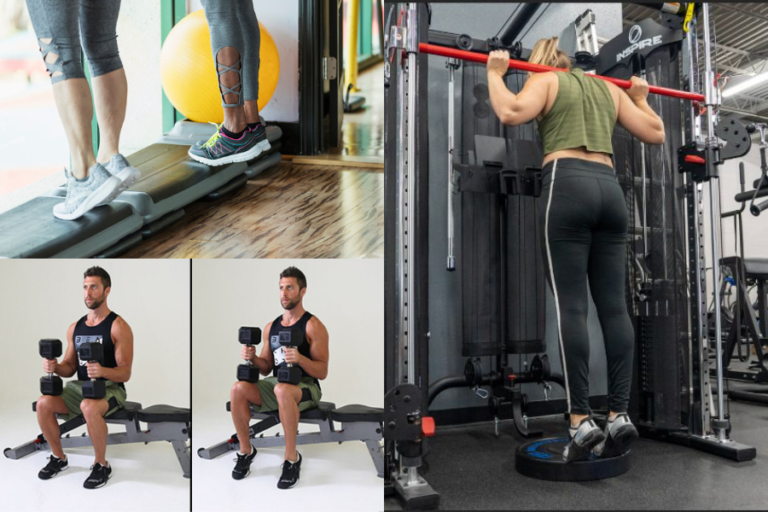
Exercise 2: Seated overhead tricep extension
The seated overhead tricep extension targets the long head of the triceps by placing your arms overhead and creating a deep stretch.
How to do seated overhead extensions
You can perform this exercise seated on a chair or bench.
- Sit tall with your feet flat on the floor and your core lightly braced.
- Hold one dumbbell with both hands by the inner plate or handle, and press it overhead.
- Keep your upper arms close to your ears, elbows pointing forward.
- Slowly bend your elbows and lower the dumbbell behind your head, keeping your upper arms as still as possible.
- Once you feel a comfortable stretch in your triceps, press the weight back up by straightening your elbows.
- Stop just before your arms are fully locked out to maintain tension, then repeat.
Form tips
- Keep your ribs down and avoid arching your lower back.
- Move only at the elbows, not through your shoulders.
- Use a controlled tempo, particularly when lowering the weight.
Because your arms are overhead, this move can place your triceps under a strong stretch and support muscle growth when paired with proper form and gradual weight increases.
Exercise 3: Close grip dumbbell floor press
The close grip dumbbell floor press is a strong dumbbell alternative to barbell close grip pressing. It focuses on your triceps while limiting stress on the shoulders.
How to do close grip floor presses
- Lie on your back on the floor with your knees bent and feet flat.
- Hold a dumbbell in each hand and press them up so they are directly over your chest.
- Bring the dumbbells close together so they are almost touching with your palms facing each other.
- Tuck your elbows in close to your sides.
- Slowly lower the dumbbells until your upper arms lightly touch the floor.
- Press the weights back up, focusing on pushing through your triceps.
- Repeat for your target reps.
Form tips
- Keep your elbows tucked, not flared, to increase tricep activation.
- Avoid bouncing your arms off the floor. Think of the floor as a gentle “brake.”
- Keep your wrists stacked over your elbows during the press.
As noted in dumbbell tricep guides from Men’s Health UK, close grip pressing can build triceps strength with less shoulder joint stress compared to some barbell variations.
Exercise 4: Alternate arm row into kickback
This combo move trains both your back and your triceps, which can save time in your at home routine.
How to do the row into kickback
- Stand with feet hip width apart and hold a dumbbell in each hand.
- Hinge forward at your hips so your torso leans slightly toward the floor, keeping your back flat and core engaged.
- Let both arms hang straight down with palms facing in.
- Row your right elbow up until your upper arm is beside your torso.
- From this position, straighten your right elbow to perform a kickback.
- Bend the elbow again to return to the row position, then lower the weight back to the start.
- Repeat on the left side and continue alternating.
Form tips
- Move smoothly from the row into the kickback without swinging.
- Keep your torso steady instead of twisting side to side.
- Choose lighter weights to keep your form clean throughout.
By combining a row with a kickback, you challenge your triceps along with your upper back and core, which supports overall upper body stability.
Exercise 5: Tricep dips with dumbbell
Tricep dips already hit the back of your arms. Adding a dumbbell increases the challenge once bodyweight alone feels easy.
How to do tricep dips with a dumbbell
- Sit on the edge of a sturdy chair or bench. Place your hands next to your hips with fingers pointing forward.
- Walk your feet out and slide your hips off the edge so you are supported by your arms.
- You can place a light dumbbell across your lap if you want more resistance and feel stable.
- Bend your elbows and lower your body straight down until your upper arms are roughly parallel to the floor.
- Press through your palms and straighten your elbows to lift back up.
- Repeat for your target reps.
Form tips
- Keep your shoulders away from your ears, not hunched.
- Lower with control instead of dropping quickly.
- If you have shoulder discomfort, reduce your range of motion or skip this exercise.
This move, along with the other dumbbell tricep exercises in your routine, helps support elbow and shoulder stability when performed with proper form.
How often to do this dumbbell tricep workout
For best results, you can perform this dumbbell tricep workout:
- 2 to 3 times per week
- With at least one rest or light activity day between sessions for recovery
Peloton instructors often recommend training triceps as part of an upper body or arm day two or three times weekly, ideally after compound pushing moves or paired with opposing muscles like biceps in a superset structure.
A simple weekly plan could look like:
- Monday: Upper body with this tricep workout
- Wednesday: Lower body or cardio
- Friday: Upper body with this tricep workout again
Listen to your body and adjust frequency if you feel joint discomfort or lingering soreness that does not fade after a day or two.
How to progress safely over time
Repeatedly doing only one tricep move like the dumbbell kickback will eventually lead to limited progress. To keep your muscles growing and your joints healthy, you want a bit of variety plus steady progression.
Ways to make the workout harder
You can increase the challenge by changing one or two variables at a time:
- Add weight
Move up to the next pair of dumbbells once you can complete 12 reps with perfect form. - Add sets
Start with 2 sets and build to 3 sets per exercise as you get stronger. - Try single arm variations
Single arm kickbacks and single arm overhead extensions improve core engagement and help correct imbalances. - Adjust tempo
Slow the lowering phase to 3 seconds to increase time under tension.
Some tricep experts also highlight incline bench variations and resistance band kickbacks to reduce lower back strain and maintain tension through the full range of motion. These can be useful options if you have access to more equipment at home.
Support your results with recovery and nutrition
For noticeable tricep gains, it is not just about the workout. Your muscles also need:
- Rest
Sleep and recovery days are when your triceps actually rebuild and grow. - Gradual overload
A steady increase in weight or difficulty over weeks, not random jumps. - Balanced nutrition
A diet rich in meats, vegetables, fruits, and dairy can support muscle repair and energy for your workouts.
These basics, combined with consistent training, help you get more out of every dumbbell tricep workout you do at home.
Common mistakes to avoid
A few small adjustments can keep your triceps safe and fully engaged.
Form issues that reduce results
Watch out for these habits and correct them as you go:
- Swinging the weights
Momentum takes work away from your triceps and can strain your joints. - Elbows flaring out
In presses and extensions, flared elbows shift work away from the triceps and may increase shoulder stress. - Arching your back
Especially during overhead exercises, this can overload your lower back. Focus on bracing your core. - Going too heavy too soon
Heavy weights with poor form lead to less activation and higher injury risk.
Slower, controlled reps with lighter weight will give you better tricep engagement than rushed sets with weights you cannot control.
Putting it all together
A simple dumbbell tricep workout at home can be very effective when you:
- Understand the basic role of your triceps
- Choose a small mix of targeted exercises like kickbacks, extensions, presses, and dips
- Train 2 to 3 times per week with good form and gradual progression
- Support your workouts with recovery and balanced nutrition
You can start today by picking one or two exercises from this list, such as the dumbbell tricep kickback and the seated overhead extension, and completing 2 sets of 10 to 12 reps each. As those begin to feel easier, add the remaining exercises and build up to the full routine. Over time, you will notice stronger, more defined arms that help you in daily life as well as in your other workouts.
About the Author