Staring at the elliptical and wondering how to make it count is common. The best elliptical workout routines help you burn calories, support weight loss, and improve your health without beating up your joints. With the right mix of steady-state cardio, intervals, and resistance work, you can get more results in less time and actually enjoy your sessions.
Below, you will find clear, trainer-inspired routines for beginners through advanced users, plus tips to tailor each workout to your fitness level and goals.
Understand why elliptical workouts work
Elliptical machines give you low impact, full-body cardio that is easy on your joints and efficient for calorie burn. Your legs drive the pedals while your arms push and pull the handles, so you work your glutes, hamstrings, quads, calves, and upper body all at once. This combination helps you build cardiovascular and muscular endurance together (Garage Gym Reviews).
Elliptical training is especially helpful if you have knee, hip, or ankle issues. You get heart-pounding cardio with less stress compared to running or even brisk treadmill walking, which is why experts recommend it to beginners and those with arthritis or chronic conditions (Verywell Fit, Garage Gym Reviews).
In 30 minutes, you can burn roughly 270 to 378 calories depending on your weight and intensity, and using the moving arms can increase that burn even more (Garage Gym Reviews). That makes the elliptical a strong tool for weight loss when you pair it with a balanced diet.
Get your form and setup right
Good form keeps you comfortable and lets you work harder without injury.
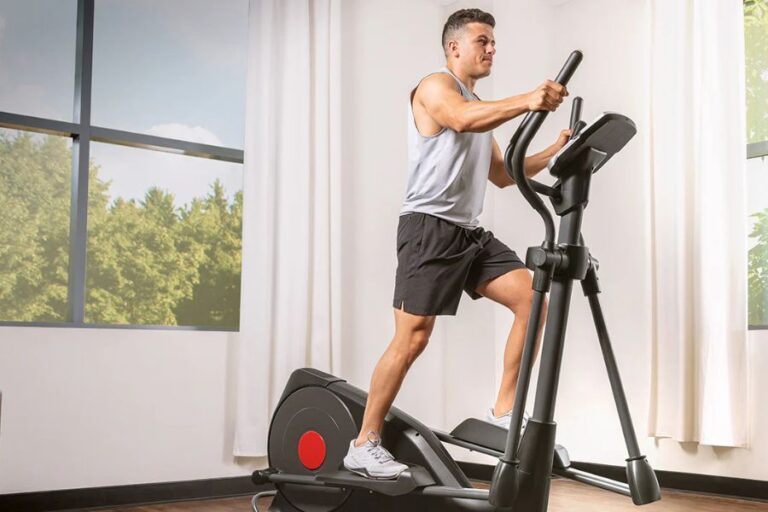
Stand tall on the machine with your shoulders rolled back and your core gently braced. Trainers suggest pulling your shoulder blades together and tucking your belly button in toward your spine to avoid slouching (Garage Gym Reviews). Keep your feet centered on the pedals, not riding too far forward or back. This helps distribute pressure evenly and protects your knees.
Use the moving handles if your machine has them. They turn the workout into a true full-body session that challenges your upper body, core, and balance (Garage Gym Reviews). If you are just starting or feel unsteady, you can hold the fixed handles until you build confidence.
Always begin with a simple warm up, for example, 5 to 10 minutes at low resistance, to increase blood flow and loosen your joints before you increase intensity (Garage Gym Reviews).
Choose the right routine length and intensity
The best elliptical workout routines match your current fitness level and schedule.
For weight loss and heart health, many coaches recommend:
- Steady-state sessions of 20 to 40 minutes at moderate intensity
- Shorter high-intensity interval training (HIIT) sessions of 10 to 20 minutes
High-intensity workouts should stay under about 20 minutes because they are very demanding, while moderate steady-state sessions can extend to 60 minutes if you have the time and conditioning (Garage Gym Reviews). A solid target for many people is 30 minutes at a moderate pace.
You can use heart rate or perceived exertion to guide your effort. One common method is to estimate your max heart rate as 220 minus your age, then work mostly between 65 and 85 percent of that for effective cardio, especially during intervals (Elite Fitness). If you do not have a monitor, use the talk test: you should be able to speak in short sentences at moderate intensity and only one or two words at a time during hard intervals.
Start with beginner friendly elliptical workouts
If you are new to exercise or coming back after a break, build your base before jumping into hardcore intervals. Beginners often do best with 15 to 30 minutes at low resistance and low incline two or three times per week, gradually increasing as fitness improves (Garage Gym Reviews).
20 minute introductory steady-state workout
This simple routine helps you get comfortable with the elliptical while still moving your heart rate into a healthy zone.
- Warm up, 3 to 5 minutes at very easy resistance. You should feel like you could go for a long time without getting winded.
- Main set, 12 to 15 minutes at a perceived exertion of 4 to 6 out of 10. You are slightly out of your comfort zone but can talk in full sentences (Verywell Fit).
- Cool down, 3 to 5 minutes reducing resistance and speed until your breathing returns near normal.
Over a few weeks, extend the main portion until you reach 30 minutes total. This helps you meet the general recommendation of at least 150 minutes of moderate activity per week for health and weight management (Garage Gym Reviews).
Beginner interval workout for quick progress
Once simple steady-state feels manageable, you can add gentle intervals to build endurance and burn more calories without a longer session.
Borrowing from trainer designed beginner plans, try this 20 to 30 minute structure (Elite Fitness):
- Warm up, 5 to 10 minutes at low resistance.
- Intervals, repeat the following 5 to 7 times:
- 2 to 3 minutes at a higher intensity, where talking in full sentences is harder.
- 1 to 2 minutes easier, so you can fully catch your breath.
- Cool down, 5 minutes easy pedaling.
You can also start with very short sessions, even 10 minutes total, if you are deconditioned or recovering. The key is steady, gradual increases rather than pushing to exhaustion, which raises your risk of soreness or injury (Verywell Fit).
Try intermediate routines for more challenge
Once you can comfortably handle 30 minutes at a moderate pace several times a week, you are ready for more structured interval work and different resistance or incline patterns.
Progressive interval workout
Progressive intervals teach your body to handle higher workloads in short bursts. They are ideal if you want to improve endurance and speed without jumping straight into all out HIIT.
One recommended style uses one minute intervals at increasing levels of resistance or speed, repeated for several sets (Garage Gym Reviews):
- Warm up, 5 to 10 minutes at easy to moderate effort.
- Intervals, repeat 3 to 4 times:
- 1 minute at slightly higher resistance or speed.
- 1 minute back to your base effort.
- Each set, nudge the work intervals a little harder, either by increasing resistance, incline, or cadence.
- Cool down, 5 minutes easy.
Focus on changing only one variable at a time, such as resistance or speed, not everything at once. This makes it easier to track progress and reduces the chance of overdoing it (Garage Gym Reviews).
25 to 30 minute mixed endurance workout
For a routine that feels more like a traditional cardio session but still keeps things interesting, you can blend longer efforts with moderate peaks. Fitness pros often recommend repeating longer intervals twice through a 20 to 30 minute block to challenge stamina while still being friendly to intermediate users (Byrdie).
Example:
- Warm up, 5 minutes easy.
- Block 1, 5 minutes at moderate intensity, then 2 minutes slightly harder.
- Recover, 3 minutes easy.
- Block 2, repeat the same 5 minute moderate, 2 minute hard pattern.
- Cool down, 3 to 5 minutes.
This format keeps you in a strong calorie burning zone while building the endurance you need for longer workouts.
Add HIIT for fast results in less time
When you think about the best elliptical workout routines for weight loss and conditioning, HIIT deserves a spot. Interval training on the elliptical alternates short bursts of high effort with recovery periods. This style can improve heart function, increase calorie burn during and after your session, and protect your joints due to the low impact motion (Garage Gym Reviews).
Ellipticals are especially well suited to HIIT because you can easily adjust resistance and incline to make intervals harder or easier on the fly (Garage Gym Reviews).
20 minute elliptical HIIT workout
This structure is ideal when you want a tough but efficient calorie burning session.
- Warm up, 5 minutes at an easy to moderate pace.
- Work intervals, 30 to 45 seconds at 80 to 90 percent of your estimated max heart rate or a 9 out of 10 effort, where talking is not realistic.
- Recovery intervals, 30 to 60 seconds at about 55 to 60 percent of max heart rate or a 3 to 4 out of 10 effort.
- Repeat the work and recovery pattern for a total of 10 to 14 minutes.
- Cool down, 3 to 5 minutes easy pedaling (Garage Gym Reviews).
If you are new to HIIT, start with fewer rounds and longer recovery, then gradually shorten the easy intervals as your fitness improves. For advanced users, there are routines that extend up to about 28 minutes with longer and more intense sprints (Garage Gym Reviews).
Quick Tabata style finisher
On days when time is tight or you want to add a short finisher to a strength session, a Tabata inspired elliptical workout can be enough. A classic version uses 8 rounds of 20 seconds all out work followed by 10 seconds of rest for a total of 4 minutes. You can extend this with longer rest blocks if needed, but even the basic 4 minute version provides a serious challenge (Garage Gym Reviews).
HIIT should not be every day. Rotate it with steady-state or lighter interval days so you have time to recover and avoid burnout.
Focus on weight loss with smarter programming
Weight loss comes down to creating a consistent calorie deficit, and elliptical workouts can play a central role because they burn a significant number of calories in a joint friendly way. Some routines can burn around 400 calories in 30 minutes depending on your body size and intensity, which supports losing 1 to 2 pounds per week when combined with a healthy diet (Set For Set).
One effective 30 minute structure for fat loss includes:
- Warm up, 5 minutes at low resistance.
- Intervals, alternate faster and slower paces while raising resistance from around level 5 up to 12, keeping your effort high but sustainable.
- Cool down, 5 minutes at lower resistance again (Set For Set).
You can also experiment with backward pedaling to shift emphasis to your calves and quads or using higher inclines for a climbing effect that targets your glutes and hamstrings. Backward strides are a simple way to engage different muscles and keep your workouts from feeling repetitive (Byrdie).
For best results:
- Aim for at least five 30 minute moderate sessions or four 45 minute sessions per week to reach the 150 minute minimum and beyond (Garage Gym Reviews).
- Mix in both steady-state and interval days to challenge your body in different ways.
- Adjust resistance and incline over time so workouts stay challenging instead of becoming too easy (Set For Set).
Stay safe and make steady progress
Progress is all about consistency, not perfection. To keep your elliptical routine sustainable, listen to your body and build up slowly.
If you are brand new to exercise, have existing health conditions, or take medications that affect heart rate, talk with your doctor before starting. Trainers also advise stopping or backing off if you feel dizzy, unusually short of breath, or notice pain that does not feel like normal muscle fatigue (Verywell Fit).
Begin with sessions as short as 10 minutes if that is what feels manageable and add a few minutes each week. Over time, you can progress to more advanced routines such as circuit style intervals that cycle through different intensity blocks, or higher resistance bursts that build strength and cardio together (Elite Fitness, Byrdie).
Even a quick 15 minute session can support better body composition if you do it regularly and pair it with smart nutrition (Garage Gym Reviews). Choose one routine from this guide that matches where you are today, commit to it for the next couple of weeks, and adjust as it starts to feel easier. With that simple approach, your elliptical can become one of the most effective tools you have for weight loss and better health.
About the Author