A solid pair of dumbbells is all you need to build stronger, more defined calves. With the right dumbbell calf exercises, you can improve lower leg strength, boost balance, and protect your ankles and Achilles tendon without needing any fancy gym machines.
Below, you will learn how your calf muscles work, how to use dumbbells to train them from every angle, and how to put everything together into an effective, simple routine.
Understand your calf muscles
Before you start loading up dumbbell calf exercises, it helps to know what you are actually training. Your calves are mainly two muscles that work together every time you walk, run, jump, or climb stairs.
- The gastrocnemius is the larger, rounded muscle you see when you flex your calves. It crosses both the knee and ankle, which means it works hardest when your leg is straight.
- The soleus sits underneath the gastrocnemius. It is a bit flatter and more endurance focused, and it works most when your knee is bent.
According to Edward R. Laskowski, M.D., from Mayo Clinic, strengthening these muscles with calf raises helps protect your Achilles tendon and lower leg from injury by improving support and shock absorption in the back of your leg.
When you design your dumbbell calf workouts, you will want at least one straight leg move for the gastrocnemius and one bent leg move for the soleus so you get complete development.
Benefits of dumbbell calf exercises
Dumbbell calf exercises do much more than make your lower legs look better in shorts. Strong calves support almost every lower body movement you do daily.
You can expect:
- Better ankle stability so you feel less wobbly when you walk on uneven ground or change direction quickly.
- Improved balance because your calves help control small shifts in your center of gravity.
- More power in sports that involve sprinting, jumping, or sudden stops.
- Reduced stress on the Achilles tendon, which can lower your risk of strains and overuse injuries, as noted by Mayo Clinic experts.
The big advantage of dumbbells is that you can train at home with minimal space. You can also adjust the load easily, which makes progressive overload simple as your calves get stronger over time.
Form tips for safer, more effective reps
Your calves are naturally strong and elastic, so they like to bounce and cheat their way through reps. To get the most from dumbbell calf exercises, you need to slow things down and be deliberate.
Focus on controlled movement
Nicole L. Campbell from Mayo Clinic recommends a simple technique: stand with a dumbbell in each hand, rise up onto your toes, then slowly return to the starting position, feeling tension in the back of your lower legs.
That slow lowering is where much of the muscle building happens. Fitness experts such as Jared Meacham, PhD, CSCS, explain that performing calf raises with controlled reps and pausing for 1 to 2 seconds at the top increases muscle activation and helps overcome the calves strong stretch reflex. In practice, this means you should:
- Rise up in 1 to 2 seconds.
- Hold and squeeze your calves at the top for 1 to 2 seconds.
- Lower in 2 to 3 seconds, without dropping your heels.
Maintain your body alignment
For standing calf raises, keep your back and knees straight throughout the movement. Mayo Clinic guidance stresses straight knees for proper form and best muscle engagement.
If you struggle with balance, place one hand lightly on a wall, chair, or pole while you hold a single dumbbell in the other hand. This stability lets you focus on the working muscles rather than on not tipping over.
Avoid swinging your hips or using your upper body to lift the weight. Experts note that thinking about pushing your toes down into the ground, rather than lifting your body up, helps prevent bigger muscles such as your hip flexors from taking over and keeps the work in your calves.
Adjust your foot position for complete development
Small changes in how you point your toes can shift the emphasis within your calves. Research highlighted by Shawn Arent, PhD, suggests that different foot angles slightly bias different heads of the gastrocnemius.
You can use three simple positions:
- Toes straight forward to hit the entire calf complex.
- Toes slightly inward to emphasize the outer (lateral) head.
- Toes slightly outward to emphasize the inner (medial) head.
You do not have to use every angle in every workout. Instead, pick one position per set, then rotate them across workouts or training blocks to keep your calves growing evenly.
Standing dumbbell calf raises
Standing dumbbell calf raises are the classic move for the gastrocnemius. They also hit the soleus, especially when you go through a full range of motion.
How to do it
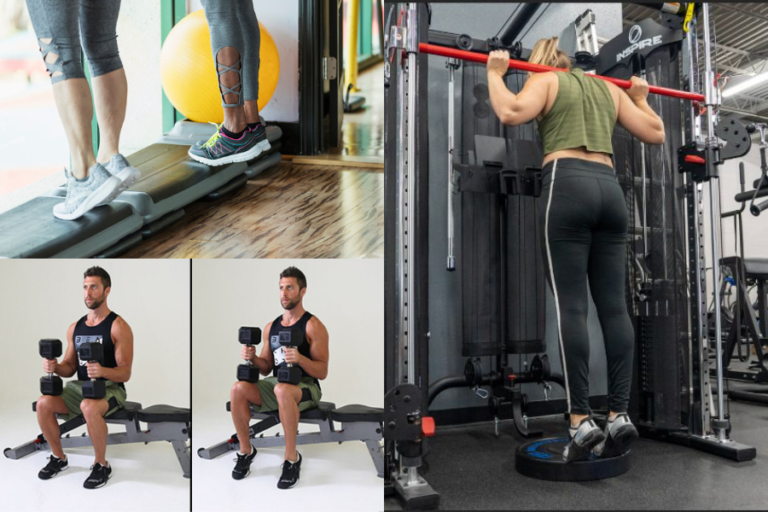
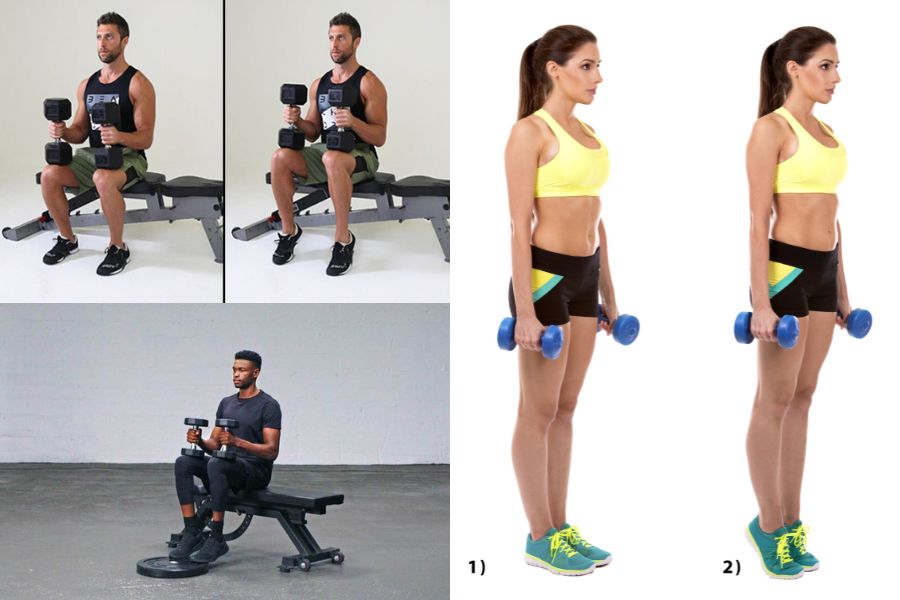
- Stand tall with your feet shoulder width apart. Hold a dumbbell in each hand at your sides.
- Place the balls of your feet on a step, weight plate, or sturdy block, with your heels hanging off the edge. This increases your range of motion and balance challenge.
- Engage your core and keep your knees straight but not locked.
- Slowly rise up onto your toes as high as you comfortably can. Pause and squeeze your calves at the top.
- Lower your heels back down in a controlled way until you feel a gentle stretch at the bottom.
- Repeat for your target number of reps.
Nicole L. Campbell describes this simple pattern of rising up, then slowly returning to the start, as enough to feel clear tension in the back of your lower legs. One set of 12 to 15 repetitions is adequate for many people to maintain strength, but for growth you can add more sets over time.
Technique cues
- Keep your weight over the first and second toes, not the outside edges of your feet.
- Do not let your ankles collapse inward as you rise.
- Use a support for balance if needed so you can focus on quality, not on staying upright.
Seated dumbbell calf raises
If you want to better target the deeper soleus muscle, you need at least one bent leg exercise. When your knees are bent, the gastrocnemius is partially “turned off” mechanically, so the soleus has to work harder.
How to do it
- Sit on a sturdy bench or chair with your knees bent at about 90 degrees and feet flat on the floor.
- Place a dumbbell across each thigh, close to your knees. You can rest a folded towel under the weights for comfort.
- Keep your back straight and supported, either by leaning slightly forward with a neutral spine or by resting against the chair back.
- Lift your heels off the floor as high as you can, keeping your toes and the balls of your feet planted.
- Pause at the top and squeeze your calves.
- Slowly lower your heels back down until you feel a stretch in the lower calves and Achilles.
Experts note that this setup isolates the soleus and improves ankle stability, which is important for walking, running, jumping, and maintaining overall posture.
Technique cues
- Do not bounce the weights off your thighs. Keep the movement smooth and controlled.
- Keep your knees stacked over your ankles, not drifting inward or outward.
- If your back feels strained, adjust your seat height or support your torso more fully.
Single leg standing calf raises
Unilateral exercises are useful for fixing side to side differences in strength or muscle size. A single leg dumbbell calf raise forces each leg to work independently, which limits the stronger side from doing all the work.
How to do it
- Stand on one foot with the ball of that foot on a step or plate, heel hanging off.
- Hold a dumbbell in the hand on the same side, and lightly hold a wall or chair with the other hand for balance.
- Keep your standing knee straight but not locked.
- Rise up onto your toes as high as possible on that single leg.
- Pause and squeeze at the top, then lower slowly into a stretch.
- Complete your reps, then switch legs.
Use lighter weight than you would with two leg raises, since your entire body weight is now on one side. Over time, this exercise helps build symmetry and reduces the risk that one side of your body dominates your movements.
Goblet squat with calf raise
Compound moves let you train your calves along with the rest of your lower body. A dumbbell goblet squat combined with a calf raise offers quad, glute, hamstring, and calf work in a single exercise and also challenges your balance.
How to do it
- Hold a dumbbell vertically at your chest with both hands, as if you are holding a goblet.
- Stand with feet about shoulder width apart and toes slightly turned out.
- Squat down, keeping your chest up and heels on the floor, until your thighs are at least parallel to the ground.
- Drive through your heels to stand back up.
- At the top of the squat, continue pressing through the balls of your feet and rise onto your toes into a calf raise.
- Lower your heels under control, then go into your next squat.
This sequence teaches your calves to contribute to powerful upward drive, which is useful for sports that require sprinting or jumping. It also improves coordination between your hips, knees, and ankles.
Jumping squats with dumbbells
If your goal includes more power and athleticism, dumbbell jumping squats increase calf activation beyond regular squats. They fall into plyometric training, which emphasizes quick, explosive movements.
How to do it
- Hold a light pair of dumbbells at your sides.
- Stand with feet shoulder width apart.
- Lower into a quarter squat, hips back and chest up.
- Explosively push through your feet to jump straight up, extending ankles, knees, and hips.
- Land softly on the balls of your feet, then roll to your heels and absorb the impact by bending your knees.
- Reset your position between jumps to avoid sloppy reps.
Because this is high impact, start slowly and use lighter weights than you think you need. Over time you can build both strength and power in your calves and the rest of your lower body.
Sample dumbbell calf workout
You can organize these dumbbell calf exercises into a simple routine to perform 2 to 3 times per week. Allow at least one day of rest between sessions.
Here is a straightforward structure:
-
Standing dumbbell calf raises
3 sets of 12 to 15 reps
Toes straight on day one, toes slightly in or out on the next workout. -
Seated dumbbell calf raises
3 sets of 15 to 20 reps
Focus on slow lowering and a strong stretch at the bottom. -
Single leg standing calf raises
2 sets of 10 to 12 reps per leg
Use a support for balance and keep your movements controlled.
On another day, you can blend calf work into a leg session by using:
- Goblet squat with calf raise, 3 sets of 8 to 10 reps.
- Dumbbell jumping squats, 2 to 3 sets of 6 to 8 controlled jumps.
Experts such as Shawn Arent recommend mixing both higher rep sets, such as 15 to 20, and moderate rep sets, such as 8 to 12, across different days to fully train the endurance oriented soleus and the more power oriented gastrocnemius.
For many people, Mayo Clinic suggests that even one set of 12 to 15 repetitions of calf raises can be an effective place to start. As you adapt, you can gradually increase sets or weight for more strength and muscle growth.
Progress safely and track your results
To keep making progress, you need to challenge your calves gradually without sacrificing form.
Increase difficulty in small steps by:
- Adding a little weight to your dumbbells when a set feels easy.
- Slowing down the lowering phase of each rep.
- Adding a pause at the bottom stretch as well as at the top squeeze.
- Elevating your toes a bit higher on a thicker step for more range of motion.
Train your calves consistently 2 to 3 times a week, and pay attention to how your ankles feel when you walk, climb stairs, or play sports. Over a few weeks, you should notice better stability, less fatigue in your lower legs, and stronger, more responsive calves.
Start with one or two of these dumbbell calf exercises in your next workout. Once they feel natural, build up to a full routine and let your lower legs do the work they were built for.
About the Author