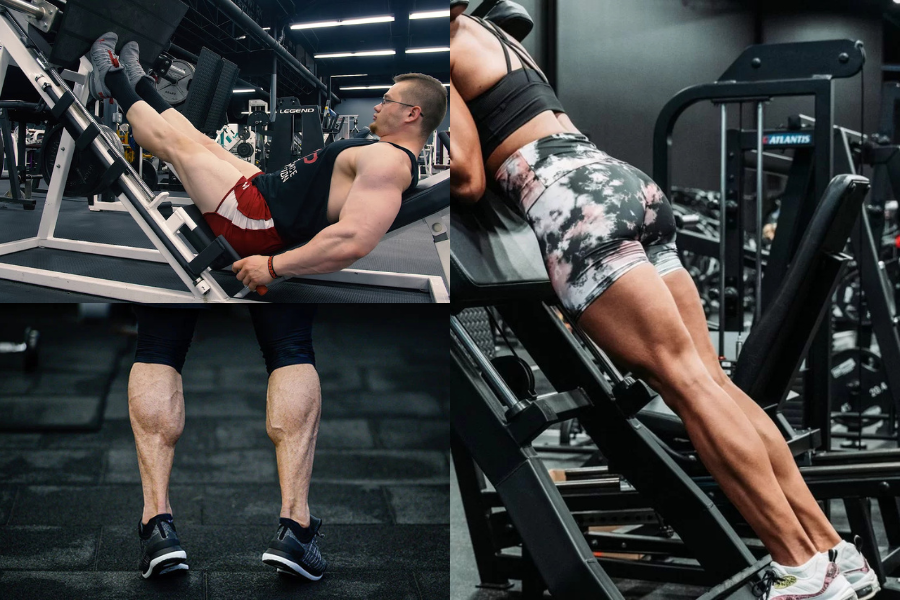
A focused calf routine does more than build definition. Effective calf workout routines improve your balance, support your knees and ankles, and help you walk, run, and jump with less effort. With the right mix of exercises and training structure, you can train your calves at any fitness level and finally see progress in a muscle group that is often stubborn.
Understand your calf muscles
Before you start, it helps to know what you are training. Your calf muscles sit at the back of your lower leg and are responsible for lifting your heels and propelling you forward.
You mainly work with three muscles, often called the triceps surae:
- Gastrocnemius, the visible, diamond shaped muscle that gives your calves their rounded look and helps with posture and powerful movements like sprinting and jumping.
- Soleus, a deeper muscle that supports endurance, balance, and standing for long periods.
- Plantaris, a small muscle that assists the others around the knee and ankle.
Most calf workout routines focus on the gastrocnemius and soleus because they handle the bulk of daily movement and athletic performance. When you design a routine, you want to include both straight leg and bent leg exercises so you can reach these muscles from different angles.
How often to train your calves
You use your calves every time you stand or walk, but that constant low level work does not build much strength. To see change, you need deliberate training and a plan.
For general fitness, you can:
- Train calves 2 to 3 times per week
- Do 1 to 3 calf exercises per session
- Perform 8 to 12 repetitions for 1 to 3 sets each exercise
If your goal is more aggressive muscle growth, some coaches recommend 3 to 6 calf sessions per week, as long as you recover well between workouts. You can adjust your frequency by watching your performance. If your strength and range of motion are back to normal or slightly better, you are ready for another session.
Progressive overload is key. Increase resistance gradually by about 10 to 15 percent every couple of weeks and always prioritize controlled form over heavier weight.
Calf workout routine for beginners
If you are new to strength training or coming back from a break, start with simple body weight moves. Focus on learning the technique and building a mind muscle connection with your calves.
Standing double leg calf raise
This classic exercise targets both the gastrocnemius and soleus at once.
- Stand tall with your feet hip width apart.
- Hold on to a wall or chair for balance if you need it.
- Keeping your knees straight but not locked, rise onto the balls of your feet.
- Pause at the top and feel your calves squeeze.
- Slowly lower your heels back to the floor.
Aim for 1 set of 12 to 15 controlled reps. According to Edward R. Laskowski, M.D., of the Mayo Clinic, smooth, controlled movements with straight knees are enough to effectively strengthen your calf muscles through calf raises.
Seated calf raise (body weight)
Seated raises shift a bit more emphasis to the soleus and are gentle on your joints.
- Sit in a sturdy chair with your feet flat on the floor.
- Place your hands on your thighs for light resistance.
- Lift your heels as high as you comfortably can.
- Pause, then slowly lower to the starting position.
A beginner friendly prescription is 2 sets of 10 reps on each side, resting 30 seconds between sets. Squeeze at the top and move slowly, as recommended in many bodybuilding style seated calf routines.
Basic calf and ankle stretches
Staying flexible helps you get more from every rep and can reduce injury risk.
Try a simple wall calf stretch:
- Stand facing a wall with one foot in front of the other.
- Place your hands on the wall.
- Keep your back leg straight and heel on the floor.
- Lean forward until you feel a gentle stretch in the calf.
Hold for about 20 to 30 seconds, then switch legs. Calf and ankle stretches like this are considered a foundation for gaining mobility and strength in your lower legs. They also prepare you for more demanding calf workout routines.
Intermediate calf workout routine
Once body weight exercises feel comfortable, you can increase the challenge. You might add dumbbells, move to single leg movements, or use gym machines for extra resistance.
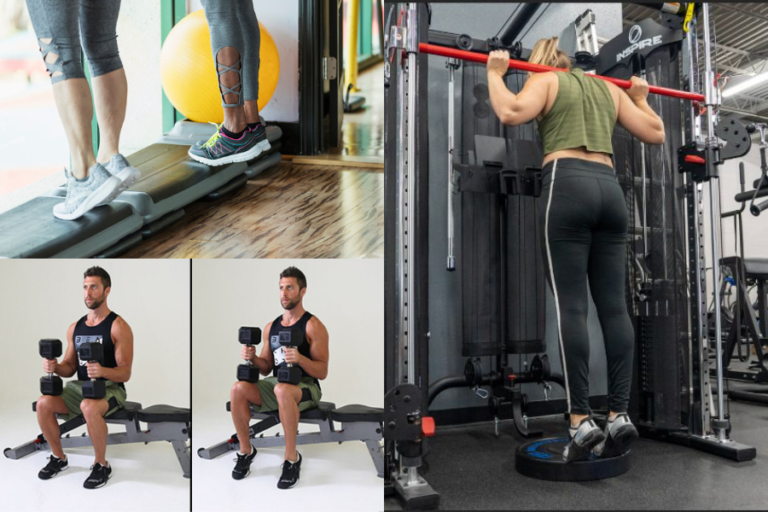
Standing dumbbell calf raise
Adding weights to your basic standing raise is a straightforward way to progress.
- Stand with a dumbbell in each hand, arms hanging by your sides.
- Keep your feet shoulder width apart and your back straight.
- Rise onto your toes, pressing through the balls of your feet.
- Pause at the top, then slowly lower your heels until you feel a stretch.
Work for 2 to 3 sets of 10 to 15 reps. Dumbbell calf raises strengthen both the gastrocnemius and soleus and help protect your Achilles tendon and calves from injury, since stronger muscles support and stabilize the area.
Single leg calf raise
This move puts your full body weight onto one calf at a time, which makes it significantly more challenging.
- Stand on one foot, using a wall or chair for balance.
- Keep your working leg straight but relaxed.
- Press through the ball of your foot to raise your heel.
- Pause, then lower slowly, letting the heel drop slightly below the edge of a step if you are using one.
A common prescription is 2 sets of 15 reps per leg with about 30 seconds of rest. You can hold a dumbbell in one hand to increase intensity. This exercise builds strength and balance at the same time.
Seated calf raise with added weight
If your gym has a seated calf raise machine, this is where you can start adding more resistance to your soleus work. If not, place a heavy dumbbell across your thighs just above your knees while seated.
- Sit with your feet on a block or plate, heels hanging off the edge.
- Place the pad of the machine or the dumbbell across your thighs.
- Lift your heels as high as possible.
- Hold for a two second squeeze at the top.
- Lower your heels under control until you feel a deep stretch.
Aim for 3 sets of 8 to 15 reps, pausing briefly at the top and bottom. Training your calves from a bent leg position like this targets the soleus more directly and supports overall lower leg development.
Advanced calf workout routine
If you already train consistently and want bigger or stronger calves, you need more intensity, variety, and strategic volume. At this level, you can combine heavy, moderate, and light rep ranges through the week.
Sample advanced structure
You might split your training like this:
- About 50 percent of your weekly sets in the moderate 10 to 20 rep range
- The remaining 50 percent split between heavy 5 to 10 rep sets and lighter 20 to 30 rep sets
Calves contain both slow twitch and fast twitch fibers, so mixing rep ranges keeps them adapting and growing.
Heavy standing calf raises
Use a Smith machine, safety squat bar, or standing calf machine so you can load more weight while keeping good form.
- Set the bar across your shoulders.
- Stand on a block or plate with your heels hanging off.
- Lower your heels until you feel a strong stretch in your calves.
- Drive up powerfully, but control the movement.
- Focus especially on the bottom half of the motion, where your calves produce the most force.
Sports rehab specialist David Grey notes that using too light a weight and relying on only a deep, full range can limit how much your calves are actually working. With heavier loads, you can prioritize strength in the range where you are strongest and then finish with higher rep, fuller range sets for growth.
High rep calf finishers
After your heavy sets, finish with lighter, high rep work to fully fatigue the muscles.
You can use:
- Body weight single leg raises off a step
- Light seated raises with a long hold in the stretched position
- Farmer walks on tiptoes with lighter dumbbells
Hold a deep stretch at the bottom of each rep for up to two seconds. This intense stretch can boost hypertrophy and improve mobility, but it also creates strong muscle soreness for beginners, so build up gradually.
Add athletic and functional work
Traditional calf raises are important, but dynamic activities train your calves in real world, multidirectional movement. They also improve coordination and explosiveness.
Sports and cardio that build calves
Many everyday activities already challenge your lower legs. Running, walking uphill, hiking, soccer, basketball, tennis, step based classes, and swimming all train your calves through speed, jumping, balance, and endurance. If you enjoy these sports, you are already supporting calf development without realizing it.
Plyometric and agility drills
You can include a couple of simple drills in your weekly plan, such as:
- Jump rope intervals, for example 3 to 4 rounds of 30 seconds jumping and 30 seconds rest, to build plyometric power and burn calories at the same time
- One leg lateral jumps over a line or low marker to improve quickness and lower body stability
- Short hurdle drills that require small jumps and rapid direction changes to recruit your calves in all planes of movement
These functional exercises complement your strength work and help you translate calf size and strength into better performance.
Common calf training mistakes
Calves have a reputation for being stubborn, but often the issue is how you train them rather than pure genetics. Here are some pitfalls to watch for as you build your calf workout routines.
Many people:
- Use short, low intensity reps that look more like bounces than controlled raises. Since your calves already handle low intensity, short range work when you walk, you need higher intensity and longer ranges of motion to see growth.
- Rely only on seated calf raises. Standing variations are generally more effective for full calf development, and seated exercises should be used as an accessory rather than the main event.
- Train with light weights too often, or perform too many low load sets through the week. Increasing the frequency of easy, low load raises does not stimulate growth as well as focused progressive overload.
- Ignore the muscles on the front of the shin. Training the tibialis anterior along with your calves helps keep your lower legs balanced and may reduce injury risk.
Genetics do play a large role in calf size, particularly in the anatomy of the gastrocnemius. If you drew the short straw there, you will likely need more patience, variety, and consistent effort to see the changes you want. The good news is that strength and performance improve even when visual changes come slowly.
If you treat your calves like any other muscle group, prioritize progressive overload, and stick with a clear plan for a few months, you will notice better balance, smoother movement, and a stronger push off the ground, even if the tape measure only creeps up a little at a time.
Putting your routine together
To build your own calf workout routines, choose the level that matches your current fitness and schedule.
For example:
- Beginner: 2 days per week, 1 to 2 exercises per session, 1 to 2 sets of 12 to 15 reps, plus light stretching.
- Intermediate: 3 days per week, 2 to 3 exercises per session, mixing standing and seated raises with dumbbells or machines, 2 to 3 sets of 8 to 15 reps.
- Advanced: 3 to 6 days per week, heavy standing work plus high rep finishers, with some plyometrics and sports play added through the week.
Stay hydrated, rest between sessions so your muscles can recover, and talk with your doctor or a qualified trainer if you are working around an existing injury. Start with one or two of the exercises above in your next lower body workout, then gradually build up to a full routine that fits your goals and lifestyle.
About the Author