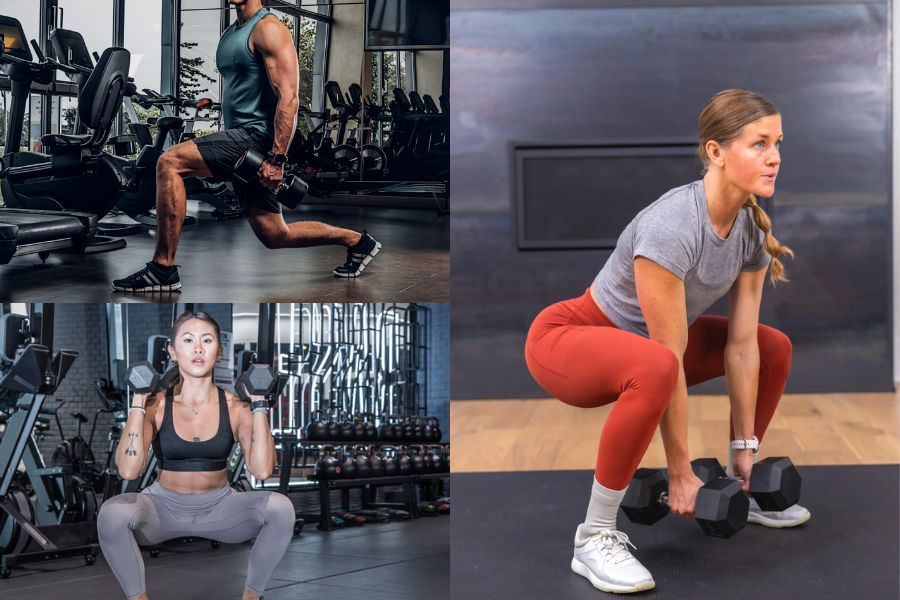
A smart quad workout with dumbbells lets you build strong, balanced legs at home or in the gym without needing a barbell or machine. Because each hand holds its own weight, dumbbells challenge your stability, correct muscle imbalances, and target your quadriceps, the big muscles on the front of your thighs that help you walk, run, squat, and jump.
Below, you will learn how your quads work, which dumbbell exercises hit them best, and how to put everything together into simple workouts for any fitness level.
Understand your quad muscles
Before you pick up a weight, it helps to know what you are training. Your quadriceps femoris is a four headed muscle on the front of your thigh. Together, these muscles straighten your knee and help stabilize your kneecap when you walk, run, jump, or kick, as explained in Iron Bull Strength’s 2024 guide on dumbbell quad exercises.
Your four quad muscles are:
- Vastus lateralis on the outer thigh
- Rectus femoris down the middle of the thigh
- Vastus medialis on the inner thigh, near the knee
- Vastus intermedius underneath the rectus femoris
A good quad workout with dumbbells will hit all four, not just the most visible parts of your thighs. That is why you will see a mix of squats, lunges, and step ups in the exercises below.
Why train quads with dumbbells
Using dumbbells for quad training gives you benefits you do not always get with machines or barbells.
Unilateral strength and symmetry
When you hold a dumbbell in each hand, each leg has to pull its own weight. This prevents your stronger side from secretly doing more work and helps bring a weaker leg up to speed faster than barbell exercises, according to Iron Bull Strength’s 2024 recommendations. Over time, this can improve your squat form, balance, and joint comfort.
Joint friendly and beginner friendly
Dumbbell versions of classic quad lifts usually give you more freedom to adjust your stance and range of motion. For example, a dumbbell squat lets you keep your arms in a comfortable position instead of locking a heavy bar across your back, which can be helpful if you have shoulder or mobility issues.
You can also start with lighter weights or even bodyweight versions, then gradually build up. This makes dumbbell quad training accessible whether you are a beginner or already lift regularly.
Full body and functional benefits
A well designed quad workout with dumbbells does more than grow your thighs. Exercises like lunges and step ups also train your hips, glutes, and core. Iron Bull Strength notes that adding squats, lunges, and step ups to your routine can improve leg strength, athletic performance, joint health, balance, posture, and injury prevention for all fitness levels.
You will also notice a bonus: your grip strength improves since your hands, wrists, and forearms must hold the weights throughout each set, which can carry over to heavier lifting later.
Key dumbbell exercises for your quads
In this section, you will find the main movements that make up an effective quad workout with dumbbells, plus what they target and how to perform them safely.
1. Dumbbell squat
The dumbbell squat is a staple lower body move that heavily targets your quads, especially the rectus femoris, while also training your glutes and core. It is a more flexible alternative to barbell squats and works well for home workouts or anyone with limited equipment.
How to do it:
Stand with feet about shoulder width apart. Hold a dumbbell in each hand by your sides or at shoulder height. Brace your core, sit your hips back slightly, and bend your knees to lower until your thighs are at least parallel to the floor. Press through your heels to stand back up.
Keep your chest up, knees tracking over your toes, and weight balanced across your mid foot.
2. Dumbbell lunge
Iron Bull Strength ranks the dumbbell lunge as one of the most effective quadriceps exercises with dumbbells because it primarily works the thigh muscles while also improving balance and strength.
How to do it:
Stand tall holding dumbbells by your sides. Step forward with one foot and lower your body until your front thigh is roughly parallel to the floor and your back knee is close to the ground. Push through your front heel to return to standing and then switch legs.
Take long enough steps so your front knee does not travel far beyond your toes. Move with control rather than rushing your reps.
3. Goblet squat
Goblet squats are excellent if you are still refining your squat technique. Holding one dumbbell close to your chest keeps you upright and encourages you to sit deeper into the movement, which increases quad activation.
How to do it:
Hold a single dumbbell vertically at your chest, cupping one end with both hands. Stand with feet a little wider than shoulder width. Drop your hips between your knees, keeping your elbows inside your knees and your chest lifted. Push through your feet to stand back up.
If you struggle to hit depth in regular squats, goblet squats are a helpful teaching tool.
4. Bulgarian split squat
Bulgarian split squats are a powerful unilateral exercise that torch your quads, especially the vastus medialis on the inner thigh, and also challenge your balance and glutes.
How to do it:
Stand a couple of feet in front of a bench or sturdy surface. Place the top of one foot on the bench behind you. Holding dumbbells by your sides, bend your front knee and lower your hips straight down until your front thigh is near parallel. Push through the front heel to return to standing.
Keep your torso upright and your front knee in line with your second toe. Start with light weight or even bodyweight if your balance needs practice.
5. Step up
Dumbbell step ups are simple but very effective for your quads and glutes. They also mimic daily actions like climbing stairs or stepping onto a curb, which makes them highly functional.
How to do it:
Stand facing a sturdy bench or box that is roughly knee height. Hold dumbbells by your sides. Place one foot fully on the bench, drive through that heel, and lift your body up until both feet are on top. Step back down under control and repeat on the same side before switching.
Pick a box height that lets you keep your balance and maintain good knee alignment.
6. Close stance dumbbell front squat
To place more emphasis on the outer portion of your thighs, the vastus lateralis, you can use a close stance dumbbell front squat. Iron Bull Strength notes that close stance front squats target the vastus lateralis particularly well.
How to do it:
Stand with your feet closer than shoulder width, almost hip width. Clean two dumbbells up to shoulder level with palms facing each other. Squat down while keeping your elbows high and chest lifted. Drive up through your feet to stand.
This narrower stance shifts more of the workload toward your outer quads. Keep your core tight to avoid tipping forward.
7. Dumbbell hack squat
Dumbbell hack squats are another way to highlight your outer quads without a machine. Here, the dumbbells stay behind you instead of at your sides.
How to do it:
Stand with your feet shoulder width apart and hold dumbbells behind your legs with your palms facing back. Sit your hips down and slightly back, allowing your knees to travel forward while keeping your torso fairly upright. Push through your feet to stand up.
Because the weights are behind you, your quads work hard to extend the knee and bring you back up.
8. Side lunge
To focus more on the inner portion of your thighs and support knee stability, you can add dumbbell side lunges. Iron Bull Strength recommends side lunges and split squats for strengthening the vastus medialis and improving knee stability.
How to do it:
Stand tall with dumbbells at your sides. Take a wide step to the side and push your hips back as you bend that knee, keeping the other leg straight. Lower your body toward the stepping leg, then drive through that foot to return to the starting stance.
Keep your toes pointed forward and your weight in your heel and mid foot on the working leg.
9. Lunge pulses
Lunge pulses are a brutal but effective finisher for your quadriceps, particularly the muscle beneath the rectus femoris known as the vastus intermedius. A 2021 guide describes lunge pulses as partial lunges with small repeated movements of about three inches in the lunge position that intensify quad activation.
How to do it:
Step into a lunge position and lower until both knees are bent. Instead of coming all the way back up, move up and down a few inches at the bottom of the range for a set number of pulses. Then switch legs.
Use light dumbbells or even just bodyweight until you get used to the burn.
If you feel pain inside the knee joint while doing any of these movements, reduce the range of motion, lower the weight, or stop and reassess your form.
Sample quad workouts with dumbbells
You can organize these exercises into simple routines based on your experience level. Here are three templates you can adapt.
Beginner quad workout
For your first few weeks, focus on control and technique. Start with bodyweight if needed, then add light dumbbells.
Perform 2 to 3 sets of each:
- Goblet squat, 8 to 12 reps
- Reverse lunge, 8 to 10 reps per leg
- Step up, 8 to 10 reps per leg
- Bodyweight lunge pulses, 10 to 15 pulses per leg
Rest 60 to 90 seconds between sets. Aim for this workout once or twice per week with at least one rest day between sessions.
Intermediate quad workout
Once you are comfortable with the basics, you can increase the challenge by using supersets, where you pair two exercises back to back. Iron Bull Strength highlights supersets as an effective way to increase intensity in intermediate dumbbell quad routines.
Try this structure:
Superset A, 3 rounds
- Dumbbell squat, 8 to 10 reps
- Bulgarian split squat, 8 to 10 reps per leg
Superset B, 3 rounds
- Dumbbell lunge, 10 reps per leg
- Step up, 10 reps per leg
Finish with:
- Lunge pulses, 15 to 20 pulses per leg, 2 rounds
Rest 60 seconds between supersets and 30 to 45 seconds between exercises if needed.
Advanced quad workout
If you are more experienced, you can divide your focus between inner and outer quad emphasis to encourage balanced development. The 2024 Iron Bull Strength guide suggests this approach for advanced lifters.
Outer quad focus:
- Close stance dumbbell front squat, 4 sets of 6 to 8 reps
- Dumbbell hack squat, 3 sets of 8 to 10 reps
Inner quad and stability focus:
- Bulgarian split squat, 3 sets of 8 to 10 reps per leg
- Dumbbell side lunge, 3 sets of 10 reps per leg
Finisher:
- Lunge pulses, 2 sets of 20 pulses per leg
Use challenging weights but keep at least one clean rep in reserve at the end of each set to protect your joints and maintain good form.
How often to train your quads
For most people, 1 to 2 dedicated quad focused sessions per week is enough to see strength and muscle gains, especially if you also do hamstring and calf work on leg days. The 2024 Iron Bull Strength article notes that pairing quad training with hamstring and calf exercises supports overall lower body development and joint health.
You could use a schedule like:
- Day 1, Quad dominant leg day
- Day 4 or 5, Posterior chain and calves, with a few quad exercises
Make sure you give your legs at least one full day of rest between hard sessions so your muscles and joints can recover.
Safety tips and form reminders
A strong quad workout with dumbbells should challenge you, not leave you limping for the wrong reasons. Keep these simple guidelines in mind:
- Warm up with 5 to 10 minutes of light cardio and dynamic leg moves like leg swings
- Start with a weight that allows you to control the full range of motion
- Keep your knees tracking in line with your toes, not collapsing inward
- Stop a set if your form breaks down, even if you have reps left on paper
- Progress gradually, by a small amount of weight or a few reps at a time
You do not need a full gym to build powerful, stable legs. With a pair of dumbbells and a little floor space, you can train all four heads of your quadriceps, improve your balance, and make everyday movements feel easier. Start with one or two of the exercises today, focus on smooth, controlled reps, and let your strength build over time.
About the Author