Why a small space chest workout works
You do not need a bench, a barbell, or a full gym to build a strong chest. A well planned small space chest workout can rely on bodyweight moves and a few simple tools, and still deliver real strength and muscle gains.
Research from Japan has shown that push ups can induce similar chest muscle growth and strength gains as the bench press, as long as you train with enough effort and volume. That makes push up variations perfect for limited spaces, tight schedules, and home workouts.
In this guide, you will learn:
- How your chest muscles work
- The best chest exercises for tight spaces
- A complete no equipment and minimal equipment chest routine
- How to progress safely and track your gains
You just need a floor, a bit of wall space, and enough room to lie down.
Understand your chest muscles
A basic idea of what you are training helps you choose better exercises and use good form.
Main chest muscles
Your chest is mostly made up of:
-
Pectoralis major
This is the large, fan shaped muscle that covers most of your chest. It has upper, middle, and lower fibers that help you push, press, and bring your arms across your body. -
Pectoralis minor
A smaller muscle that sits underneath the pec major. It helps stabilize your shoulder blade, which is important for safe pressing movements.
Chest workouts matter for everyone. Strong pecs support:
- Everyday pushing tasks like getting up from the floor or pushing a heavy door
- Upper body strength for sports and fitness
- Posture and shoulder stability
- Overall metabolism, because more muscle means you burn more energy, as guides like the 8fit chest workout resource explain
When you structure a small space chest workout, you want exercises that challenge the chest from slightly different angles, without needing big machines.
Key principles for training in small spaces
Limited space does not have to mean limited results. You just need the right strategy.
Focus on push up variations
Classic and varied push ups are some of the best bodyweight chest exercises for small spaces. They require no equipment, are easy to progress, and can rival bench pressing for muscle growth.
Useful push up variations include:
- Regular push ups
- Wide grip push ups
- Incline push ups
- Decline push ups
- Diamond push ups
- Offset or one leg push ups
- Plyometric and time under tension push ups
All of them fit into a small area, and you can mix several into one workout for complete chest training.
Train upper, middle, and lower chest
You cannot isolate each chest region perfectly, but you can emphasize them with small changes in angle and body position:
- Upper chest focus
Decline push ups with your feet elevated - Middle chest focus
Standard push ups and dumbbell presses - Lower chest focus
Incline push ups, dips with a forward lean, and decline style dumbbell presses or flies
In a small space you can create these angles with a sturdy chair, bench, or even a glute bridge position on the floor.
Use enough sets, reps, and frequency
For strength and muscle growth in a small space chest workout:
- Aim for 2 to 4 chest exercises per session
- Do a total of 4 to 12 working sets per week for the chest
- Train your chest about twice per week
For many people, that might look like 3 to 4 sets of 8 to 15 repetitions for each main move, using slower tempo or harder variations as you get stronger.
Best no equipment chest exercises
If you have only your bodyweight and a small patch of floor, start here. These moves are simple, scalable, and effective.
1. Regular push up
Muscles worked: Chest, shoulders, triceps, core
You can treat the standard push up as your base move.
How to do it
- Place your hands slightly wider than shoulder width.
- Keep your body in a straight line from head to heels.
- Lower your chest toward the floor while keeping elbows at about a 45 degree angle from your body.
- Push back up until your arms are fully extended.
Tips
- If this is too hard, drop to your knees or raise your hands onto a low table or bench.
- If this is too easy, slow the tempo or add a pause at the bottom.
2. Incline push up
Muscles worked: Chest with more emphasis on the lower region, shoulders, triceps
Incline push ups are easier than regular push ups because they reduce how much bodyweight you have to lift. They are ideal if you are a beginner or returning from a break.
How to do it
- Place your hands on a stable elevated surface like a bench, table, or sturdy chair.
- Walk your feet back until your body forms a straight line.
- Bend your elbows and lower your chest toward the edge.
- Push back up to the start position.
This variation will still challenge your chest while being gentle on your wrists and shoulders.
3. Decline push up
Muscles worked: Upper chest, front shoulders, triceps
Decline push ups ramp up the difficulty and shift more focus to your upper chest.
How to do it
- Place your feet on a chair, bench, or low table.
- Put your hands on the floor, slightly wider than shoulder width.
- Brace your core, then lower your chest until it is close to the floor.
- Push back up without letting your hips sag.
For strength and hypertrophy, aim for 3 to 4 sets of 5 to 15 reps, resting 30 to 60 seconds between sets.
4. Diamond push up
Muscles worked: Middle chest, triceps, shoulders, core
This narrow hand position increases triceps and inner chest involvement.
How to do it
- Start in a regular push up position.
- Bring your hands together so your thumbs and index fingers form a diamond shape under your chest.
- Keep your elbows close to your body as you lower down.
- Push back up while keeping your core tight.
You can perform 3 to 4 sets of 8 to 15 repetitions, resting 30 to 60 seconds between sets. If this is too difficult, try it on your knees first.
5. Isometric push up hold
Muscles worked: Chest, shoulders, triceps, core with high time under tension
Holding a lowered push up position builds strength where you are usually weakest.
How to do it
- Lower yourself into the bottom position of a push up with your elbows at about 90 degrees.
- Hold this position for up to 15 seconds without letting your hips drop.
- Rest 45 to 60 seconds and repeat.
Isometric holds are especially handy in small spaces because you do not need to move much but still challenge your muscles hard.
Best small space chest exercises with minimal equipment
If you have a few simple tools, you can add variety and make your small space chest workout even more effective.
Loop band chest exercises
Resistance bands barely take up any room, and you can use them at multiple angles.
Loop band push up on knees
Muscles worked: Chest, shoulders, triceps, core
This variation is ideal if you want more resistance without doing full high rep push ups.
How to do it
- Loop the band across your upper back and hold each end in your hands.
- Set up in a push up position on your knees.
- Lower your chest toward the floor, keeping the band snug against your back.
- Push back up against the band resistance.
This is also useful if you are rehabbing or easing back into training in a small space.
Loop band standing chest press
Muscles worked: Chest, shoulders, triceps
This move simulates a bench press using a band instead of a barbell.
How to do it
- Anchor the loop band behind you at about chest height, for example around a post or sturdy door anchor.
- Hold one end of the band in each hand and step forward to create tension.
- With elbows bent and hands at chest height, press your hands forward until your arms are straight.
- Slowly return to the start position.
You can adjust the difficulty simply by moving closer or farther from the anchor point.
Dumbbell chest exercises for tight spaces
Dumbbells do not require much room and allow you to work each side independently.
Dumbbell squeeze press
Muscles worked: Chest, shoulders, triceps
Pressing two dumbbells together keeps constant tension through your chest.
How to do it
- Lie on your back on the floor or a bench.
- Hold two dumbbells together directly above your chest, palms facing each other.
- Squeeze the dumbbells into each other throughout the movement.
- Lower them slowly to your chest, then press back up while continuing to squeeze.
This is perfect if you only have a small area to lie down and a pair of dumbbells.
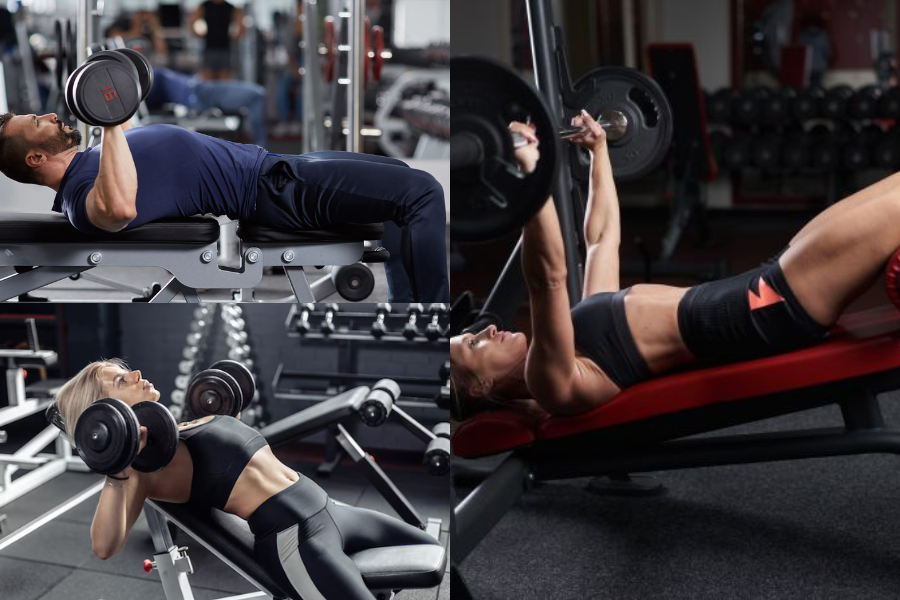
Floor or bridge decline dumbbell press
Muscles worked: Lower chest, triceps, shoulders, core and glutes when done in a bridge
You can mimic a decline bench without owning one by using a glute bridge on the floor.
How to do it
- Lie on your back with knees bent and feet flat.
- Hold a dumbbell in each hand at chest level.
- Lift your hips into a glute bridge so your body forms a straight line from knees to shoulders.
- Press the dumbbells up, then lower them in a controlled way.
This angle emphasizes the lower chest and fits easily into a living room or bedroom corner.
Decline chest fly in bridge position
Muscles worked: Lower chest, front shoulders, stabilizers
This fly variation emphasizes the stretch and squeeze of the lower chest.
How to do it
- Get into the same glute bridge setup as the decline dumbbell press.
- Start with dumbbells above your chest, palms facing each other, arms slightly bent.
- Open your arms out to the sides in a wide arc until the dumbbells are near the floor.
- Squeeze your chest to bring the dumbbells back together over your chest.
Keep the movement slow, and do not let your hips drop during the exercise.
TRX or suspension trainer chest fly
If you have a TRX or similar straps, you can train your chest using only your bodyweight and a small standing area.
How to do it
- Set the straps to about waist height and hold one handle in each hand.
- Lean forward at an angle, arms extended in front of you.
- Slowly open your arms out wide while keeping a slight bend in your elbows.
- Use your chest muscles to bring your hands back together.
You can make it harder by stepping your feet back so your body is at a steeper angle.
Target your lower chest in a small space
People often feel their upper chest more than the lower region, but you can emphasize the lower chest with specific body angles, even at home.
Best small space lower chest moves
You can combine these into your weekly routine to add shape and balance.
-
Incline push ups
Hands elevated on a step or bench. This shifts more load to the lower pec fibers and is friendly on your shoulders. -
Dips with a forward lean
If you have parallel bars or two sturdy chairs, do dips while leaning your torso slightly forward. This body position increases lower chest activation. -
Bridge decline dumbbell press
The bridge position mimics a decline bench, putting more stress on the lower portion of the pec major. -
Bridge decline chest fly
Flies performed in a glute bridge target the lower chest through a long range of motion.
Throughout lower chest work, focus on pushing your arms down and slightly across your body. A strong mind muscle connection can help you feel the lower chest engage, even if you cannot fully isolate it.
Weekly structure for lower chest focus
For balanced development with an emphasis on the lower chest:
- Train your chest twice per week
- Include 2 to 4 exercises, mixing bodyweight and dumbbells if you have them
- Aim for 4 to 12 total sets per week focused on lower chest moves like dips, incline push ups, and decline presses or flies
This approach fits easily into a small apartment or home gym without heavy gear.
A complete small space chest workout plan
Use these sample routines as templates. You can follow the no equipment version, the minimal equipment version, or alternate between them.
No equipment small space chest workout
Do this 2 times per week. Rest 45 to 60 seconds between sets.
- Regular push ups
- 3 sets of 8 to 15 reps
- Start on knees if needed and progress to full push ups.
- Incline push ups
- 3 sets of 10 to 20 reps
- Use a higher surface to make it easier, then lower the surface over time.
- Decline push ups
- 3 sets of 5 to 12 reps
- Elevate your feet on a stable chair or step.
- Diamond push ups
- 2 to 3 sets of 8 to 12 reps
- Drop to your knees at the end if you struggle to reach the rep range.
- Isometric push up holds
- 3 rounds of 15 second holds
- Hold the bottom position with strict body alignment.
If you want a conditioning effect, you can mix in cardio moves like star jumps or mountain climbers between sets, as suggested by some home chest workout routines in the research.
Minimal equipment small space chest workout
You will need a loop band and/or dumbbells. Perform this routine 2 times per week with at least one rest day between sessions.
- Loop band standing chest press
- 3 sets of 12 to 20 reps
- Focus on a full squeeze at the end of each press.
- Dumbbell squeeze press
- 3 sets of 8 to 15 reps
- Keep steady tension by pressing the dumbbells together throughout the set.
- Bridge decline dumbbell press
- 3 sets of 8 to 12 reps
- Hold the glute bridge and keep your hips high.
- Bridge decline chest fly
- 2 to 3 sets of 10 to 15 reps
- Use light to moderate weights and move slowly.
- Optional: TRX chest fly or push up variation
- 3 sets of 8 to 12 reps
- Adjust your body angle to match your current strength level.
If you are just starting, use lighter dumbbells and higher reps while you get comfortable with the movement. Then increase weight gradually.
How to progress your chest workouts in a small space
Progress is what builds muscle and strength over time. Even if your space and equipment stay the same, you can keep challenging yourself.
Simple ways to make exercises harder
You do not have to jump to very advanced variations instantly. Small changes add up.
Try one or more of these:
- Add more reps or sets when the current amount feels easy
- Slow the tempo, for example 3 seconds down, 1 second pause, 1 second up
- Add isometric holds, such as pausing at the bottom of a push up
- Elevate your feet to increase load in push ups
- Move your hands closer together, like in diamond push ups
- Use a heavier band or heavier dumbbells when possible
Track what you do in a simple notebook or app, so you can see progress from week to week.
Stay consistent and recover well
Even with a great small space chest workout, your muscles grow when you rest and fuel them properly.
Keep in mind:
- Leave at least one day between intense chest sessions
- Sleep enough so your body can repair
- Eat enough protein through your overall diet to support muscle recovery
- Back off the volume if your shoulders or wrists feel irritated
Listening to your body is key, especially when you are training frequently in a compact environment.
Bringing it all together
A strong, defined chest does not require a gym membership or a big home setup. By combining smart push up variations, simple tools like bands or dumbbells, and a clear weekly plan, you can build impressive upper body strength in just a small corner of your home.
Pick one of the sample routines, try it for the next four to six weeks, and track how many reps you can do or how much resistance you can handle. As you get stronger, adjust the angles, tempo, or load to keep the challenge high.
Your small space chest workout can be simple, efficient, and surprisingly powerful, all without leaving your living room.
About the Author