Why a HIIT workout without jumping still works
You might think a HIIT workout without jumping cannot be “real” high intensity. In reality, you can raise your heart rate, build strength, and break a sweat using only low impact moves that are kind to your joints and friendly to your neighbors.
High intensity interval training, or HIIT, is about short bursts of effort followed by brief rest. That format stays the same whether you are doing burpees or glute bridges. Trainers note that speeding up low impact movements can quickly spike your heart rate while reducing impact on your ankles, knees, and hips, so you still get the classic HIIT benefits without the pounding.
If you have knee pain, poor balance, live in an apartment, or are just easing into exercise, low impact HIIT is a practical way to build fitness without feeling wrecked the next day.
Understand low impact HIIT
Low impact HIIT, sometimes called high intensity low impact training (HILIT), keeps the intensity while removing jumps and hard landings. You still work in intervals, you just choose exercises that keep at least one foot on the floor.
You might:
- March or step instead of run
- Squat and stand instead of squat jump
- Step back into a lunge instead of jumping in and out of a split stance
Trainers highlight that low impact HIIT can improve cardiovascular fitness, help with weight management, and build muscle strength while being more accessible to beginners, people returning from injury, seniors, and anyone exercising in tight or quiet spaces. It also reduces the risk of joint strain or awkward landings that can lead to ankle twists and ligament sprains.
Key benefits for your body
A no jump HIIT workout is not just a backup plan. It has some unique upsides.
Protects your joints
Removing jumps takes away the harsh impact that hits your knees and hips every time you land. That is important if you:
- Have arthritis or chronic knee pain
- Are rehabbing from a lower body injury
- Feel uncomfortable with fast, bouncy moves
Low impact routines swap burpees, squat jumps, and high knees for options such as glute bridges, lateral lunges, no jump burpees, and boxing punches that are easier on your joints but still challenging.
Still raises your heart rate
Multiple trainers emphasize that you can get your heart rate up with no jumping at all. You simply:
- Move faster with control
- Use more muscle groups at once
- Add resistance like dumbbells, kettlebells, or bands
For example, rowing machines are described as a great option because they are low impact, recruit your legs, core, and upper body, and can still be pushed to a very high intensity, which works well if you have joint issues like arthritis.
Supports fat loss and conditioning
Low impact HIIT may burn slightly fewer calories in the same time as very jump heavy workouts, but trainers note that you still burn a meaningful number of calories and your muscles often use a higher percentage of fat as fuel at these lower impact intensities. That makes it a smart pick if your focus is sustainable weight loss combined with better conditioning, not just all out exhaustion.
Easier to stick with
Because no jump HIIT is gentler on your body, you are less likely to feel beaten up or sore in a way that keeps you from coming back. That consistency is what really improves your fitness over time.
Low impact exercises are also quiet and space efficient, which is ideal if you are working out at home in an apartment or during early or late hours when noise is a concern. One trainer in New York City specifically designed a no jumping HIIT routine so apartment dwellers could train hard without bothering neighbors.
How to structure your no jump HIIT
You can format a HIIT workout without jumping in a few simple ways. The key is alternating focused effort with targeted rest.
Option 1: Classic intervals
Pick 5 to 10 exercises. For each one:
- Work for 20 to 40 seconds at a challenging pace
- Rest for 10 to 20 seconds
- Move to the next exercise
For a quick low impact circuit, trainers suggest doing 40 seconds on and 20 seconds off for 5 moves, and repeating that sequence 3 times for a 15 minute workout. A shorter version uses 20 seconds on and 10 seconds off, with up to 5 rounds if you are more advanced.
Option 2: Rounds and repeats
Another common format is:
- 20 seconds work
- Up to 45 seconds rest
You repeat each exercise for 4 to 7 rounds before moving on. This can be helpful if you want to really master a few specific movements or track progress on those exercises week to week.
Option 3: Ladder style
A ladder workout adds a small challenge each round. One no jumping HIIT routine uses 5 exercises performed like this:
- Set 1: 1 rep of each
- Set 2: 2 reps of each
- Keep adding 1 rep per exercise each set
- Work up to 10 reps per exercise
You move quickly while maintaining good form, and you can modify each movement to your current fitness level.
Warm up before you go hard
Even a low impact HIIT workout without jumping demands effort, so you still want a gentle warm up to prepare your muscles and joints.
Spend 3 to 5 minutes on:
- Marching in place
- Alternating knee lifts
- Heel taps in front of you
- Side step touches
These moves are specific enough to raise your heart rate and increase blood flow, but they avoid bouncing. They are especially helpful if you are protecting your knees.
Upper body HIIT without jumping
If your knees are sensitive, focusing on upper body and core in your HIIT blocks is a smart way to go hard without stressing your legs.
Here is an example circuit that uses 20 seconds on and 10 to 20 seconds off. Repeat 4 to 7 rounds based on your fitness level.
Sample upper body circuit
- Medicine ball slams
- Stand with feet shoulder width apart.
- Lift the ball overhead, then slam it to the floor in front of you, bending at your hips and knees in a comfortable, pain free range.
- Catch, reset, and repeat quickly.
- Push ups
- Use a wall, counter, bench, or your knees on the floor for support.
- Keep your body in a straight line and lower with control.
- Press the floor away as you exhale.
- Renegade rows
- From a high plank or hands on a sturdy surface, feet wide for balance.
- Row one hand toward your ribcage, lower it, then switch sides.
- Move briskly while keeping your hips as steady as possible.
- Russian twists
- Sit tall, lean back slightly, and keep your feet on the floor for less strain.
- Rotate your torso side to side, tapping the floor next to your hip with or without a weight.
- Modified or full pull ups
- Use an assisted pull up machine, resistance band, or a TRX style strap if you have access.
- Focus on strong pulls and controlled descents.
Between rounds, rest up to 45 seconds. This format lets you push your upper body and core while keeping knee impact low.
Lower body and core HIIT without strain
You can train your hips, glutes, and core in a way that actually supports your knees rather than irritates them. Here is a knee friendly lower body and core circuit.
Sample lower body and core circuit
Use 20 seconds of work and 10 to 20 seconds of rest, with 4 to 7 rounds.
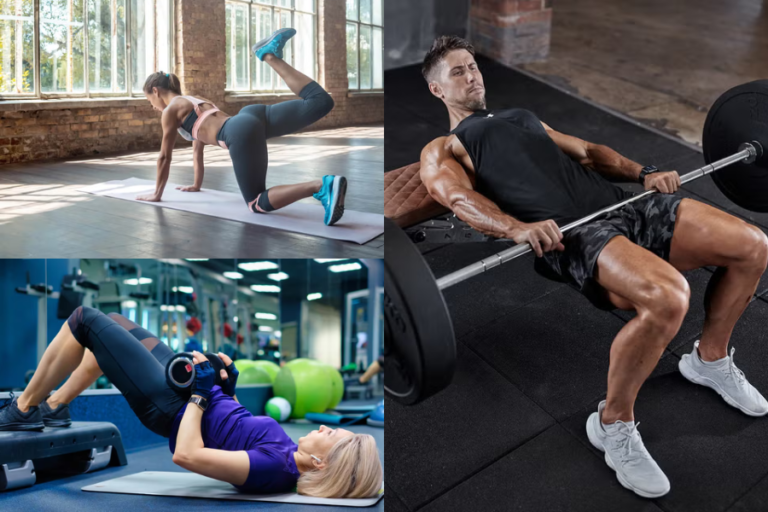
- Glute bridges
- Lie on your back, knees bent, feet flat.
- Press through your heels to lift your hips, squeeze your glutes, then lower slowly.
- This strengthens your posterior chain which helps unload your knees.
- Push up plank with alternating leg raises
- From a high plank, brace your core.
- Lift one leg a few inches, hold briefly, lower, and switch sides.
- Keep your hips square and movements controlled.
- Side lying leg raises
- Lie on your side, bottom leg bent for support, top leg straight.
- Lift the top leg up and slightly back, then lower with control.
- This targets the lateral hip muscles that help keep your knees aligned.
- Side plank dips
- From a side plank on your forearm and bottom knee or both feet.
- Lower your hip toward the floor, then lift it back up.
- Switch sides each round or halfway through.
- Standing high knee raises
- Stand tall and alternate lifting each knee toward your chest without hopping.
- Pump your arms like you are jogging.
- Move quickly but keep the motion smooth and low impact.
These moves challenge your muscles and heart without deep bending or hard landings that can provoke knee discomfort.
Full body no jump HIIT ideas
If you like the feeling of working everything at once, you can build a full body HIIT workout without jumping that mixes strength and cardio.
Sample full body circuit
Try 20 seconds on, 10 to 20 seconds off, 4 to 6 rounds.
- Bear crawls
- Start on hands and knees, lift your knees an inch off the floor.
- Move opposite hand and foot forward a small step, then the other side.
- Keep steps short to stay in control.
- Side planks with cable or band rows
- Anchor a band to a stable point at chest height.
- Hold a side plank and row the band with your top arm.
- Switch sides each round or halfway.
- Overhead presses
- Stand with feet hip width apart, dumbbells at shoulder height.
- Press weights overhead, then lower slowly.
- Avoid leaning back or arching your lower back.
- Glute bridges
- Repeat the bridge from the previous section, or place a weight on your hips for more challenge.
- Mountain climbers, low impact version
- From a high plank, step one foot forward toward your hands, then step it back and switch.
- Focus on quick but controlled steps rather than hopping both feet.
When you want more intensity, add another round or shorten your rest to 10 seconds.
Power moves that skip the jump
You can still feel powerful without leaving the ground. Here are specific low impact “power” alternatives you can plug into any HIIT block.
Lateral and hip focused moves
These help keep your knees stable by strengthening your hip muscles.
-
Standing side leg lifts with jack arms
-
Perform a jumping jack arm motion while stepping one leg out to the side and lifting it slightly.
-
This mimics the feel of a jumping jack without the impact and trains the muscles that keep knees aligned.
-
Squat hold lateral walks
-
Sink into a shallow squat, then step side to side while staying low in a range that does not hurt.
-
Lateral lunges
-
Step one foot out to the side, shift your hips back, and bend that knee while the other leg stays straight.
-
Push back to center and repeat on the other side.
Squat and hinge variations
These build leg power without jumps or deep knee bends.
-
Partial squat heel jacks
-
From a gentle quarter squat, step one heel out to the side then the other, as if doing a jack but without a hop.
-
Squats and squat pulses
-
Do regular bodyweight squats in a comfortable range.
-
For pulses, hold near the bottom of the squat and move up and down just a few inches to generate continuous tension.
-
Bridge pulses
-
From the top of a glute bridge, pulse your hips up and down in short, controlled movements.
No jump cardio finishers
These keep your heart rate high with limited stress on your joints.
-
No jump burpees
-
Raise your hands overhead.
-
Squat down, place your hands on the floor, and walk your feet back to a plank.
-
Lower into a cobra style back extension if it feels good, walk your feet back in, and stand up without jumping.
-
Low impact burpees without jump
-
Similar pattern, but you can skip the cobra and just focus on a strong plank and stand.
-
Boxing punches and squat punches
-
Stand in a light squat and throw quick punches at shoulder height or slightly higher.
-
Rotate your torso and keep your core tight.
-
Stationary speed skaters
-
Step side to side in a speed skater motion without hopping or crossing your foot behind.
-
Reach one arm toward the opposite foot for more rotation.
You can combine 4 to 6 of these moves into a focused power block, 20 seconds each, 10 seconds rest, for 3 to 5 rounds.
Simple no equipment routines you can try
Here are two ready to go, HIIT workout without jumping options that use only your bodyweight. Adjust the work and rest periods to match your current fitness.
10 minute standing HIIT
This routine is inspired by a certified trainer who designed a joint friendly, all standing workout that logs over 1,000 steps in just 10 minutes.
Perform each move for 45 seconds with 15 seconds rest, then move on.
- Wide step knee pull
- Standing hamstring curl with back fly arms
- Crossbody jab with standing crunch
- Cross behind jack taps
- Squat to overhead reach
- Standing side leg lifts with jack arms
- Crossbody punches
- Lateral taps with mini squats
- March in place at a brisk pace
- Boxing finisher at fast speed
If 45 seconds feels too long, start with 30 seconds of work and 15 to 20 seconds of rest.
15 to 20 minute mixed circuit
Combine strength and cardio for a balanced session.
Work 40 seconds, rest 20 seconds, repeat the circuit 3 times:
- Squat to overhead reach
- Glute bridge or bridge pulses
- Inchworm walkout to high plank
- Lateral lunges
- Low impact power jacks or heel jacks
- Russian twists
- Low impact burpees without jump
- Boxing punches
By the end of the third round, you should feel pleasantly tired but not in pain. If you are brand new to HIIT, start with 2 rounds and build up over time.
Smart ways to increase intensity without jumping
If you feel ready for more but still want to avoid impact, you can make your HIIT workout tougher in a few joint friendly ways.
-
Move faster, not sloppier
Trainers highlight that speeding up squats or other low impact moves safely can replicate the training effect of jumps because your muscles still lengthen and shorten quickly. -
Add resistance
Use dumbbells, kettlebells, or resistance bands. For example, tie a band to a doorknob and perform fast rows to challenge your upper body and heart rate at once. -
Extend your work intervals
Go from 20 seconds of work to 30 or 40, or shave a few seconds off your rest. -
Increase total rounds
If you start with 2 rounds of a circuit, aim for 3 next week and 4 the week after. -
Incorporate machines
Rowing machines are noted as a strong low impact, high intensity option. You can use them for short, hard sprints with easy rowing in between.
If your long term goal includes better bone health, some trainers do recommend sprinkling in occasional low impact jumping like gentle jumping jacks or light jump rope, especially for women concerned about osteoporosis. You can talk with your doctor or physical therapist first to see what is appropriate for your body.
Safety tips and when to modify
To get the most from a HIIT workout without jumping, pay attention to how your body feels and make changes as needed.
-
Start small
Begin with 1 to 2 sessions per week and non consecutive days. Add more only when recovery feels easy. -
Watch your knees
If any move causes sharp or lingering pain in your knees, shorten your range of motion, slow down, or switch the exercise. Side lying leg raises, glute bridges, and boxing punches are good substitutes. -
Mind your form
In squats and lunges, keep your knees tracking roughly over your middle toes. In planks and push ups, keep your body in a straight line from shoulders to hips. -
Use modifications
Many exercises have easier versions, such as wall push ups instead of floor push ups, shoulder taps from a high plank instead of a bear crawl pose, and bent knee V ups instead of straight leg V ups. -
Stop if something feels wrong
Muscle fatigue and heavy breathing are normal. Sharp pain, dizziness, or joint instability are not. If that happens, pause your workout and talk with a medical professional if it persists.
Putting it all together
A HIIT workout without jumping is a powerful tool when you want serious cardio and strength benefits without punishing your joints. By:
- Choosing low impact moves that still use major muscle groups
- Structuring your sessions with clear work and rest intervals
- Progressing intensity through speed, resistance, and extra rounds
you can design routines that leave you energized instead of achy. Start with one of the sample circuits, see how your body responds, and adjust from there. Over time, you will build a library of go to low impact power moves that fit your space, your schedule, and your knees.
About the Author