A strong lower body is about more than just squats and lunges. Targeted hamstring isolation exercises help you build strength and muscle where you need it most, support your knees and hips, and improve how your legs look from the side.
Below, you will learn why your hamstrings matter so much, how isolation work fits into your routine, and the best hamstring isolation exercises to add to your workouts, whether you train at the gym or at home.
Understand what hamstring isolation exercises do
Your hamstrings are the three muscles that run along the back of your thigh, the biceps femoris, semitendinosus, and semimembranosus. They bend your knee and help extend your hip, which means they are involved every time you walk, run, jump, or stand up from a chair.
Hamstring isolation exercises focus almost entirely on these muscles by moving mainly at one joint, usually the knee. That is different from compound lifts like squats or deadlifts that share the work across your quads, glutes, and lower back.
This more targeted approach is useful when you want to:
- Correct imbalances between your quads and hamstrings
- Add extra muscle size to the back of your legs
- Reduce your risk of hamstring strains and knee issues
- Train around back or hip discomfort that makes big lifts harder
Because isolation movements use lighter weights and simpler joint actions, they are also safer to take close to muscle failure compared with heavy compound exercises, as noted in guidance summarized by Gymshark.
Plan how often to train your hamstrings
To get the most from hamstring isolation exercises, you need the right mix of frequency, intensity, and exercise order.
You can use these guidelines as a starting point:
- Train your hamstrings 2 to 3 times per week
- Use 4 to 6 reps at about 70 to 85% of your one rep max for strength
- Use 8 to 12 reps at about 50 to 70% of your one rep max for hypertrophy
- Combine both heavier and moderate rep ranges across the week
Research based summaries suggest that this mix supports both strength and size gains while still allowing recovery when you manage your total volume.
In your workouts, do compound leg exercises first, for example squats, deadlifts, or Bulgarian split squats. Then follow with hamstring isolation exercises like leg curls or Nordics. This order helps you save energy for the most demanding lifts and then finish the muscle off with focused work when the rest of the body is already fatigued.
A simple rule of thumb: big multi joint lifts first, targeted hamstring isolation exercises second.
Try the best machine hamstring isolation exercises
If you have access to a gym, a few machines make it very easy to zero in on your hamstrings.
Seated leg curl
The seated leg curl is one of the best hamstring isolation exercises for underdeveloped hamstrings. In the seated position, your hips are flexed and your torso is supported, which helps you keep tension on the hamstrings and focus on pure knee flexion.
It is especially good at targeting the inner hamstring, the semitendinosus. This can help balance dominance from your quads and reduce injury risk.
How to do it:
- Adjust the backrest so your knees line up with the machine’s pivot point.
- Place your lower legs behind the ankle pad and lock the thigh pad comfortably on top of your thighs.
- Start with your legs almost straight, but do not lock your knees.
- Curl the pad down by bending your knees until your heels move toward your glutes.
- Pause and squeeze your hamstrings, then slowly return to the start.
Aim for 3 to 4 sets of 8 to 12 controlled reps. If your lower back tends to fatigue during Romanian deadlifts or good mornings, seated curls let you keep training your hamstrings without that extra strain.
Prone leg curl
Prone leg curls, sometimes called lying leg curls, also isolate the hamstrings by moving only at the knee. Because you are lying face down with your hips extended, this version hits the outer hamstring, the biceps femoris, very effectively.
You can safely push these to high reps or even to failure because there is little risk of dropping a weight or losing your balance.
How to do it:
- Lie face down with your knees just off the edge of the bench and the pad behind your lower legs.
- Brace your core and keep your hips pressed into the bench.
- Bend your knees to curl the pad toward your glutes.
- Stop just before the weight stack touches, then lower under control.
Again, 3 to 4 sets of 8 to 12 reps works well. Focus on a steady tempo rather than swinging the weight.
Hamstring curl machine tips
Regardless of the style of machine you use:
- Start lighter than you think, your hamstrings are usually weaker than your quads.
- Use a full but comfortable range of motion, extend your legs without locking your knees, then curl as far as you can without pain.
- Control both the lifting and lowering phases, do not let the weight slam down.
If you already use a leg extension machine to train your quads, adding hamstring curls to your routine helps keep the front and back of your thighs in better balance.
Use free weight hamstring isolation movements
You might think of deadlifts as pure compound work, but some variations act much like hamstring isolation exercises because they minimize involvement from the quads.
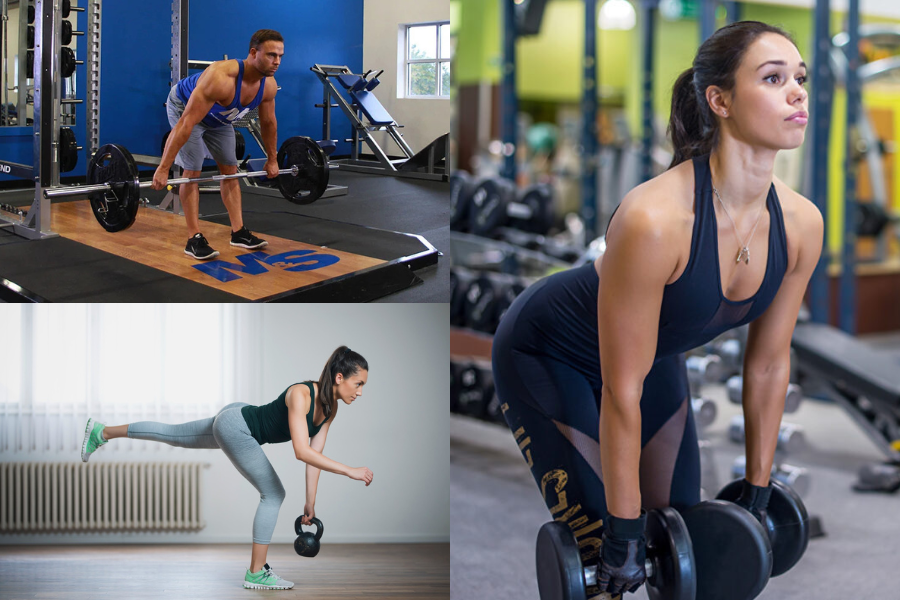
Romanian deadlift (RDL)
Romanian deadlifts are often considered one of the best hamstring isolation exercises because they train the hamstrings in a lengthened position with only a slight bend in the knee. This puts a deep stretch on the back of your thighs and builds strong hip hinge mechanics.
You can perform RDLs with dumbbells, a barbell, or kettlebells. A common setup is 3 to 4 sets of 8 to 12 reps.
How to do it:
- Stand tall with the weight in front of your thighs and a soft bend in your knees.
- Hinge at your hips, push your hips back while keeping your spine neutral.
- Lower the weight until you feel a strong stretch in your hamstrings, usually around mid shin.
- Drive through your heels and squeeze your glutes to return to standing.
Keep the movement slow and controlled, especially in the bottom half of the range where your hamstrings are under the most tension.
Single leg deadlift
Single leg deadlifts are a unilateral hamstring isolation exercise that also challenges your balance and core stability. Working one leg at a time can reveal and correct left right differences in strength and control.
To perform them:
- Stand on one leg with a dumbbell or kettlebell in the opposite hand.
- Keep a soft bend in your standing knee.
- Hinge at the hips, reaching the weight toward the floor while extending your free leg behind you.
- Go as low as you can while keeping your back flat, then return to standing.
Try 3 to 4 sets of 8 to 12 reps per side. Start without weight if balance is a struggle, then add load as you improve.
Add bodyweight and minimal equipment hamstring work
You do not need machines to benefit from hamstring isolation exercises. Several bodyweight options hit your hamstrings hard, sometimes even more than traditional curls.
Nordic hamstring curl
The Nordic hamstring curl is a powerhouse exercise for building eccentric hamstring strength, which is crucial for preventing strains and enhancing sprint performance. It targets knee flexion specifically, one of the primary functions of the hamstrings.
In many programs, Nordic curls are used as a key tool for hamstring injury prevention and performance. You can do them with a partner holding your ankles or by anchoring your feet under a heavy object or couch.
Basic setup:
- Kneel on a pad with your body upright and your feet anchored.
- Cross your arms over your chest.
- Slowly lean your body forward from the knees, keeping your torso straight.
- Use your hamstrings to resist the fall for as long as possible, then catch yourself with your hands.
- Push lightly off the floor to help yourself back up if needed.
Since they are very demanding, start with a few controlled negatives, maybe 2 to 3 sets of 3 to 5 reps, and build up over time.
Swiss ball leg curl
Swiss ball leg curls are one of the top bodyweight hamstring isolation exercises and they add a stability challenge for your core and hips. They are especially useful if you train at home with limited equipment.
How to do them:
- Lie on your back with your heels on a stability ball and your arms by your sides.
- Lift your hips so your body forms a straight line from shoulders to heels.
- Bend your knees and pull the ball toward your glutes.
- Keep your hips up throughout the movement.
- Slowly extend your legs to roll the ball away again.
You can start with both legs, then progress to single leg variations as you get stronger.
Glute bridge and hip thrust variations for more hamstring
Glute bridges and hip thrusts primarily target your glutes, but with small changes you can shift more of the load to your hamstrings. When you position your feet further in front of your body and drive your heels down as you lift your hips, your hamstrings work harder through hip extension.
You can experiment with:
- Feet slightly in front of your knees instead of directly under them
- Pausing at the top of the movement and squeezing your hamstrings
- Using a single leg bridge to increase demand on each side
These tweaks help you get more hamstring involvement from exercises you might already use in your lower body days.
Put it all together in your weekly training
To make progress, you need a plan that uses hamstring isolation exercises consistently while leaving room for recovery. If you train legs twice per week, a simple structure might look like this:
- Day 1: Squats, Romanian deadlifts, seated leg curls, calf work
- Day 2: Deadlift or hip thrust focus, single leg deadlifts or Nordics, Swiss ball curls or prone curls
Start with 2 to 3 sets per exercise and gradually add sets or weight every 4 to 8 weeks as you adapt. If you are more advanced, you may adjust more frequently and use slightly higher weekly volume, as long as joint pain and fatigue stay in check.
Pay attention to how your hamstrings feel during daily activities and other training. Less tightness, fewer twinges, and a stronger push off the ground are all good signs that your isolation work is paying off.
Key takeaways
Hamstring isolation exercises give you precise control over how you train the back of your thighs. They let you:
- Target the three hamstring muscles directly through knee flexion and hip extension
- Build strength and size that carry over to running, jumping, and squatting
- Reduce injury risk by balancing your quads and hamstrings
- Train effectively around back or hip limitations using machines or bodyweight
Choose two or three of the exercises above and add them to your next lower body session. Focus on smooth, controlled reps, gradually increase the challenge, and your hamstrings will get stronger, more stable, and more defined over time.
About the Author