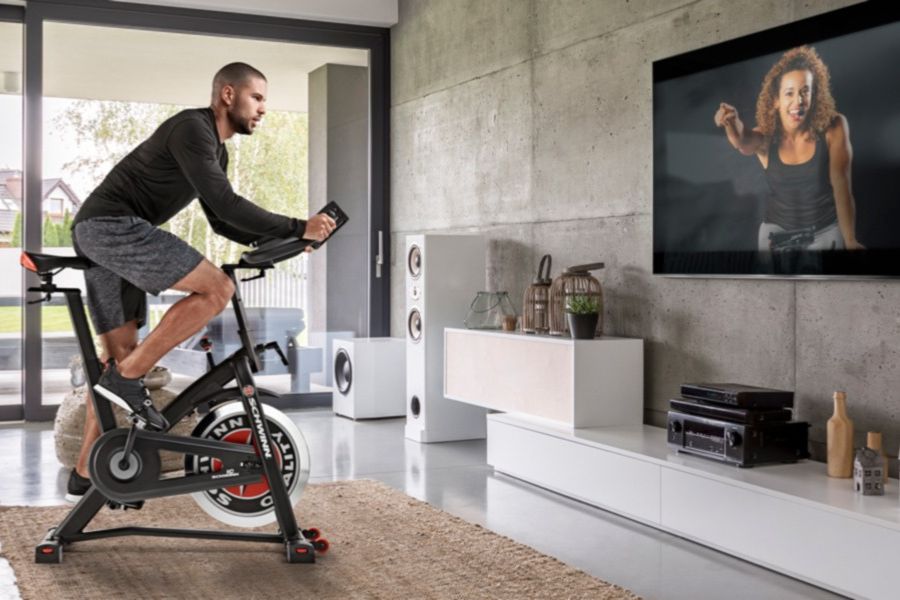
Why an exercise bike is great for beginners
If you want to start moving more, lose some weight, or simply feel healthier, an exercise bike workout for beginners is a smart and approachable place to start. A stationary bike is low impact, easy on your joints, and lets you control speed and resistance with a simple dial or button.
Research shows that stationary biking offers similar cardiovascular benefits to walking, running, and using the elliptical, while putting less stress on your knees and hips, which is helpful if you have joint pain or are returning to exercise after a break (Verywell Fit; Garage Gym Reviews).
You can also ride at home in any weather, at any time, without worrying about traffic or daylight. That convenience makes it much easier to stay consistent, which is what actually drives weight loss and long‑term health changes.
Key benefits you can expect
A regular beginner exercise bike routine can help you:
- Improve heart and lung health through steady aerobic work (Garage Gym Reviews)
- Burn calories and support fat loss, especially when paired with a modest calorie deficit (Garage Gym Reviews; NordicTrack)
- Strengthen legs and glutes by working your quads, hamstrings, calves, and hips (Garage Gym Reviews)
- Protect your joints with a low‑impact movement that is gentler than running (Healthline)
A 30 minute moderate session can burn roughly 210 to 294 calories depending on your weight and pace, and increasing resistance or speed raises that number further (Garage Gym Reviews).
If you are new to exercise, have medical conditions, take medication, or have significant joint pain, talk with your doctor before starting a new routine (Healthline).
Choose the right exercise bike
You have two main styles to consider as a beginner: upright and recumbent. Both can support a solid exercise bike workout for beginners, but they feel different in your body.
Upright vs recumbent bikes
| Bike type | What it looks like | Best for | Things to consider |
|---|---|---|---|
| Upright bike | Seat over pedals, similar to outdoor bike | General fitness, higher intensity, small spaces | Requires slightly more balance and core strength |
| Recumbent bike | Larger seat with backrest, pedals out in front | Beginners with back, joint, or mobility issues | Takes more floor space but feels very stable |
If you struggle with low back pain, mobility limits, or balance, a recumbent bike is usually more comfortable because it supports your back and reduces load on your hips and knees (Healthline).
If you feel fine standing and walking, you can choose based on what feels natural. The best bike for you is the one you will actually use.
Set up your bike for comfort and safety
Proper bike setup is the first step to avoiding sore knees, hips, or back. It also helps you get more out of every minute you ride. An exercise bike workout for beginners should feel challenging but not painful.
Adjust your seat height
Most people are comfortable when the seat is about level with the top of their hip bone when they stand next to the bike. From there, sit down and place your heel on the pedal at its lowest point. Your knee should be almost straight, with only a slight bend.
If your leg is totally straight and your hips rock side to side while you pedal, the seat is probably too high. If your knee stays very bent even at the bottom of the stroke, the seat is too low, which can strain your knees. Correct saddle height reduces injury risk and improves cycling efficiency, something that is supported by research on cycling biomechanics (NordicTrack).
Position the handlebars
Raise or lower the handlebars so you can:
- Sit upright with a gentle forward lean
- Keep a soft bend in your elbows
- Relax your neck and shoulders
If you feel like you have to round your back or shrug your shoulders to reach the bars, bring them closer or higher if your bike allows. A comfortable posture helps you breathe more deeply and reduces unnecessary fatigue (ProForm).
Find a comfortable resistance
As a beginner, keep resistance light to moderate. You should feel some gentle push against the pedals, but still be able to move smoothly. Very heavy resistance makes pedaling choppy and can overload your knees. Experts recommend avoiding extremely high resistance settings when you are new, since they can damage the bike and increase injury risk (NordicTrack).
Aim for a steady cadence between about 80 and 100 pedal revolutions per minute. This range is effective for cardio and feels rhythmic rather than frantic (NordicTrack).
Learn basic riding form and breathing
Good technique helps you stay comfortable and get better results without needing to overdo intensity.
Sit with your hips all the way back on the seat, your core gently engaged, and your hands resting lightly on the handlebars. Keep your knees tracking over your feet, not bowing sharply in or out. Your neck, shoulders, and arms should feel relaxed. This posture allows for easier breathing and less muscle fatigue (NordicTrack; ProForm).
As you pedal, let your hips move naturally with the stroke instead of locking them in place. This helps engage your core and prevents too much pressure from going into your knees and hamstrings (NordicTrack).
For breathing, try this simple pattern:
- During easy and moderate riding, inhale through your nose and exhale through either your nose or mouth.
- During harder bursts, breathe in and out through your mouth to move more air.
Paying attention to your breath improves oxygen delivery to your muscles and makes intense efforts feel more manageable (ProForm).
Try this 25 minute beginner workout
You can use this simple session as your go to exercise bike workout for beginners. Adjust the resistance and speed so that the effort levels feel right for your body.
Think of effort on a scale from 1 to 10, where 1 is sitting on the couch and 10 is your absolute maximum.
-
Warm up, 5 minutes, effort 3 out of 10
Pedal at an easy, relaxed pace with light resistance. You should be able to talk in full sentences without difficulty. -
Steady ride, 5 minutes, effort 4 out of 10
Increase resistance slightly. Your breathing is a little heavier but you can still carry on a conversation. This is your baseline pace. -
Mini interval, 2 minutes, effort 5 out of 10
Add a small amount of resistance or pedal a bit faster. You are breathing more deeply now, but it still feels manageable. -
Recovery, 3 minutes, effort 3 out of 10
Reduce resistance and slow your pace to the easy warm up level. Focus on steady breathing. -
Mini interval, 2 minutes, effort 6 out of 10
Increase resistance or speed again. You should feel challenged and slightly breathless, but not gasping. -
Recovery, 3 minutes, effort 3 out of 10
Back to easy pedaling. Check your posture, relax your shoulders, and sip some water. -
Steady finish, 3 minutes, effort 4 out of 10
Return to your earlier steady pace to finish strong but controlled. -
Cool down, 2 to 5 minutes, effort 2 to 3 out of 10
Gradually reduce resistance and slow your pedaling. Let your heart rate drift down until you can talk comfortably.
This structure gives you about 25 minutes in the saddle, which fits the 25 to 35 minute beginner recommendation from experts (Healthline). If this feels long right now, it is fine to cut the main intervals in half and slowly build up. You can start with just 10 or 15 minutes and add 1 to 2 minutes each week as it becomes easier (Verywell Fit).
Once you can comfortably ride for 20 minutes, you can begin adding a short extra block with alternating easier and harder minutes to work toward a 30 minute workout (Verywell Fit).
Plan your weekly routine
For health and mood benefits, aim to ride an exercise bike 3 to 5 days per week as a beginner. A helpful starting point is 15 to 20 minutes per session, then progress toward 30 to 45 minutes on most days as your fitness improves (NordicTrack).
You can structure your week like this:
- Two to three days of the 25 minute beginner workout above
- One day of a shorter, very easy recovery ride, such as 10 to 15 minutes at effort 2 to 3
- One or two rest days with no riding, or gentle walking and stretching
Rest at least one day per week to allow your muscles and joints to recover, especially if you include higher intensity intervals. If you prefer very casual, low intensity riding, you can ride more days, but still pay attention to any unusual or persistent pain (NordicTrack).
Many beginners wonder if they need a complex training plan. At first, consistency matters more than perfectly timed intervals. Shorter, regular rides are better for building fitness than rare, very long rides, and that pattern is echoed by experienced cyclists and coaches (Reddit Fitness).
Support weight loss and health goals
If your main goal is weight loss, your exercise bike workout for beginners will work best alongside a few simple lifestyle changes.
Experts suggest pairing cycling with strength training and moderate dietary changes, such as eating in a 300 to 500 calorie deficit, to support fat loss while preserving muscle (NordicTrack). That might mean smaller portions, fewer sugary drinks, or more high fiber foods, depending on what fits your life.
At the same time, a beginner friendly program should focus on building your base aerobic fitness at mostly low intensity. As your foundation grows, you can add more challenging intervals. This slow build approach is recommended by many cycling communities and helps you avoid burnout (Reddit Fitness).
Do not overlook basic habits that impact both performance and safety:
- Hydration. Drink water before, during, and after your ride. Losing just around 2 percent of your body weight in fluid can hurt performance, and water supports temperature control and joint lubrication (ProForm).
- Cool downs and stretching. After riding, keep pedaling lightly for a few minutes, then stretch your quads, hamstrings, glutes, and calves. This 10 to 15 minute cool down can reduce muscle soreness and prevent blood from pooling in your legs (ProForm).
You may notice positive changes like better mood, improved sleep, and more stable energy before the scale moves. Those are signs your routine is working, so give your body time to adjust.
When and how to progress
As your fitness improves, you can make your exercise bike workout for beginners a bit more challenging in three simple ways:
- Add a few minutes to your total ride time
- Gently increase average resistance
- Include short, slightly harder intervals followed by easy pedaling
A common progression is to master a smooth 20 minute ride, then add a five minute block where you alternate three minutes at your regular baseline pace and two minutes at a harder but sustainable effort. Over time, you can build this up to a 30 minute workout, which lines up with general daily exercise recommendations (Verywell Fit).
You do not need to rush this process. Increasing your ride duration by just one minute at a time works well for many beginners (Healthline). If a new level feels overwhelming, you can always step back and hold steady for another week.
If you enjoy structure and variety, you might eventually explore apps like Zwift, TrainerRoad, or the Peloton app. They offer guided classes and training plans that can make your rides more engaging, even if you only have a basic stationary bike at home (Reddit Fitness).
Bringing it all together
An exercise bike workout for beginners does not need to be complicated to be effective. Start with a comfortable bike setup, an easy to follow 20 to 25 minute routine, and a plan to ride several days a week. Pair that with small nutrition improvements, good hydration, and regular rest days.
Choose one simple step to try in your next ride, such as adjusting your seat height or following the 25 minute workout above. As those small changes become habits, you will build stronger legs, a healthier heart, and more confidence every time you get on the bike.
About the Author