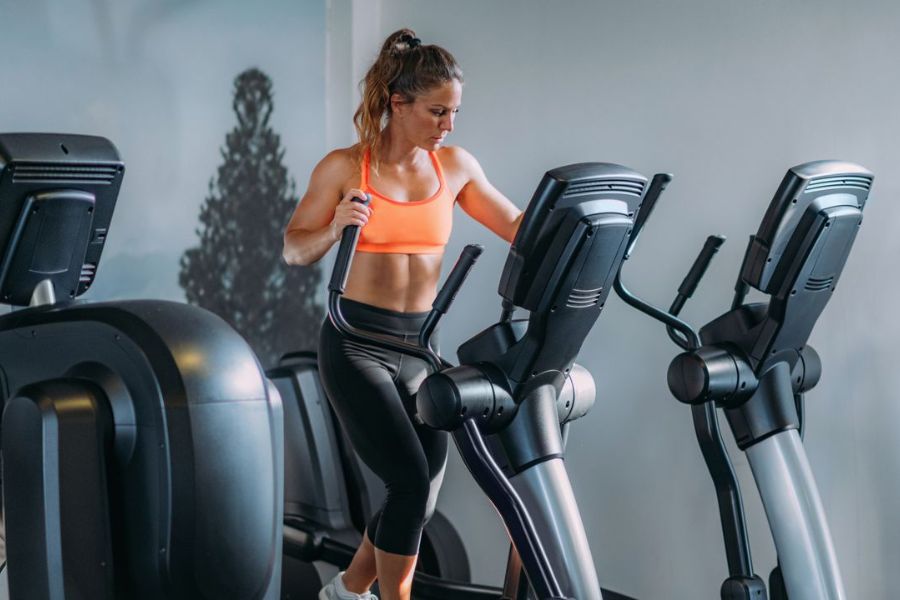
Elliptical machine exercises give you a joint friendly way to burn calories, build stamina, and work your whole body in one session. Whether you are new to cardio, returning from an injury, or just tired of pounding away on the treadmill, the elliptical can help you lose weight and improve your health with less stress on your joints.
Below, you will learn how elliptical machine exercises work, how to use the machine correctly, and several beginner to advanced workouts you can try today.
Understand why the elliptical is so effective
Elliptical workouts count as low impact cardio, which means your feet stay on the pedals instead of striking the ground. That reduces stress on your knees, hips, ankles, and lower back while you still get many of the same benefits as walking or jogging. Your body glides in a smooth circular motion that is easier on joints than running on a treadmill or pavement (Healthline, NordicTrack).
When you use the moving handles, you engage your upper body, core, and lower body muscles at the same time. Your glutes, quads, hamstrings, calves, chest, back, biceps, triceps, and core all pitch in, which can increase your calorie burn compared with exercises that mainly work your legs (Healthline, Verywell Fit).
Calorie burn on an elliptical machine varies by your weight and how hard you work. In general, you can expect somewhere around 270 to 400 calories in 30 minutes at a moderate pace depending on your body weight (Healthline, Garage Gym Reviews). That makes elliptical workouts a useful tool for weight loss and long term weight maintenance.
Finally, elliptical training strengthens your heart and lungs. When you work at a moderate pace where you feel slightly out of breath but can still hold a conversation, you are improving your cardiovascular fitness and endurance (Cleveland Clinic).
Set up your elliptical machine correctly
Before you dive into elliptical machine exercises, take a minute to set up the machine so it fits your body and goals.
If your machine allows you to adjust stride length, choose a length that feels natural, not choppy or overly stretched. Many home machines have a fixed stride that works for most people, so you may only need to adjust resistance and incline.
Start with a low to moderate resistance level and a low incline so you can focus on form first. Beginner guides suggest starting with resistance under 5 and incline between 1 and 8 during your first week, then increasing gradually to avoid injury (Garage Gym Reviews).
You do not need to rely on the built in programs at first. Instead, manually control speed and resistance so you can learn what each setting feels like and how quickly your heart rate responds.
Use proper form to protect joints and boost results
Good form on the elliptical makes your workout safer and more effective. It also helps the motion feel more natural if you are not used to it.
Stand tall instead of hunching over the console. Keep your shoulders relaxed and down, your chest open, and your eyes looking forward, not at your feet. This posture helps you breathe better and reduces the risk of neck or back strain (CNET).
Hold the moving handles with a light but steady grip. Avoid leaning your body weight on your arms. When you push and pull the handles in coordination with your leg movement, your arms, back, and chest join the work which can increase calorie burn and muscle activation (Healthline).
Pay attention to your feet. Distribute your weight evenly across your full foot instead of standing on your toes. Roll through each pedal stroke so your heels stay involved. This protects your knees and can reduce numbness or tingling in your feet and legs that sometimes comes from constant pressure on the pedals (CNET, Garage Gym Reviews).
During warm ups, cool downs, and easy intervals, you can let go of the handles for short periods to challenge your balance and engage your core in a different way. Just be sure you feel stable before doing this, especially if you are new to the machine (Lose It!).
Choose the right intensity for your goals
Elliptical machine exercises can be as gentle or intense as you need. How you structure your workouts depends on your current fitness level and what you want to achieve.
For general health and weight management, the American Council on Exercise recommends at least 150 minutes per week of moderate physical activity. You can reach this with five 30 minute or four 45 minute elliptical sessions. If weight loss is your goal, pairing those sessions with strength training will help improve your body composition and resting metabolic rate (Garage Gym Reviews).
A simple way to gauge intensity is the Rate of Perceived Exertion, or RPE, on a scale from 1 to 10. For most steady workouts, aim to stay around 4 to 6, where your effort feels easy to moderate and you can still speak in short sentences. As your fitness improves, you can experiment with higher intensity intervals in the 7 to 9 range for short bursts (Verywell Fit).
High intensity interval training, or HIIT, on the elliptical can help you burn more calories in less time while still being kind to your joints. Alternating hard efforts with easier recovery periods is especially helpful if you get bored with steady state cardio (Garage Gym Reviews, Cleveland Clinic).
Try beginner friendly elliptical workouts
If you are new to elliptical machine exercises, start short and simple. That way, you give your muscles, joints, and lungs time to adjust and you are more likely to stay consistent.
A good introduction is a 10 to 20 minute workout made up of short intervals. One beginner plan suggests starting with 3 minutes at an easy effort, followed by 2 minutes at a slightly harder effort, and repeating that pattern until you reach about 20 minutes. Over time, you can gradually build up to 30 minutes of continuous moderate to vigorous activity (Verywell Fit).
Here is a simple starter workout you can follow:
- 3 minutes at very easy resistance, focus on form
- 2 minutes at slightly higher resistance, still comfortable
- Repeat steps 1 and 2 three more times
- Finish with 3 minutes very easy to cool down
If 20 minutes feels like too much at first, begin with just 10 minutes and add 1 to 2 minutes each week. Beginner guidelines often encourage shorter workouts at the start to avoid soreness or injury while you build endurance safely (Verywell Fit).
Add variety with intermediate interval sessions
Once you are comfortable with 20 to 30 minutes of steady elliptical work at a moderate intensity, you can introduce more challenging interval sessions to push your fitness and weight loss forward.
One effective approach is a 32 minute HIIT session at a moderate resistance where you pedal forward the entire time. You alternate between harder efforts and easier recovery periods, which can help you burn more calories than simply keeping the same pace the whole time (Garage Gym Reviews).
Another strategy is to use hill style workouts. For example, you might set up a 45 minute session where you gradually increase incline and resistance to simulate long climbs, then drop them back down for recovery periods. Guidance from training plans shows that playing with those settings improves both muscle endurance and calorie burn (Lose It!).
You can also try mid intensity long intervals, sometimes called mile repeats, where you work at a strong but sustainable pace for several minutes, then recover, and repeat. A weekly schedule that cycles through different styles, such as short sprints, hills, and mile repeats, keeps your muscles guessing and your workouts more interesting (Lose It!).
Explore advanced HIIT and Tabata style workouts
If you already have a solid cardio base and want a time efficient challenge, you can use elliptical machine exercises for higher intensity options.
One example is a 4 minute Tabata routine. You perform 8 rounds of 20 seconds of very hard effort followed by 10 seconds of complete or near complete rest. That short burst style has been shown to be very demanding, so you should only try it after you are comfortable with other interval formats and cleared for intense exercise. Using the elliptical keeps the impact low even when the effort is high (Garage Gym Reviews).
You might also follow a session known as High Intensity Short Intervals, around 30 minutes long. You spend a few minutes warming up, then alternate between brief sprints and easier pedaling. Another advanced pattern is The Ladder, where you slowly increase and then decrease resistance and incline over 60 minutes, which targets strength, endurance, and calorie burn all at once (Lose It!).
Because HIIT is demanding, you do not need to do these workouts every day. One or two sessions a week, paired with easier days or strength training, is usually enough.
If you ever feel lightheaded, overly breathless, or in pain, slow down or stop. Intensity should feel challenging, not dangerous.
Fine tune your workout for better results
Small changes in how you use your elliptical can make your workouts more effective and less monotonous.
Changing resistance and incline lets you focus on different muscles. Higher resistance builds more strength, while higher incline places extra emphasis on your glutes and hamstrings. These small adjustments can increase calorie burn and improve both muscle tone and cardiorespiratory health (CNET, NordicTrack).
You can also pedal backward to hit your hamstrings and glutes differently. Many users find that alternating between forward and backward motion during a workout makes the session feel shorter and challenges their muscles in a fresh way (CNET, Healthline).
Pay attention to your footwear. Running shoes or cross trainers with good arch support, stability, and cushioning are recommended. Lightweight road running shoes often work better than stiffer trail shoes, since elliptical pedals are flat and you do not need extra traction (Lose It!).
If you experience foot numbness, experiment with shifting your weight slightly, relaxing your toes, and occasionally changing your foot position within the pedal. This numbness is usually a minor side effect of keeping your feet planted the whole time, and adjusting your technique can help reduce it (Garage Gym Reviews, CNET).
Support joint health and injury recovery
One of the biggest advantages of elliptical machine exercises is how they protect your joints. Because your feet never leave the pedals, you avoid the repeated impact that comes with running, which can be especially helpful if you have arthritis, osteoporosis, low back pain, or knee or hip issues (Healthline).
In fact, a 24 week program of low impact aerobic exercise similar to elliptical training improved body composition, physical fitness, and cardiovascular health in participants, showing that you do not need high impact activities to see significant benefits (Healthline).
Because of that joint friendliness, trainers and physical therapists often recommend the elliptical as a way to maintain cardio fitness while recovering from running injuries or managing chronic joint concerns (NordicTrack). Just remember that the movement can feel unusual at first. If it feels too easy, you may need to increase resistance and use intervals to truly challenge your cardiovascular system, as some users notice when they switch from running to an elliptical for the first time (Reddit r/Fitness).
If you are cleared by your doctor, you can also alternate elliptical days with other forms of exercise, like treadmill walking or outdoor cycling. This variety helps prevent overuse injuries and keeps your routine from feeling stale (NordicTrack).
Put it all together
Elliptical machine exercises give you a low impact, full body way to work toward your weight loss and health goals. By setting up the machine correctly, focusing on posture and foot placement, and using a mix of steady and interval workouts, you can build a routine that is both joint friendly and challenging.
Start with one small change today. You might try a 10 minute beginner interval session or simply focus on standing taller and using the moving handles correctly. As those sessions become a habit, you can layer in more intensity, longer workouts, and new interval patterns that keep you improving week after week.
About the Author