Why dumbbell chest exercises are worth your time
If you want stronger, more defined pecs without relying on a barbell, dumbbell chest exercises are one of the most effective ways to reshape your upper body. With a pair of dumbbells you can train your chest anywhere, increase your range of motion, iron out strength imbalances, and make everyday movements like pushing, lifting, and reaching feel easier.
Dumbbell chest workouts target your pectoralis major, pectoralis minor, and supporting muscles like the serratus anterior. That means better performance in the gym and in daily life, not just a stronger bench press.
Understand your chest muscles
Before you start pressing and flying weights around, it helps to know what you are actually training.
The three key chest muscles
-
Pectoralis major
This is the large, fan-shaped muscle that gives your chest its size and shape. It is responsible for moving your upper arm across your body, pressing, and pushing. -
Pectoralis minor
A smaller muscle that sits underneath the pec major. It helps stabilize your shoulder blade and supports pushing movements. -
Serratus anterior
Located along the side of your ribcage. It rotates your shoulder blade so you can raise your arm overhead. Targeting it helps your shoulders feel more stable when you press, reach, or push.
With the right mix of dumbbell chest exercises, you can hit all three areas for balanced development rather than only building the middle of your chest.
Why choose dumbbells for chest training
You can build a strong chest with barbells or machines, but dumbbells come with a few standout benefits.
More range of motion
Unlike a barbell, dumbbells are not limited by the bar stopping on your chest. You can lower them a bit deeper, which:
- Increases the stretch at the bottom of a press
- Creates more tension through the full movement
- Helps stimulate more muscle growth
Guides from Gymreapers note that this extra range of motion is a key reason dumbbells often feel more effective for chest development than barbells.
Better symmetry and balance
With dumbbells, each arm works independently. Your stronger side cannot secretly take over. This helps you:
- Correct left to right strength imbalances
- Avoid overloading one shoulder
- Build a more symmetrical chest
Gymreapers specifically highlight unilateral dumbbell work as one of the best ways to address muscular imbalances, especially in pushing movements.
Joint friendly movement patterns
Dumbbells allow micro adjustments in your wrists, elbows, and shoulders. If a straight bar path bothers your joints, you can slightly rotate your hands or adjust your elbow path to find a comfortable angle. According to Gymreapers, this freedom often reduces joint discomfort compared to barbell pressing, especially for your shoulders.
Functional strength that carries over
Because dumbbell chest exercises allow more natural movement patterns and demand more stabilization, you improve:
- Coordination
- Balance
- Flexibility
- Control through different angles
Those are the qualities you feel when you push open a heavy door, lift a suitcase into an overhead bin, or brace yourself during sports.
Essential dumbbell chest exercises
You do not need a long list of movements to build muscle. Start by getting very good at a few core presses and fly variations.
1. Dumbbell bench press
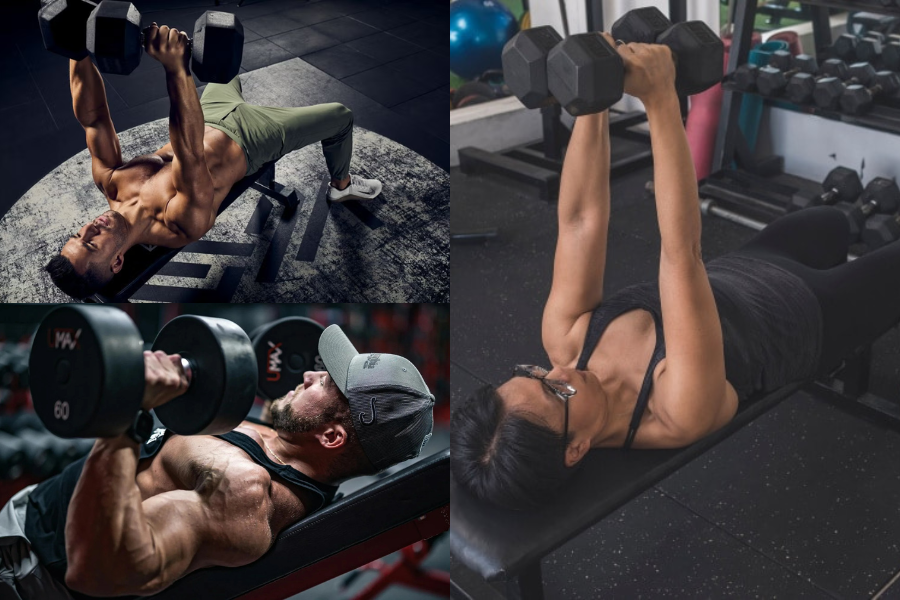
The dumbbell bench press is one of the best dumbbell chest exercises you can do. It builds strength and size through your entire chest and engages your shoulders and triceps.
According to Men’s Health, it is a top choice for chest development when done in the 3 to 4 sets of 6 to 8 reps range for strength and size.
How to do it
- Lie on a flat bench with a dumbbell in each hand, feet planted.
- Start with the dumbbells just outside your chest, palms facing forward, elbows slightly below shoulder level.
- Keep your forearms vertical over your elbows as you press the weights up until your elbows are almost straight.
- Pause briefly, then lower in a controlled motion until your upper arms are just below horizontal.
- Press back up, keeping your shoulders pinned to the bench.
Form tips that matter
A Built With Science analysis points out that your arm path and forearm angle change how much your chest actually works:
- Avoid flaring your elbows straight out, which shifts work to the front delts.
- Do not let your forearms angle inward, which turns the move into more of a triceps exercise and cuts chest tension roughly in half.
- Keep your shoulder blades pulled together and avoid rounding your shoulders at the top, so your pecs stay in charge rather than your front shoulders.
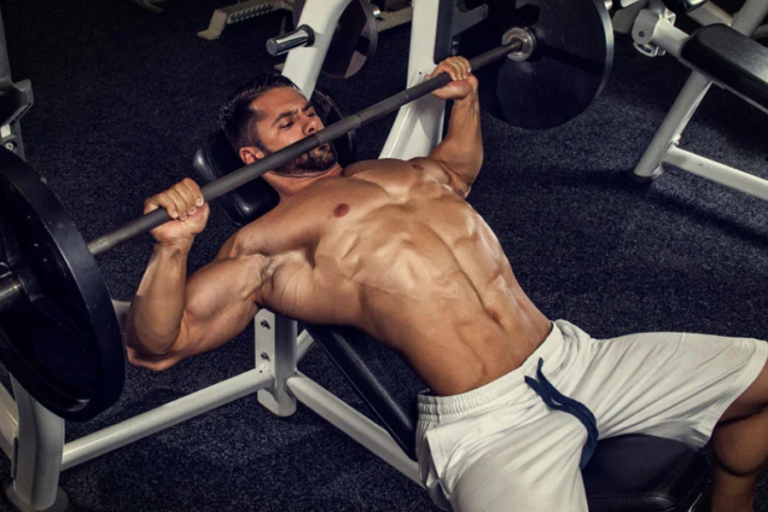
2. Incline dumbbell press
The incline press emphasizes your upper chest by changing the angle of the bench. Men’s Health suggests 3 to 4 sets of 8 to 10 reps to effectively build the upper portion.
How to do it
- Set a bench to a low incline, about 15 to 30 degrees.
- Lie back with dumbbells at chest level, palms facing forward.
- Press up until your elbows are almost straight.
- Lower slowly until your elbows are just below shoulder level.
- Repeat without letting your shoulders roll forward.
A slight incline is enough. Built With Science notes that 15 to 30 degrees is ideal for targeting the upper chest. Higher angles tend to involve your shoulders more than your pecs.
3. Decline or low angle dumbbell press
You can place a bench at a gentle decline or simply raise your hips slightly on a flat bench to create a low angle. This shifts more emphasis to your lower chest.
Bench angle matters here too. Small declines can help direct tension toward the lower pec fibers, again highlighted in the Built With Science breakdown.
4. Neutral grip and reverse grip presses
Small grip tweaks can change how your chest feels the movement:
-
Neutral grip press
Palms face each other. This can feel easier on your shoulders and still deliver strong chest activation. -
Reverse grip press
Palms face toward you. This tends to hit the upper chest more and can be a useful variation if straight bar paths bother your shoulders.
Both are popular compound dumbbell chest exercises that keep your joints happy by letting you adjust your wrist and elbow alignment.
5. Dumbbell floor press
If you do not have a bench, or your shoulders feel cranky, the floor press is an excellent option. Men’s Health recommends 3 to 4 sets of 8 to 10 reps.
How to do it
- Lie on the floor with your knees bent and feet flat.
- Hold a dumbbell in each hand above your chest, elbows bent about 45 degrees from your sides.
- Lower until your upper arms gently touch the floor.
- Press back up, focusing on squeezing your chest, not driving through your feet.
Because your elbows stop on the floor, your shoulders avoid the extreme stretch that can cause discomfort, while your chest and triceps still get a solid workout.
Fly variations for chest shaping
Presses build a lot of your mass and strength. Fly exercises complement them by emphasizing the adduction function of your pecs, in simple terms, bringing your arms toward the center of your body.
6. Dumbbell chest fly
Men’s Health recommends 3 sets of 10 to 12 reps for the chest fly, focusing more on the quality of the squeeze than the weight.
How to do a standard flat fly
- Lie on a flat bench holding dumbbells above your chest with palms facing each other.
- Keep a soft bend in your elbows, do not lock them.
- Slowly open your arms out to the sides, like you are hugging a wide tree, until your upper arms are level with your torso.
- Pause briefly, then bring the dumbbells back together over your chest, focusing on squeezing your pecs.
Ironmaster emphasizes that you should avoid:
- Locking your arms, which strains your elbows and shoulders
- Letting the dumbbells drop too close to the floor, which risks overstretching and injury
The goal with flys is tension and control, not heavy weight.
7. Incline and floor fly variations
To adjust stress on your chest and protect your shoulders, you can use these safer variations from Ironmaster:
- Incline dumbbell fly
Hits more of the upper and mid chest. Position your arms slightly lower toward your chest region rather than directly in line with your shoulders. - Dumbbell floor fly
The floor prevents your arms from dropping too far, which keeps your shoulders in a safer range of motion.
Trainers often suggest using flys after your main pressing work, when your chest is already warm and partially fatigued, so you do not need heavy weights to feel them.
8. T Bench dumbbell fly for inner chest focus
The T Bench Fly is a variation recommended by trainers Ebenezer Samuel and Brett Williams in Men’s Health. It lets you challenge your chest with heavier weights while keeping your shoulders safer.
How to do it
- Sit with your upper back across a bench so your body forms a “T” shape and your hips are up in a glute bridge.
- Squeeze your glutes and abs so your body forms a straight line from knees to shoulders.
- Start with dumbbells above your chest, palms facing each other.
- Slowly lower for about four seconds, letting your elbows gently touch the bench without resting.
- Bring the weights back together, squeezing your chest at the top.
You are not just training your chest here. Your core and glutes work to keep you stable, and that extra stability lets you focus more intensity on your inner chest region.
How to put the exercises into a workout
Once you are familiar with a few key dumbbell chest exercises, you can organize them into simple routines that match your experience level.
Beginner friendly routine
If you are new to strength training or coming back after a long break, start with control and consistency.
Try 1 to 2 times per week:
- Dumbbell bench press
- 3 sets of 8 to 10 reps
- Incline dumbbell press
- 3 sets of 8 to 10 reps
- Dumbbell floor fly or light flat fly
- 2 to 3 sets of 10 to 12 reps
Use weights that let you move smoothly without your form falling apart. For many beginners, one set of 12 to 15 reps on a chest press can be enough to start, as noted by Mayo Clinic.
Intermediate routine for size and strength
If you already train regularly, you can increase volume and intensity using recommended rep ranges from Gymreapers and Men’s Health:
Train chest twice per week, for example:
Workout A
- Dumbbell bench press
- 4 sets of 6 to 8 reps for strength
- Incline dumbbell press
- 3 sets of 8 to 10 reps
- Dumbbell chest fly
- 3 sets of 10 to 12 reps
Workout B
- Neutral grip dumbbell press or floor press
- 3 to 4 sets of 8 to 10 reps
- Decline or low angle dumbbell press
- 3 sets of 8 to 10 reps
- Incline or floor fly
- 3 sets of 10 to 15 reps
For muscle growth, Gymreapers suggests working in a 10 to 30 rep range across your sets, as long as your last few reps feel challenging.
Advanced routine with supersets and finishers
If you are more experienced, you can use supersets, where you do two exercises back to back without rest, to increase intensity and shorten workouts.
For example:
- Superset 1
- Dumbbell bench press, 4 sets of 6 to 8 reps
- Incline dumbbell press, 4 sets of 8 to 10 reps
- Superset 2
- Neutral grip press, 3 sets of 8 to 10 reps
- Dumbbell floor fly, 3 sets of 10 to 12 reps
- Finisher
- Bodyweight push ups for 3 to 5 minutes total, resting only as needed, aiming close to muscle failure
Guides on intermediate and advanced dumbbell chest training note that supersets and bodyweight burnout phases are effective for pushing your chest close to failure and maximizing hypertrophy, as long as you recover properly between sessions.
Basic technique and safety guidelines
Good form is non negotiable if you want long term progress without joint issues.
Chest press safety cues
Drawing from Mayo Clinic’s how to on the dumbbell chest press:
- Do not lock your elbows at the top, stop just before full lockout to keep tension on your chest.
- Keep your head relaxed and neutral on the bench.
- Avoid pushing with your feet to “bounce” the weight up, your chest should be leading the movement.
- Do not let your elbows drop far below the horizontal line of your body, which can stress your shoulders.
Chest fly safety cues
Ironmaster and other experts recommend:
- Keep a soft bend in your elbows throughout.
- Never lower the dumbbells past the line of your torso.
- Use lighter weights, especially if you do flys after heavy pressing.
- Consider floor or incline flys if your shoulders feel sensitive.
If you have a history of shoulder, back, or arm injuries, a doctor or physical therapist should clear you first, and working with a qualified trainer to check your technique is a smart move.
How often to train your chest
You do not need to hammer your chest every day to see results. Consistency and the right dose of effort are more important.
Research based recommendations from Gymreapers suggest:
- Frequency
Training your chest about twice per week works well for most people. - Rep ranges
- 5 to 10 reps per set to focus on strength
- 10 to 30 reps for muscle growth, spread across your sets
Make sure you allow at least one full rest day between hard chest sessions so your muscles can recover and grow.
Also remember your back. Including opposing muscle group work, like rows and pulldowns, helps keep your shoulders healthy and your posture balanced as your chest gets stronger.
Turning information into progress
Dumbbell chest exercises can transform your workout by giving you more control, better range of motion, and a simple way to train your chest almost anywhere. You do not need fancy machines or a heavy barbell to build muscle and strength.
To get started, you can:
- Pick 3 to 4 of the exercises above
- Train them twice per week
- Focus on steady form and a small increase in weight or reps over time
Keep the movements controlled, stop a set when your form starts to slip, and use variations that feel kind to your joints. With a pair of dumbbells and a consistent plan, your chest workouts can quickly become one of the most rewarding parts of your routine.
About the Author