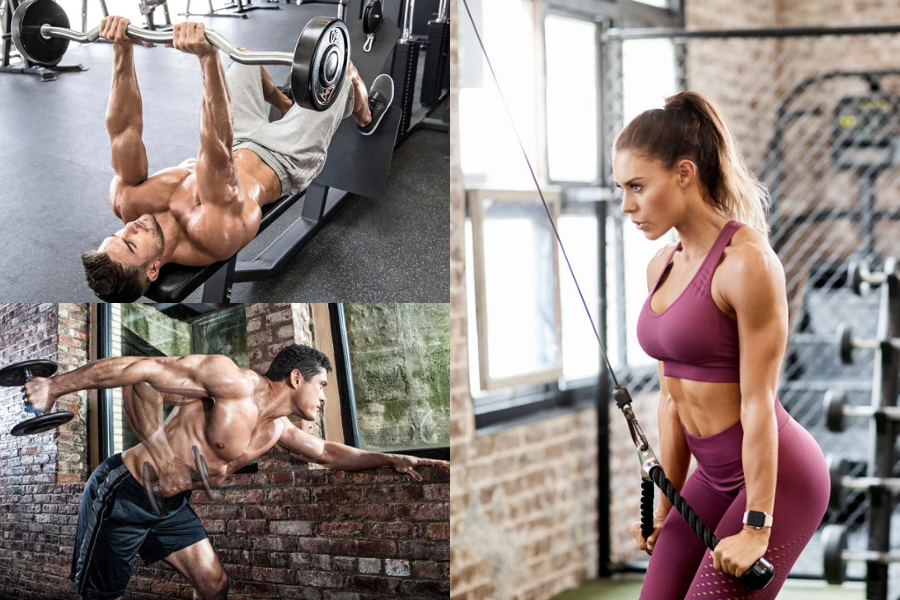
Understand cable vs dumbbell tricep exercises
If you are trying to build stronger, more defined arms, you will eventually ask the question: cable vs dumbbell tricep exercises, which should you focus on? Both tools can grow your triceps, but they load the muscles in slightly different ways and feel very different on your joints.
Cable machines provide smooth, consistent tension through the whole range of motion. Dumbbells demand more balance and stabilizer strength, and they usually give you more freedom in how you move. Knowing how each one affects your triceps helps you build a smarter workout instead of guessing.
In this guide, you will see how cables and dumbbells compare for tricep training, where each shines, and how to choose the right mix for your goals.
Know your tricep anatomy
Before you decide between cable and dumbbell tricep exercises, it helps to know what you are actually trying to train.
Your triceps brachii has three heads:
-
Long head
Runs along the back of your upper arm and crosses the shoulder joint. It contributes a lot to upper arm size and helps with shoulder stability. -
Lateral head
Sits on the outer side and pops the most in side views. It is heavily involved in pressing strength and that “horseshoe” look. -
Medial head
Lies deeper under the other two. It supports lockout strength and overall arm function.
Most tricep exercises hit all three heads, but arm and shoulder position, grip, and resistance type can shift the emphasis. Overhead work usually gives the long head more stretch. Pushdown style movements target the lateral head strongly. Both cables and dumbbells can do these patterns, but they load them differently.
How cable training affects muscles and joints
Cable machines are popular for tricep workouts because they apply a steady pull on the muscles. Unlike free weights where tension changes based on leverage, cables keep the resistance more constant, which can make each rep feel smoother.
What research says about cable resistance
A 2017 study by Signorile et al. compared cable-based machines with traditional selectorized weight machines during biceps curls, chest press, and overhead press in young adults. The cable exercises showed:
- Greater muscle activation for several muscles, including the biceps brachii, anterior deltoid, pectoralis major, and external obliques in various movements, at a significance level of p ≤ 0.05.
- Larger overall range of motion across the exercises compared with selectorized machines, at p < 0.0001.
The authors suggested that cable resistance equipment provides more degrees of freedom and more varied muscle and joint use patterns than fixed-path machines, which may be useful when you want to train movement patterns that resemble everyday tasks.
While this study did not focus on triceps directly, it supports a key idea for your arm training: cables allow more natural paths and more continuous tension than many machines, and in some cases, they can rival or beat other options in muscle activation.
Cable benefits for tricep work
For triceps specifically, you get several clear advantages with cables:
-
Consistent tension
Cable tricep exercises such as rope pushdowns and overhead extensions keep the muscle loaded through the whole rep. That continuous tension can help with muscle engagement and a strong mind muscle connection. -
Joint friendly resistance
The resistance profile is smoother than many free weight options. Cable rope pushdowns, in particular, let your wrists follow a natural path and often feel better if you have elbow or wrist issues. Home Gym Supply notes that a rope attachment can reduce wrist strain compared with a straight bar. -
Good isolation
Cable tricep pushdowns are known for isolating the lateral head, the part you see clearly from the side, with less stress on the elbow joint compared with some other heavy tricep moves, according to Home Gym Supply’s 2025 comparison. -
Overhead focus on the long head
Cable tricep extensions, especially overhead variations, allow a large range of motion, particularly during the eccentric (lowering) phase. Home Gym Supply points out that this helps fully activate the long head of the triceps, the biggest portion of the muscle and a key driver of arm size and upper body strength.
When cables might be a better choice
You might lean toward cable tricep exercises if:
- You want smooth, consistent resistance that keeps the triceps loaded through the entire motion.
- Your elbows or wrists feel irritated during some free weight tricep moves, and you need more joint friendly options.
- You are trying to isolate specific tricep heads with different angles and attachments.
- You train in a gym with good cable stations and want simple weight adjustments via the stack.
How dumbbell training affects muscles and joints
Dumbbells are the classic free weight tool and are extremely useful for tricep training. They do not guide your path like machines, so you need to control every part of the rep.
Stabilizer activation and control
A 2023 fitness analysis highlights that dumbbells:
- Require more stabilizer muscle activation, since you must control the weight in all directions.
- Improve balance, coordination, and joint stability.
- Encourage more mindful form, because nothing is forcing the movement along a track.
For triceps, this means that dumbbell exercises such as kickbacks, skull crushers, and overhead extensions can challenge not only your triceps but also your shoulders, core, and grip, depending on how you set them up.
Dumbbell advantages for tricep training
When you compare cable vs dumbbell tricep exercises, dumbbells stand out in a few areas:
-
Unilateral training and symmetry
Dumbbells naturally lend themselves to single arm work. That is helpful if one tricep lags behind the other or if you want to be sure both arms do equal work. -
Fine tuned progression
According to a July 2023 analysis, dumbbells often allow smaller, more precise weight jumps than many cable stacks. That can be valuable when you are trying to progress gradually, especially on single arm movements and isolation work. -
Versatility and accessibility
Dumbbells are usually more versatile, cost effective, and space saving than cable machines. They give you a wide variety of tricep exercises and angles, whether you are at home or in a gym. -
High tricep activation options
A University of Wisconsin–La Crosse EMG study found that dumbbell triceps kickbacks reach about 87 percent of peak triceps activation, similar to dips and just below triangle push ups. That suggests well executed dumbbell work can be very effective for muscle recruitment.
When dumbbells might be a better choice
You might favor dumbbell tricep exercises if:
- You train at home or in small spaces and do not have access to a cable machine.
- You want to build stabilizer strength and improve balance and joint control.
- You prefer unilateral training to fix imbalances or focus on one arm at a time.
- You want precise control over weight progression in small increments.
Compare cable vs dumbbell tricep exercises
Both tools can grow your triceps, and both support strength, size, and definition. The right choice depends on how each one lines up with your body, your goals, and your training environment.
Side by side comparison
| Factor | Cable tricep exercises | Dumbbell tricep exercises |
|---|---|---|
| Tension profile | Consistent tension through most of the range of motion. | Tension varies with leverage and gravity, some positions feel easier or harder. |
| Joint stress | Often smoother on joints, especially with rope attachments and pushdowns, per Home Gym Supply. | Can feel more stressful on elbows or shoulders if form or load is off, but path is fully self selected. |
| Range of motion | Cable extensions can offer large ROM, especially in the eccentric phase, which benefits the long head. | ROM can be large too but depends heavily on your shoulder mobility and setup. |
| Muscle emphasis | Pushdowns strongly hit the lateral head, overhead cables emphasize the long head with constant stretch. | Overhead extensions hit the long head, kickbacks and skull crushers can emphasize different portions. |
| Stabilizer demand | Moderate. Machine guides resistance, but you still control the path. | High. You must stabilize each arm in all directions. |
| Progression | Weight stack increments may be larger and less precise. | Usually allows smaller jumps between dumbbells for gradual progression. |
| Equipment access | Requires a cable station and attachments. | Needs only a set of dumbbells, suitable for home or gym. |
| Versatility | Many angle and grip variations, but limited to what the machine allows. | Very versatile with countless setups and positions. |
| Learning curve | Easy to learn and adjust. | Requires more technique, especially on free lying or seated extension variations. |
Focus on specific tricep heads
Instead of thinking “cables or dumbbells,” it helps to think “which tool fits this tricep head and movement pattern best?”
Lateral head focus
If you want that outer arm “horseshoe” look, the lateral head is a big part of the picture.
-
Cable pushdowns
Rope pushdowns with a cable are excellent for isolating the lateral head. They keep tension on the muscle through the entire movement and allow you to flare the rope at the bottom, which can improve muscle engagement. Home Gym Supply notes that this exercise hits the lateral head strongly while keeping elbow stress relatively low. -
Dumbbell kickbacks
Kickbacks mainly target the lateral head too, especially when you keep your upper arm fixed and your elbow tight. The University of Wisconsin–La Crosse EMG study showing 87 percent of peak triceps activation suggests they are a strong option when you perform them with control.
How to decide
- Choose cable pushdowns if you want smoother joints, consistent tension, and easy load adjustment.
- Choose dumbbell kickbacks if you want to train each arm separately and build more stabilizer control.
Long head focus
The long head responds well to overhead positions, where it can stretch deeply at the bottom.
-
Cable overhead tricep extensions
Research and coaching reports from 2024 indicate that overhead cable extensions provide consistent tension across the rep and emphasize the long head. The ability to pull a rope attachment apart at the top can increase contraction. Home Gym Supply notes that cable tricep extensions, including overhead variations, may be particularly effective for hypertrophy because of their large range of motion and full activation. -
Dumbbell overhead tricep extensions
These also target the long head through a big stretch. Many lifters like the feel, especially with back support on a bench. One personal anecdote from a natural bodybuilding community describes more intense long head activation and greater stretch with dumbbells compared with cables. However, the same person found the effectiveness inconsistent over time, possibly due to subtle form changes.
How to decide
- Choose cable overhead extensions if you want constant tension and a smoother feel on your elbows and wrists.
- Choose dumbbell overhead extensions if you prefer a supported position and want to focus on stretch and unilateral control.
Overall size vs definition
Cables and dumbbells can both build size and definition, but they lean into slightly different strengths.
-
For hypertrophy and muscle growth
Home Gym Supply suggests that cable tricep extensions are a strong choice because of their full range of motion and comprehensive tricep activation. The continuous tension from cables can be especially useful for higher rep sets where you want to keep constant load on the muscle. -
For definition and joint friendly strength
Cable pushdowns are often considered more joint friendly and better suited for maintaining definition and overall pushing strength, with relatively less elbow stress compared with some other heavy extension moves.
Dumbbells can absolutely do both, especially when you use variations like skull crushers, kickbacks, and overhead extensions. Their main advantage is flexibility in how you set them up and progress them.
Consider joint health and comfort
Your elbows and shoulders should guide your choice as much as your muscles do. Long term consistency matters more than any single “best” exercise.
Elbow and wrist comfort
-
Cable pushdowns
Generally lower elbow stress than heavy overhead extensions, and Home Gym Supply points out that cables, especially with a rope, allow wrist positions that feel more natural. That can be valuable if straight bar work bothers you. -
Cable extensions
Can place more stress on the elbow joint than pushdowns, especially at higher intensities or for beginners, which may lead to more soreness according to Home Gym Supply. If you notice lingering elbow pain after these, you might reduce load, limit range, or prefer pushdowns. -
Dumbbell extensions
Give you the freedom to rotate your wrists and adjust your elbow path. Some people find them more comfortable than EZ bar or cable overhead work, particularly with back support. Others report more discomfort if they let elbows flare excessively, as noted in an anecdotal report where EZ bar French presses felt awkward.
Managing awkward movements
Not every popular tricep exercise will feel natural to you, and that is fine.
- In one Reddit Fitness discussion from 2021, several people reported that overhead cable tricep exercises felt awkward and gave lackluster activation compared with pushdowns, dips, and reverse curls.
- A different individual found skull crushers more effective and comfortable than both cable and dumbbell overhead work, though still not as effective as some other compound tricep moves.
The takeaway is simple: use research as a guide, but pay attention to your own joints and what you actually feel working. If a movement feels off, you can usually find a similar pattern with a different tool or setup.
Choose the right option for your situation
You do not have to pick a single winner in the cable vs dumbbell tricep exercises debate. Instead, match the tool to your training context.
If you train in a commercial gym
You likely have access to both cables and dumbbells, so you can combine them:
- Use cable pushdowns for heavy sets that are easy to load and track.
- Add cable overhead extensions or rope variants for long head focus.
- Mix in dumbbell kickbacks or single arm overhead extensions to build unilateral control and keep stabilizers strong.
If you train in a home gym
Your equipment will drive your choice:
-
If you only have dumbbells
You can still build impressive triceps with: -
Overhead dumbbell extensions
-
Kickbacks
-
Skull crushers on a bench
-
Close grip dumbbell presses
Use smaller weight jumps over time for steady progress. -
If you have a cable attachment
Prioritize: -
Rope pushdowns for lateral head and joint friendly strength
-
Overhead cable extensions for long head overload
-
Variations with different bars or grips to find what feels best
If you are managing joint issues
If your elbows or wrists are sensitive:
- Start with cable pushdowns using a rope, since they often feel smoother and allow neutral wrist positions.
- Keep overhead work lighter and higher rep, whether cable or dumbbell.
- Use dumbbell variations that allow back support and a neutral or semi pronated grip.
If a certain motion consistently hurts, swap it for a similar pattern that does not. For example, replace heavy cable extensions with lighter rope pushdowns or dumbbell kickbacks.
Build a balanced tricep routine
A well rounded routine does two things:
- Trains the triceps through different angles and ranges of motion.
- Uses the right mix of tools that you can perform comfortably and progress over time.
Here is a sample structure that blends cable and dumbbell work. Adjust sets and reps based on your level.
Example gym routine with cables and dumbbells
You can try a tricep focused day or insert this after your main pressing work 1 to 2 times per week.
- Cable rope pushdowns
- 3 sets of 8 to 12 reps
- Focus: Lateral head, overall strength
- Tip: Keep your shoulders still and elbows close to your sides. Spread the rope at the bottom and pause briefly.
- Overhead cable rope extensions
- 3 sets of 10 to 15 reps
- Focus: Long head, stretch and constant tension
- Tip: Use manageable weight, keep your core braced so your lower back does not arch.
- Dumbbell overhead tricep extensions
- 2 to 3 sets of 10 to 12 reps
- Focus: Long head, unilateral control if done one arm at a time
- Tip: Use a bench with back support if possible. Move through a comfortable range without forcing the stretch.
- Dumbbell kickbacks
- 2 to 3 sets of 12 to 15 reps
- Focus: Lateral head, peak contraction
- Tip: Keep your upper arm fixed and parallel to the floor. Move only at the elbow.
Example dumbbell only routine
If you only have dumbbells, you can focus on these:
- Close grip dumbbell press, 3 sets of 8 to 10
- Overhead dumbbell tricep extension, 3 sets of 10 to 12
- Skull crushers on a bench, 2 to 3 sets of 8 to 12
- Dumbbell kickbacks, 2 to 3 sets of 12 to 15
This still covers heavy pressing, overhead long head work, and isolation for definition.
Put it all together
Cable vs dumbbell tricep exercises is not an either or decision. Cables offer smooth, joint friendly resistance, strong isolation for the lateral head with pushdowns, and great long head emphasis with overhead extensions. Dumbbells give you unilateral control, more stabilizer activation, and easy access in almost any setting.
To decide what is best for you:
- Use cables when you want constant tension, easy load changes, and joint friendly patterns.
- Use dumbbells when you want unilateral work, fine tuned progression, and more freedom in movement.
- Pay attention to how your elbows and shoulders feel, and keep the exercises that let you train hard without pain.
If you are unsure where to start, add one cable and one dumbbell tricep exercise to your next upper body workout and see how they feel. Over a few weeks you will know which combination gives your triceps the best pump, strength, and comfort.
About the Author