Understand your quad muscles
To choose the best quad exercises, you need a quick map of the muscles you are training. Your quadriceps are a four‑muscle group on the front of your thigh:
-
Rectus femoris
Crosses both the hip and knee. Helps flex your hip and extend your knee, so it is key for sprint starts and kicking. -
Vastus lateralis
The largest quad muscle on the outer thigh. Builds that outer “sweep” and contributes heavily to leg strength. -
Vastus medialis
Sits on the inner thigh near your knee. Helps extend the knee and stabilize the joint. -
Vastus intermedius
Lies underneath the other muscles and helps extend the knee.
The best quad exercises target all four. You will see a mix of big compound lifts and focused isolation work in this guide so you can build size, strength, and stability together.
You will also see a pattern: exercises that keep your torso more upright and your knees tracking over your toes tend to shift more work to your quads. That detail matters for the choices below, as highlighted by the Gymshark quad training guidance updated in 2024.
How to structure your quad training
Before you dive into the 10 best quad exercises, dial in your plan.
Train quads often enough to grow
Research from Gymshark’s 2024 guide suggests a simple framework for hypertrophy:
- Frequency: Train quads twice per week
- Volume: Aim for 10 or more working sets per week that directly hit quads
- Reps: Work mostly in the 8 to 12 rep range
- Rest: Give your quads at least 48 hours between hard sessions
You can go heavier for some big compound lifts and slightly higher rep for isolation work like leg extensions. What matters most is that total weekly volume and consistent progression.
Use both bilateral and unilateral work
You rely on your legs one at a time when you walk, run, and change direction. Unilateral quad exercises like lunges and Bulgarian split squats:
- Fix left to right imbalances
- Improve balance and core stability
- Make it easier to focus tension on the working leg
Gymshark’s 2024 advice highlights these unilateral drills as key for balanced quad development.
Prioritize form and foot position
To get more from the best quad exercises, watch three things:
-
Knee tracking
For squats, lunges, and split squats, let your knees track in line with your toes rather than caving in or drifting way outside. -
Torso angle
A more upright torso reduces hip dominance and pushes more work to your quads. -
Foot placement on machines
On leg press and hack squat, placing your feet lower on the platform increases knee flexion and quad involvement, as stressed in the Gymshark 2024 recommendations.
Now you are ready for the list.
1. Barbell front squat
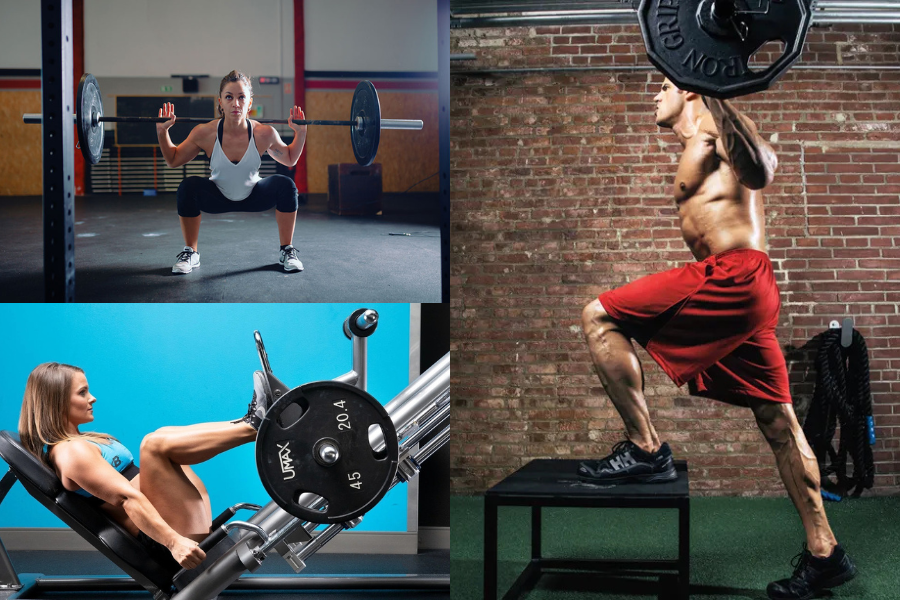
If you want a heavy compound lift that hammers your quads, the barbell front squat deserves a top spot. By resting the bar in front of your shoulders, you keep your torso more upright and limit hip bending. That shifts more work to your quads compared with a back squat.
Gymshark highlights front squats as one of the most effective quad builders in their 2024 guide.
How to do it
- Set the bar on a rack at about mid chest height.
- Step under and place the bar across the front of your shoulders.
- Use either a “clean grip” with fingers under the bar or a cross arm grip.
- Keep your elbows high and chest up.
- Step back, set your feet shoulder width with toes slightly out.
- Inhale, brace your core, and sit down between your hips while keeping your torso upright.
- Let your knees track over your toes.
- Drive through your whole foot to stand back up.
Key benefits
- Heavy loading for strength and muscle
- High quad activation due to upright torso and knee flexion
- Builds core and upper back strength as you stabilize the bar
Programming tip
If you are new to front squats, start light and treat them as a skill lift. Focus on:
- Clean bar position
- Stable feet
- Smooth depth
Try 3 to 4 sets of 5 to 8 reps, 1 to 2 times per week.
2. Heel elevated goblet squat
If you want the best quad exercises without a barbell, the heel elevated goblet squat is a smart pick. Elevating your heels on plates or a slant board reduces ankle demands and lets your knees travel further forward. That increases quad tension and makes it easier to stay upright.
According to Gymshark’s 2024 technique breakdown, this variation is excellent for quad size, especially if your ankle mobility is limited.
How to do it
- Place your heels on small plates or a slant board.
- Hold a dumbbell or kettlebell at your chest, “goblet” style.
- Stand tall with feet about shoulder width.
- Sit straight down, letting your knees track over your toes.
- Keep your chest up and core braced.
- Squat as low as you can while staying in control.
- Push through your midfoot and heels to stand.
Key benefits
- Extremely quad focused
- Back friendly compared to heavy back squats
- Great groove builder for beginners
Programming tip
Gymshark suggests 2 sets of 10 reps with about 60 seconds rest as a starting point. You can progress by:
- Increasing weight
- Adding sets
- Slowing the lowering phase
3. Hack squat
The hack squat machine lets you drive serious tension into your quads with built in back support. By placing your feet lower on the platform and focusing on depth, you can maximize knee flexion and quad engagement.
Natural bodybuilders often rank hack squats near the top for quad size because you can safely push intensity and volume.
How to do it
- Set your shoulders under the pads and your back against the support.
- Place your feet shoulder width and slightly lower on the platform for more quad focus.
- Unrack the weight and unlock your knees.
- Lower under control, letting your knees track over your toes.
- Descend as deep as your hips and knees comfortably allow.
- Drive through your feet to return to the top without snapping your knees.
Key benefits
- High quad load with back support
- Easier to take near failure safely
- Simple to adjust stance for more or less quad emphasis
Programming tip
Treat the hack squat as a main or secondary strength movement:
- 3 to 4 sets of 8 to 12 reps
- Focus on consistent depth and smooth tempo
- Use controlled progress, adding load or reps over several weeks
4. Leg press (low foot placement)
The leg press is another “S tier” quad exercise in many lifters’ eyes. With back support and a guided track, you can handle heavier loads than free weight squats for many people.
Foot placement is the lever that turns a general leg press into one of the best quad exercises. A lower position on the platform increases knee bend and reduces hip dominance, which increases quad activation according to Gymshark’s 2024 recommendations.
How to do it
- Sit with your back flat and hips fully against the pad.
- Place your feet shoulder width, lower on the platform for more quad focus.
- Unrack and unlock your knees.
- Lower the sled until your knees are deeply bent but your hips stay on the pad.
- Press back up without locking your knees hard.
Key benefits
- Big weights with less systemic fatigue than heavy barbell squats
- Easy to adjust stance, load, and range of motion
- Great for advanced techniques like single leg sets or drop sets
Programming tip
You can use the leg press as your primary heavy movement or after squats:
- 3 to 5 sets of 10 to 15 reps
- Rest 60 to 120 seconds between sets
- Optionally use single leg sets to iron out imbalances
5. Bulgarian split squat
If you are looking for a single movement that crushes your quads and tests your balance, the Bulgarian split squat is hard to beat. By elevating your back foot, you isolate the front leg and increase the stretch and tension on the working quad.
Gymshark and many natural bodybuilders highlight Bulgarian split squats for unilateral strength and serious quad growth, sometimes reporting better progress than back squats.
How to do it
- Stand about two feet in front of a bench.
- Place the top of your back foot on the bench.
- Bring your front foot a bit closer than a long lunge would be.
- Keep your torso mostly upright.
- Lower your hips straight down, letting your front knee track over your toes.
- Stop just before your back knee touches the floor.
- Push through your front foot to stand.
Key benefits
- Targets quads, glutes, and hamstrings on the front leg
- Fixes side to side strength differences
- Improves balance and core stability
Programming tip
For muscle and control, start with body weight or light dumbbells:
- 2 to 4 sets of 8 to 12 reps per leg
- Rest 30 to 60 seconds between legs
- Use a shorter stance and upright torso to emphasize quads, as Gymshark suggests
6. Walking lunge and split squat
Lunges and split squats are classic, versatile quad builders that need very little equipment.
- Walking lunges move you forward step by step and hit your quads, hamstrings, glutes, and core. Adding dumbbells increases difficulty.
- Split squats let you stay in one spot and focus on one leg, improving quad strength and balance.
How to do a forward lunge
- Stand tall with feet hip width apart.
- Step forward and plant your front foot firmly.
- Lower until your front knee is around 90 degrees and your back knee is close to the floor.
- Keep your torso upright and your front knee over your toes, not collapsing inward.
- Drive through your front heel to stand and step into the next lunge.
How to do a split squat
- Start in a lunge stance with one foot forward and one behind.
- Stay in place, then lower your hips straight down.
- Stop just before your back knee touches the floor.
- Push through the front foot to stand.
Key benefits
- Train balance, coordination, and single leg strength
- Easy to progress with dumbbells or longer sets
- Friendly for home workouts
Programming tip
You can rotate lunges and split squats across the week:
- Walking lunges: 2 to 3 sets of 10 to 15 steps per leg
- Split squats: 2 sets of 10 reps per side with about 30 seconds rest, as suggested in beginner programs
Use a front foot elevation on a plate if you want even more quad emphasis, which Gymshark notes helps increase knee flexion and recruitment.
7. Leg extension
If you want a pure isolation move in your list of best quad exercises, leg extensions are your go to. They target the quadriceps only and let you push closer to failure with less total body fatigue.
Gymshark highlights leg extensions as the most effective isolation exercise for maximal quad growth, particularly for the rectus femoris, with many natural bodybuilders using them heavily in quad programs.
How to do it
- Sit on the leg extension machine with your back flat.
- Adjust the pad so it rests just above your ankles.
- Grip the handles or sides of the seat.
- Extend your knees until your legs are almost straight.
- Squeeze your quads at the top for one to two seconds.
- Lower slowly under control.
Key benefits
- Isolates quads with minimal stress elsewhere
- Great finisher after big compounds
- Easy to adjust load and range of motion for comfort
Programming tip
Use leg extensions toward the end of your workout:
- 3 to 4 sets of 10 to 15 reps
- Experiment with single leg sets or brief holds at the top for extra tension
- Because they are less taxing overall, you can perform them slightly more often than heavy squats
8. Leg raise and straight leg variations
Straight leg raises and short arc quads seem simple, but they are effective for targeting the rectus femoris and building foundational quad strength. They are especially useful if you are a beginner or returning from knee issues.
How to do a straight leg raise
- Lie on your back with one leg straight and the other bent.
- Tighten the quad on your straight leg so your knee locks.
- Raise the straight leg to about the height of your bent knee.
- Pause, then lower slowly.
How to do short arc quads
- Lie on your back with a rolled towel or foam roller under your knee.
- Keep your thigh on the support.
- Straighten your knee by contracting your quad.
- Pause at the top, then lower.
Key benefits
- Gentle on joints
- Build mind muscle connection with quads
- Help rehab and prepare for heavier quad work
Programming tip
You can use these as warm ups, accessory work, or part of rehab:
- 2 to 3 sets of 10 to 15 reps per leg
- Focus on slow, controlled movement and full quad contraction
9. Plyometric quad work: squat and box jumps
Once you have strength, power is the next step. Squat jumps and box jumps recruit your quads, glutes, calves, and core to produce force quickly. They are especially useful if you care about sprinting speed or jumping ability.
Research notes that these powerful movements develop lower body power and emphasize quad involvement, but the injury risk rises when you are fatigued. For that reason, many coaches recommend starting with small sets of about five reps per set.
How to do a squat jump
- Stand with feet shoulder width apart.
- Drop into a quarter to half squat.
- Swing your arms and explode upward.
- Land softly, absorbing force through the hips, knees, and ankles.
- Reset fully between reps.
How to do a box jump
- Stand a short distance from a stable box or platform.
- Drop into a quarter squat and swing your arms.
- Jump onto the box, landing softly with knees slightly bent.
- Step down, do not jump back down.
Key benefits
- Build explosive quad power
- Improve athleticism and sprint transfer
- Train absorption and landing mechanics
Programming tip
Treat jumps as power work, not conditioning:
- Perform them early in your workout, after a warm up
- 3 to 5 sets of 3 to 5 reps
- Stop as soon as your jumps lose height or crispness
10. Sled push and sprint specific quad work
If you are interested in speed, some of the best quad exercises are those that mimic sprinting mechanics. Strong quads are crucial for the start and drive phases of sprinting, especially in the first 20 meters of acceleration.
Coaches use tools like heavy sled pushes, heel elevated front squats, and specific split squat patterns to build quad strength that carries to the track.
Heavy sled push
A heavy sled push with a forward lean and elevated heels teaches you to push hard with your quads and glutes.
How to do it
- Load a sled heavy enough that it feels challenging over 10 to 15 meters.
- Lean forward, keeping your heels slightly elevated to maintain plantar flexion.
- Drive through the balls of your feet and extend your knees and hips powerfully as you walk the sled forward.
Programming
- 3 sets of 10 to 15 meters
- Focus on strong, powerful strides rather than speed only
Dumbbell elevated split squat
A dumbbell elevated split squat using a slant board puts your front heel on an incline while your back foot rests lower, which:
- Shifts more work to the quads
- Challenges your trunk control
- Transfers well to the drive phase of sprinting
Basic prescription
- About 3 sets of 10 reps per leg
- Maintain an upright torso and strong core
Banded skater squat into hip lock
This variation uses a band anchored to an immovable object to challenge your balance and quad explosiveness.
- Anchor a PowerLastic or similar band in front of you.
- Hold the band and perform a skater style single leg squat.
- Drive up into a “hip lock” position on the working leg, pausing briefly.
Recommended use is 3 sets of 5 reps per leg to improve max acceleration mechanics.
How to build your own quad workout
You do not need all ten of the best quad exercises in a single session. Mix and match based on your gear, level, and goals.
Sample quad hypertrophy day
- Front squat or hack squat: 3 × 6 to 8
- Leg press (low foot): 3 × 10 to 12
- Bulgarian split squat: 3 × 8 to 10 per leg
- Leg extension: 3 × 12 to 15
Sample beginner friendly quad day
- Goblet squat: 2 to 3 × 10
- Split squat: 2 × 10 per leg
- Wall sit: 2 × 30 seconds
- Straight leg raises: 2 × 12 per leg
Sample speed and power focused day
- Squat jumps or box jumps: 3 × 3 to 5
- Heel elevated front squat: 3 × 5 to 8
- Heavy sled push: 3 × 10 to 15 meters
- Banded skater squat into hip lock: 3 × 5 per leg
Aim to train quads twice per week, with at least one day between sessions, and reach around 10 or more quality sets total per week as suggested by Gymshark’s 2024 guidance.
Form, safety, and progression
To get the most from the best quad exercises and stay healthy, keep a few guardrails in place.
Prioritize technique over load
- Move through a controlled, comfortable range of motion.
- Keep knees tracking with your toes.
- Avoid bouncing or letting weight pull you into positions you cannot own.
If you feel joint pain, reduce load, shorten range, or choose a different variation such as goblet squats or leg presses that are easier to control.
Progress gradually
- Add small amounts of weight or a couple of reps per week.
- When that stalls, add a set or change tempo.
- Stick with a given plan for at least 4 to 6 weeks before overhauling it.
Recover like it matters
Stronger quads grow outside the gym:
- Sleep enough
- Eat enough protein and calories for your goals
- Respect that 48 hour recovery window between hard quad sessions
Bringing it all together
The best quad exercises work because they respect how your quads function, from deep knee flexion in squats to isolated extension in machine work and explosive power in jumps and sled pushes. When you train them with solid technique, enough volume, and a mix of bilateral and unilateral moves, you give your legs every reason to grow stronger and more powerful.
Pick two or three of the exercises above, plug them into a twice a week plan, and track your progress. Stay consistent and your next set of stairs, sprints, or heavy lifts will feel very different.
About the Author