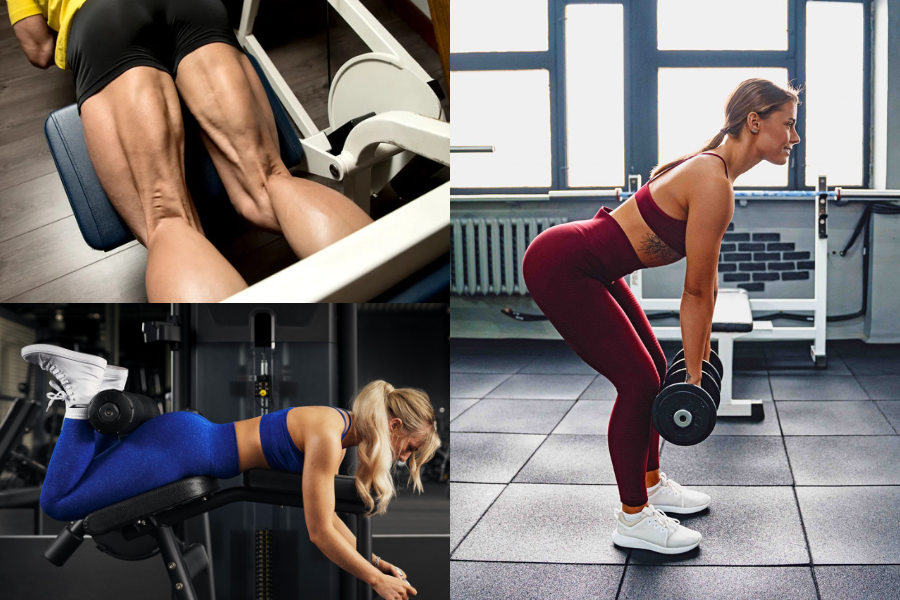
Understand your hamstrings first
If you want the best hamstring exercises to actually work, you need a quick picture of what you are training.
Your hamstrings sit at the back of your thigh and cross both your hip and knee. They:
- Extend your hip, like when you sprint, jump, or come up from a deadlift
- Bend your knee, like during a leg curl or when you push off in a run
- Help rotate the thigh and stabilize the knee and pelvis
Most guides describe three hamstring muscles, the semitendinosus, semimembranosus, and biceps femoris. Others break the biceps femoris into long and short heads and treat them as four muscles. Either way, the key point is simple: these muscles work hard any time you hinge at the hips or bend the knee under load.
Hamstring injuries are common in sports that involve sprinting or kicking. They also have one of the highest re‑injury rates, with many recurrences happening within the first month of returning to sport, which is why consistent strengthening is so valuable.
Your goal is not just to “feel a stretch” in the back of the leg. The best hamstring exercises build strength, control, and range of motion so you can move better, lift more, and stay out of the treatment room.
Why hamstring strength matters
Stronger hamstrings do more than make the back of your legs look defined. They help you:
- Run faster and accelerate harder
- Jump, cut, and change direction with more control
- Protect your knees and hips from overload
- Support your lower back in daily life and heavy lifts
- Reduce the risk of pulled or torn hamstrings
Research shows that eccentric strength training, where your hamstrings work as they lengthen, is especially effective for reducing injury risk. Nordic hamstring curls, stiff‑leg deadlift variations, and hamstring slides are all examples of this.
A consistent program that includes 10 to 16 total hamstring sets per week can significantly cut your injury risk, even if you only train them a couple of times per week.
How to warm up your hamstrings
Before you dive into the best hamstring exercises, prepare the tissue. You want your warm up to increase blood flow, improve range of motion, and wake up the muscles, without blunting your strength.
Current guidance from physical therapy sources suggests:
- Avoid long static hamstring stretches before heavy lifting or explosive work, especially holding a stretch for 30 seconds or more, because that can briefly reduce maximal strength
- Use dynamic movements instead to open up range of motion without killing power
Good dynamic options include:
- Leg swings, front to back and side to side
- Walking lunges
- Air squats
- Butt kicks
Save longer static hamstring stretches for the cool down or separate flexibility sessions.
If you have a recent hamstring strain from sprinting or a sharp incident like slipping, do not stretch aggressively into pain. Early after an acute injury, it is safer to get a physical therapist to assess you and map out the right progression.
How to choose your hamstring exercises
There is no single “best” move for everyone. You will get the most from your training if you balance three types of patterns:
- Hip hinge dominant
- Example: Romanian deadlifts, good mornings, kettlebell swings, glute bridges
- These hit your hamstrings hard as hip extensors
- Knee flexion dominant
- Example: seated or lying leg curls, band curls, Nordic curls
- These focus on the hamstring role in bending the knee
- Eccentric focused
- Example: Nordic curls, hamstring slides, many single‑leg deadlift variations
- These are powerful for resilience and injury prevention
You will see all three ideas show up in the list below, using a mix of bodyweight, bands, and weights. You can build an effective routine even if you only have a resistance band at home.
1. Romanian deadlift (RDL)
If you pick just one lift from this list of best hamstring exercises, the Romanian deadlift is a leading candidate. It places the hamstrings under a deep stretch while they work hard, which is a potent signal for strength and muscle growth.
You can use a barbell, dumbbells, or a kettlebell.
How to do it
- Stand tall with your feet hip‑width apart, weight held in front of your thighs.
- Soften your knees slightly, then hinge at the hips, sending your hips back like you are closing a car door with your glutes.
- Keep your spine neutral, chest proud, and let the weight slide down your thighs toward mid‑shin.
- Stop when you feel a strong but tolerable stretch in the back of your legs, not when your back rounds.
- Drive your feet into the floor, squeeze your glutes, and return to standing.
Key tips
- Keep the bar or weights close to your body the whole time.
- Think about pushing your hips back, not bending your spine forward.
- Start light and earn extra range of motion gradually.
Good starting prescription
- 3 to 4 sets of 6 to 10 reps
- Rest 90 to 150 seconds between sets
2. Conventional deadlift
The conventional deadlift is a full posterior chain builder. Your glutes, hamstrings, lower back, and upper back all work together. It is slightly more knee‑dominant than an RDL, but your hamstrings still play a major role in hip extension.
How to do it
- Stand with your mid‑foot under the bar, feet about hip‑width apart.
- Hinge down, bend your knees, and grab the bar just outside your legs.
- Flatten your back, brace your core, and pull the slack out of the bar.
- Push the floor away and stand up, keeping the bar close.
- Reverse the motion with control and return the bar to the ground.
Key tips
- Treat each rep like a single. Reset your brace before lifting again.
- If your lower back rounds, reduce the weight and tighten your setup.
Good starting prescription
- 3 to 5 sets of 3 to 6 reps
- Longer rest, 2 to 3 minutes, because loads tend to be heavier
3. Single‑leg Romanian deadlift
The single‑leg RDL trains similar mechanics to the standard RDL but with one big upgrade, unilateral control. You improve balance, hip stability, and side‑to‑side symmetry. You can use a dumbbell, kettlebell, or just bodyweight to start.
How to do it
- Stand tall on one leg, with a slight bend in the knee. Hold a weight in the opposite hand.
- Hinge at the hip of the standing leg while the free leg reaches straight back behind you.
- Keep your hips square to the floor and your spine neutral.
- Lower until you feel a strong stretch in the hamstrings of the standing leg.
- Drive through the mid‑foot and return to standing.
Key tips
- Keep your pelvis level. Avoid letting your hip open toward the side.
- Move slowly to control balance. Use a wall or support if needed at first.
Good starting prescription
- 3 sets of 8 to 12 reps per leg
- Rest 60 to 90 seconds between legs
4. Nordic hamstring curl
The Nordic curl is one of the most researched hamstring exercises for injury prevention. It focuses on eccentric strength at the knee and can be very challenging even with your bodyweight alone.
How to do it
- Kneel on a soft surface with your torso upright.
- Anchor your feet under a sturdy object or have a partner hold your ankles.
- Cross your arms or keep your hands ready to catch yourself.
- Slowly lean your body forward from the knees, keeping hips extended and body in a straight line.
- Control the descent as long as possible, then catch yourself with your hands and lightly push off the floor to help return to the starting position.
Key tips
- Focus on slow lowering rather than explosive coming up.
- Do not worry if you cannot pull back up yet. The eccentric only version still builds strength.
Good starting prescription
- 3 sets of 5 to 6 controlled reps
- Rest 2 to 3 minutes, because these are taxing
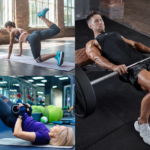
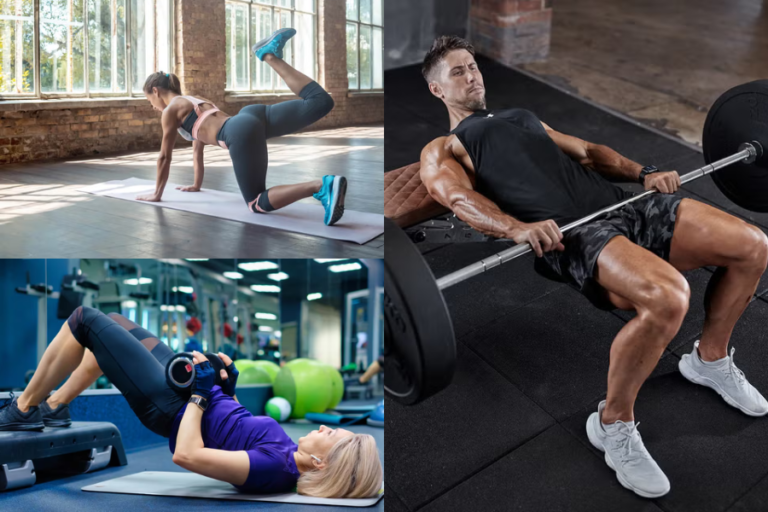
5. Glute bridge and hip thrust
Hip thrusts and glute bridges are often treated as “glute exercises”, but if you adjust your foot position, you shift more demand to the hamstrings.
Placing your feet slightly farther away from your body increases hamstring involvement in hip extension.
How to do a basic hip thrust
- Sit on the floor with your upper back resting against a bench.
- Place your feet flat on the floor, shoulder‑width apart, and a bit in front of your knees.
- Drive through your heels and extend your hips until your body forms a straight line from shoulders to knees.
- Squeeze your glutes and hamstrings at the top.
- Lower your hips under control.
You can load this movement with a barbell, dumbbell, or resistance band across your hips.
Single‑leg variations
Single‑leg glute bridges increase the challenge and are effective even with no equipment. They are especially useful if you train at home.
Good starting prescription
- 3 to 4 sets of 10 to 15 reps
- For single‑leg bridges, 8 to 12 reps per side
6. Seated and lying leg curls
Hamstring curl machines allow you to isolate the muscles that bend your knee and are useful if you want to target weak points or build volume safely.
- Seated hamstring curls tend to emphasize the semitendinosus
- Prone or lying leg curls often stress the biceps femoris more
How to do them well
- Adjust the machine so the pad rests just above your heels or on your lower calves.
- Brace your core and keep your hips stable.
- Curl the pad toward your glutes in a controlled motion.
- Squeeze at the end range, then lower slowly.
Why use them
- Great for beginners who need to learn to feel their hamstrings work
- Useful for higher rep “pump” work at the end of a workout
- Helpful in rehab settings or when you need lower back friendly options
Good starting prescription
- 3 sets of 10 to 15 reps
- Focus on a 2 to 3 second lowering phase
7. Resistance band hamstring exercises
If you train at home or on the road, resistance bands are an efficient way to hit your hamstrings with constant tension. Guides on banded training point out that bands can deliver strong muscle activation and progressive overload even without heavy equipment.
Common band variations that target your hamstrings include:
- Seated hamstring curls
- Lying hamstring curls
- Band good mornings
- Band Romanian deadlifts
- Band glute bridges and single‑leg glute bridges
- Resistance band donkey kicks
- Banded hamstring marches
Example: banded lying hamstring curl
- Anchor a band to a sturdy object at floor level.
- Loop the other end around your ankles or heels.
- Lie face down, legs extended.
- Curl your heels toward your glutes against the band, then lower slowly.
Key tips from band training guides:
- Use lighter bands for smooth, controlled lying curls
- In seated curls, pull past a 90‑degree knee angle to train the full range
- In band good mornings, keep a neutral spine and push your hips back
Good starting prescription for a band‑only session
- Band RDL: 3 to 4 sets of 8 to 15 reps
- Single‑leg glute bridge: 3 sets of 12 to 20 reps per side
- Banded hamstring marches: 3 sets of 8 to 10 reps
- Lying curls: 2 to 3 sets close to technical failure
8. Kettlebell swings
Kettlebell swings are a powerful hip hinge exercise that has been identified as one of the best for activating the biceps femoris. They target your hamstrings, glutes, and lower back, and add a conditioning element.
How to do it
- Place a kettlebell about a foot in front of you.
- Hinge at the hips, grab the handle, and hike the bell back between your legs.
- Snap your hips forward to drive the bell to chest height.
- Let the bell fall naturally as you hinge again, keeping your back neutral.
Key tips
- Your arms are hooks, your hips are the engine.
- The movement is a hip hinge, not a squat.
- Keep the bell close to your body path, not arcing far in front of you.
Good starting prescription
- 3 to 5 sets of 10 to 20 swings
- Rest 60 to 90 seconds between sets
9. Bodyweight hamstring slides and gliders
If you have a hardwood floor, sliders, or even towels, you can use hamstring slides to build serious eccentric strength with minimal equipment.
How to do hamstring slides
- Lie on your back with your heels on sliders or a towel, knees bent.
- Lift your hips into a bridge position.
- Slowly slide your heels away from your body, extending your knees while keeping hips off the ground.
- When your legs are nearly straight, either pull your heels back in or drop your hips and reset.
You can also do single‑leg versions for more challenge.
Why they work
- They place your hamstrings under load as they lengthen
- They demand core stability and glute engagement
- They are joint‑friendly, since resistance is self‑limited by your control
Good starting prescription
- 3 sets of 6 to 8 reps for standard slides
- Focus on a slow, 3 to 4 second slide out
10. Bulgarian split squat and reverse lunge
You might think of these as “quad moves”, but Bulgarian split squats and reverse lunges light up your hamstrings and glutes, especially when you emphasize a hip hinge and longer stride.
Bulgarian split squat
- Stand a step or two in front of a bench and place one foot behind you on the bench.
- Lean slightly forward at the hip and lower your back knee toward the floor.
- Push through the front foot to stand back up.
Reverse lunge
- Stand tall, then step one foot back into a lunge, dropping the back knee toward the floor.
- Keep a long stride so your front shin does not push too far past your toes.
- Drive through the front heel to return to standing.
Why they help your hamstrings
- A longer stance loads the back of the front leg more
- The slight forward torso angle makes the movement more hip dominant
Good starting prescription
- 3 sets of 8 to 12 reps per leg
- Add dumbbells once bodyweight feels easy
How many sets and reps for best results
You can build strong hamstrings with different set and rep patterns, as long as you are consistent and progress gradually.
General training guidelines from current recommendations:
- Weekly volume
- Aim for about 10 to 16 total sets of hamstrings per week
- This can be split across 2 focused sessions or sprinkled through your lower body days
- Rep ranges
- Strength: 4 to 8 reps per set with heavier loads
- Hypertrophy and endurance: 8 to 20 reps with moderate loads or bodyweight
- Frequency
- Twice per week is a sweet spot for most people, with at least 48 hours between hard hamstring sessions
The key is to increase difficulty slowly over time by:
- Adding weight
- Adding reps
- Slowing the eccentric portion
- Moving to more challenging variations like single‑leg or Nordic versions
When stretching and mobility fit in
You often hear that tight hamstrings just need more stretching. The research is more nuanced.
A 2021 review of multiple trials found that strength training can improve range of motion just as well as stretching. In some specific joint movements, like knee extension, strength training even showed a slight advantage once researchers adjusted for publication bias.
In practice, this means:
- If your hamstrings always feel tight, it may reflect weakness or poor control, not just inflexibility
- A progressive strengthening program for your hamstrings and hips can improve how loose you feel
- Stretching still has a place, especially after training, but it is not the only tool
Short dynamic stretches fit well before training. Longer static hamstring stretches are better saved for the end of your workout or separate mobility sessions, especially if maximal strength or power is on the agenda.
When to see a professional
Most people can safely start with the easier versions of these best hamstring exercises. You should speak with a medical professional or physical therapist before ramping up if:
- You have a recent or recurring hamstring strain
- You feel sharp pain during daily activities like walking or climbing stairs
- You experience significant pain or weakness during simple bodyweight moves
Physical therapists can test whether you need more stretching, more strengthening, or both, and then build a tailored plan. This is especially important because hamstring injuries have a tendency to recur if the rehab process is rushed or incomplete, with a large share of re‑injuries occurring within the first few weeks back to full sport.
How to build your hamstring workout
You do not need all ten exercises at once. Aim for one or two hip hinge moves, one knee flexion move, and one unilateral or eccentric‑focused move in each lower body session.
Here is a simple template you can use twice per week:
Day A
Romanian deadlift
- 3 sets of 6 to 8 reps
Bulgarian split squat
- 3 sets of 8 to 10 reps per leg
Seated or lying leg curl
- 3 sets of 10 to 15 reps
Day B
Conventional deadlift or kettlebell swings
- Deadlift: 3 sets of 3 to 5 reps
- Or swings: 4 sets of 15 to 20 reps
Single‑leg Romanian deadlift
- 3 sets of 8 to 12 reps per leg
Nordic hamstring curl or hamstring slides
- 3 sets of 5 to 6 Nordics
- Or 3 sets of 6 to 8 slides
Adjust the total based on your experience level:
- If you are a beginner, start with 2 sets per exercise and focus on form.
- If you are more advanced, use the higher set counts and push your last 1 to 2 reps of each set close to your technical limit.
Putting it into action
Hamstrings respond well to work, but they are unforgiving if you ignore them. By mixing hip hinges, curls, unilateral moves, and eccentric‑focused drills, you cover strength, stability, and resilience in one package.
Your next step:
- Pick three or four exercises from this list that match your equipment.
- Slot them into two lower body sessions this week.
- Stay consistent for at least six to eight weeks before you judge your results.
You will feel the difference every time you run, jump, or stand up from a heavy set.
About the Author