Why your back workouts matter
If you are chasing a stronger body, better posture, or just want your t‑shirt to fit better, you cannot ignore your back. The best back exercises do much more than build muscle. They support your spine, protect your shoulders, and help you move well in almost every daily task.
Your back is involved when you stand up, carry groceries, pick up kids, or reach overhead. It is also one of the most commonly injured areas for all age groups, according to orthopedic surgeon Matthew Wert in 2021. That is why picking smart, safe, and effective back moves is worth your time.
Below, you will find 10 of the best back exercises, pulled from current research and strength coaching experience. You will see why each move works, how to do it, and how to plug it into your routine whether you lift at home or in a gym.
Use this as a menu, not a script. You do not need all 10 in a single workout. Start with three to five, focus on form, and build from there.
How to use this guide
Before you jump into the best back exercises, set yourself up to win.
- If you are a beginner, pick 3 to 4 exercises, 2 to 3 sets each
- If you are more experienced, pick 5 to 6 exercises, 3 to 4 sets each
- Aim for 6 to 12 controlled reps on most moves
- Rest 60 to 90 seconds between sets for muscle building
- Keep 1 to 2 reps in reserve instead of pushing every set to failure
You will also get more from this list if you cover four key patterns:
- Hip hinge (heavy whole‑back loading)
- Horizontal pull (rows)
- Vertical pull (pullups or pulldowns)
- Posture and stability (lighter work for mid and lower traps, spinal erectors, and core)
The 10 exercises below hit all four.
1. Deadlift
Few moves deserve a spot on any “best back exercises” list as much as the deadlift. In 2024 testing from Built With Science, deadlifts showed very high activation across all measured back muscles. They train your entire posterior chain from calves to upper traps and are one of the most efficient ways to build overall back strength and size.
What it works
- Spinal erectors
- Lats and traps
- Glutes and hamstrings
- Grip and core
How to do it
- Stand with your mid‑foot under the bar, feet about hip‑width apart.
- Hinge at the hips, bend your knees slightly, and grab the bar just outside your legs.
- Flatten your back and brace your core. Your chest should be up, eyes fixed on a spot a few feet ahead on the floor.
- Push the floor away with your legs and stand up tall, keeping the bar close to your body.
- Lock out by squeezing your glutes, not leaning back.
- Reverse the motion by pushing your hips back and bending your knees to lower the bar with control.
Coaching tips
- Place deadlifts first in your back workout while you are fresh. Heavy pulls are demanding and give the best return when you are not fatigued.
- Start conservatively and progress your weight slowly to avoid lower back strain.
- If standard deadlifts bother your back, explore trap‑bar deadlifts or lighter Romanian deadlifts as an alternative.
2. Bent‑over row
Bent‑over rows are another top overall back builder. In the 2024 Built With Science experiment, they ranked near the top for full‑back activation. An overhand grip tends to hit the mid‑back more, while an underhand grip can increase lower lat focus. Either way, you are training a lot of muscle in one move.
What it works
- Mid‑back (rhomboids, mid traps)
- Lats
- Rear delts
- Spinal erectors and core
How to do it
- Stand with feet shoulder‑width apart, holding a barbell or two dumbbells.
- Hinge at your hips until your torso is about 30 to 45 degrees from parallel, knees slightly bent.
- Let the weight hang at arm’s length, keep your spine neutral, and brace your core.
- Pull your elbows back toward your hips, squeezing your shoulder blades together.
- Pause briefly, then lower under control.
Coaching tips
- Place bent‑over rows early in your workout, often right after deadlifts, in the 6 to 10 rep range. This saves your lower back while you are still strong.
- Avoid shrugging. Think about pulling your elbows back, not up.
- If your lower back protests, switch to a chest‑supported row variation on a bench.
3. Pullup
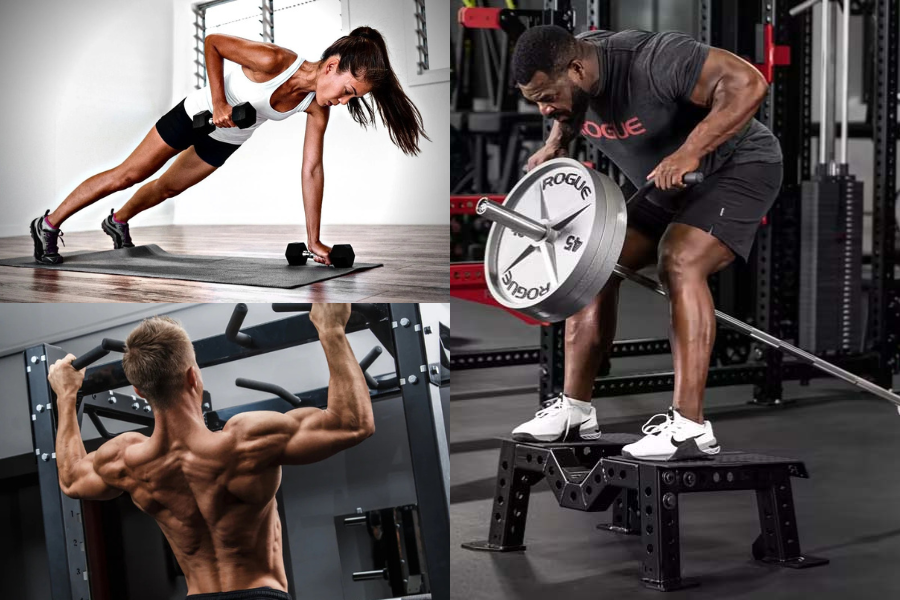
If there is a “test” for back strength, it is the pullup. You lift your own bodyweight to a bar, which demands both strength and control. Pullups are one of the best back exercises for building your lats and upper back, and they carry over well to sports and everyday life.
What it works
- Lats, especially upper lats with a wider grip
- Teres major and mid‑back
- Biceps and forearms
- Core
How to do it
- Grab a pullup bar with an overhand grip, slightly wider than your shoulders.
- Start from a dead hang with arms straight and shoulders engaged, not relaxed.
- Pull your elbows down and toward your ribs, lifting your chest toward the bar.
- Aim to get your chin over the bar without swinging.
- Lower with control to a full hang.
A common prescription is 3 to 4 sets of 6 to 10 reps. Use a band or an assisted machine if you cannot yet hit that range.
Coaching tips
- Think of driving your elbows into your back pockets instead of just pulling with your hands. This mental cue can improve lat activation, a tip also echoed by community members on Muscle & Strength in 2024.
- Experiment with neutral or close‑grip pullups to find a variation that feels best on your shoulders.
- If you are heavier or new to training, start with assisted pullups or inverted rows and progress over time.
4. Lat pulldown (neutral grip)
No bar access or still building up to pullups? A close neutral‑grip lat pulldown is a smart substitute. Research shows that a close neutral grip can increase time under tension and provide a long range of motion, which is effective for activating the lats and building muscle.
What it works
- Lats
- Mid‑back
- Biceps and forearms
How to do it
- Sit at a lat pulldown station and grab the neutral handle (palms facing each other).
- Set your thighs snug under the pads and plant your feet.
- Lean back slightly from the hips while keeping your spine neutral.
- Pull the handle down toward your upper chest, driving your elbows down and in.
- Pause briefly at the bottom, then let the bar rise under control until your arms are straight.
Coaching tips
- Place pulldowns in the middle or later part of your workout for 3 to 4 sets of 8 to 12 reps.
- Stay strict. Avoid using momentum or leaning too far back, which turns the move into more of a row.
- Focus on feeling your lats stretch at the top and contract at the bottom, not just moving the weight.
5. Inverted row
The inverted row is one of the best back exercises if you want strong results with minimal equipment. In the 2024 Built With Science testing, the inverted row was the best upper and mid‑back exercise for beginners and many women, eliciting high back activation in less experienced lifters.
You can do it with a bar in a rack, a Smith machine, or suspension straps.
What it works
- Mid and upper back
- Rear delts
- Core and glutes (as stabilizers)
How to do it
- Set a bar in a rack around waist height or adjust your straps.
- Lie under the bar and grab it with an overhand grip, slightly wider than shoulders.
- Extend your legs and keep your body in a straight line from head to heels.
- Pull your chest toward the bar by driving your elbows back.
- Touch your chest to the bar or get as close as you can, then lower with control.
A common routine is 3 sets of 8 to 10 reps.
Coaching tips
- Bend your knees and keep your feet flat if full‑body rows are too hard. Straighten your legs as you get stronger.
- Do not let your hips sag. Squeeze your glutes and keep your core tight to maintain a straight line.
- Use this as either a primary rowing movement if you are a beginner or as a high‑rep finisher for more experienced lifters.
6. T‑bar row
The T‑bar row helps you move heavy weight with more lower‑back support than a traditional barbell row. It is especially good for targeting the muscles across the middle of your back. A neutral grip version tends to be easier on the shoulders and wrists.
What it works
- Rhomboids
- Mid traps
- Lats
- Rear delts
How to do it
- Load the T‑bar machine or landmine attachment.
- Stand on the platform or straddle the bar, feet shoulder‑width apart.
- Hinge at the hips with a slight knee bend and grab the handles with a neutral grip.
- Brace your core and keep your chest up.
- Pull the handles toward your lower chest or upper stomach.
- Squeeze your shoulder blades together, then lower with control.
Coaching tips
- Place T‑bar rows near the start or middle of your session for 3 to 4 sets of 6 to 10 reps.
- Avoid “heaving” the weight up with momentum. If you cannot pause briefly at the top, the load is likely too heavy.
- Adjust your torso angle. A slightly higher chest position can reduce lower‑back strain.
7. Incline‑prone Y raise
Most people hammer lats and upper traps but neglect the lower traps, which are crucial for shoulder health and posture. Incline‑prone Y raises fix that gap. In 2024 research from Built With Science, this simple bodyweight or light‑weight move showed superior activation of the lower traps, which help you keep your shoulders back and down.
What it works
- Lower and mid traps
- Rotator cuff and small stabilizers
- Posture muscles around the shoulder blades
How to do it
- Lie face down on an incline bench set to about 30 to 45 degrees.
- Let your arms hang down with thumbs pointing up. You can use light dumbbells or just bodyweight.
- Keeping your elbows mostly straight, raise your arms in a Y shape until they are in line with your body.
- Focus on pulling your shoulder blades down and back rather than shrugging.
- Pause, then lower slowly.
Coaching tips
- Keep the weight light. The goal is control and muscle activation, not load. Think 2 to 5 pounds or even no weight to start.
- Place this toward the end of your workout for 2 to 3 sets of 10 to 15 reps.
- If your neck feels tension, reset and make sure your head is in line with your spine, not jutting forward.
8. Superman variations
The Superman and its Y, W, T, and pullup variations are simple floor moves that strengthen the entire length of your back. They require no equipment and are especially useful if you train at home or want to add extra posture work without heavy loading.
These variations were highlighted as effective back builders in 2024 guidance, with typical routines of 3 sets of 12 to 15 reps.
What they work
- Spinal erectors
- Glutes and hamstrings
- Mid and upper back (in Y, W, T versions)
Basic Superman
- Lie face down on the floor with arms extended overhead and legs straight.
- Brace your core gently.
- Lift your arms, chest, and legs a few inches off the floor.
- Hold for 2 to 3 seconds, then lower with control.
Y, W, T and pullup Supermans
- Y: Arms in a Y shape overhead, thumbs up. Focus on lower traps.
- T: Arms straight out to the sides. Emphasize rear delts and mid traps.
- W: Bend elbows to create a W. Targets mid back and rotator cuff.
- Pullup Superman: Mimic a pullup motion with your arms while holding the raised position.
Coaching tips
- Keep the range of motion small. You do not need to crank your back into a big arch.
- If you have a history of back issues, start with shorter holds and lower reps.
- Use these at the end of your workout as a finisher for posture and endurance.
9. Back extension
The back extension is a direct way to strengthen your spinal erectors and glutes, both key for a stable, resilient lower back. Done correctly, it is one of the best back exercises for building endurance and support around your lumbar spine.
What it works
- Spinal erectors
- Glutes and hamstrings
- Lower back endurance
How to do it
You can use a 45‑degree hyperextension bench or a Roman chair.
- Set the pad so your hips can bend freely without digging into your thighs.
- Cross your arms over your chest or place your hands lightly behind your head.
- Start from a straight line from head to heels.
- Lower your upper body by hinging at the hips while keeping your back neutral.
- Raise your torso back to the starting line by squeezing your glutes and hamstrings.
Guidance from 2024 resources suggests 3 to 5 sets of 15 to 20 reps for optimal effect.
Coaching tips
- Do not hyperextend. Stopping at a straight line is enough.
- If you feel this mainly in your lower back, focus on driving the movement from your glutes.
- Add a light plate or dumbbell against your chest only after you can do high‑quality bodyweight sets.
10. Wall and floor “snow angels”
You might not think of posture drills as “best back exercises,” but they can dramatically improve how your back feels and looks. Two simple options come from Cleveland Clinic physical therapist Jennifer Danzo in 2024, who highlights “wall angels” and “Reverse Snow Angels” as powerful no‑equipment moves.
These exercises help open tight chest muscles, wake up your mid‑back, and counter the hunched position you hold at your desk or phone.
Wall angels
According to Danzo at Cleveland Clinic, the “wall angels” exercise mimics making a snow angel with your arms against a wall and helps stretch your arms and chest to correct posture by counteracting rounded shoulders and a slumping back.
- Stand with your back, head, and hips against a wall, feet a few inches out.
- Raise your arms to shoulder height, elbows bent 90 degrees, backs of hands against the wall.
- Slowly slide your arms up and down the wall, as if making a snow angel.
- Keep your lower ribs pulled gently toward the wall and avoid arching your lower back.
Reverse Snow Angels (floor)
In 2021 guidance on no‑equipment back training, Reverse Snow Angels were listed among the five best bodyweight back exercises for the lats, rhomboids, and spinal erectors.
- Lie face down on the floor, arms at your sides, palms facing your thighs.
- Lift your chest slightly off the floor.
- With elbows mostly straight, sweep your arms out and up in a wide arc until they are overhead, like a reverse snow angel.
- Pause, then return to your sides.
Guidelines suggest 3 sets of 5 reps with 30 to 60 seconds rest.
Coaching tips
- Move slowly and stay within a pain‑free range. These are about mobility and control, not intensity.
- Use them as part of your warmup or as a daily posture break during work.
- If you already have shoulder pain, check with a physical therapist before adding these.
Supporting moves for posture and neck
A strong back is not just about big lifts. A few simpler drills can make your posture and neck feel better, especially if you sit a lot.
Jennifer Danzo at Cleveland Clinic recommends several low‑load exercises that help restore alignment:
- Shoulder blade push: Lying on your back, knees bent, you press your shoulder blades down and back into the ground. This strengthens key back muscles for posture.
- Pull your head back: This chin tuck style move fights “head‑forward posture” by strengthening your neck and upper back while reducing stress on tight neck and chest muscles.
- Pelvic tilt: This targets lower back posture issues like swayback by strengthening and lengthening muscles to restore your natural lumbar curve.
You can slot these into your warmup or as a separate 5 to 10 minute posture routine a few times per week.
Warmup, form and safety
Back training pays off only if you respect your joints and spine. A few rules help you stay in the game.
Warm up smart
Muscle & Strength guidance from 2024 suggests:
- At least two warmup sets before your first heavy exercise
- At least one warmup set before each new big movement
You can use lighter weights and higher reps to groove the motion without fatigue.
Protect your back while you train
Several expert sources underline the same key ideas:
- Keep a neutral spine. Avoid rounding or hyperextending your back in deadlifts, rows, and extensions.
- Build steadily. Do not jump into weights heavier than you can control, especially on new exercises.
- Skip crunches if your back gets irritated. According to Spine and Wellness Centers of America in 2025, crunches can tighten hip flexors and pull the lumbar spine forward, which can trigger back pain. Choose ab moves that do not bother your back.
- Stretch hips and hamstrings. Tight hips and hamstrings can tug on your pelvis and spine. Full‑body stretching for at least 10 minutes after workouts, with an emphasis on hips and hamstrings, helps reduce muscle tightness that can set off back pain.
If you have a history of back issues or any current pain, talk to a medical professional or physical therapist before you ramp up your training.
Building your own back workout
Now that you know the best back exercises, here is how you might put them together depending on your experience.
Beginner template
Once per week, 7 total sets is enough to start, as suggested by Muscle & Strength in 2024. For example:
- Deadlift or trap‑bar deadlift
- 3 sets of 5 to 8 reps
- Inverted row
- 3 sets of 8 to 10 reps
- Superman or back extension
- 1 to 2 sets of 12 to 15 reps
Keep the weight light to moderate, master your form, and focus on consistent weekly training. A 2025 Men’s Journal article emphasizes at least six months of consistent work before you expect big visible changes in back size and shape.
Intermediate template
Train back once or twice per week with more volume.
Day 1 (heavy focus)
- Deadlift
- 3 to 4 sets of 3 to 6 reps
- Bent‑over row
- 3 sets of 6 to 8 reps
- Pullup or neutral‑grip pulldown
- 3 sets of 6 to 10 reps
Day 2 (volume and posture)
- T‑bar row
- 3 sets of 8 to 10 reps
- Inverted row
- 3 sets of 10 to 12 reps
- Incline‑prone Y raise
- 2 to 3 sets of 10 to 15 reps
- Wall or Reverse Snow Angels
- 2 sets of 5 to 8 slow reps
Progress by adding a rep or a small amount of weight each week while keeping your form crisp.
The bigger payoff of a strong back
A strong, well‑trained back gives you more than muscle.
You get:
- Better posture and less slumping over your desk
- A more pronounced V‑taper that can make your waist look smaller
- Stronger lifts in every other movement, from bench press to squats
- A lower risk of the “bad back” issues that hit most people at some point, as highlighted in Men’s Health polling
Your back supports almost everything you do. When you invest in the best back exercises, you invest in how you look, how you move, and how you feel for years to come.
Pick three exercises from this list, schedule your first session, and commit to showing up for the next few months. Add weight slowly, protect your form, and let consistency do its work.
About the Author