Understand the basic bench press
If you want effective bench press variations for chest gains, it helps to start with the classic flat barbell bench press. It is simple, loadable, and still one of the best upper body strength builders you can use.
On a flat bench, you lie on your back, grip the barbell just outside shoulder width, and lower it to your mid chest. Your pecs, triceps, and front delts do most of the work, while your lats and upper back stabilize the bar. Because the bar path is fixed, you can gradually increase weight over time, which is ideal for strength and muscle growth.
Why start with barbell bench
- It allows you to press more total weight than most other chest exercises.
- The fixed bar path makes it easier to learn basic technique.
- It builds a foundation that carries over to many other bench press variations.
Once you feel confident with this movement, you can explore different angles, grips, and equipment to target your chest from every direction.
Use barbell variations for strength
Barbell variations are useful when you want to handle heavier weights and build pressing power. You still work your chest, but each option slightly shifts the emphasis.
Flat, incline, and decline bench
These three angles are the foundation of most bench press variations for chest.
Flat bench press
- Target: Overall chest with help from triceps and front delts.
- Setup: Lie flat, grip slightly wider than shoulders, keep elbows tucked, lower to mid chest.
- Best for: General chest size and strength, progressive overload.
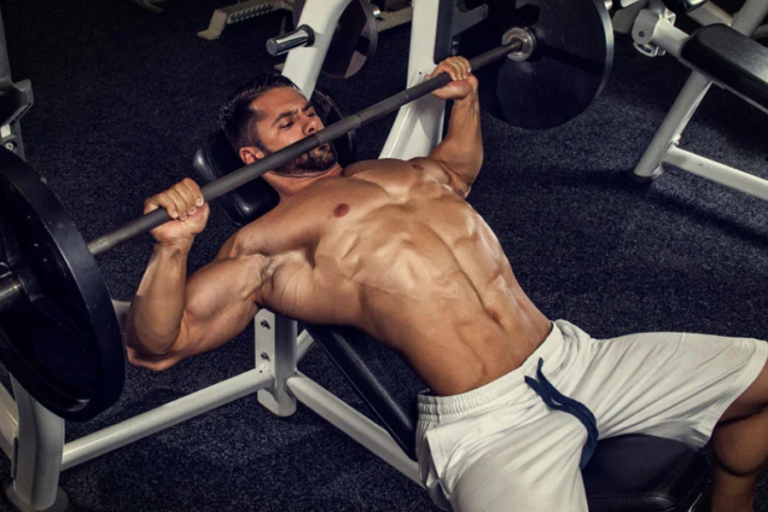
Incline bench press
The incline bench press raises the bench, usually 10 to 45 degrees, and helps you focus more on your upper chest.
- Target: Upper chest with support from shoulders and triceps.
- Setup: Set bench to roughly 30 to 45 degrees, grip the bar just outside shoulder width, press the bar slightly up and back so it touches your lower chest or upper ribcage.
- Benefits: Great if your upper chest lags or your chest looks flat.
- Tips for beginners: Start light with a weight you can press for 12 to 20 reps, then add weight as those sets feel easy. Focus on dropping your shoulders down into the bench so you feel the work in your chest, not just your arms or shoulders.
Using dumbbells for incline can also be a safer choice when you train alone because you can lower the weights to the floor instead of re racking a bar overhead.
Decline bench press
The decline bench press puts your feet higher than your head and shifts the stress toward your lower chest.
- Target: Lower chest with help from triceps.
- Setup: Secure your feet under the pads, grip as you would for flat bench, lower the bar in a similar path.
- Benefits: Emphasizes the lower portion of your chest and often feels easier on some shoulders.
Close grip bench press
If you want a bench variation that boosts both your chest and triceps strength, the close grip bench press is worth learning.
Instead of a wide grip, you slide your hands to about shoulder width. This increases the range of motion, so each rep does more work. It also challenges you to stay tight through your back, lats, and shoulder blades, which improves your overall bench technique.
Lifters using a close grip as their main style have been able to match, and sometimes beat, their wider grip one rep maxes as of April 2022 based on experiments with multiple lifters. It is also one of the best exercises you can use for triceps size because you can load it heavier than dumbbell extensions, dips, or pushdowns.
Specialty barbell variations
Once you are comfortable with standard movements, you can rotate in other barbell focused options to hit sticking points.
- Floor press: You lie on the floor instead of a bench. Your elbows stop at the floor, which shortens the range of motion and places extra focus on your triceps and mid chest. It is useful when you want to build strength in the top half of the press and reduce shoulder stress.
- Dead bench press: You start from a dead stop with the bar resting on safety pins or blocks at chest level. There is no negative phase, so you have to generate power from zero. This helps improve strength right off the chest, which often translates to a stronger full range bench.
- Board press and JM press: Both shift more work to your triceps. Board presses shorten the range by resting the bar on a board on your chest so your shoulders and pecs take less stress. JM presses use a specific elbow position to overload the triceps and are often used to increase max bench numbers.
These options are especially useful if you already bench regularly and want to address specific weak spots.
Add dumbbell presses for muscle and control
Barbells are ideal for heavy loading, while dumbbells shine for range of motion, control, and muscle balance. Combining both types can give you better total chest development.
Flat dumbbell bench press
With dumbbells, your hands are not locked on a bar. You can lower the weights a bit deeper, which creates a stronger stretch and often a better hypertrophy response.
- Target: Chest with extra stretch at the bottom of the movement.
- Setup: Sit on a flat bench with dumbbells on your thighs, lie back and press them up, palms facing forward or slightly inward. Lower until your elbows are below bench level if your shoulders tolerate it, then press back up.
- Benefits: Greater range of motion, more time under tension, and the ability to bring the dumbbells slightly together at the top for extra chest contraction.
- Trade off: You usually use less total weight than with a barbell, so it is better for muscle focus than pure strength.
Because each arm works independently, the flat dumbbell bench press also helps address strength imbalances. If one side is weaker, you will notice it right away and can work to correct it.
Incline dumbbell bench press
You can apply the same idea to an incline. An incline dumbbell press is especially effective if you want to bring up your upper chest.
- Target: Upper chest with more stretch and squeeze than a barbell incline.
- Setup: Set the bench to about 30 degrees, press the dumbbells up, and lower them slowly until you feel a deep stretch at the top of your chest.
- Benefits: Emphasizes upper chest, improves shoulder stability, and allows a natural arm path so you can adjust to what feels best on your joints.
Stability and core benefits
Dumbbell presses require more shoulder and core stability compared to a barbell because each hand moves on its own. This means more work for:
- Your rotator cuff muscles that stabilize the shoulder.
- Your core, which prevents your torso from twisting as you press.
- Smaller stabilizer muscles that support smooth pressing.
This extra demand can translate into better control and functional strength, which is especially useful if you play sports or do other dynamic activities.
Try grip changes to hit different fibers
You can get more mileage out of your existing press setup by changing how you grip the bar or weights. Small adjustments often produce a noticeable difference in how your chest feels.
Wide and narrow grip
- Wide grip: Moving your hands wider increases the stretch across your chest and can raise pec involvement. It slightly shortens the range of motion but places more emphasis on chest fibers.
- Narrow grip: A closer grip keeps elbows tucked and adds more triceps focus, as in the close grip bench. You still train your chest, but the lockout becomes more triceps heavy.
Be conservative with wide grips if your shoulders feel sensitive and focus on staying tight through your upper back.
Reverse grip bench press
The reverse grip bench press uses a supinated hand position, with your knuckles facing your feet. This change significantly increases activation of the upper chest, by around 30 percent compared to a traditional flat bench with a pronated grip according to available research. It also involves your front delts and biceps differently than a standard bench.
This variation can be tricky at first, so practice with lighter weights and make sure you use a spotter or safety bars.
Neutral and specialty grips
Using a neutral grip, with palms facing each other, often feels friendlier on your shoulders. You can use it with:
- Dumbbells on a flat or incline bench.
- Specialty bars designed with parallel handles.
- Floor presses where you want a stable, shoulder friendly position.
These tweaks help you keep training your chest even if certain positions bother your joints.
Use machines and overload tools wisely
Free weights do most of the work, but machines and specific overload techniques can fill in gaps in your chest training.
Standing machine press
Standing machine presses provide strong resistance for arm adduction, which is the motion of bringing your arms toward the midline of your body. This is one of the key functions of your chest muscles.
However, pressing from a standing position demands a lot from your core as you resist the forward push of the weights. If your core stability is a limiting factor, you might not be able to use as much load as your chest could handle.
Smith machine overload and eccentric work
Smith machine presses allow you to control the bar path while using heavier weights in specific portions of the lift. For example, you can focus on eccentric overload by using more weight on the lowering phase than you could handle on the way up.
This style of training can highlight the negative portion, where your muscles are stronger, and can lead to more muscle development. Smith machine overload presses can even let you handle up to about 60 percent more weight on the negative part of the lift, which greatly stresses the chest during that phase.
Because this is demanding work, it is better suited for more experienced lifters who already have solid technique and recovery habits.
Adduction focused assistance
For extra hypertrophy beyond traditional pressing, you can pair barbell work with an exercise that strongly overloads adduction, such as a cable crossover. Some coaches refer to heavy crossover style moves as 3D crossovers. These moves take advantage of one of the primary roles of the chest and can complement standard bench press training.
Choose the right variations for you
You do not need to use every bench variation at once. You will see more progress if you pick a small group that matches your current level, goals, and equipment.
If you are a beginner
Focus on learning solid form and building basic strength.
A simple starting rotation might look like this:
- Flat barbell bench press
- Incline dumbbell bench press
- Flat dumbbell bench press
Use moderate weights that let you focus on feeling your chest work. Aim for 2 to 4 sets of 8 to 12 reps, leaving one or two reps in the tank, and move up in weight slowly over time.
If you want more strength
Keep barbell work at the center of your program and add accessories to support weak points.
Options to include:
- Flat barbell bench press as your main lift.
- Close grip bench press or narrow floor press to build triceps and pressing power.
- Dead bench or board presses to strengthen bottom or mid range strength.
You can still sprinkle in dumbbell work for balance and extra muscle but your priority will be heavy sets in lower rep ranges, such as 3 to 6 reps.
If you want more chest size
Use a mix of barbell and dumbbell pressing to cover both heavy loading and deep range of motion.
You might use:
- Barbell bench press for strength and overall mass.
- Incline dumbbell bench for upper chest.
- Flat dumbbell press or machine press for higher rep, stretch focused sets.
- An adduction focused exercise, such as crossovers, as a finisher.
Think about training your chest from different angles each week: flat, incline, and sometimes decline.
Sample chest focused bench workout
Here is an example you can adapt, depending on what equipment you have.
- Flat barbell bench press
- 3 to 4 sets of 5 to 8 reps
- Focus on controlled, powerful reps and consistent technique
- Incline dumbbell bench press
- 3 sets of 8 to 12 reps
- Use a full, comfortable range of motion
- Close grip bench press or floor press
- 3 sets of 6 to 10 reps
- Emphasize strong triceps driven lockout
- Machine press or heavy crossover movement
- 2 to 3 sets of 10 to 15 reps
- Focus on squeezing the chest, not just moving weight
You can perform this workout once or twice a week depending on your overall schedule and recovery.
Key takeaways
- Start with the flat barbell bench press to build a strength foundation, then expand into bench press variations for chest gains.
- Use incline and decline pressing to target upper and lower chest while still involving shoulders and triceps.
- Add dumbbell presses for greater range of motion, better muscle balance, and increased stability demands.
- Experiment with grip changes like close, wide, reverse, or neutral to shift emphasis and keep progress moving.
- Include specialized variations like floor presses, dead bench, and triceps focused moves if you want to raise your pressing max.
- Consider machine and eccentric overload only after you have strong technique and consistency.
Pick one or two new variations that fit your current setup, try them for a few weeks, and pay attention to how your chest responds. Over time, you will find the mix that feels best and delivers the results you are looking for.
About the Author