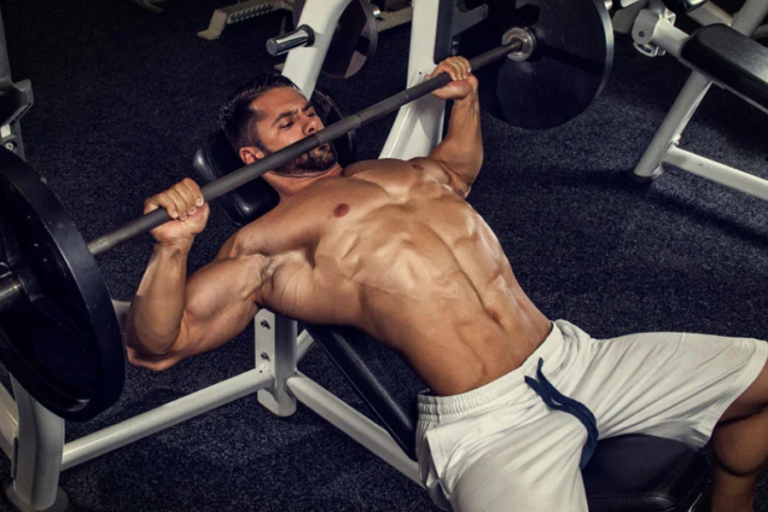
Understand your barbell chest workout
A well planned barbell chest workout helps you build a bigger, stronger upper body without wasting effort. The barbell bench press and its variations let you use relatively heavy weight to target your chest, triceps, and shoulders for size and strength gains.
With a few smart tweaks to your exercise selection, form, and weekly volume, you can grow your pecs, protect your shoulders, and avoid the droopy, lower chest heavy look that comes from only doing flat bench.
Know what the barbell bench works
Before you load the bar, it helps to know what you are training and why.
Main muscles involved
A standard flat barbell bench press primarily works:
- Pectoralis major (both heads of the chest)
- Triceps
- Anterior deltoids (front shoulders)
- Core and upper back muscles for stability
Because the bench press is a compound lift and lets you handle heavier loads than most chest exercises, it is a popular test of upper body strength for bodybuilders, powerlifters, and athletes.
Flat vs incline vs decline
Research suggests that you can build chest size and strength with any bench angle as long as you train near muscular failure in a wide range of 3 to 20 reps and use a large range of motion. Still, each variation has a slightly different emphasis:
-
Flat barbell bench press
-
Classic chest builder
-
Targets mid chest, triceps, and shoulders
-
Allows relatively heavy loading
-
Incline barbell bench press
-
Bench around 45 degrees
-
Emphasizes upper chest and shoulders
-
Helps your overhead pressing strength
-
Decline barbell bench press
-
Bench tilted down so feet are higher than head
-
Targets lower chest fibers
-
Typically places less strain on shoulders
-
Often feels easier on joints for some lifters
Your barbell chest workout should include more than just flat bench so you do not overdevelop the lower chest and neglect the upper pecs.
Avoid common barbell chest mistakes
You can put a lot of effort into your barbell chest workout and still see limited chest growth if your form or exercise balance is off.
Overdoing the flat bench
Relying only on low rep, heavy flat bench sets can:
- Overemphasize the lower pec region
- Contribute to a droopy, bottom heavy chest look
- Increase stress on your shoulders, elbows, and wrists
- Raise the risk of pec strains or tears
Flat bench is still valuable, it just should not be your only chest exercise or the only way you test strength.
Letting ego drive your weight choices
Ego lifting in barbell chest workouts usually looks like:
- Loading more weight than you can control
- Bouncing the bar off your chest
- Cutting your range of motion short
- Shifting tension to shoulders and triceps instead of your pecs
When you push too heavy too soon, you end up training your joints and secondary muscles more than your chest, which means slower gains and a higher injury risk.
Skipping warm up and mobility
If you jump straight into heavy sets without a warm up you increase your chances of:
- Strains and sprains
- Limited range of motion
- Poor bar path and unstable shoulders
A better approach is to spend a few minutes warming up and preparing the joints you are about to load.
Set up perfect barbell bench form
Good form keeps the work where you want it, on your chest, and away from your joints.
Step by step bench setup
Use these cues for a flat or incline barbell bench press:
- Position on the bench
- Lie with your eyes roughly under the bar.
- Plant your feet firmly on the floor.
- Create a slight arch in your lower back, not an exaggerated one.
- Set your shoulders
- Pull your shoulder blades together and slightly down.
- Keep them retracted and pressed into the bench during the entire set.
- This protects your shoulders and directs more tension into your chest.
- Choose your grip
- Start with a grip slightly wider than shoulder width.
- A wider grip will flare your elbows and place the bar higher on your chest.
- A narrower grip will tuck your elbows and lower the bar touch point.
- Adjust to what feels stable and pain free.
- Unrack with control
- Take a deep breath into your belly.
- Press the bar up to straight arms.
- Move it so it is directly over your shoulders before starting the first rep.
- Lower the bar
- Tuck your elbows to roughly 45 degrees from your torso.
- Lower the bar in line with your mid chest or sternum.
- Keep your wrists stacked over your elbows.
- Do not let your shoulders roll forward or your shoulder blades protract.
- Press up
- Drive your feet into the floor for stability.
- Push the bar back up in a slight arc toward your chin.
- Finish with straight, but not hyperlocked, elbows.
If you feel the front of your shoulders or elbows more than your chest, lighten the weight and focus on shoulder blade position and elbow path.
Learn and use the main variations
To build a strong, balanced chest with a barbell, you will mostly rotate through three presses.
Flat barbell bench press
You will treat this as your main heavy strength builder.
- Lie flat, feet planted, shoulder blades retracted.
- Grip the bar slightly wider than shoulder width.
- Lower to mid chest, press up in a controlled arc.
This lift is one of the three standard powerlifting movements and is excellent for building pressing strength and overall upper body mass.
Incline barbell bench press
Use incline to emphasize your upper chest:
- Set the bench to about 45 degrees.
- Use a shoulder width or slightly wider grip.
- Keep your elbows about 45 degrees from your sides.
You will feel more work in your upper chest and shoulders, which helps create a fuller chest and supports overhead pressing strength.
Decline barbell bench press
If your shoulders feel beat up from flat bench, decline can help:
- Secure your feet on the decline bench pads.
- Retract your shoulder blades before unracking.
- Lower the bar to the lower chest or sternum area.
- Keep your elbows from flaring too wide.
The decline angle often reduces shoulder joint strain while hitting the lower pec fibers.
Use a smart weekly chest plan
You do not need a complicated program. You just need a structure that balances volume and recovery.
How many sets per week
A simple guideline based on current recommendations:
- Beginners: about 12 sets of chest per week
- Novices with some experience: up to 16 sets per week
- Veterans: up to 20 sets per week
Try to leave 48 to 72 hours between hard barbell chest workouts so your muscles and joints can recover.
Example barbell chest workout (twice per week)
You can split your barbell chest work into two sessions.
Day 1, strength focus
- Flat barbell bench press
- 4 sets x 4 to 6 reps
- Rest 2 to 3 minutes
- Incline barbell bench press
- 3 sets x 6 to 8 reps
- Rest 2 minutes
- Optional: light dumbbell bench or push ups
- 2 sets x 10 to 15 reps
Day 2, hypertrophy focus
- Flat barbell bench press
- 3 sets x 8 to 10 reps
- Rest 90 to 120 seconds
- Decline barbell bench press
- 3 sets x 8 to 12 reps
- Rest 90 to 120 seconds
- Optional: dumbbell fly or cable fly
- 2 sets x 12 to 15 reps
Across the week, you will hit around 14 to 16 total barbell working sets for your chest, which lines up well for most intermediate lifters.
Progress your barbell chest workout safely
Your body adapts when you give it enough challenge. The key is to increase that challenge gradually.
Use progressive overload
One simple progression method for barbell chest workouts looks like this:
- Start with about 80 percent of your one rep max.
- Perform 4 sets of 4 reps.
- Each week, add one rep to each set.
- Week 1: 4 x 4
- Week 2: 4 x 5
- Week 3: 4 x 6
- Week 4: 4 x 7
- Week 5: 4 x 8
- Once you can complete 4 sets of 8 reps with good form, increase the weight slightly and restart at 4 x 4.
This approach lets you build both strength and muscle without huge jumps that might compromise your form.
Add intensity carefully
If your technique is solid and you are not in pain, you can sometimes use intensity techniques to spur growth:
- Drop sets: After your last set, lower the weight by 20 to 30 percent and continue pressing to near failure.
- Paused reps: Pause for 1 to 2 seconds with the bar on or just above your chest before pressing.
- Partials to failure: After you can no longer complete full reps, do short top half reps for a few more seconds of tension.
A standard barbell chest routine of 3 sets of 8 to 12 reps can feel brand new once you layer in these methods sparingly.
Protect your shoulders and wrists
Chest strength is not helpful if your joints constantly ache. A few habits will keep your barbell chest workout sustainable.
Prioritize warm up and preparation
Before your first working set, aim to:
- Do 5 to 10 minutes of light cardio to increase general warmth.
- Perform shoulder circles, band pull aparts, or light rows.
- Do 1 to 3 lighter bench press sets, gradually increasing the load.
This routine increases blood flow, improves range of motion, and lowers injury risk during heavy presses.
Maintain shoulder blade retraction
If you allow your shoulder blades to protract, your shoulders will rise and the bar path may drift forward. This shifts more load to your shoulders and arms and away from your chest.
By keeping your shoulder blades squeezed together and pressed into the bench, you:
- Reduce shoulder stress
- Increase pec engagement
- Improve bar stability
Adjust if you have pain
If barbell bench pressing bothers your shoulders or wrists, you can:
- Narrow or widen your grip slightly until it feels more natural.
- Double check that your elbows are not flaring excessively.
- Lower the weight and improve control.
- Swap in dumbbell bench press for a while, since it challenges stabilizers and lets your arms move more freely.
Other bar variations like a football bar or Swiss bar can also ease shoulder strain while you maintain a pressing pattern.
If pain persists, especially sharp or localized pain, it is wise to speak with a medical professional before continuing heavy barbell work.
Combine barbells with other chest tools
Your barbell chest workout can be your main focus, but adding other exercises can improve your results.
- Dumbbell presses increase your range of motion and stability demands.
- Push ups are excellent for beginners or as a high rep finisher.
- Cable or dumbbell flyes stretch the chest through a longer range and add variety.
Studies show that as long as you are working near failure in a reasonable rep range and using a full range of motion, you can grow muscle with many different chest movements and angles.
Barbells give you the heaviest weights, other tools help you refine how your chest works.
Put it all together
If you want a strong, well developed chest, your barbell chest workout should:
- Use flat, incline, and possibly decline bench variations
- Include enough weekly sets for your experience level
- Emphasize controlled form over ego lifting
- Progress gradually with reps and load
- Protect your shoulders through proper setup and warm up
Pick one adjustment to start with today, such as tightening your shoulder blade position or following the 4 x 4 to 4 x 8 progression. Over the next few weeks, you will feel a more stable press and see better chest development from the same time you already spend on the bench.
About the Author