Why home chest workouts go wrong
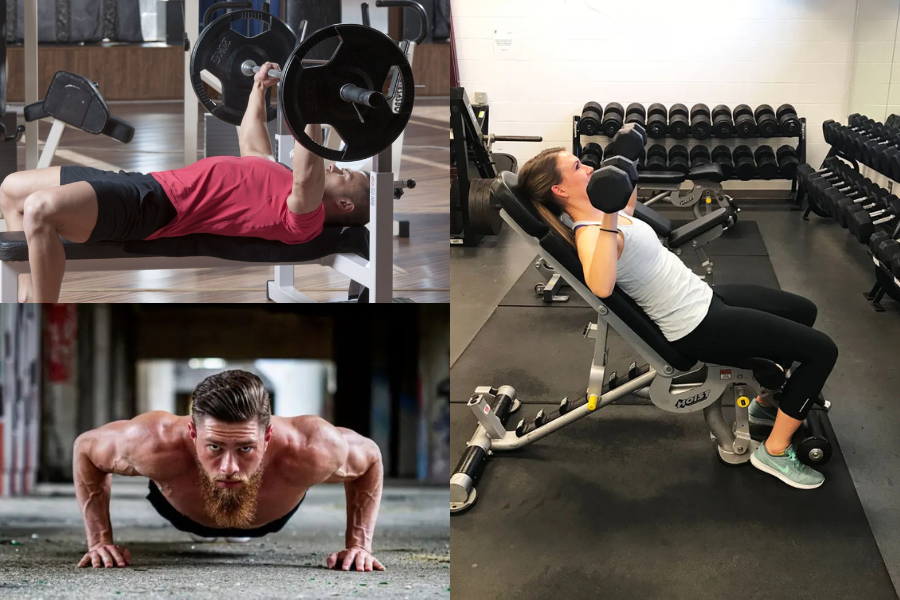
A home gym chest workout can be just as effective as training in a commercial gym. Push-ups, dips, and simple dumbbell exercises can build size and strength across your pectoralis major and pectoralis minor, plus your shoulders, triceps, and core. Research comparing push-ups and the bench press in trained men has even found similar hypertrophy outcomes when effort is matched, which makes bodyweight training a practical option for building your chest at home.
The problem usually is not the exercises. It is a handful of common mistakes that limit your results or irritate your shoulders and elbows. If you fix those, the same home routine suddenly feels harder, safer, and more productive.
Below are the biggest errors to watch for and what to do instead.
Mistake 1: Skipping a proper warmup
If you drop straight into heavy push-ups or dumbbell presses, your chest and shoulders are cold and stiff. Over time, that can show up as nagging aches, poor range of motion, and weaker performance.
In some beginner chest programs, two warmup sets of the first exercise are recommended before the working sets. That simple step gets blood flowing and prepares your joints.
How to warm up before chest day
Spend 5 to 10 minutes on:
- Light cardio
March in place, brisk walking, or a few star jumps - Dynamic mobility
Arm circles, band pull-aparts if you have a band, or gentle chest stretches - Two easy sets of your first exercise
For example, 2 sets of push-ups on a counter or incline at very low effort
If your first work set still feels creaky, add another light set and focus on smooth reps.
Mistake 2: Ignoring exercise form
Poor technique is one of the fastest ways to turn a good home gym chest workout into a shoulder problem. This shows up as:
- Elbows flaring out wide on push-ups or presses
- Lower back sagging during push-ups
- Short, rushed reps on dumbbell presses or flies
- Shoulders hunching up toward your ears
Simple form cues for key movements
Use these checkpoints as you train:
Push-ups and variations
- Hands just outside shoulder width
- Body in a straight line from head to heels
- Elbows pointing back at roughly a 45 degree angle, not straight out to the side
- Chest lowers toward the floor or handle, not your face
Bench press with dumbbells or weights
- Feet flat and steady
- Shoulder blades gently pulled back into the surface you are lying on
- Lower the weights with control, then press without bouncing
- Stop if you feel sharp shoulder pain anywhere in the range
If incline, decline, or flat bench presses consistently hurt your shoulders, swap them for alternative movements and work on your form. Pain is a signal, not something to push through.
Mistake 3: Relying on only one exercise
Push-ups are excellent. Dips are excellent. Dumbbell presses and flies are excellent. The issue is doing only one movement and calling it a full home chest routine.
Your chest has different regions, and different angles emphasize different fibers. For example:
- Incline variations shift more work to the upper chest
- Decline variations can emphasize the lower chest
- Flies focus on stretching and squeezing the pecs rather than pressing
Build a balanced exercise mix
Try to include at least one exercise from each group:
- Horizontal press
Standard push-ups or flat dumbbell press - Angle variation
Incline or decline push-ups or presses - Isolation or stretch focus
Dumbbell flies or a pec deck machine if you have access
Chest machines can also help you mix it up. A chest press machine mimics the bench press and targets the pectoralis major and minor through a controlled range of motion. A pec deck or chest fly machine lets you isolate the inner chest by bringing the handles together slowly, and incline chest press machines emphasize the upper pecs.
Varying angles and tools keeps your home gym chest workout from stalling.
Mistake 4: Forgetting progressive overload
Doing the same number of reps, with the same tempo, at the same difficulty for months will eventually stall your progress. Your muscles adapt and stop growing.
The good news is that you can still use progressive overload without buying more weight plates.
Ways to progress at home
Choose one progression at a time and apply it for a few weeks:
- Add reps
Turn 3 sets of 8 push-ups into 3 sets of 10 or 12 - Add sets
Move from 3 sets to 4 sets once the current volume feels manageable - Reduce rest
Shorten rest periods by 10 to 15 seconds while maintaining form - Increase time under tension
Slow the lowering phase of each rep to 3 or 4 seconds - Advance the variation
Move from incline push-ups to regular push-ups, then to decline or deficit push-ups
Gymshark notes that increasing reps or sets, reducing rest, and increasing time under tension are all effective ways to maintain progressive overload in a home gym setup.
Mistake 5: Using the wrong push-up variations for your level
Push-ups are one of the best home chest exercises because they work your pecs, triceps, shoulders, and core at the same time. On average, a standard push-up has you lifting about 64 percent of your body weight, which is plenty of resistance to build strength and muscle.
The mistake is treating all push-up variations as interchangeable. Some are beginner-friendly, and others are very demanding.
Match the push-up to your current strength
Here is how different variations generally line up:
-
Easier, ideal for beginners
-
Incline push-ups (hands on a bench or sturdy chair)
-
Wide push-ups with a higher hand position
-
Moderate, good for most people
-
Regular push-ups
-
Diamond push-ups for triceps and inner chest, done in 3 to 4 sets of 8 to 15 reps with 30 to 60 seconds of rest
-
Harder, for advanced lifters
-
Decline push-ups, feet on a bench or chair, 3 to 4 sets of 5 to 15 reps
-
Deficit push-ups, hands elevated to increase range of motion
-
Plyometric or explosive push-ups with a jump and clap, 3 to 4 sets of 8 to 15 reps with 45 to 60 seconds of rest
Gymshark also highlights 10 effective push-up variations for at-home workouts, including offset, one-leg, seal, and deficit push-ups that all hit the chest with slightly different emphases.
Start on an incline if regular push-ups feel too hard. Progress to floor push-ups, then experiment with decline, diamond, or plyometric versions as your strength improves.
Mistake 6: Neglecting full range of motion
If you only move halfway, you only get half the benefit. Short, partial reps can limit muscle growth and control.
In exercises like deficit push-ups or dumbbell flies, increasing range of motion at the shoulders and elbows can improve muscle hypertrophy by recruiting more motor units and adding volume. You just need to stay within a comfortable, pain-free range.
How to improve range of motion safely
- Lower until your chest is close to your hands or handles without losing body alignment
- In dumbbell presses or flies, lower until you feel a firm stretch in your chest, not a sharp pull in the shoulder joint
- Avoid bouncing at the bottom, move smoothly and deliberately
If extended ranges irritate your shoulders, pull back a little and rebuild gradually. Caution is especially important with deficit or deep push-ups to avoid shoulder strain.
Mistake 7: Overlooking bodyweight dips and simple tools
If you do not have a full gym at home, it is easy to assume that only basic push-ups are available to you. In reality you can get creative with furniture and a few pieces of compact equipment.
Bodyweight dips are a perfect example. Traditional parallel bars are great, but you can adapt dips using a sofa, chair, or sturdy low surface. When you place your hands behind you and extend your feet forward, you emphasize your chest, especially the lower chest, even though the triceps work hard too.
Smart equipment choices for chest training
You do not need a full rack to challenge your chest. A few options from the research include:
- Dumbbells or weighted objects
Ideal for home bench presses and flies, 2 to 4 sets of 8 to 15 reps - Foldable push-up racks
Help with wrist comfort and increased range of motion - Twister Arm Trainer
Adjustable resistance from around 20 pounds up to roughly 440 pounds depending on the model, designed to train chest, arms, shoulders, and forearms with ergonomic, anti-slip handles - Compact chest press machines
For example, the GMWD Chest Press Machine provides a bench with flat and incline positions and a high weight capacity, suitable for chest, abs, and shoulders - Multifunctional kits
Some combine chest twister trainers, ab rollers, and resistance bands so you can work your whole upper body in a small space
Choose tools that fit your room and your budget, then build a consistent routine around them.
Mistake 8: Training too often or not often enough
Your chest needs both stimulus and recovery. If you hardly ever train it, nothing changes. If you hammer it every day, fatigue accumulates faster than strength.
Some beginner chest routines, such as a simple 3 exercise plan with 7 total sets, are designed to be performed once per week to allow recovery. More experienced lifters may train chest more frequently, but the principle is the same. Hard sessions need time to sink in.
Find your ideal training frequency
Keep these guidelines in mind:
- Beginners
A focused chest session once per week is often enough, especially if you are sore for several days after - Intermediate
Two moderate sessions per week can work well as long as you manage overall volume - Soreness and performance
If your chest is still very sore or your numbers are dropping, you might need an extra rest day
Quality sessions matter more than sheer frequency.
Mistake 9: Ignoring pain signals
A good home gym chest workout should feel challenging, not injurious. Muscle fatigue and a deep burn during the last few reps are normal. Sharp pain in your shoulders, elbows, or wrists is not.
For people who feel shoulder pain during incline, decline, or flat bench presses, it is important to adjust. This can mean:
- Reducing the range of motion
- Switching to a machine that offers more joint support, like a chest press or pec deck
- Focusing on pain-free push-up angles, such as a slight incline
If pain persists, stop the aggravating exercise and consider a professional assessment. Joint irritation that you ignore now can easily turn into a longer layoff later.
Mistake 10: Not having a simple plan
Random workouts make it harder to track progress or build habits. A basic, repeatable plan removes guesswork and keeps you honest.
Sample home gym chest workout (no equipment)
Perform this routine 2 to 3 times per week, with at least one rest day between sessions. Adjust sets and reps based on your level.
- Incline push-ups
3 sets of 8 to 15 reps - Regular push-ups
3 sets of 8 to 15 reps - Decline push-ups
3 sets of 5 to 12 reps - Diamond push-ups
3 sets of 8 to 12 reps - Bodyweight dips using a chair or sofa edge
3 sets of 8 to 12 reps
Rest 30 to 60 seconds between sets. Focus on form, smooth reps, and small weekly progressions.
Sample home gym chest workout (with dumbbells)
Try this if you have a bench or sturdy flat surface and a pair of dumbbells.
- Flat dumbbell bench press
3 sets of 8 to 15 reps - Incline dumbbell bench press
3 sets of 8 to 15 reps - Dumbbell flies
2 to 3 sets of 10 to 15 reps - Push-ups or deficit push-ups
3 sets close to technical failure with good form
Dumbbells can also help you correct left and right strength imbalances and increase stretch and contraction for hypertrophy.
Bringing it all together
An effective home gym chest workout does not depend on expensive machines or a huge room. It depends on:
- A brief warmup so your chest and shoulders are ready
- Solid form on presses, flies, dips, and push-ups
- A mix of angles and variations that target your whole chest
- Steady progressive overload, with smarter intensity instead of random effort
- Respect for your joints and enough rest for your muscles
Pick one mistake from this list that sounds familiar and fix it in your very next workout. Small adjustments in technique, exercise choice, or structure can make your home chest training feel stronger, safer, and far more rewarding.
About the Author