Understand chest supersets and drop sets
If you want a stronger, more defined chest without living in the gym, chest supersets and drop sets are two of the most efficient tools you can use. Both techniques help you build muscle, increase time under tension, and make even short chest workouts count.
You will see the terms “supersets” and “drop sets” a lot in strength training content. They are sometimes used together and sometimes on their own, so it helps to understand what each one actually means before you start adding them to your routine.
What is a superset?
A superset is when you perform two exercises back to back with little or no rest in between. Only after finishing both exercises do you rest.
You can superset:
- The same muscle group, for example two chest exercises
- Opposing muscle groups, like chest and back, or biceps and triceps
According to guidance summarized by ISSA in 2020, supersets increase workout efficiency and can improve both muscular and cardiorespiratory fitness by raising heart rate, blood lactate, and oxygen use. A 2022 study they cite shows that supersets are especially useful if you have limited workout time because you do more total work in less time.
What is a drop set?
A drop set is a high intensity technique where you perform an exercise to failure or very close to it, then immediately reduce the weight and keep going. You can repeat this “drop” multiple times.
The basic pattern looks like this:
- Lift a challenging weight until you cannot do another rep with good form.
- Reduce the weight right away, for example by 10 to 30 percent.
- Continue the set until you reach failure again.
- Optional, drop the weight again and repeat.
This method, also known as the “multi poundage system,” was popularized in the 1940s and is still common today because it increases muscle fiber recruitment and metabolic stress. A 2018 study cited by ISSA found that six drop sets produced a higher muscle response than three drop sets, based on changes in skin temperature, which suggests greater training volume can lead to more growth stimulus.
A recent BOXROX article in 2025 points out that single set drop set protocols can match the hypertrophy of multiple traditional sets while saving time, which makes drop sets particularly useful if you want effective yet shorter chest workouts.
Muscle & Fitness also notes that drop sets drive more blood into the working muscles and push you deep into fatigue, which is a powerful trigger for hypertrophy.
Benefits of chest supersets and drop sets
You do not need advanced techniques to build a bigger chest, but chest supersets and drop sets can speed up progress, break plateaus, and make training more engaging.
Why use chest supersets?
When you structure chest supersets well, you get several advantages:
-
More work in less time
You perform two exercises back to back, so your overall session becomes more time efficient, a benefit supported by ISSA and 2022 research on superset training. -
Higher training intensity
Short rest periods and continuous work raise your heart rate and increase calorie burn compared to traditional straight sets. -
Increased time under tension
Working the chest with two exercises in a row keeps the muscles loaded longer, which is important for strength and muscle growth. -
Better pump and mind muscle connection
Supersets that pair pressing and fly movements can help you feel the chest working instead of letting shoulders or triceps dominate the exercise.
Why use drop sets for chest?
Drop sets are usually considered an advanced technique. If you use them carefully they provide benefits such as:
-
Maximized muscle fatigue
You push past the point where you would normally stop by reducing the weight, so you recruit additional muscle fibers that are not fully challenged by normal sets. Muscle & Fitness describes this effect as a key reason dropsets build size efficiently. -
More time under tension in one set
You extend a single set by reducing the load instead of resting, which keeps your chest muscles working longer. Research summarized by BOXROX shows that this extended time under tension can match the hypertrophy of longer straight set workouts. -
Plateau breaking potential
If you have been stuck at the same weights or chest size for a while, the extra stress from drop sets can provide a new stimulus. -
Time efficiency
A single drop set can give you the same or greater muscle building effect as multiple traditional sets in less time, according to the BOXROX review of drop set science.
When you should and should not use them
Chest supersets and drop sets can be very effective, but they are not something you should tack onto every set of every workout.
Are you ready for chest supersets?
You will benefit from chest supersets if:
- You already know proper form on basic chest movements like bench presses, push ups, and fly variations
- You want to get more work done in 30 to 45 minute sessions
- You enjoy a faster pace with higher heart rate and more of a conditioning feel
You may want to limit or skip supersets if:
- You are learning new exercises and still dialing in your form
- Your primary goal is maximal strength on big lifts like the barbell bench press, where longer rests often work better
- You struggle with shoulder or elbow pain that gets worse as fatigue builds
Are you ready for chest drop sets?
Drop sets for the chest are best if you:
- Have at least a few months of consistent lifting experience
- Already know how failure feels and can stop when form breaks down
- Want to overcome a chest plateau or add intensity without lengthening your workout
You should be more cautious with drop sets if:
- You are a beginner or coming back after a long break
- You are lifting without a spotter on free weight compound movements
- You are recovering from shoulder, pec, or elbow injuries
- You already feel very fatigued, stressed, or under recovered
ISSA recommends that drop sets be limited to one per training session and ideally used with isolation exercises rather than heavy compound presses, mostly for safety reasons as fatigue can quickly degrade form on big lifts.
How to program chest supersets
There is no single “correct” way to structure chest supersets, but some patterns are more effective and safer than others. Think of supersets as a tool to either:
- Intensify your main chest work, or
- Make accessory chest and upper body work more time efficient
Same muscle group chest supersets
These are compound supersets that hit the chest twice in a row. They are great for hypertrophy and for advanced lifters who want to increase training stress.
Common pairings include:
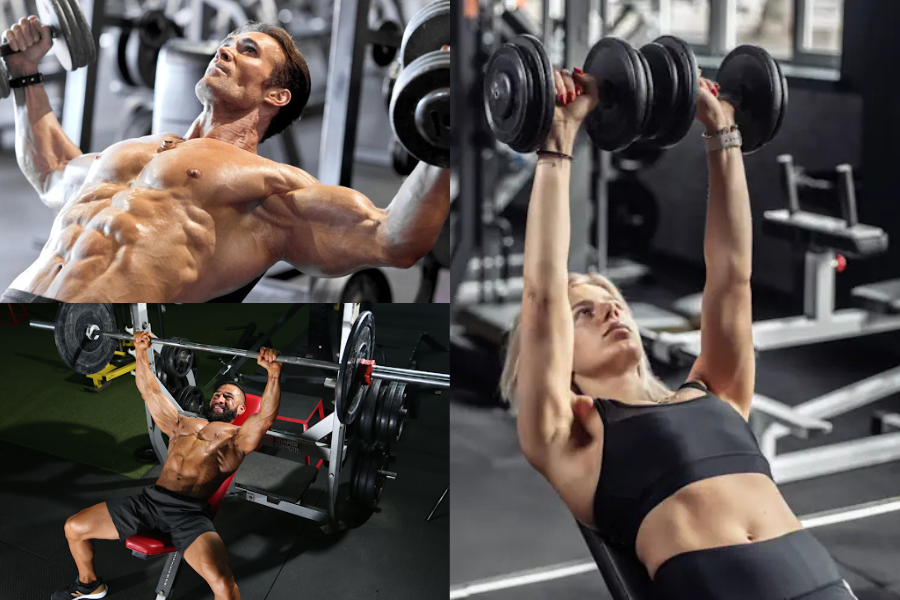
- Press + fly, such as bench press followed by dumbbell fly
- Heavy machine press + bodyweight movement, such as machine chest press followed by suspension trainer pec fly
Research in your brief notes that compound supersets that target the same muscle group usually benefit from 60 to 90 seconds rest between rounds because the intensity and fatigue are high.
Example same muscle superset
- Barbell bench press, 8 to 10 reps
- Dumbbell fly, 8 to 10 reps
- Rest 60 to 90 seconds
- Repeat for 3 to 4 rounds
This combination helps you load the chest heavily with the barbell, then stretch and squeeze the muscles with flyes to increase time under tension.
Opposing muscle group supersets
ISSA highlights another version of supersets where you alternate between opposing muscles, such as chest and back. For example, a chest press followed by a row. This can:
- Balance strength around your shoulders
- Improve posture and joint health
- Increase total upper body volume without making workouts much longer
A simple pattern might look like:
- Set A1: Incline dumbbell press
- Set A2: Seated cable row
- Rest 60 seconds, then repeat
You can still use these to grow your chest, and you gain the added benefit of back training for symmetry and injury prevention.
Rest periods for chest supersets
Because you are combining two exercises, you usually rest only after the second one. Typical rest ranges are:
- 0 to 30 seconds between Exercise 1 and Exercise 2 within the superset
- 30 to 90 seconds after Exercise 2 before repeating the superset
Shorter rests increase cardiovascular stress and calorie burn. Slightly longer rests help you lift more total weight and maintain form.
How to program chest drop sets
Drop sets place intense stress on your chest and your nervous system. They work best when you use them sparingly and at the right point in your workout.
Basic chest drop set structure
The standard drop set for a chest exercise uses this structure:
- Choose a weight you can lift for about 8 to 12 controlled reps.
- Perform reps until you reach failure or you are one rep away from failure.
- Immediately reduce the weight by 10 to 30 percent.
- Continue to perform reps until you again reach failure with good form.
- Optional, drop the weight once more and repeat.
For example, on a cable fly:
- Set 1: 40 pounds to failure
- Drop to 30 pounds, continue to failure
- Drop to 20 pounds, continue to failure
Muscle House and BOXROX both emphasize maintaining strict form during these sets, since fatigue rises quickly and you want to fatigue the chest rather than your joints.
Best chest exercises for drop sets
Because form can break down under intense fatigue, many experts recommend you focus on isolation or machine based chest work for drop sets. Safer options include:
- Cable crossovers
- Pec deck / chest fly machine
- Machine chest press
- Push up variations, especially in mechanical drop sets
According to ISSA, compound barbell lifts like the flat bench press are not ideal for heavy drop sets due to the higher risk if form fails while you are under the bar. If you do experiment with barbell drop sets, it is safer to:
- Use a power rack with safety bars
- Have a reliable spotter
- Keep the drops moderate, not extreme
How often to use drop sets for chest
Both the BOXROX article and other programming guidelines in your research suggest a conservative approach:
- Use chest drop sets 1 to 2 times per week at most
- Limit yourself to 1 to 2 drop set exercises per chest session
- Let your chest recover fully before the next intense session
This keeps you from slipping into overtraining, since drop sets are very taxing on both muscles and your nervous system.
Sample chest superset workouts
To help you put everything together, here are sample chest focused supersets you can plug into your training. Adjust weights and reps based on your experience level.
Superset workout for beginners
If you are new to chest supersets, your main goal is to learn the movements and get used to the faster pace.
Warm up, 5 to 10 minutes
- Light cardio or dynamic arm swings and band pull aparts
- Two light sets of push ups or machine chest press
Superset A: Machine chest press + suspension fly
- Machine chest press, 10 to 12 reps
- Suspension trainer pec fly (TRX style), 10 to 12 reps
- Rest 60 to 90 seconds
- Repeat for 3 rounds
Your research notes that combining machine chest press and suspension pec fly for 30 to 60 seconds of tension per set is effective for strength and endurance.
Superset B: Incline push up + band pull apart
- Incline push ups on a bench, 8 to 12 reps
- Resistance band pull aparts, 12 to 15 reps
- Rest 60 seconds
- Repeat for 3 rounds
This pairing trains your chest and upper back for better posture and shoulder stability.
Superset workout for intermediate lifters
Once you are comfortable with basic form, you can move toward free weight supersets that target different regions of the chest.
Warm up, 5 to 10 minutes
Superset A: Incline barbell press + incline dumbbell fly
- Incline barbell press, 10, 8, then 6 reps across 3 rounds
- Incline dumbbell fly, match the rep ranges above
- Rest 60 to 90 seconds between rounds
This pattern reflects a common upper chest focus superset from a 2024 Muscle & Strength style routine, where you lift heavier on the press then stretch the upper pecs with flyes.
Superset B: Flat dumbbell fly + flat dumbbell press
- Flat dumbbell fly, 10 to 12 reps
- Flat dumbbell press, 8 to 10 reps using the same weight
- Rest 60 to 90 seconds
- Repeat for 3 rounds, optionally going to failure on the final round
Your research notes that taking the last round to failure and even using partner assisted reps can significantly increase fatigue and stimulus. Use that only when you know your limits and have help.
Finisher: Cable crossover + push ups
- Cable crossover, 12 to 15 controlled reps
- Push ups, to near failure
- Rest 60 seconds
- Repeat for 2 or 3 rounds
This type of finisher, with minimal transition time between cable work and push ups, keeps constant tension on the chest and drives a deep pump.
Sample chest drop set workouts
You do not need an entire workout of drop sets. Often, one or two well placed drop sets at the end of your session are enough.
Simple machine chest drop set
You can use this at the end of any chest or upper body day.
- Choose a chest press machine weight that allows 8 to 10 solid reps.
- Perform 8 to 10 reps to failure or one rep short.
- Reduce the weight by about 25 percent and continue to failure.
- Reduce the weight by another 25 percent and again go to failure.
- Stop, rest, and move on to cool down.
This single triple drop set will likely leave your chest fully exhausted. You do not need to repeat it many times.
Cable fly drop set for lower or mid chest
- Set the pulleys just above shoulder height if you want to emphasize the lower chest, or at mid chest height for middle pecs.
- Start with a weight for about 12 controlled reps.
- Perform reps to failure, keeping a slight elbow bend and focusing on squeezing the chest.
- Reduce the load by 20 to 30 percent and repeat to failure.
- Optional, drop again by 20 to 30 percent and go to failure once more.
According to BOXROX, ending your chest workout with this kind of isolation drop set after your heavier lifts is an efficient way to maximize hypertrophy while minimizing injury risk.
Advanced push up mechanical drop set
Mechanical drop sets change body position instead of weight so that the movement becomes easier as you fatigue. Your research describes an advanced routine that looks like this:
- Start with feet elevated push ups, to failure.
- Immediately move to standard push ups, to failure.
- Immediately drop to knee push ups, to failure.
You do not change resistance, you only change leverage. This is a simple but powerful way to apply drop set logic even without equipment.
Combine supersets and drop sets in a week
If you like both chest supersets and drop sets, you can use them together while still managing fatigue.
Here is a sample weekly structure if you train chest twice per week:
Day 1, Strength and volume focus
- Start with heavy compound presses using traditional straight sets and full rests, for example bench press 4 sets of 5 to 8 reps with 2 to 3 minute rests.
- Add 1 or 2 chest supersets, such as incline press + incline fly, and flat fly + flat press.
- Skip drop sets on this day, since you already have high volume.
Day 2, Intensity and metabolic stress focus
- Begin with one or two moderate weight compound sets, for example dumbbell bench press 3 sets of 8 to 10.
- Use 1 or 2 supersets with slightly lighter weights, focusing on control and time under tension.
- Finish with a single isolation drop set on cables or pec deck to fully exhaust the chest.
The BOXROX programming guidelines, as well as ISSA recommendations, support the idea of combining traditional sets, supersets, and drop sets but keeping advanced methods somewhat limited so that you can recover.
Safety tips and common mistakes
Chest supersets and drop sets only help you if you stay healthy enough to use them consistently. A few habits keep your training both effective and safe.
Prioritize form over ego
It is easy to let technique slip when you are tired, especially during high intensity methods. To stay safe:
- Stop your set when you can no longer maintain proper bar path or range of motion.
- Reduce the weight sooner if you notice your shoulders or elbows rather than your chest doing most of the work.
- Avoid bouncing the bar off your chest or letting dumbbells drop quickly during the eccentric phase.
Respect fatigue and recovery
The research you are working from notes that drop sets are very taxing and can lead to overtraining if you overuse them. Supersets also increase cardiovascular and muscular stress.
You can manage fatigue by:
- Limiting drop sets to 1 per workout and 1 to 2 chest focused drop set sessions per week.
- Emphasizing quality sleep and nutrition, especially protein and total calories if you want to grow.
- Deloading, meaning you reduce volume and intensity, every few weeks if you constantly feel run down.
Watch your shoulder health
Chest training often irritates shoulders when technique is off. Protect yourself by:
- Keeping your shoulder blades pulled back and slightly down on presses.
- Avoiding flared elbows at 90 degrees to your torso. Instead keep them at roughly 45 degrees.
- Using a grip width that allows your forearms to stay vertical at the bottom of the press.
If pain appears during a set, especially sharp or sudden pain, stop and reassess. You can always adjust exercise choice or range of motion rather than forcing more intensity.
How to progress over time
Chest supersets and drop sets are tools, not short cuts. You still need progressive overload over weeks and months.
You can progress by:
- Gradually increasing the weight you use on your main compound presses.
- Adding a rep here and there to your superset exercises before you increase load.
- Slightly shortening rest intervals as your conditioning improves.
- Using drop sets only as needed, for example when a movement has stalled for several weeks with normal training.
The 2025 BOXROX article on drop sets emphasizes combining them with traditional sets and steady progression for best hypertrophy results, rather than depending on drop sets alone.
Bringing it all together
When you understand how to use chest supersets and drop sets, your chest workouts become more efficient and more effective. You can:
- Use supersets to get more work done in less time and to hit the chest from multiple angles.
- Save drop sets for the tail end of your workout when you want to thoroughly exhaust the chest.
- Adjust frequency and intensity to match your experience and recovery.
Start by adding just one chest superset to your current routine, or finish one session this week with a single isolation drop set. Pay attention to how your chest feels during and after, then slowly build from there.
About the Author