Why a dumbbell chest workout at home works
If you have a pair of dumbbells and a bit of floor space, you already have what you need for an effective dumbbell chest workout at home. Dumbbells give you a greater range of motion than barbells and let you train each side separately, so you can correct strength imbalances and engage more muscle fibers with every rep.
You also avoid waiting for equipment at the gym and can move at your own pace. With a few smart exercise choices and clear set and rep ranges, you can build a stronger, more defined chest right in your living room.
How to set up for safe home chest training
A good home chest workout starts with a safe setup. Before you pick up any weight, run through a quick checklist.
Choose the right weight
Use trial and error to find the right dumbbell weight for your current strength level.
General guidelines based on your goal:
- Strength: 85–90% of your estimated one rep max, 3 to 6 reps per set
- Muscle growth (hypertrophy): 70–80%, 6 to 12 reps per set
- Endurance: 50–60%, 12 to 20 reps per set
Whatever you choose, the last 2 reps of each set should feel challenging but still under control. If your form breaks, the weight is too heavy.
Protect your joints
Chest training stresses your wrists, elbows, and shoulders. A few small adjustments can make a big difference:
- Keep wrists straight on presses. Avoid letting them bend backward.
- Use a full grip, do not use a thumbless or “suicide” grip.
- Lower dumbbells to roughly nipple line on presses. If you feel elbow discomfort, experiment with bringing them slightly lower or use elbow sleeves for support.
- If you have wrist or elbow issues, the dumbbell floor press is a joint friendly choice because the floor limits range of motion and reduces strain.
If you plan to lift heavy regularly, consider wrist wraps and compression elbow sleeves for extra support and stability.
Lock in your body position
For nearly every dumbbell chest exercise, you will get more from each rep if you:
- Squeeze your glutes
- Brace your abs as if preparing for a gentle punch
- Keep your chest proud and shoulders pulled slightly down and back
This helps protect your shoulders and lets your chest do more of the work.
Best dumbbell chest exercises without a bench
You can build a complete dumbbell chest workout at home with just the floor. The exercises below hit your chest from several angles and include options for different fitness levels.
1. Dumbbell floor press
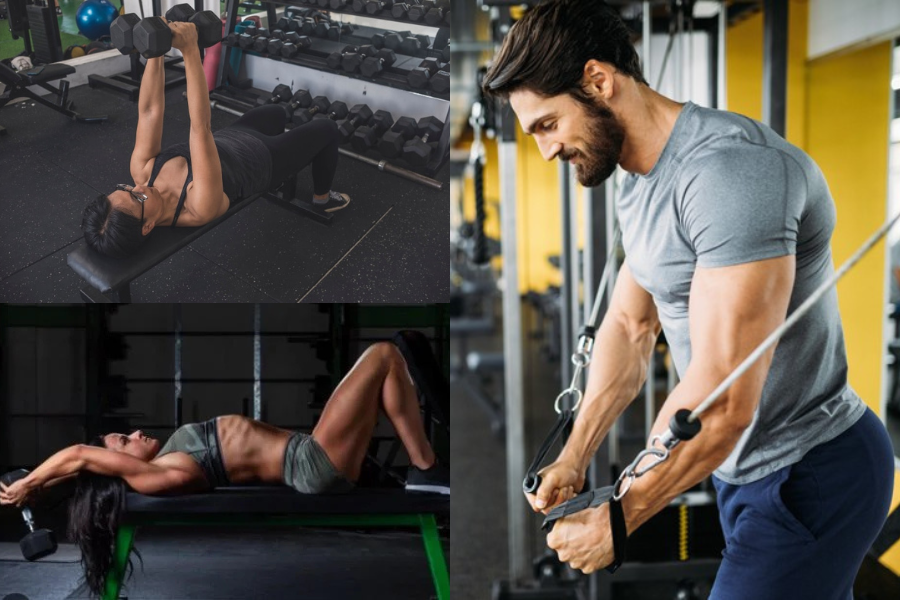
The dumbbell floor press is a staple when you train chest without a bench. You lie on your back with knees bent, then press the dumbbells from arm’s length above your chest down until your elbows lightly touch the floor.
Because your elbows stop around a 90 degree bend, you protect your shoulders and can often handle heavier weights safely. The floor press targets your triceps, chest, and shoulders and is especially useful if you have shoulder issues or limited equipment.
Suggested work:
- 3 to 4 sets of 8 to 10 reps
- Rest 60 to 90 seconds between sets
Form tips:
- Keep your wrists stacked above your elbows.
- Do not bounce the elbows off the floor. Pause gently, then press back up.
- At the top, think about squeezing your chest, not just locking out your arms.
2. Dumbbell chest fly on the floor
The dumbbell chest fly focuses on adduction, which is the motion of bringing your arms toward the middle of your body. This is a key function of the chest muscles and adds a stretch and squeeze that presses do not fully match.
On the floor, you lie on your back with a slight bend in your elbows. Arms open out to the sides, then come back together above your chest. The floor becomes a safety barrier that prevents overstretching your shoulders.
Suggested work:
- 3 sets of 10 to 12 reps
Form tips:
- Maintain the same soft elbow bend through the movement.
- Lower until your elbows just touch the floor, not beyond.
- As you bring the dumbbells together, imagine hugging a wide tree. Actively squeeze your chest at the top.
3. Bridge dumbbell chest press
The bridge dumbbell chest press is a variation of the floor press that asks more of your entire body. You press the dumbbells while holding your hips lifted in a bridge position.
In addition to your chest, shoulders, and triceps, this version trains your posterior chain, including glutes, hamstrings, and erector spinae. That makes it a smart choice if you want more total body benefit from your home workout.
Suggested work:
- 3 sets of 8 to 10 reps
Form tips:
- Drive through your heels to lift your hips, then keep them level.
- Do not let your hips sag as you get tired. If they do, lower the weight or pause between reps.
- Keep your ribs down so you are not arching your lower back excessively.
4. Dumbbell push‑ups
If you have hexagonal dumbbells, you can use them for dumbbell push ups. Place them on the floor so they do not roll, hold the handles, and perform push ups.
Using dumbbells lets you lower your chest deeper than standard push ups, which increases the stretch on your chest muscles. Holding the handles also keeps your wrists in a more neutral position, which reduces wrist strain.
Suggested work:
- 3 sets to near failure, leaving 1 to 2 reps in the tank
- If full push ups are tough, do them from your knees or with hands on a sturdy elevated surface.
Form tips:
- Keep your body in a straight line from head to heels or knees.
- Lower under control until your chest is slightly below hand level.
- Push the floor away and think of spreading your shoulder blades slightly at the top.
5. Alternating dumbbell floor press
The alternating dumbbell floor press is a unilateral version of the standard floor press. You lie on the floor with both dumbbells up, then lower one at a time.
This forces each side of your chest to work independently and challenges your core and stabilizers to keep you steady as the weight shifts from side to side. It is a useful tool for improving strength symmetry and overall stability.
Suggested work:
- 3 sets of 8 to 10 reps per arm
Form tips:
- Keep both shoulders and your lower back in contact with the floor.
- Do not twist or rock your body as you alternate presses.
- Move smoothly, avoiding any jerky or rushed motion.
6. Floor fly variations for growth
For muscle growth, eccentric floor fly variations can be very effective. Eccentric simply means focusing on the lowering phase.
One approach uses heavier dumbbells lowered slowly to the floor with control. The floor supports the weight at the bottom, so you can emphasize the eccentric portion without overstretching your shoulders. This eccentric overload is known to create muscle fiber damage that can encourage chest growth when paired with enough recovery and nutrition.
Suggested work:
- 3 sets of 6 to 8 slow eccentrics
- Aim for a 3 to 5 second lowering phase on each rep.
Form tips:
- Use a spotter if you are unsure about your control with heavier weights.
- Make the descent steady and deliberate, then use your legs and free hand if needed to help reset the weights at the top.
Effective dumbbell chest exercises with a bench
If you do have access to a bench at home, you can add classic movements that many lifters rely on for chest strength and size.
1. Dumbbell bench press
The dumbbell bench press is one of the best chest exercises you can perform. With a bench, you can lower your elbows deeper than on the floor, which increases stretch and overall range of motion. Dumbbells demand more shoulder stability than a barbell and allow each arm to move on its own path.
It is often recommended after you are comfortable with barbell bench pressing because you need good shoulder control to manage the freedom of movement.
Suggested work:
- 3 to 4 sets of 6 to 8 reps for strength and size
Form tips:
- Pull your shoulder blades together slightly and down toward your hips.
- Lower the dumbbells to around the nipple line. Adjust if you feel elbow discomfort.
- Do not let the dumbbells slam together at the top. Meet them with control and squeeze your chest.
2. Dumbbell chest fly on a bench
The bench dumbbell chest fly is a progression from the floor fly. The extended range of motion brings a deeper stretch into the pecs and gives you a different tension curve than presses.
Suggested work:
- 3 sets of 10 to 12 reps
Form tips:
- Use lighter dumbbells than you would for presses.
- Stop before you feel any sharp stretch in the front of your shoulders.
- Keep movements smooth and controlled, especially at the bottom.
3. Incline and decline dumbbell presses
To build a well rounded chest, it helps to vary angles so you hit upper, middle, and lower fibers.
- Incline dumbbell press targets more of the upper chest.
- Decline dumbbell press shifts emphasis slightly toward the lower chest.
An article from July 2024 by Roc Pilon highlights ten effective dumbbell chest builders, including incline and decline dumbbell presses, neutral grip presses, chest squeeze presses, dumbbell reverse grip presses, chest fly variations, and dumbbell pullovers among the top options for a bigger chest at home.
Suggested work:
- 3 sets of 8 to 10 reps per angle you include in your routine
Form tips:
- Keep the same wrist, elbow, and shoulder alignment principles as the flat bench press.
- Do not overdo the incline. A moderate angle is usually more comfortable for shoulders and keeps tension on the chest.
Sample dumbbell chest workout at home
You do not need to use every exercise each session. A simple structure is to choose 2 to 4 movements, start with compound presses, then finish with a fly or push up variation.
Here are three sample routines you can follow, depending on your experience level. All are designed around a dumbbell chest workout at home with minimal equipment.
Beginner home chest workout
This option focuses on learning form and building a base. You can do it with just the floor and a pair of dumbbells.
- Dumbbell floor press
- 3 sets of 8 to 10 reps
- Dumbbell floor fly
- 3 sets of 10 to 12 reps
- Dumbbell push ups
- 2 sets to comfortable fatigue, using knee or elevated variations if needed
Rest 60 to 90 seconds between sets. Focus on controlled movement, full range of motion, and bracing your core.
Intermediate home chest workout
At this stage, you can use supersets to make your workout more time efficient and intense. A superset means doing two exercises back to back with minimal rest.
Superset A
- Bridge dumbbell chest press
- 3 sets of 8 to 10 reps
- Dumbbell push ups
- 3 sets of 8 to 12 reps
Rest 60 seconds after each superset.
Superset B
- Alternating dumbbell floor press
- 3 sets of 8 to 10 reps per side
- Floor dumbbell chest fly
- 3 sets of 10 to 12 reps
Again, rest 60 seconds after each round of both moves.
Advanced home chest workout
For advanced training, you can combine supersets with a high rep bodyweight finisher. The goal is to push close to failure in a controlled way to maximize muscular stress.
Superset A
- Dumbbell floor press or flat dumbbell bench press (if you have a bench)
- 4 sets of 6 to 8 reps
- Eccentric floor fly
- 4 sets of 6 to 8 slow reps
Superset B
- Bridge dumbbell chest press
- 3 sets of 8 to 10 reps
- Dumbbell push ups
- 3 sets to near failure
Finisher
- 5 minute bodyweight push up block
- As many push ups as possible in 5 minutes
- Briefly shake out your arms when needed, then continue
Some advanced programs also add a focused “burnout” phase without rest to drive metabolic fatigue and chest firmness at home. Adjust based on how your joints and recovery feel.
How often to train your chest at home
For most people, training the chest twice per week works well. This gives enough frequency for progress and enough rest for recovery.
You might follow a schedule like:
- Day 1: Full chest workout
- Day 3 or 4: Lighter or alternate chest workout
With consistent training and appropriate nutrition, many people notice performance improvements within three to four weeks. Visible changes in muscle size and definition can take six to twelve weeks or longer, depending on your starting point and overall lifestyle.
Simple technique cues that boost results
The details matter more than adding another exercise. Small technique changes can noticeably improve your dumbbell chest workout at home.
Keep these cues in mind:
-
Drive from the chest
Think of your chest pushing the weights away, not just your arms extending. -
Squeeze at the top
On presses and flies, actively contract your chest for a brief pause at the top of each rep. -
Control the descent
Lower the dumbbells under control instead of letting gravity do the work. This eccentric control is a big driver of muscle growth. -
Use your whole body
Lightly squeeze your glutes and brace your abs on every set. You will feel more stable and protect your lower back and shoulders. -
Stop 1 to 2 reps before failure on most sets
Occasionally pushing to failure is fine, but living there every set can stall progress and increase joint stress.
Putting your home chest workout into action
To turn this information into a routine you actually stick with, start small and simple:
- Pick one of the sample workouts that matches your current level.
- Commit to doing it twice this week.
- Track your weights and reps in a notebook or app.
- When the final reps of every set start to feel easy, increase the weight slightly or add a few reps.
With consistent effort, even a basic dumbbell chest workout at home can build real strength and visible muscle. The key is not the fanciest variation, it is choosing good exercises, using solid form, and showing up week after week.
About the Author