Why tricep strength matters for sculpted arms
If you want bigger, stronger arms, a focused tricep workout for strength will give you more visible progress than endless biceps curls. Your triceps make up about two thirds of your upper arm and roughly 70% of total arm mass, so building them is essential for both arm size and pressing power.
Stronger triceps do more than fill out your sleeves. They stabilize your shoulders and improve the “lockout” portion of compound lifts like the bench press and push up. With the right mix of heavy compound movements and smart isolation work, you can grow your triceps and increase strength at the same time.
In this guide, you will learn how to train all three heads of the triceps, how many sets and reps to use for strength, and how to structure a simple routine you can run for months.
Understand your triceps before you train
A good tricep workout for strength starts with understanding what you are training. Your triceps have three heads:
- Long head
- Lateral head
- Medial head
You do not need an anatomy degree to train them well, but you do need a variety of angles.
- Overhead movements target the long head in a stretched position, which is linked to strong hypertrophy when loaded properly.
- Pressing movements like close grip bench press and dips train all three heads and carry over directly to other compound lifts.
- Pushdowns and similar cable work let you focus on form and control, which is especially useful if you are coming back from soreness or are new to free weights.
Your goal is not to hammer one favorite exercise. Instead, build a small menu of movements that together hit the triceps from different positions.
Choose the best exercises for strength
Several exercises stand out in research and coaching practice for building tricep size and strength. Here is how they fit into your program.
Close grip bench press
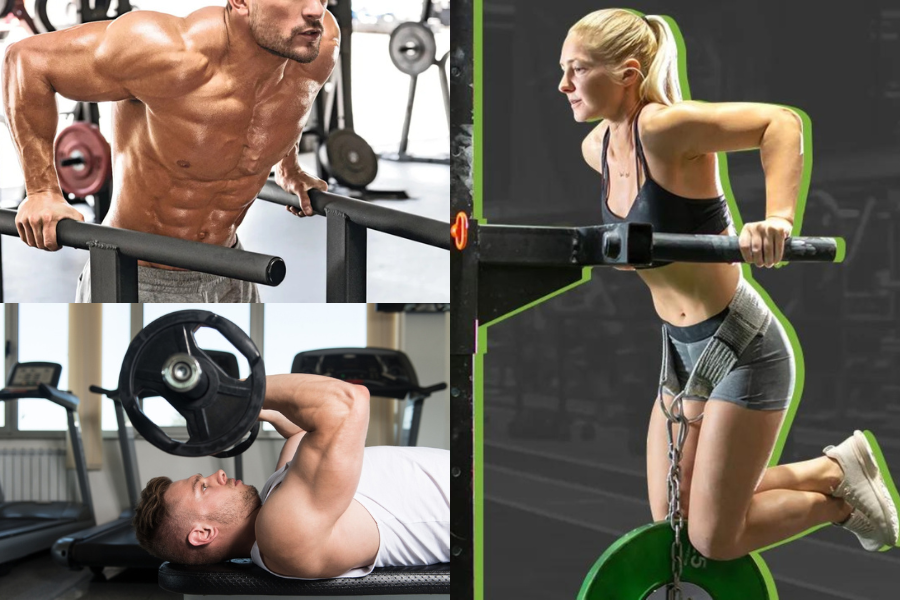
Close grip bench press is one of the most effective compound exercises for tricep strength. Bringing your hands to about shoulder width shifts more of the load from your chest to your triceps and lets you handle heavier weights than many bodyweight variations.
Why include it
- Trains all three heads of the triceps
- Builds lockout strength for other presses
- Easy to progressively overload with small weight jumps
Form cues
- Grip the bar about shoulder width, not ultra narrow, to protect your wrists and elbows
- Keep your elbows close to your body as you lower the bar to your lower chest or upper ribs
- Press up while driving your feet into the floor and keeping your upper back tight
Dips
Dips are another top tier pushing movement for tricep strength because they work chest, shoulders, and triceps together and are easy to load heavier over time. You can add plates, chains, or a weighted vest as you get stronger.
Why include them
- Strong carryover to push ups and bench press
- Great option if you train in a minimalist gym or at home with parallel bars
- Build both size and pressing power
Form cues
- Start with locked out elbows and shoulders down and back
- Lower your body under control until your elbows are around 90 degrees or slightly more, depending on shoulder comfort
- Lean slightly forward for more chest, stay more upright for more triceps focus
- Press back up without letting your shoulders shrug toward your ears
If full bodyweight dips are too challenging, use an assisted dip machine or loop a resistance band around the bars for support.
Overhead tricep extensions
Overhead tricep extensions, especially with a dumbbell, strongly target the long head of the triceps in a stretched position, which is associated with greater muscle growth when loaded sensibly.
Why include them
- Emphasize the long head, the largest part of the triceps
- Help create that “full” look on the back of your arms
- Single arm variations can fix left and right imbalances
Form cues
- Sit or stand tall, brace your core, and keep your ribs down
- Lower the weight behind your head until you feel a good stretch without joint pain
- Extend your elbows until your arms are straight, then pause briefly at the top
Tricep pushdowns
Tricep pushdowns are cable or band based and let you isolate the triceps with precise loading. They are great for both strength and hypertrophy, depending on how you use them. You can use a rope, straight bar, or angled bar based on comfort.
Why include them
- Versatile, you can train heavy for strength or lighter for volume
- Useful warm up or finisher to add extra sets without beating up your joints
- Easy to maintain good form and range of motion
Form cues
- Lean slightly forward to improve your range of motion
- Pin your elbows close to your sides and keep your upper arms still
- Let your forearms rise until you feel a stretch, then push down and fully contract your triceps at the bottom
Skull crushers and safer alternatives
Skull crushers are a classic triceps builder, especially for the long head, because they also work the muscle in a lengthened position. However, they can be uncomfortable or risky for beginners, especially when you use too much weight or lose control.
Some lifters experience significant soreness or joint strain when using an EZ bar for skull crushers for the first time. If you notice sharp pain or lingering tenderness, you can:
- Reduce the weight significantly
- Switch to dumbbells for a more natural wrist position
- Replace them with cable pushdowns or machine based extensions
Machine pushdowns and seated isolation push down machines are safer options if you want to keep stress off your elbows and shoulders, especially early in your training.
Diamond push ups
Diamond push ups are a simple bodyweight option that emphasizes the triceps by bringing your hands close together under your chest. They are useful if you have no access to equipment or want to add extra volume at the end of a session.
Form cues
- Place your hands under your chest with your thumbs and index fingers forming a diamond
- Keep your elbows close to your sides as you lower
- Maintain a straight line from head to heels
Use the right sets, reps, and loads
To get stronger triceps, you need to train in the right intensity ranges, not just do random sets until you feel a burn.
Loading for strength vs hypertrophy
According to guidelines summarized by Gymshark in 2024, you can think of your training like this:
- Strength focus
- 1 to 5 reps per set
- 80 to 100% of your one repetition max (1RM)
- Hypertrophy focus (muscle size)
- 8 to 12 reps per set
- 60 to 80% of 1RM
For pushdowns specifically, lifters often use:
- 3 to 6 reps per set when training them as a heavy strength accessory
- 8 to 12 reps per set when focusing on hypertrophy, often around 3 to 5 sets per exercise each week
Broader hypertrophy guidelines suggest that effective tricep training can use a wide rep range between 5 and 30 reps per set, with about half of your weekly work in the moderate range of 10 to 20 reps for a balance of stimulus and joint friendliness.
For a practical strength oriented program, you can blend ranges like this:
- Heavy compound lifts: 3 to 6 reps
- Moderate isolation work: 8 to 12 reps
- Occasional higher rep sets: 15 to 20 reps to pump blood into the muscle without extra joint stress
Weekly sets and frequency
Research summarized by Gymshark suggests that training your triceps with 12 to 28 sets per week and at least two sessions per week is effective for maximizing growth and strength. More is not always better once you reach that range.
A useful starting point if triceps are a priority for you:
- 2 to 4 tricep focused sessions per week
- 12 to 20 total working sets per week for triceps
- 1 to 3 different tricep exercises in each session
If your elbows feel beat up or your performance drops, you are likely near your maximum recoverable volume. In that case, keep your sets closer to the low end and favor moderate loads.
Rest between sets
Rest periods do not need to be exact, but they should let you perform your next set with solid form. Common ranges:
- 30 to 60 seconds for lighter isolation sets
- 60 to 120 seconds for heavy compound sets
Judge your rest by how ready you feel, including your breathing and your ability to focus on the next set, rather than by a stopwatch alone.
Sample tricep workouts for strength
You can apply these principles in a simple way. Below are two plug and play tricep workouts. You can run both each week with at least one rest day between them.
Workout A, compound focused
Goal: Build pressing strength plus overall tricep mass
- Close grip bench press
- 4 sets of 3 to 6 reps
- Rest 90 to 120 seconds
- Dips or assisted dips
- 3 sets of 6 to 8 reps
- Rest 60 to 90 seconds
- Tricep pushdowns
- 3 sets of 8 to 12 reps
- Rest 45 to 60 seconds
Workout B, long head and isolation focused
Goal: Emphasize the long head and add safe volume
- Overhead dumbbell tricep extensions
- 3 to 4 sets of 8 to 12 reps
- Rest 60 to 90 seconds
- Tricep pushdowns, heavier
- 3 sets of 5 to 8 reps
- Rest 60 to 90 seconds
- Diamond push ups or machine extensions
- 2 to 3 sets of 12 to 15 reps
- Rest 45 to 60 seconds
Across both workouts, you will likely fall into the 12 to 20 sets per week range for triceps, which puts you well inside the effective zone for strength and growth.
Progress your tricep training safely
Progressive overload is key for long term strength gains, but it does not mean adding weight every single workout no matter what. You can progress your tricep workout for strength in several ways.
Add weight gradually
On big movements like close grip bench and dips, increase weight when you can complete all sets at the top of your target rep range with solid form. For example:
- If your plan is 4 sets of 3 to 6 reps and you hit 4 x 6 with clean technique twice in a row, add a small weight increase next time.
On isolation exercises like pushdowns and overhead extensions, you can use smaller jumps or sometimes add only one extra rep to a couple of sets before increasing the load.
Adjust reps and sets
You do not have to chase heavier weight endlessly. You can also:
- Add a set to an exercise, for example from 3 sets to 4 sets, once your joints feel good and you are recovering well
- Fill in the low end of a rep range before pushing higher. For instance, if your plan is 8 to 12 reps, sit at 8 or 9 reps for a few weeks as you get used to the motion and then expand toward 12
Monitor soreness and discomfort
Triceps often get sore when you first introduce lengthened position exercises like skull crushers or heavy overhead extensions. Normal muscle soreness is fine, but look out for:
- Sharp pain in your elbows
- Soreness that lasts more than 3 days
- Pain during daily tasks like pushing open a door
If any of these show up, you can:
- Reduce load on problem exercises, like dropping weight on skull crushers
- Swap high strain free weight movements for machine based or cable work for a few weeks
- Keep at least 24 to 48 hours between hard tricep sessions, especially if you are also doing a lot of pressing for chest and shoulders
Allowing this recovery window is important for avoiding long term joint issues and stalled progress.
Balance tricep work with your overall training
Your triceps are involved in many upper body exercises even when they are not the “main” muscle you are targeting. Bench press variations, overhead presses, and some rowing patterns all recruit the triceps to stabilize or extend your elbows.
To keep training balanced:
- On heavy chest and shoulder days, be conservative with extra tricep volume
- If you run a push pull split, place your direct tricep work toward the end of push days so your pressing strength stays high
- Avoid starting your workout with very high rep isolation sets that fatigue your triceps before compound lifts, because this can reduce performance and increase your risk of overuse problems
Free weights like dumbbells and barbell skull crushers often give you a larger range of motion than machines, which can be great for growth. Just be honest about your current level. If you are a beginner or coming back from time off, it is reasonable to:
- Learn the pattern with cables or machines first
- Introduce free weight tricep work gradually as your control improves
Key takeaways you can use today
If you want your tricep workout for strength to actually sculpt your arms instead of just leaving you sore, focus on these fundamentals:
- Train your triceps at least twice per week with around 12 to 20 working sets in total, adjusting based on how well you recover
- Base your program around big strength builders like close grip bench press and dips, then add overhead extensions and pushdowns to target all three tricep heads
- Use heavier loads for 3 to 6 reps on compound exercises and moderate loads for 8 to 12 reps on isolation work, with occasional higher rep sets for extra volume
- Progress steadily with small weight increases or extra reps instead of rushing to heavy loads that your joints are not ready for
- Respect recovery, especially after introducing lengthened position exercises like skull crushers and overhead extensions, and use machine or cable alternatives if your elbows or shoulders feel strained
Pick one of the sample workouts, run it twice a week for the next eight weeks, and track your loads and reps. By the end, you should notice stronger presses, fuller arms, and a much clearer sense of how your triceps respond to training.
About the Author