Why barbell tricep exercises matter
If your pressing strength has stalled or your arms do not look as solid as you would like, your triceps are usually the missing piece. Well chosen barbell tricep exercises help you build bigger, stronger arms and unlock better performance on lifts like the bench press and overhead press.
Your triceps do more than fill out a shirt sleeve. The three heads of the triceps brachii (long, lateral, and medial) straighten your arm and stabilize your elbow and shoulder during pressing. When you overload them with a barbell, you create the kind of stimulus that drives size and strength gains.
In this guide, you will see how to use barbell tricep exercises safely and effectively, plus how to plug them into your current routine.
Key benefits of barbell tricep work
Before you add more volume to your training, it helps to be clear on why these lifts deserve a spot in your program.
Build more muscle with heavier loads
Barbells let you move more weight than dumbbells or cables. That extra load translates into more mechanical tension, which is a major driver of hypertrophy.
Exercises like the close grip bench press, floor press, and skull crushers allow you to progressively add small amounts of weight over time while keeping your form consistent. Over weeks and months that steady overload is what builds noticeable tricep mass.
Improve pressing strength and lockout power
Struggling to finish the last few inches of a bench press or overhead press usually points to weak triceps. Barbell tricep exercises strengthen that lockout portion specifically.
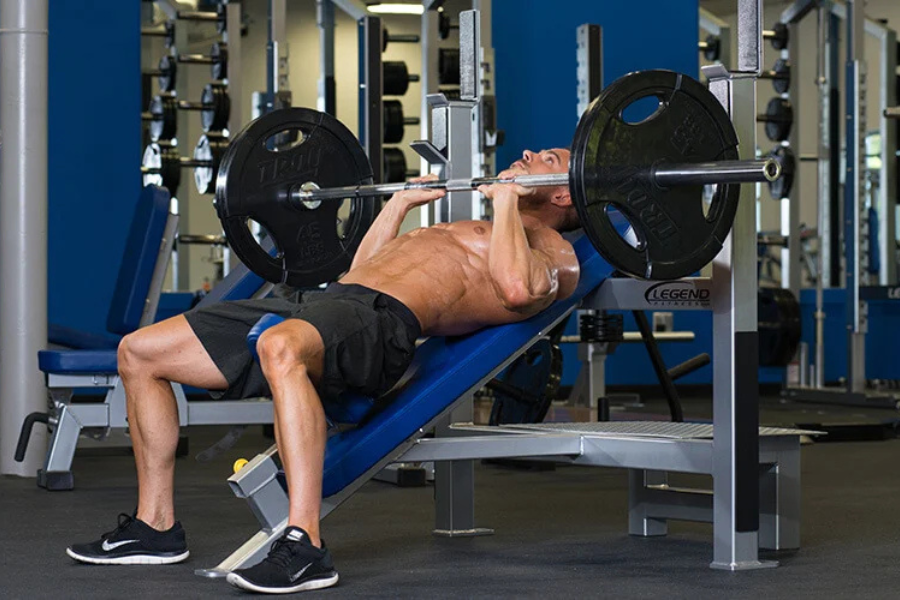
- Close grip bench press targets the triceps more than a standard bench and is considered one of the most effective barbell exercises for triceps strength and size.
- Floor press limits range of motion to emphasize the top half of the press, which greatly increases triceps activation and lockout strength.
- JM press sits between a skull crusher and close grip bench, so you can load it heavier than a skull crusher while still hammering the triceps.
As your triceps get stronger, you will notice more control off the chest, faster bar speed, and a smoother finish on heavy sets.
Support shoulder and elbow health
Stronger triceps stabilize your elbow joint and help your shoulders handle pressing volume with less irritation. Training all three heads, especially the long head, spreads the work across more muscle tissue so one area is less likely to get overworked and cranky.
Close grip bench press, JM press, and overhead work like the French press all place significant demand on the long head, which crosses the shoulder joint. Developing it can improve shoulder stability during other upper body exercises.
The anatomy behind barbell tricep training
You do not need a degree in anatomy to train effectively, but a quick overview helps you understand why certain barbell moves feel different.
The triceps brachii has three heads:
- Long head: runs from your shoulder blade down the back of your arm. It is heavily involved when your arm is overhead or when you get a big stretch at the bottom of an extension.
- Lateral head: the outer portion that contributes to that “horseshoe” look. It works hard in heavy pressing.
- Medial head: sits deeper underneath and helps with elbow stability and lighter, endurance-type work.
Barbell exercises that let you use a large range of motion and significant load, such as the French press (overhead barbell tricep extension) and close grip bench press, do a good job of challenging all three heads, often with extra emphasis on the long head.
1. Close grip bench press
If you only pick one barbell tricep exercise, this is a strong choice. The close grip bench shifts focus away from your chest and directly onto your triceps, while still letting you handle heavy weights safely.
How to do it
- Lie on a flat bench with your feet flat and shoulder blades pulled back.
- Grip the bar about shoulder-width apart or slightly narrower. Avoid going extremely narrow since that can strain your wrists.
- Unrack the bar and hold it above your chest with arms straight.
- Keep elbows close to your body as you lower the bar under control to the lower chest or upper stomach.
- Press the bar back up, driving through your palms and consciously extending your triceps at the top.
Form tips to protect joints
Guidance from coaching resources such as ATHLEAN-X emphasizes a few key points for safe and effective reps:
- Keep elbows close to your sides, not flared, to reduce shoulder strain.
- Maintain shoulder blade retraction through the set for joint stability.
- Use a full but controlled range of motion rather than bouncing the bar.
- Choose a weight you can move without twisting or arching excessively.
A grip that is too narrow can stress the wrists and create imbalances, so aim for “close” not “hands touching.”
Why your triceps need it
- Massive loading potential for strength and size
- Great carryover to regular bench press and other presses
- Hits the inner and outer portions of the triceps depending on grip and elbow path
A closer grip of roughly 5 to 6 inches with elbows in emphasizes the inner head of the triceps, while a slightly wider close grip of about 8 to 10 inches with elbows out can hit the outer head more and usually allows heavier weights.
2. Skull crusher with an EZ bar
The skull crusher is a classic isolation move, and using an EZ bar makes it easier on your wrists and elbows while you focus on pure elbow extension.
How to do the EZ bar skull crusher
- Lie on a flat bench with feet planted and core lightly braced.
- Hold the EZ bar with a narrow, comfortable grip and press it above your chest.
- Keeping your upper arms still and roughly perpendicular to your torso, bend only at the elbows to lower the bar.
- Aim to bring the bar down to your forehead, just above your nose, with control.
- Extend your elbows back to the starting position, focusing on squeezing your triceps.
The movement should be almost entirely at the elbow joint. Do not roll your upper arms back and forth, or you will pull in your lats and reduce tricep emphasis.
Variation: behind-the-head stretch
You can also angle your arms slightly back so they point more toward your head and lower the EZ bar behind your head instead of toward your forehead. Only your forearms move.
This version gives the long head a powerful stretch and can feel better on your elbows. Many lifters find the long head responds well to that stretched position.
Dumbbell alternative
If you do not have access to an EZ bar or your wrists prefer a different angle, you can mimic the skull crusher with dumbbells.
- Lie on a bench and press two dumbbells up.
- Halve the weight you would normally use on the bar and focus on form.
- Lower the dumbbells toward either side of your head or slightly behind it, then extend.
Dumbbells give each arm its own path and can be friendlier on joints as long as you control the movement.
Why your triceps need it
- Strong isolation of the triceps, especially the long head
- Great for high rep “pump” work after heavier pressing
- Helps build balanced arm development that complements compound lifts
Men’s Health Fitness director Ebenezer Samuel, C.S.C.S., has highlighted skull crushers with a barbell (ideally an EZ bar) as one of the most effective moves for isolating the triceps and building arm size, since they focus on elbow extension and minimize help from other muscles.
3. French press (overhead barbell tricep extension)
The overhead triceps extension with a barbell, also called the French press, targets all three triceps heads with extra focus on the long head.
How to do it
You can perform this seated or standing.
- Grip an EZ bar or light straight bar with hands about shoulder-width apart.
- Press the bar overhead so your arms are straight and biceps are near your ears.
- Keep your upper arms fixed and slowly bend at the elbows, lowering the bar behind your head.
- When you feel a strong but comfortable stretch in your triceps, extend your elbows to return to the top.
Use a controlled tempo. Do not let the weight yank your arms into an extreme stretch.
EZ bar vs dumbbells and cables
The French press with a barbell lets you use more weight and a long range of motion, which increases upper arm mass compared to some dumbbell versions that are harder to load.
Some lifters, however, report that dumbbell overhead extensions feel better on the elbows and provide a more intense stretch to the long head than cable overhead extensions, even though cables keep constant tension and let you pull the handles apart at the top. Others find EZ bar overhead work uncomfortable due to flared elbows.
That mix of experiences is a good reminder: technique, joint structure, and equipment all shape how an exercise feels for you. Start lighter, test different grips, and choose the version that lets you feel your triceps working without joint pain.
Why your triceps need it
- Strong emphasis on the long head due to the overhead position
- Long range of motion and deep stretch for hypertrophy
- Complements presses done with your arms out in front of you
Use this either earlier in the workout on a moderate weight or later with lighter weight and higher reps to flush the muscle with blood.
4. Floor press
At first glance, the floor press looks like a shortened bench press. That limited range of motion is exactly what makes it valuable for your triceps.
How to do it
- Lie on the floor under a barbell set in a rack.
- Plant your feet if your lower back feels better that way or keep legs straight for more strict work.
- Grip the bar with a close or medium width.
- Unrack and lower the bar until your upper arms gently touch the floor.
- Pause for a brief moment, then press back up to lockout.
You can also use a close grip to further increase tricep demand.
Why your triceps need it
- Focuses on the lockout portion of the press where triceps work hardest
- Reduced range of motion is easier on the shoulders
- Starting from a dead stop increases motor control and tricep activation
This is especially useful if you feel shoulder discomfort on flat bench or if you repeatedly miss presses near the top.
5. JM press
The JM press is a hybrid between a skull crusher and a close grip bench press. It looks unusual at first but offers a powerful way to load your triceps heavily while maintaining a fairly short range of motion.
How to do it
- Set up like a close grip bench press with a shoulder-width grip.
- Unrack the bar and bring it above your upper chest.
- Instead of lowering straight down or hinging only at the elbows, let your elbows bend and travel slightly forward, guiding the bar toward your face or throat area.
- Stop when you feel strong tension in the triceps, then press back to the starting position.
The range of motion is smaller than a skull crusher. You are essentially performing a heavy tricep extension with a bit of press built in.
Why your triceps need it
- Lets you handle heavier weight than skull crushers alone
- Keeps tension focused on the triceps, especially around the mid range and lockout
- Helpful if you want to strengthen pressing muscles without more wide grip benching
Because this exercise is demanding, it is often best in lower rep ranges with a focus on tight, repeatable technique.
Other helpful barbell tricep moves
Beyond the main lifts above, a few more barbell tricep exercises are worth knowing:
- Single-arm landmine press: great for tricep strength with added core stabilization and a shoulder-friendly pressing path.
- Board press: uses boards on your chest to shorten bench press range of motion, overloading the triceps in the top half.
These can be rotated into your program when you need a variation that still emphasizes lockout strength and tricep development.
How to program barbell tricep exercises
You do not need to perform every exercise at once. A focused mix that fits your goals works best.
Sample approach for size
If your priority is hypertrophy:
- Close grip bench press: 3 to 4 sets of 8 to 12 reps
- EZ bar skull crushers or French press: 3 sets of 10 to 12 reps
- Optional: JM press or floor press: 2 to 3 sets of 6 to 10 reps
Aim for one or two tricep-focused sessions each week. For isolation moves like skull crushers, some recommendations suggest starting around 4 sets of 10 to 12 reps and over time gradually increasing weight and decreasing reps to 6 to 8 as you grow stronger.
Sample approach for strength and lockout
If your priority is pressing strength:
- Close grip bench press: 3 to 5 sets of 6 to 8 reps
- Floor press: 3 to 4 sets of 6 to 10 reps
- JM press: 3 to 4 sets of 4 to 8 reps
You can add lighter tricep isolation at the end, such as 2 sets of higher rep skull crushers, to maintain size while you focus on strength.
Weekly frequency
For most lifters, training triceps directly 1 to 2 times per week is enough. You are also getting indirect work from regular bench presses, push-ups, dips, and overhead presses.
If your elbows feel beat up, reduce volume and keep isolation exercises in higher rep ranges with strict control instead of chasing constant PRs.
Technique checklist for safer training
Pushing your triceps hard is important, but doing it with smart form is what keeps you in the gym long term.
Body position
- Keep your feet flat and engaged on bench variations.
- Lightly brace your core and squeeze your glutes to prevent excessive arching.
- Retract your shoulder blades on bench and floor pressing to protect your shoulders.
Elbow and shoulder alignment
- For skull crushers and French presses, keep your elbows roughly shoulder-width apart, not excessively wide or pinned together.
- For bench variations, avoid letting your elbows flare out too far; keep them at a comfortable angle near your torso.
- In all extension movements, keep upper arms relatively still to maintain tricep focus.
Load selection and progression
- Start lighter than you think, especially with new exercises like JM presses or overhead work.
- Add weight slowly over time rather than jumping too quickly and compromising form.
- Stop sets a rep or two before your form breaks down.
Listening to your elbows and shoulders is key. If a barbell pattern consistently feels wrong even when you lighten the load and adjust form, swap to a dumbbell or cable variation that lets you work the same muscle without irritation.
Putting it all together
When you give barbell tricep exercises a dedicated place in your training, you get more than just bigger arms. You build stronger presses, more joint stability, and better overall performance on nearly every upper body lift.
Start by choosing 2 or 3 of the exercises above, plug them into your week, and commit to slow, steady progression. Stay consistent with your technique and recovery, and your triceps will quickly show you why they needed these barbell movements in your program.
About the Author