Why ab workouts matter for athletes
If you are serious about performance, an ab workout for athletes is about much more than visible six‑pack abs. Your core is the link between your upper and lower body. It stabilizes your spine and pelvis, helps you transfer force efficiently, and protects you from injury every time you sprint, cut, jump, or lift.
A strong core helps you:
- Maintain better posture and alignment
- Reduce the risk of lower back pain
- Improve balance and body control
- Produce more power in big lifts like squats and deadlifts
- Move more efficiently in your sport
Research from physical therapists highlights that your core is not just your abs. It includes the abdominals, obliques, lower back muscles, glutes, and even your pelvic floor, all working together to stabilize your spine and pelvis. When you train this whole system, your performance in running, jumping, throwing, and changing direction improves.
Understand your core muscles
To build an effective ab workout for athletes, it helps to know what you are training. Your “abs” include several key muscle groups:
-
Rectus abdominis
The classic six‑pack muscle. Helps you flex your spine, like in crunches and sit‑ups. -
External and internal obliques
Run along the sides of your torso. Important for rotation, side bending, and resisting twisting forces. -
Transverse abdominis
A deep corset‑like muscle that wraps around your midsection. Acts like a natural weightlifting belt to stabilize your spine and pelvis during heavy or fast movements. -
Lower back muscles (including quadratus lumborum)
Support trunk extension and help keep your spine stable when you bend, lift, or land. -
Hip flexors and related core muscles (including psoas major and glutes)
Support movements like sprinting, kicking, and lifting your legs, and help tie your pelvis into the rest of your core system.
When you build a workout that hits all of these muscles in different ways, you get a core that not only looks strong but also performs under pressure.
Core training for performance, not just looks
Visible abs mostly come from having a low enough body fat percentage, typically somewhere between about 6 to 15 percent for men and 10 to 22 percent for women, combined with muscle development in your midsection. That is a body composition goal, not just a training goal.
For performance, your focus should be on:
- Stability, so your spine stays safe under load
- Force transfer, so power from your hips and legs reaches your upper body
- Control in multiple directions, not just forward and backward
Coaches like Mike Boyle have popularized an “anti‑movement” approach for athletes. Instead of endless crunches and sit‑ups, you spend more time on exercises where your core resists motion, such as anti‑rotation or anti‑lateral flexion. This style of training builds a “bracing” core that protects you when you cut, land, or collide.
Train all planes of motion
Many athletes overemphasize sit‑ups and similar movements. These mostly work your rectus abdominis in one plane of motion, the sagittal plane, which is flexion and extension. Overdoing this can create imbalances and even contribute to low back pain.
For a complete and durable core, you want exercises that cover:
-
Sagittal plane (flexion and extension)
Example: crunches, deadbugs, supermans -
Frontal plane (lateral flexion and resisting side bending)
Example: side planks, kettlebell teapots -
Transverse plane (rotation and anti‑rotation)
Example: Russian twists, Pallof presses, banded rotations
When your program includes all three, you prepare your body for the unpredictable, multi‑directional demands of most sports.
Key movement patterns to include
Think of your ab workout for athletes as covering these core patterns rather than just specific exercises:
-
Anti‑flexion
Your core prevents your torso from collapsing forward under load. -
Example exercises: planks, ab wheel rollouts
-
Anti‑lateral flexion
You resist bending sideways, which protects your spine when you carry loads or absorb contact. -
Example exercises: side planks, farmer’s carries with one dumbbell
-
Anti‑rotation
You control unwanted twisting, which is critical when you cut, pivot, or decelerate quickly. -
Example exercises: Pallof presses, plank with shoulder taps
-
Controlled rotation
You generate and control rotational force for throwing, swinging, and striking. -
Example exercises: Russian twists, cable woodchoppers, landmine rotations
This mix creates a “bulletproof” trunk that is strong in every direction.
Sample 15‑minute core workout you can do anywhere
You can train your core effectively in about 15 minutes, two or three times per week, with just body weight or light equipment. Here is a simple starting workout you can adapt to your sport and fitness level.
Perform 2 to 3 rounds. Rest 30 to 45 seconds between exercises and 1 minute between rounds.
- Deadbug
- Focus: Core bracing, anti‑extension
- How: Lie on your back with arms reaching to the ceiling and hips and knees bent to 90 degrees. Press your lower back gently into the floor. Slowly extend your right arm overhead and your left leg toward the floor without letting your back arch. Return to the start, then switch sides.
- Reps: 8 to 10 per side
- Why it works: The deadbug is a staple for athletes because it teaches you to maintain a neutral spine while your limbs move. It is often programmed 2 to 3 times per week to reduce low back pain and build stable movement patterns.
- Plank
- Focus: Anti‑flexion, deep core and shoulder stability
- How: Set up on your forearms with elbows under shoulders and legs extended. Form a straight line from head to heels. Gently tighten your glutes and brace your midsection as if someone might tap your stomach. Do not let your hips sag or pike.
- Time: Start with 10 seconds and build up to 30 seconds or longer over time
- Why it works: Engages the transverse abdominis and surrounding muscles, which act like a natural weight belt to support your spine during heavy lifts.
- Side plank
- Focus: Anti‑lateral flexion, obliques, deep stabilizers
- How: Lie on your side, elbow under shoulder, legs straight. Lift your hips so your body forms a straight line. Keep your top hip stacked directly over the bottom one.
- Time: 15 to 30 seconds per side
- Why it works: Side planks train your core to resist side bending which supports posture, reduces injury risk, and improves performance in cuts and lateral movements.
- Bird dog
- Focus: Core and lower back stability, anti‑rotation
- How: Start on hands and knees. Brace your core lightly. Extend your right arm forward and left leg back without letting your hips twist or your back arch. Pause, then return and switch sides.
- Reps: 8 to 10 per side
- Why it works: Bird dogs strengthen both core and back muscles and have been recommended as a safe option for athletes who experience back pain with traditional ab exercises ([2019 and 2021 research summarized in sports conditioning resources]).
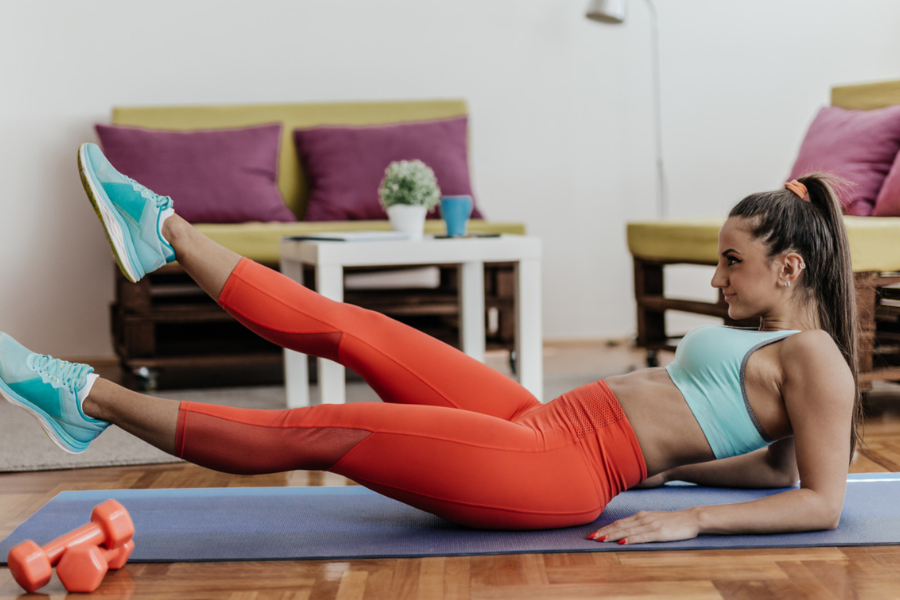
- Bicycle crunches
- Focus: Abs and obliques with rotation
- How: Lie on your back with hands behind your head and legs lifted. Bring your right elbow toward your left knee while extending your right leg, then switch sides in a pedaling motion. Move slow enough to stay in control.
- Reps: 10 to 15 per side
- Why it works: The American Council on Exercise ranks bicycle crunches among the most effective ab exercises for activating both the obliques and the deep transverse abdominis, and they require no equipment.
If you want a bit more challenge, you can add one more exercise:
- Russian twist
- Focus: Rotational strength, obliques and transverse abdominis
- How: Sit in a V‑shape with your torso leaning back slightly. Either keep your heels on the floor or lift them for a harder version. Hold your hands together or grab a light weight. Rotate your chest to one side, then the other, keeping your core braced.
- Reps: 10 to 15 touches per side
- Why it works: Russian twists are a classic for rotational core strength, which helps in sports that involve twisting like tennis, baseball, or golf ([Gymshark guides, 2019]).
Progressions and variations for advanced athletes
Once the basic movements feel solid, you can progress to more demanding variations that better match high‑level sport demands.
Build more anterior core strength
-
Ab wheel rollouts
Start on your knees and slowly roll forward only as far as you can while maintaining a flat back. This is a powerful anti‑flexion and anti‑extension drill. -
Long‑lever planks
Move your elbows slightly forward of your shoulders. This increases the load on your anterior core without extra equipment.
Challenge lateral stability
-
Side plank with leg lift
From a side plank, slowly raise your top leg without letting your hips drop or twist. -
Single‑arm farmer’s carry
Walk with one heavy dumbbell or kettlebell in one hand. Keep your torso upright and avoid leaning toward the weight.
Add rotational and anti‑rotational power
-
Pallof press
Attach a band or cable at chest height. Stand side‑on to the anchor, hold the handle at your chest, then press it straight out, resisting the band’s pull. This is a go‑to anti‑rotation drill for many athletes. -
Isometric lunge banded rotations
Get into a split stance. Hold a band or cable in front of you with both hands. Rotate your torso slightly and hold while the band tries to pull you back, then return. This mimics real sport positions like catching or swinging while your lower body is staggered. -
Landmine rotations
With one end of the barbell anchored, hold the free end and draw a rainbow arc from hip to hip, rotating through your torso while keeping your hips and knees stable. This builds powerful and controlled rotation for throwing and striking sports.
How often you should train your abs
You do not need to hammer your abs every day to see benefits. In fact, quality and consistency matter more than volume.
A practical guideline for most athletes is:
- Frequency: 2 to 3 dedicated core sessions per week
- Duration: 10 to 20 minutes per session
- Structure: 3 to 5 exercises, 2 to 3 rounds, 10 to 15 reps or 15 to 30 second holds each
You can place these sessions:
- At the end of your main strength workout
- As part of your warm‑up with lower intensity versions, like bird dogs and deadbugs
- On lighter training days as extra stability work
If your sport has a busy competition schedule, you can cycle your core training focus. For example:
- Early off‑season: Emphasize stability and basic strength
- Pre‑season: Add more “chaos” and reactive drills that mimic unpredictable sport situations
- In‑season: Maintain strength with shorter, lower‑fatigue sessions
Common ab training mistakes to avoid
When you put together an ab workout for athletes, watch out for these pitfalls:
-
Only doing sit‑ups and crunches
These heavily target the rectus abdominis in a single plane of motion and can overwork your hip flexors. Over time, this can contribute to imbalances and back discomfort. -
Ignoring your lower back and glutes
Your core is a full 360‑degree system. If you only train the front, you leave the back side underprepared for heavy loads and fast movements. -
Training through pain
If a movement consistently causes sharp pain in your back or hips, stop and adjust. Exercises like bird dogs and deadbugs are often better tolerated and can still build a strong foundation. -
Rushing through reps
Fast, sloppy reps turn core training into momentum training. Slow down enough to feel your abs brace and control each phase. -
Chasing soreness instead of function
Sore abs are not the only sign of a good workout. Your goal is improved stability, better movement quality, and stronger performance, not just a burning sensation in your midsection.
Supporting your core with recovery and nutrition
No ab workout for athletes works in isolation. A few supportive habits can make your training more effective:
-
Nutrition for muscle support
Support core strength by eating enough protein plus key minerals like magnesium, calcium, and potassium, and limit highly processed, high‑sugar foods that do little for recovery and body composition. -
Sleep and recovery
Muscles, including your core, adapt when you rest. Aim for consistent sleep and take at least one or two low‑intensity days each week. -
Movement quality in daily life
Practice good posture when you sit, stand, or carry heavy bags. This reinforces the alignment you train in the gym.
Putting it all together
If you want your core to help you run faster, lift heavier, and stay healthier, treat your ab workout for athletes as performance training, not just cosmetic work.
You can start with this simple plan:
- Pick 4 to 5 exercises that cover anti‑flexion, anti‑lateral flexion, and rotation or anti‑rotation.
- Train them 2 to 3 times per week in short 10 to 20 minute sessions.
- Focus on control, breathing, and quality of movement rather than speed.
- Progress slowly by increasing time under tension, adding load, or choosing more advanced variations.
Try adding one of the core circuits above to your next workout. After a few consistent weeks, you will likely notice better stability in your lifts, more control when you cut or jump, and a midsection that finally feels as strong as the rest of your game.
About the Author