Understand your no equipment ab workout
A no equipment ab workout lets you train your core anywhere using just your body weight. You do not need ab machines, fancy gadgets, or a gym membership. With a few focused moves and consistent effort, you can build a stronger midsection that supports your posture, protects your back, and makes everyday movement feel easier.
Most effective ab workouts at home rely on simple patterns, like planks, leg raises, and controlled crunch variations. The key is not complexity, it is how well you control each repetition and keep your core muscles engaged.
Know what your core actually is
When you think of an ab workout, you might picture only a six pack. Your core is much more than that. It includes:
- Rectus abdominis, the visible “six pack” muscles
- Obliques along your sides
- Transverse abdominis, the deep corset like muscles
- Muscles around your spine and hips that stabilize your torso
A good no equipment ab workout should make all of these work, not just the front of your belly.
Strong core muscles help:
- Support your spine and reduce pressure on your lower back
- Improve balance and stability when you walk, run, lift, or play sports
- Make lifting groceries, carrying kids, and sitting upright at a desk feel easier
Set realistic goals and expectations
Ab exercises alone will not “melt” belly fat, with or without equipment. Many infomercial style ab gadgets suggest you can get flat abs quickly, but they mostly exist to make money, not to guarantee results. What actually reveals muscle definition is reducing overall body fat through a mix of strength training, movement, and nutrition.
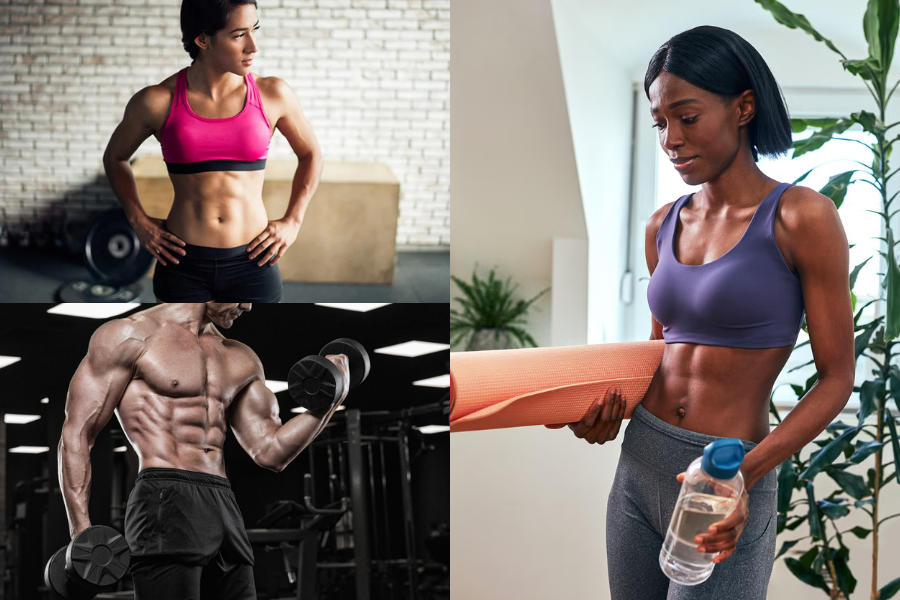
Guidance from trainers suggests that for most people, visible abs usually appear when body fat is roughly 8 to 12 percent for men and around 15 percent for women. Without getting into those ranges, even the best ab routine will build muscle that you might not see.
Your main goals for a no equipment ab workout at home can be:
- Better posture and fewer back aches
- A stronger, more stable core for daily life and sports
- Gradual muscle development that may become visible as overall fitness improves
Learn five beginner friendly ab exercises
If you are starting out, you can build a simple no equipment ab workout using five foundational moves. These focus on control and core engagement rather than high speed or high reps. A 15 minute routine designed by personal trainer Kira Jones, CPT, uses these same types of exercises for beginners.
Deadbug
Deadbugs train your deep core while keeping your spine supported.
- Lie on your back with your arms reaching toward the ceiling.
- Lift your legs so your knees are bent at 90 degrees above your hips.
- Brace your core and press your lower back gently into the floor.
- Slowly lower your right arm and left leg toward the floor while keeping your back flat.
- Return to the starting position and switch sides.
Modification: Instead of moving your arm and leg through a full range, hold the starting position and move only a small amount until you can maintain a flat lower back.
Forearm plank
Planks work your entire core as stabilizers. You hold the position against the clock, which challenges endurance.
- Start on all fours, then lower onto your forearms.
- Step your feet back until your body forms a straight line from head to heels.
- Keep your elbows under your shoulders and your hips level.
- Brace your core and squeeze your glutes.
- Hold while breathing steadily.
Modifications:
- Drop your knees to the floor to reduce intensity.
- Place your hands on a sturdy bench or couch for an incline plank.
Seated straight leg lift
This move targets your lower abs and hip flexors.
- Sit on the floor with your legs extended in front of you.
- Place your hands lightly on the floor beside your hips.
- Sit tall, brace your core, and lean back slightly.
- Lift one or both legs a few inches off the floor without rounding your back.
- Lower with control.
Modification: Place your hands slightly behind your hips to give more support and reduce strain on your lower back.
Side plank
Side planks focus on your obliques and lateral stability.
- Lie on your side with your elbow under your shoulder and legs extended.
- Stack your feet or place one in front of the other.
- Lift your hips to form a straight line from head to feet.
- Keep your neck neutral and your top shoulder stacked over the bottom one.
- Hold, then switch sides.
Modification: Lower your bottom knee to the floor and keep your top leg extended, which lightens the load on your core.
Toe touch
Toe touches emphasize your upper abs with a short, controlled crunch.
- Lie on your back and lift your legs so they are vertical or as close as comfortable.
- Reach your arms toward your toes.
- Exhale as you lift your shoulders off the floor, reaching up.
- Pause briefly at the top, then lower with control.
Tip: Think about curling your ribcage toward your pelvis instead of straining your neck forward.
Try a simple 15 minute beginner routine
You can turn the five exercises above into a complete no equipment ab workout you can do in your living room.
Use this structure:
- Choose Deadbug, Plank, Seated Straight Leg Lift, Side Plank, and Toe Touch.
- Perform each exercise for 30 to 45 seconds.
- Rest for 15 to 30 seconds between moves.
- Complete the circuit 3 times.
- Rest 60 to 90 seconds between circuits if you need it.
This format is similar to beginner friendly routines created by trainers like Kira Jones, CPT, which are designed to emphasize form and muscle engagement, not complicated choreography.
Explore a 10 minute no equipment ab circuit
Once you feel comfortable, you can try a slightly more advanced 10 minute circuit. This version adds dynamic, conditioning based moves that also raise your heart rate.
Perform each move for 30 seconds, then go to the next. Repeat the full circuit twice and rest as needed.
Mountain climber twist
Mountain climber twists combine core contraction and stabilization with a cardio element.
- Start in a high plank with your hands under your shoulders.
- Bring your right knee toward your left elbow.
- Return to plank and bring your left knee toward your right elbow.
- Continue alternating at a steady pace while keeping your hips low and core tight.
Side plank with leg lift
This variation challenges your obliques and glute stability.
- Start in a side plank on your forearm.
- Once stable, lift your top leg a few inches, pause, then lower.
- Keep your hips stacked and avoid rotating forward or backward.
Side plank hip dips
Hip dips build endurance in the side of your core.
- Begin in a strong side plank.
- Lower your hip toward the floor without resting it.
- Lift back to the starting position and repeat.
You can combine leg lifts and hip dips in separate 30 second blocks on each side.
Reverse crunch
Reverse crunches focus on your lower abs.
- Lie on your back with your knees bent at 90 degrees and feet off the floor.
- Place your hands beside you or lightly under your hips for stability.
- Press your lower back into the floor.
- Use your abs to curl your hips slightly off the floor and bring your knees toward your chest.
- Lower slowly without swinging your legs.
Plank up
Plank ups work your core, shoulders, and triceps.
- Start in a forearm plank.
- Press up onto one hand, then the other, to reach a high plank.
- Lower back down to your forearms one arm at a time.
- Keep your hips stable and avoid rocking side to side.
Lying leg raise
Leg raises specifically target your lower abs and can feel demanding but rewarding.
- Lie on your back with your legs straight and your arms at your sides.
- Press your lower back into the floor.
- Raise your legs together toward the ceiling.
- Slowly lower them until you feel your lower back start to lift, then stop.
- Lift back up to repeat.
Tip: If your lower back feels strained, bend your knees slightly or limit the range of motion.
Bicycle crunch
Bicycle crunches activate your rectus abdominis and obliques.
- Lie on your back with your hands lightly behind your head.
- Bring your knees up to tabletop.
- Extend your right leg while bringing your right elbow toward your left knee.
- Switch sides in a pedaling motion.
- Move slowly enough that you can feel your abs doing the work, not your neck.
Inchworm push up
The inchworm push up combines flexibility, core engagement, and upper body strength.
- Stand tall with your feet hip width apart.
- Hinge at your hips to place your hands on the floor.
- Walk your hands forward to a plank position.
- Perform a push up, or hold the plank if a push up feels too intense.
- Walk your feet toward your hands and stand up.
Use smart modifications to stay consistent
You do not have to start with full versions of every exercise. Modifications help you improve your form and stay focused on quality, which is more important than doing a high number of reps.
Helpful options include:
- Planks on your forearms or knees
- Holding a static Deadbug instead of moving arms and legs fully
- Placing your hands behind your hips for added support during seated leg lifts
- Dropping your bottom knee in side planks
Adjust the difficulty so you can move with control and breathe steadily, without holding your breath or straining.
Protect your back with proper form
Core workouts without equipment, especially moves like Bird Dog and plank variations, are effective for building stability around the spine. When your midsection is strong and engaged, it takes pressure off your lower back and can help reduce discomfort.
To keep your back safe:
- Keep your ribcage and pelvis aligned rather than letting your lower back arch hard.
- Brace your core as if you are gently preparing for a cough.
- Stop a leg raise or crunch where your form starts to break, not where momentum takes over.
- Focus on slow, controlled movement instead of rushing for more repetitions.
Because your core supports posture all day, you can handle small extra doses of core work. Still, it is important to respect recovery, especially when you are new to training.
Plan your weekly ab training
You do not need to train your abs every day. Fitness guidance from coaches like Chris Protein in Austin, Texas suggests:
- Train your abs 2 to 3 times per week.
- Include 2 to 3 core exercises per session.
- Spend 5 to 30 minutes on focused ab work, depending on your schedule and experience.
Shorter sessions of 5 to 10 minutes can still be effective when you concentrate on form. Longer sessions up to 30 minutes make sense when you combine core work with full body strength training or cardio.
A simple weekly structure could look like:
- Day 1: 15 minute beginner routine
- Day 3: 10 minute no equipment circuit
- Day 5: Mix of planks, bird dogs, and leg raises for 10 to 20 minutes
On non core days, full body strength work and walking or other cardio will support your overall fitness and help with body composition, which is crucial if your long term goal includes visible abs.
Choose tools wisely and skip ab gimmicks
You might see a lot of products that promise flat abs without effort. Research notes that these gadgets, especially those heavily advertised on infomercials, often make unrealistic claims and are not required for strong abs. They mainly benefit companies, not your results.
If you want to invest in equipment over time, you will usually get more value from:
- Dumbbells
- Resistance bands
- An exercise ball
These tools let you train your entire body, including your abs, instead of locking you into one limited motion. A simple exercise ball, for example, can add variety to crunches and planks while costing far less than a bulky machine.
Key takeaways
- A no equipment ab workout can be done at home in as little as 5 to 15 minutes and still be effective when you focus on form.
- Planks, deadbugs, leg raises, and controlled crunch variations cover most of what your core needs.
- Training your abs 2 to 3 times per week with a few quality exercises is usually enough for strength and stability.
- Strong abs come from consistent training plus overall fat loss. No ab gadget or single exercise can spot reduce belly fat.
- Prioritize technique and control over the number of reps, and use modifications so you can move well instead of just moving more.
If you are not sure where to start, pick three exercises from the beginner list, set a timer for 10 minutes, and cycle through them at an easy pace. Over time, you can build up to longer circuits and more advanced variations, all without adding a single piece of equipment.
About the Author