Understand what makes a “best” chest exercise
If you want to build a bigger, stronger chest, the best chest exercises all have a few things in common. They challenge your pecs through a big range of motion, let you control the load safely, and can be progressed over time. You do not need a full commercial gym to grow your chest. You can get far with bodyweight, dumbbells, or a simple bench and cable setup.
In this guide, you will walk through the 10 best chest exercises based on current expert recommendations and practical gym experience. You will see how each move targets your chest, how to perform it with strong technique, and how to adjust sets and reps for strength or muscle growth.
Before you dive into the list, it helps to know the main regions of your chest and how to train each one.
Know your chest muscles
Your chest is not just one slab of muscle. When you pick the best chest exercises, you are really trying to hit three main regions.
Upper chest
- Muscle focus: Clavicular head of the pectoralis major
- How to target it: Angled presses and flyes where your torso is leaned back on an incline, roughly 30 to 45 degrees
- Why it matters: A strong upper chest gives your chest that squared, lifted look that many lifters want but often neglect
Mid and inner chest
- Muscle focus: Sternal head of the pec major
- How to target it: Flat presses and flyes, and movements that bring your arms across your body toward the midline
- Why it matters: This is where most of your chest mass comes from and where big compound presses shine
Lower chest
- Muscle focus: Lower fibers of the pec major
- How to target it: Decline angles, dips, and movements where you press slightly downward and forward
- Why it matters: A developed lower chest rounds out your pecs and avoids a “flat bottom” look
A complete chest program works all three areas in different planes of motion, including pressing straight out, slightly up, and slightly down, plus fly or crossover patterns that bring your arms across your body.
Master chest training fundamentals
Before you pick specific moves, lock in a few basics that apply to almost all of the best chest exercises.
Weekly volume and frequency
Research suggests you should aim for at least 10 hard sets of chest work per week to maximize muscle growth. That can look like:
- 3 to 4 exercises per week
- 3 to 4 sets per exercise
- Trained once or twice per week
You can split that across two chest days or one push day plus one full upper body day.
Choose the right rep ranges
Use rep ranges that match your goals:
- Strength: 2 to 6 reps per set with heavier loads
- Muscle growth: 6 to 12, or even up to 20 to 30 reps when loads are lighter
- Endurance: 12 to 20 plus reps
You do not have to stay locked into one range. Many effective programs mix heavy sets and moderate to higher rep work across the week.
Form cues that protect your shoulders
Most chest injuries come from sloppy technique and ego loads. On presses and pushups:
- Keep your ribs stacked over your pelvis instead of letting your lower back arch heavily
- Squeeze your shoulder blades lightly toward your back pockets
- Think “elbows at about 45 degrees” to your torso, not flared straight out
- Lower with control and avoid bouncing at the bottom
With that base in place, you are ready for the top 10.
1. Barbell bench press
The barbell bench press is a classic for a reason. It lets you load your chest heavily, build total upper body strength, and coordinate your lats, glutes, core, chest, and triceps together. It is one of the best chest exercises for overall power and size when you have access to a bar and rack.
How to do it
- Lie on a flat bench with your feet planted.
- Grip the bar slightly wider than shoulder width.
- Pull your shoulder blades back and down and keep your eyes under the bar.
- Unrack, then lower the bar to mid chest with control.
- Press the bar up in a straight line until your elbows lock out softly.
Sets and reps
- Strength focus: 3 to 5 sets of 3 to 6 reps
- Hypertrophy focus: 3 to 4 sets of 6 to 10 reps
Why it is effective
The bench press lets you move more weight than dumbbells or machines, and that higher load is a strong driver of strength and size, especially once you have mastered pushups and want to progress beyond bodyweight work.
2. Dumbbell bench press
The dumbbell bench press rivals the barbell version as one of the best chest exercises for growth, and in some ways it beats it. Training each arm independently improves motor control, exposes and corrects imbalances, and lets you choose hand positions that feel better on your joints.
According to a 2025 guide from Men’s Health, the dumbbell bench press is one of the top chest builders and works well at 3 to 4 sets of 6 to 8 reps for strength and muscle.
How to do it
- Sit on a bench with a dumbbell in each hand, resting them on your thighs.
- Lie back and use your legs to help kick the dumbbells into position above your chest.
- Set your feet, brace your core, and lightly pull your shoulders toward the bench.
- Lower the dumbbells in a controlled arc to chest level.
- Press them back up until your arms are straight and your wrists are stacked over your elbows.
Sets and reps
- General muscle growth: 3 to 4 sets of 6 to 10 reps
Why it is effective
Dumbbells increase your range of motion compared with a bar and allow small adjustments in elbow and wrist position that keep your shoulders comfortable. Because you can safely drop the weights at the end of a set, you can push closer to failure without needing a spotter.
3. Incline dumbbell bench press
If you want your T‑shirt to “sit” better across your upper chest, the incline dumbbell bench press deserves a top spot in your program. Adjusting the bench to 30 to 45 degrees shifts more stress to the clavicular head of your pec major, which many lifters undertrain.
Men’s Health recommends 3 to 4 sets of 8 to 10 reps for upper chest growth.
How to do it
- Set an adjustable bench to a 30 to 45 degree incline.
- Hold dumbbells at shoulder height with your palms facing forward.
- Brace your core, keep your feet planted, and lightly squeeze your shoulder blades together.
- Press the dumbbells up and slightly toward each other, but do not bang them at the top.
- Lower with control until your elbows are just below bench level.
Sets and reps
- Upper chest emphasis: 3 to 4 sets of 8 to 12 reps
Why it is effective
By changing the angle of tension, you bias the upper chest without losing the benefits of a compound press. The increased stretch at the bottom position drives muscle growth and helps build a more balanced chest.
4. Pushup and advanced pushup variations
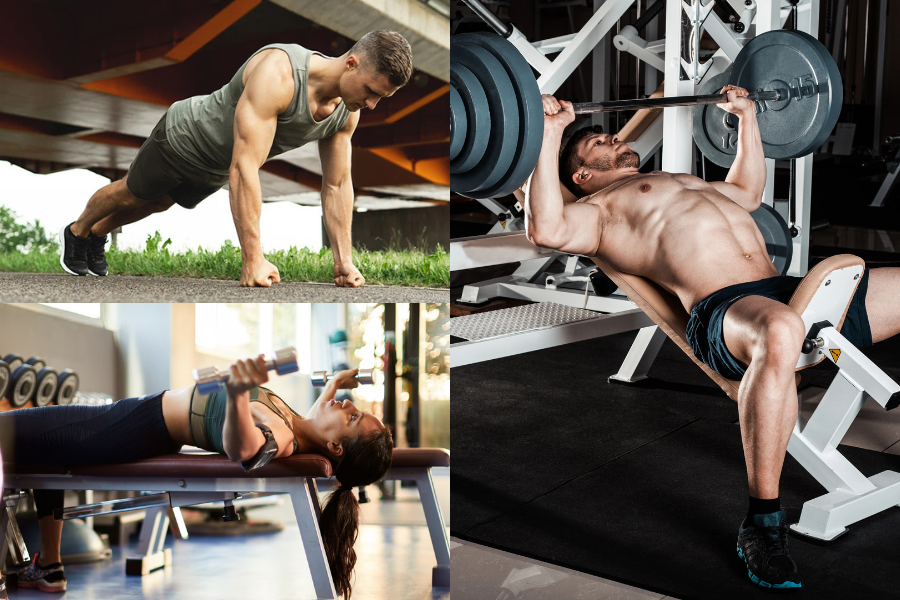
Pushups remain one of the best chest exercises you can do anywhere. They hit your chest in a pattern similar to a bench press but use bodyweight resistance and total body tension.
For beginners, mastering the standard pushup is essential. Simon King, P.T., notes that pushups build the foundation for all later chest work and improve overall upper body strength.
For advanced lifters, pushups do not have to be easy. Variations like archer pushups, post pushups, and single arm pushups force one side of your chest to work harder, challenge your core and glutes, and increase the load without any equipment.
Technique cues that upgrade any pushup
To maximize chest engagement in your pushups:
- Hold a perfect plank. Keep your abs tight and your body in a straight line from head to heels.
- Turn your elbow pits forward. This encourages shoulder external rotation and a safer elbow path.
- Use full range of motion. Lower until your chest is within an inch of the ground, then press all the way back up.
Progression ideas
- Standard pushup: 3 to 4 sets of 8 to 20 reps
- Post pushup dropset: Start with a harder variation then “drop” to an easier version as you fatigue.
- Half typewriter or archer pushups: 3 to 4 sets of 6 to 10 reps per side.
- EMOM or AMRAP formats:
- EMOM (every minute on the minute): Perform a set number of pushups at the start of each minute.
- AMRAP (as many reps as possible): Perform maximum quality pushups in a set time.
Why they are effective
Pushups teach you to create full body tension, keep your shoulders healthy, and build strength that carries over to presses, rows, and even lower body lifts. With creative variations and time under tension strategies like pauses, they can challenge even advanced athletes.
5. Dumbbell chest fly
The dumbbell chest fly is your go to isolation exercise to stretch and squeeze your pecs. Instead of pushing the weight away from you, you focus on bringing your arms together in a wide hugging motion, which emphasizes horizontal adduction, one of the main actions of your chest.
A 2025 Men’s Health article recommends 3 sets of 10 to 12 reps to maximize chest engagement.
How to do it
- Lie on a flat bench with dumbbells held above your chest, palms facing each other.
- Maintain a soft bend in your elbows and a neutral wrist.
- Open your arms out to the sides in a wide arc until you feel a deep but comfortable stretch across your chest.
- Squeeze your pecs to bring the dumbbells back together over your chest.
Sets and reps
- Chest isolation: 3 to 4 sets of 10 to 15 reps
Why it is effective
By reducing triceps involvement and keeping constant tension through the arc, this move targets your chest uniquely compared with presses. Use a controlled tempo and avoid going so heavy that you lose shoulder stability.
6. Incline cable chest fly
If you want consistent tension across the entire range of motion, cables have a clear edge. The incline bench cable chest fly targets your upper chest through a frontal plane, fly style motion and keeps the muscles working even at the top where dumbbells usually go “easy.”
Setting your bench at about 45 degrees helps you focus tension on the upper chest.
How to do it
- Place an adjustable bench between two low cable pulleys, set to about 30 to 45 degrees.
- Grab the handles and sit back on the bench with your arms out and slightly bent.
- With your chest up and shoulders set, bring your hands together above your chest in a hugging motion.
- Pause briefly at the top to squeeze your pecs, then return to the start under full control.
Sets and reps
- Upper chest isolation: 3 to 4 sets of 10 to 15 reps
Why it is effective
Cables provide constant tension and a smooth path that is easier on your joints. This makes the incline cable fly ideal late in your workout when you want to fatigue your upper chest without stressing your shoulders.
7. Chest dip
Bodyweight dips have long been a staple for lower chest and triceps. When you lean slightly forward and let your elbows flare a bit, you shift more of the work into your lower chest and create one of the toughest bodyweight presses around.
How to do it
- Grab parallel bars and support yourself with locked elbows.
- Lean your torso slightly forward and cross your ankles behind you.
- Lower your body by bending your elbows, aiming to feel a stretch in your chest.
- Press back up until your elbows are straight but not slammed.
To emphasize chest over triceps, keep your torso forward and your elbows a bit flared. To regress the movement, use an assisted dip machine or band.
Sets and reps
- Strength: 3 to 4 sets of 4 to 8 reps
- Hypertrophy: 3 to 4 sets of 8 to 12 reps
You can add load with a dip belt or by holding a dumbbell between your ankles once bodyweight dips feel easy.
Why it is effective
Dips require significant strength and stability. They light up your lower chest, triceps, and shoulders and can be progressed for years simply by adding weight.
8. Cable crossover
Cable crossovers are a classic finishing move for the chest. You stand between two high pulleys and bring your arms together in front of you, often finishing with your hands crossing slightly. This bilateral movement isolates your pecs and lets you fine tune the angle to emphasize upper, mid, or lower chest.
How to do it
- Set both pulleys to a high position.
- Step forward into a staggered stance and lean slightly forward.
- With a slight bend in your elbows, sweep your hands down and together in front of your chest or just below it.
- Squeeze your chest hard at the bottom. You can even pause briefly to eliminate momentum.
- Return slowly until your chest feels a stretch.
Sets and reps
- Definition and finishing work: 3 to 4 sets of 10 to 15 reps
Why it is effective
Cable crossovers keep continuous tension on your pecs and allow you to tweak the line of pull to hit different chest regions. Because each handle moves independently, you can also work on correcting left to right imbalances and improving mind muscle connection.
9. Dumbbell floor press
The dumbbell floor press is a joint friendly substitute for bench pressing, especially if your shoulders are touchy or you do not have a bench. Lying on the floor limits the range of motion, which reduces shoulder strain while still hitting your chest and triceps.
Men’s Health notes that 3 to 4 sets of 8 to 10 reps work well for chest strength and muscle when using this move.
How to do it
- Lie on your back on the floor with dumbbells in each hand.
- Bend your knees and plant your feet for stability.
- Start with your upper arms resting on the floor and your elbows bent at about 90 degrees.
- Press the dumbbells straight up until your arms are almost fully extended.
- Lower until your triceps gently touch the floor, pause, then press again.
Sets and reps
- Shoulder friendly pressing: 3 to 4 sets of 8 to 12 reps
Why it is effective
By taking away the bottom stretch that can irritate some shoulders, the floor press allows you to train heavy in a safer range. It also forces you to accelerate the weight from a dead stop, which can improve pressing power.
10. Decline dumbbell fly
The decline dumbbell fly helps you build a more three dimensional chest by emphasizing the lower portion of your pecs through a deep stretch and strong contraction. Although decline presses often get all the attention, decline flyes are excellent for focused lower chest work.
Some guides point out that performing the exercise at a greater decline angle can enhance upper pec involvement as well, due to the specific line of pull and how individual anatomy responds.
How to do it
- Set a decline bench and secure your feet.
- Lie back with dumbbells held over your chest, palms facing each other.
- With a soft elbow bend, lower the weights out to your sides until you feel a strong stretch across your chest.
- Bring the dumbbells back together over your chest using your pecs rather than your arms.
Sets and reps
- Lower chest focus: 3 to 4 sets of 10 to 15 reps
Why it is effective
Decline flyes apply the stretch and contract principle to the lower chest. The long range of motion and deep stretch signal your body to grow thicker, more defined pecs when paired with enough weekly volume and recovery.
How to build your own chest workout
You do not need all 10 exercises every week. Instead, build simple, repeatable workouts that cover your whole chest and let you progress.
Step 1: Choose your training setup
Pick one of these simple frameworks:
- Two chest focused days per week
- One heavy “strength” day and one moderate “hypertrophy” day
- One full upper body day and one push day
Step 2: Pick 2 to 4 exercises per workout
Use this structure:
- Start with 1 to 2 compound presses
- Finish with 1 to 2 isolation or cable moves
Example A: Dumbbell focused chest day
- Dumbbell bench press
- Incline dumbbell bench press
- Dumbbell chest fly
- Cable crossover
Example B: Minimal equipment day
- Pushups (progressed to advanced variations)
- Dumbbell floor press
- Dumbbell chest fly
Step 3: Match reps to your goal
For muscle growth with healthy joints, a wide rep range works. A practical template:
- Compound presses: 3 to 4 sets of 6 to 10 reps
- Isolation work and cables: 3 sets of 10 to 15 reps
- Pushups: 3 to 4 sets for as many controlled reps as you can
Step 4: Progress your training
To keep seeing results over the next 6 to 8 weeks and beyond:
- Add small amounts of weight when you can hit the top end of your rep range with solid form.
- Add a set on one or two exercises if you recover well.
- Slow your lowering phase to increase time under tension.
- Use short pauses at the bottom of presses or flyes to remove momentum.
With consistent twice weekly training, you can expect to feel performance improve in about 3 to 4 weeks and start noticing visual changes in 6 to 8 weeks, provided your nutrition and sleep are on point.
Quick recap and next steps
To put this all together:
- Use the barbell or dumbbell bench press plus incline dumbbell presses as your main strength builders.
- Master pushups and then explore advanced variations to challenge your chest anywhere.
- Add flyes, cable work, and dips to round out your upper, mid, and lower chest.
- Aim for at least 10 quality sets of chest work per week, spreading them across 2 to 4 of the best chest exercises per session.
- Progress slowly but consistently by adding weight, reps, or sets only when your form is solid.
Pick one or two of the exercises in this guide to plug into your next workout. Set your first target, write it down, and give your chest a four to six week window of focused effort. Your shirts, and your pressing strength, will show the difference.
About the Author