Calves are one of the most overlooked muscles in the gym, yet strong, well developed calves help you run faster, jump higher, and stay more stable on every step. If you want results that show in your performance and in the mirror, you need a smart approach built around the best calf exercises, not random sets at the end of leg day.
This guide walks you through the 10 best calf exercises, how they work, and how to use them in a simple program you can actually stick to. You will see how to target both major calf muscles, adjust volume and load, and avoid the common mistakes that keep calves small and stubborn.
Before you pick exercises, it helps to know what you are training.
Understand your calf muscles
Your calves are more than one lump of muscle on the back of your lower leg. The calf muscle group, often called the triceps surae, has three muscles that work together to point your toes, push you off the ground, and keep you upright when you stand or walk.
Gastrocnemius vs soleus
The two muscles you care about most for training are:
-
Gastrocnemius
-
The big, visible calf muscle with two heads that form the classic diamond shape
-
Crosses the knee and ankle
-
Works hardest when your knee is straight
-
Contributes a lot to sprinting speed and jumping
-
Soleus
-
Sits underneath the gastrocnemius
-
Originates just below the knee on the tibia and fibula
-
Made mostly of fatigue resistant type 1 slow twitch fibers
-
Works hardest when your knee is bent to about 90 degrees
-
Critical for standing, walking, and running because it helps control every step
A third, smaller muscle called the plantaris also assists, but most of your training focus should stay on the gastrocnemius and soleus.
Why strong calves matter
Stronger calves do more than fill out your socks:
- Improve posture and balance by stabilizing the ankle
- Help you absorb impact when you run, jump, or change direction
- Contribute to acceleration and short sprints, with research identifying dynamic maximum calf strength as a key factor for sprinting ability
- Support vertical jump, speed, and agility, with a 2021 study on young male basketball players linking increased calf circumference to better performance in all three
If you skip heavy and focused calf work, you leave free gains in speed, stability, and power on the table.
How calf muscles actually grow
You often hear that “calves are all genetics” or that you “just need to go heavier.” The research paints a more nuanced picture.
Volume, load, and fiber type
The soleus is dominated by slow twitch fibers, and the gastrocnemius also has a big slow twitch component. These fibers handle long walks, standing, and daily steps without tiring, so you need a strong enough signal to make them grow.
A 2020 study by Brad Schoenfeld and colleagues showed that calf muscles can grow well with high volume and relatively low loads if your effort is high. That means you do not always have to go extremely heavy, but you do need to push close to failure on many of your sets.
On the other hand, sports rehab specialists like David Grey point out that most people train calves too light and with poor mechanics. His key points:
- Many lifters load calf raises so lightly that they never challenge the muscle
- Chasing an exaggerated “deep stretch” with heavy load can create active insufficiency and reduce the force your calves can produce
- You should bias the range of motion that lets you produce the most force, then progressively overload over time
You can combine both insights. Use loads that feel heavy in the 8 to 15 rep range, work with control, and build high weekly volume by training calves several times per week.
Foot position and muscle focus
A 2020 study by Nunes and colleagues showed you can shift emphasis within the gastrocnemius by changing foot angle during calf work:
- Toes out: more medial head
- Toes in: more lateral head
- Toes forward: solid overall activation
For most lifters, you will get enough coverage by keeping your feet straight most of the time, then occasionally rotating in or out if you want to fine tune shape.
Core principles of effective calf training
Before you dive into the list of the best calf exercises, lock in these fundamentals. They decide whether your hard work translates into bigger, stronger calves.
- Train both knee angles
- Straight leg exercises target the gastrocnemius
- Bent knee exercises at about 90 degrees emphasize the soleus
- Use a full but strong range of motion
- Drop your heel to a comfortable stretch
- Drive up hard and finish with a strong squeeze
- Avoid collapsing into an extreme stretch that makes you lose tension
- Focus on effort, not just reps
- Most sets should finish within 2 or 3 reps of failure
- If you easily hit 15 reps with perfect form, add weight
- Progressive overload beats random burnout
- Track weights and reps
- Aim to add small amounts of load or a rep or two over time
- Train calves often enough
- They recover quickly, especially the soleus
- Two to three focused sessions per week works well for most people
With those basics in place, you are ready for the 10 best calf exercises.
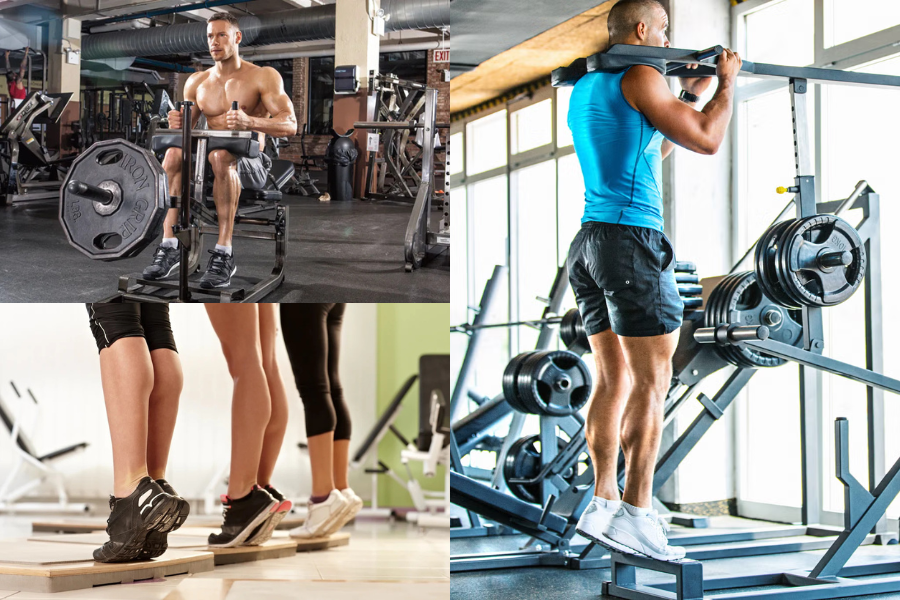
Standing barbell or machine calf raise
This is your primary mass builder for the gastrocnemius and a staple in almost every effective calf routine.
How to do it
- Stand on a sturdy platform or calf machine with the balls of your feet on the edge and heels free to drop.
- Keep your knees straight but not locked. Brace your core.
- Slowly lower your heels until you feel a comfortable stretch in the calves.
- Push hard through the balls of your feet to rise up, lifting your heels as high as you can.
- Pause briefly at the top and squeeze your calves.
- Lower under control and repeat.
Why it works
- Directly loads both the gastrocnemius and soleus
- Works in a functional standing position that carries over to running and jumping
- Easy to progress by adding weight on a Smith machine or standing calf raise machine
Programming tip
Aim for 3 to 4 sets of 8 to 15 reps. Choose a weight that lets you complete the reps with a strong squeeze at the top and a full stretch at the bottom without bouncing.
Seated calf raise
To build the soleus, you need the knee bent. The seated calf raise is the classic way to do that.
How to do it
- Sit on a seated calf raise machine or bench with your knees bent at about 90 degrees.
- Place the balls of your feet on the foot plate so your heels can drop freely.
- Position the knee pad or weights securely on your thighs.
- Lower your heels under control into a stretch.
- Drive your toes down, lifting your heels as high as possible.
- Pause and squeeze at the top, then lower slowly.
Why it works
- Bending the knee reduces gastrocnemius involvement and puts more stress on the soleus
- Targets the fatigue resistant muscle that does most of the work when you stand or walk
- A 90 degree knee angle is the primary and best way to isolate the soleus for strengthening
Programming tip
Try 3 sets of 10 to 15 reps. You can focus on slower tempos and long squeezes at the top to fully fatigue the soleus.
If you train at home, you can mimic this with a dumbbell or weight plate on your thighs.
Single leg calf raise
Once you know the basics, training one leg at a time raises the challenge and exposes imbalances.
How to do it
- Stand next to a wall or stable support for balance.
- Place the ball of one foot on a step, plate, or flat floor.
- Lift the non working leg slightly behind you.
- Lower your heel into a stretch.
- Push through the ball of your foot to rise up as high as you can.
- Pause and squeeze, then lower under control.
You can hold a dumbbell in the opposite hand to increase difficulty.
Why it works
- Doubles the load on one calf since your whole body weight sits on a single leg
- Builds balance and ankle stability
- Research backed routines often prescribe 2 sets of 15 reps per leg with short rests for an effective stimulus
Programming tip
Use this as a second exercise after your heavier bilateral work. Go for 2 to 3 sets of 12 to 15 reps per leg.
Double leg calf raise
Sometimes simple wins. The basic bodyweight or lightly loaded double leg calf raise is a great starter for beginners and a reliable high rep finisher for more advanced lifters.
How to do it
- Stand near a wall or support with your feet hip width apart.
- Keep your body in a straight line from head to heel.
- Press down through the balls of both feet and raise your heels.
- Pause briefly at the top, then lower slowly.
You can add weight by holding dumbbells at your sides or wearing a weighted vest.
Why it works
- Strengthens and tones both the gastrocnemius and soleus
- Easy to learn and perform almost anywhere
- Useful in warm ups and high rep burnout sets
Programming tip
Start with 2 to 3 sets of 15 to 20 reps. Focus on smooth reps and controlled tempo, not speed.
Eccentric calf raise
Eccentric work, where you emphasize the lowering phase, is powerful for both muscle growth and tendon resilience.
How to do it
- Stand on a step with both feet, then rise onto your toes using both legs.
- Shift your weight onto one leg at the top.
- Slowly lower your heel for a count of 3 to 5 seconds.
- Put the other foot back on the step and repeat.
You can hold a dumbbell or use a Smith machine for extra load.
Why it works
- Eccentrics place high mechanical tension on the calf muscles
- Helpful for building strength and for many rehab protocols
- Great way to overload the lowering portion even if you cannot yet raise the same weight concentrically
Programming tip
Use 2 to 3 sets of 8 to 10 eccentric reps per leg. The slow lower is the key, so do not rush it.
Tiptoe farmer’s carry
Not every great calf exercise looks like a traditional calf raise. Loaded carries on your toes challenge both strength and endurance.
How to do it
- Grab a pair of dumbbells or kettlebells.
- Stand tall and rise up onto your toes.
- Walk forward slowly, staying as high on your toes as possible.
- Keep your core braced and shoulders relaxed.
- Walk for a set distance or time, then rest.
Why it works
- Trains the calves isometrically, which is similar to how they work during standing and walking
- Adds a strong stability challenge for the ankles and feet
- Builds grip and upper body stability at the same time
Programming tip
Start with 3 to 4 carries of 20 to 30 seconds on your toes. Use a load that feels tough by the end of each carry.
Squat to calf raise
Combining a compound lower body pattern with a calf raise gives you efficient lower body work and teaches you to generate force through a full kinetic chain.
How to do it
- Stand with your feet shoulder width apart.
- Squat down to a comfortable depth while keeping your heels on the ground.
- Stand up powerfully. At the top, continue into a calf raise by lifting your heels as high as you can.
- Pause briefly at the top, then lower your heels and go into the next squat.
You can do this with bodyweight, a barbell, or dumbbells.
Why it works
- Integrates calf work into a movement that already fits into many leg days
- Trains coordination from hips to ankles
- Builds calf strength in a pattern similar to jumping
Programming tip
Use more moderate loads and 3 sets of 10 to 12 reps. The goal here is flow and controlled power, not grinding maximal weight.
Soleus focused seated raise variations
Because the soleus is so important for standing, walking, and running, you benefit from extra direct work. You can vary how you target it, especially if you train without machines.
Effective options
Try rotating these:
-
Seated soleus raises with dumbbell
-
Sit on a bench, knees at 90 degrees
-
Place a dumbbell or plate across your thighs above the knees
-
Lift and lower your heels for 10 to 15 reps
-
Soleus bridge with heel raise
-
Lie on your back with knees bent and feet flat
-
Bridge your hips up
-
Raise your heels while keeping hips lifted, then lower them
-
Squats with end range soleus raise
-
Squat down
-
At the bottom, raise your heels and lower them once or twice before standing
-
Lunge with soleus raise
-
Take a lunge stance
-
In the bottom position, raise and lower the heel of the front leg
Why they work
All of these keep the knee bent around 90 degrees while performing a heel raise, which is exactly how you best isolate and strengthen the soleus. You also train it in positions relevant to walking, squatting, and lunging.
Programming tip
Pick one variation per session and do 2 to 3 sets of 12 to 20 reps, chasing a strong burn in the lower calf.
Sports and functional calf work
You can add a lot of extra calf training without more sets in the weight room by using movements that hit the calves as they were designed to work: dynamically.
Good options
- Running uphill
- Soccer, basketball, tennis, and other court sports
- Step classes or stair work
- Swimming for a low impact option, especially useful if you are coming back from injury
Functional drills from athletic training are also helpful, such as:
-
3 hurdle drill
-
Hop or step quickly over three low hurdles, focusing on quick, springy ground contacts
-
Recommended for 2 sets in athletic programs
-
One leg over the line
-
Stand on one leg and move your other leg over a line repeatedly
-
Hits lateral quickness and lower body stability, often for 2 sets of 10 reps per side
Why they work
- Calves fire on every push off, step, and jump
- You build power, coordination, and durability in ways that isolated machine work cannot fully match
- These options help translate your calf strength into better sport performance
Programming tip
You do not need to overhaul your training plan. Start by adding one or two of these activities once or twice per week based on your goals and interests.
Seated calf raise machine plate loaded
If you train in a gym that has a plate loaded seated calf raise machine, it can be one of your most reliable tools for calf growth, especially for the soleus.
Key features
Typical plate loaded seated calf machines offer:
- A diamond foot plate for secure, optimal foot placement
- Chrome plated weight sleeves for easy loading
- High density, dual layered vinyl pads for durability and comfort
- Adjustable knee pads with multiple vertical and horizontal positions so different heights can train securely
The compact design also makes it a solid choice for home gyms where space is limited.
Why it works
- Specifically targets both the soleus and gastrocnemius with slight foot placement tweaks
- Lets you add weight easily and safely so you can apply progressive overload session after session
- Supports both strength and hypertrophy goals for the lower legs
Programming tip
Use this machine as your main seated movement:
- 3 sets of 10 to 15 reps with a 1 to 2 second pause at the top
- Progressive overload by adding small weight jumps when you can hit the top of the rep range with solid form
Stretching and mobility for calf growth
The best calf exercises get even better when your ankles move well enough to use a full, strong range of motion.
Calf and ankle stretches
You can use simple stretches such as:
-
Gastrocnemius stretch
-
Stand facing a wall
-
Step one leg back, keep the back knee straight, and lean forward
-
Stretch the upper calf
-
Soleus stretch
-
Use the same stance but bend the back knee
-
You should feel the stretch lower in the calf
-
This helps improve dorsiflexion and relieve tightness in the soleus
Prescribed routines often call for 2 sets of 10 reps per side or 20 to 30 second holds with short rests.
Why mobility matters
- Better ankle mobility allows deeper, smoother squats and lunges
- A full but controlled stretch at the bottom of calf raises improves the growth stimulus
- Looser calves can reduce strain on your Achilles and help your lower leg tolerate higher training volumes
Include 5 minutes of calf and ankle stretching and mobility work at the end of your leg or running sessions.
Sample calf workouts you can use
You do not need a complicated plan. Here are two straightforward ways to put the best calf exercises together depending on where you train.
Gym based calf workout
Do this 2 to 3 times per week, ideally after your main leg or lower body work.
- Standing calf raise (barbell or machine)
- 3 to 4 sets of 8 to 12 reps
- Seated calf raise machine
- 3 sets of 10 to 15 reps
- Single leg calf raise
- 2 sets of 12 to 15 reps per leg
- Eccentric calf raises
- 2 sets of 8 slow eccentrics per leg
Focus on adding a little weight or a rep every week or two while keeping tension on the calves, not bouncing.
Home or minimal equipment calf workout
If you just have bodyweight and a few dumbbells, use this 2 to 3 times per week.
- Double leg calf raise on a step
- 3 sets of 15 to 20 reps
- Single leg calf raise holding a dumbbell
- 3 sets of 10 to 15 reps per leg
- Seated soleus raises with dumbbell or plate
- 3 sets of 12 to 20 reps
- Tiptoe farmer’s carry
- 3 carries of 20 to 30 seconds
Then add one or two functional options on other days, such as uphill running, stair work, or a ball sport session.
Common calf training mistakes to avoid
Even the best calf exercises will not get you far if you fall into the traps that stop most lifters.
-
Rushing the reps
-
Bouncing up and down kills tension
-
Slow the lowering phase and pause at the top
-
Training calves “if there is time”
-
Put them in your plan, not as an afterthought
-
Two or three scheduled calf sessions beat one occasional burnout set
-
Going too light forever
-
If you can do 25 or 30 reps easily, you are not challenging the muscle
-
Raise the weight, even if your rep count drops
-
Ignoring the soleus
-
Only doing straight leg work leaves a lot of strength and size gains untapped
-
Always include a bent knee option such as a seated raise or soleus bridge
-
No progression
-
Doing the same weight and reps every week stops growth
-
Track what you do and push for gradual improvement
Bringing it all together
You now have a clear list of the 10 best calf exercises, how they work, and exactly how to plug them into your training. Your next step is simple:
- Pick one standing calf exercise and one seated or bent knee option as your core.
- Add one or two single leg or functional movements for extra stimulus.
- Train calves 2 to 3 times per week, push your sets hard, and track your progress.
Stick with that plan for at least 8 to 12 weeks. Your calves will not just look stronger. You will feel the difference every time you sprint, jump, or climb a set of stairs.
About the Author