Advanced calf workouts can do more than add definition to your lower legs. When you train your calves with intent and structure, you build strength for sprinting, jumping, and lifting, and you reduce your risk of nagging Achilles and calf strains. With the right mix of strength, volume, and plyometrics, your lower legs can finally catch up to the rest of your training.
Below, you will find how advanced calf workouts should look, how to warm up and progress safely, and a full sample routine you can plug into your week.
Understand your calf muscles
Before you load up heavy calf raises, it helps to know what you are actually training.
Your calves are mainly two muscles that work together any time you walk, run, or push off the ground.
- Gastrocnemius: This is the larger, two‑headed muscle you see when you flex your calf. It has more fast‑twitch fibers, which makes it especially important for sprinting and jumping.
- Soleus: This sits underneath the gastrocnemius and has more slow‑twitch fibers. It works hard during standing and endurance activities and plays a big role in stabilizing your ankle.
Knee angle changes which muscle works harder. Straight‑knee movements emphasize the gastrocnemius, while bent‑knee movements shift more work to the soleus. A 2014 study by Suzuki et al. found that plantar flexion with knee extensor activity increases soleus activation and reduces gastrocnemius involvement, which is why bent‑knee exercises are so useful for balanced training.
For advanced calf workouts, you want both straight‑knee and bent‑knee exercises so you do not overdevelop one muscle while neglecting the other.
Warm up for heavy and explosive work
Because advanced calf workouts often include heavy resistance and plyometrics, your warm up should do more than a few ankle circles.
Start with 5 to 10 minutes of light movement, such as brisk walking, cycling, or easy jogging, to raise your body temperature. Then add dynamic drills that specifically target the calves and ankles. Physical therapists and sports clinicians recommend moves such as leg swings and high knees to improve flexibility and get your calves firing before intense activity.
You can use a short sequence like this:
- Forward and side‑to‑side leg swings, 10 to 15 per leg
- High knees over 15 to 20 yards or in place for 20 to 30 seconds
- Ankle hops or gentle pogo jumps for 2 sets of 15 to 20 repetitions
This type of warm up prepares your joints and tissues for both heavy strength training and the fast stretch‑shorten cycles you will use in plyometric exercises.
Set your training goal and structure
Advanced calf workouts can be built around three overlapping goals: strength, hypertrophy, and power.
- Strength and hypertrophy help with muscle size, force production, and overall resilience.
- Power improves how quickly you can apply that force. This matters for acceleration, short sprints, vertical jumps, and quick changes of direction.
For runners, sports like basketball, or anyone who wants strong and durable lower legs, building maximal calf strength is especially important. Research on runners and ACSM strength guidelines suggests using loads that limit you to about 8 to 12 good repetitions per set when you are working on strength and muscle growth.
A practical way to dial in the right load is to find your 10 rep max (10RM), which is the maximum weight you can lift 10 times with solid form. You can do this safely on exercises such as standing calf raises using a Smith machine or by loading a backpack for single‑leg calf raises. Once you know this number, you can train with confidence that you are using a challenging enough weight.
Key elements of advanced calf training
When you design your advanced calf workouts, a few variables matter more than fancy machines.
Include both straight and bent‑knee work
Since straight‑knee exercises bias the gastrocnemius and bent‑knee movements bias the soleus, you want both in your week. For example:
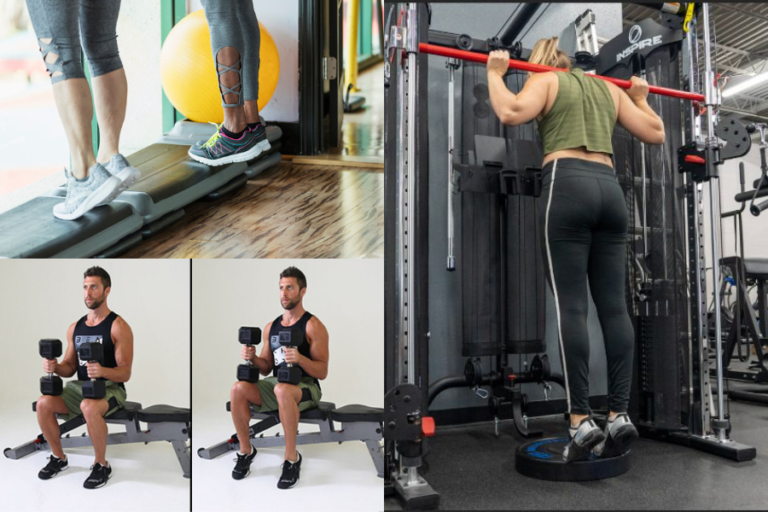
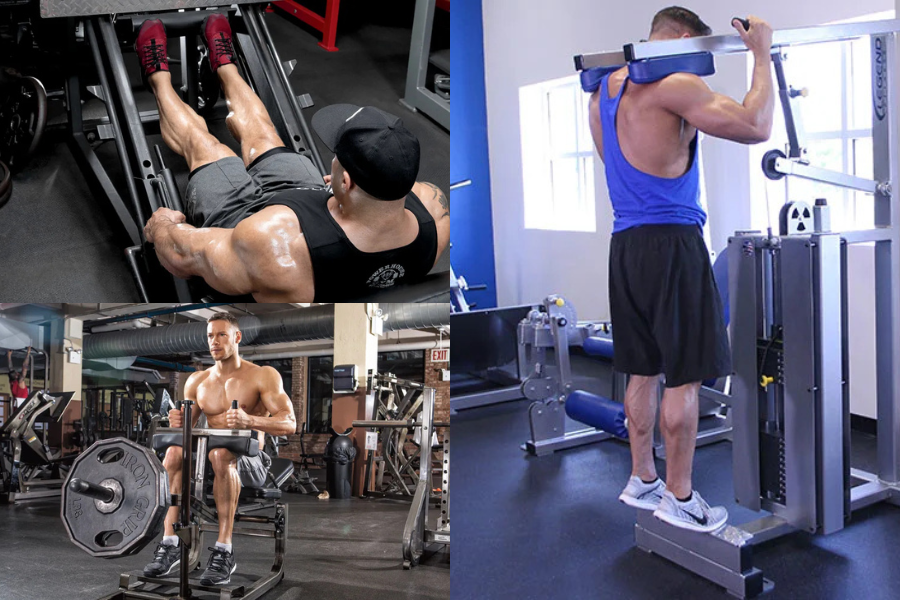
- Standing calf raises or tiptoe farmer carries for gastrocnemius
- Seated calf raises or deficit soleus raises for soleus
Hinge‑health physical therapists highlight straight‑knee calf raises as a fundamental option to help with ankle and knee pain, and they also recommend bent‑knee deficit soleus raises to build strength around the Achilles tendon.
Use full range of motion and high effort
Evidence suggests your calves respond well to higher volume and lower loads, as long as you train with high effort. A 2020 study led by Brad Schoenfeld found similar growth in the soleus and gastrocnemius across different loads, provided sets were taken close to muscular fatigue. This means you do not always have to go as heavy as possible. You do need to work hard through a full range, from a deep stretch at the bottom to a strong squeeze at the top.
Vary your foot angle
You can shift emphasis within the gastrocnemius by changing how your toes point:
- Toes turned out slightly to target more of the medial head
- Toes turned in slightly to target more of the lateral head
- Toes straight ahead for balanced activation
Research from Nunes et al. in 2020 recommends using different foot positions with your calf work to fully develop the muscle.
Build your strength and hypertrophy base
For serious muscle growth, you will want at least one straight‑knee and one bent‑knee strength move in each advanced calf workout.
Sample strength‑focused structure
Use a 10RM‑based setup in line with ACSM style guidelines:
- Frequency: 2 to 3 times per week on non‑consecutive days
- Load: Around your 10RM for strength work
- Sets and reps: 3 sets of 10 reps per exercise
- Rest: 2 to 3 minutes between sets
You can progress by increasing the load 2 to 10 percent once 10 reps feel comfortable and controlled for all sets.
Good strength and hypertrophy choices include:
- Standing calf raises, with a barbell or Smith machine
- Seated calf raises, using a machine or holding weights on your thighs
- Eccentric calf raises, where you lower slowly to improve tissue health
- Squats into calf raises, for functional strength through the entire lower body
Some bodybuilding‑style plans also encourage extra volume throughout the day, such as doing sets of 10 to 20 bodyweight raises at home. This approach helps you accumulate more time under tension when it is not realistic to add endless sets in the gym.
Add plyometrics for power and athleticism
Once you have a strength foundation, advanced calf workouts really level up when you add plyometric work. Plyometrics use explosive, stretch‑shortening actions. You quickly load a muscle as it lengthens, then immediately reverse into a fast contraction. This kind of training is highly effective for power development in both rehabilitation and sport according to Davies and colleagues in 2015.
Lower‑body plyometric programs with hundreds of jumps per week have been shown to improve vertical jump height, sprint speed, and overall lower‑body power. For the calves specifically, explosive exercises such as box jumps, squat jumps, jumping jacks, and calf hops challenge both your muscles and the tendons that store elastic energy.
To keep things safe and productive:
- Meet basic strength standards first, such as being able to perform controlled squats with additional load, before heavy plyometrics.
- Start with low volumes and short bursts of 10 to 20 seconds that focus on form.
- Progress gradually to more jumps and more complex variations, including weighted plyometric drills if appropriate.
Plyometric‑focused advanced calf workouts can improve sprint speed over short distances and make you more reactive and stable on your feet.
Sample advanced calf workout
Here is a structured session that blends strength, hypertrophy, and plyometrics. You can run through it 2 or 3 times per week, depending on your overall training load.
Always adjust volume and intensity based on how your calves and Achilles tendons feel. Occasional muscle soreness is normal, but sharp pain or swelling is a sign to back off and recover.
- Standing calf raises
- 3 sets of 10 to 12 reps at a challenging load
- 2 to 3 minutes rest between sets
- Use different foot angles each set, for example straight, toes in, toes out
- Seated calf raises or deficit soleus raises
- 3 sets of 12 to 15 reps
- Focus on a full stretch at the bottom and a strong hold at the top
- Use slightly lighter weight than your standing work since the soleus is more fatigue resistant
- Eccentric calf raises
- 2 sets of 8 to 10 slow lowerings per leg
- Rise up with both feet, then lower for a count of 3 to 4 seconds on one leg
- This helps improve tissue health and control around the ankle
- Tiptoe farmer carry
- 2 sets of 20 to 30 seconds walking on your toes with weights in each hand
- Keep your core stable and move slowly
- This trains loaded endurance and reinforces calf strength in motion
- Plyometric finisher: calf hops or sprinter‑style jumps
- 2 to 3 sets of 10 to 15 quick jumps
- Rest 60 to 90 seconds between sets
- Focus on short ground contact time and soft, controlled landings
If you prefer a circuit style, you can also group 5 or 6 exercises in a row with minimal rest and repeat the full circuit 3 times with one minute between rounds. Some advanced circuits use moves like handwalks for mobility, single‑leg standing calf raises, and high‑rep seated raises for a dense, time‑efficient session.
Manage frequency, recovery, and progression
Calves tend to handle frequent work, but advanced training is still stressful. Physical therapists who work with runners and racket‑sport athletes emphasize that progressive strengthening takes patience and consistency. Ramping up too aggressively can lead to overuse problems like tendonitis.
A practical plan:
- Train your calves hard 2 to 3 times per week.
- Leave at least one day of lighter or no calf loading between advanced sessions.
- Increase load or volume in small steps, around 2 to 10 percent at a time.
Pay attention to how your calves feel the next day. Mild tightness is normal. Persistent soreness, stiffness in the Achilles, or performance drops are signs you should hold the line or pull back for a week.
Support your training with regular stretching and soft tissue work. Simple wall calf stretches and foam rolling help maintain muscle suppleness and may reduce strain. These tools are especially valuable if you spend a lot of time in stiff shoes or on hard surfaces.
Put it all together
Advanced calf workouts are not about endless light reps tacked onto the end of leg day. To see noticeable growth and performance gains, you will want:
- Heavy or challenging resistance for 8 to 15 reps
- Both straight‑knee and bent‑knee exercises to hit the gastrocnemius and soleus
- Varying foot angles to fully recruit the muscle
- Plyometric drills for explosive power and sport carryover
- Consistent training 2 to 3 times per week with smart progression
Choose one or two changes to implement in your next lower‑body day, such as adding seated raises after your standing work or finishing with a short plyometric block. Over the next few months, you will notice stronger push‑offs, better spring in your step, and calves that finally reflect how hard you train the rest of your body.
About the Author