A solid pair of calves does more than fill out your jeans. With the right high rep calf workouts, you can build endurance for running and sports while also carving out more definition in your lower legs.
This guide walks you through how high repetitions fit into calf training, how to program them for best results, and the exact exercises and routines you can start using today.
Why high rep calf workouts work
Your calves work all day every day. Walking, climbing stairs, standing in line, they are constantly handling light, low intensity effort. That is one reason high rep calf workouts tend to be so effective for both endurance and muscle detail.
Research summarized in a Gymshark training guide notes that calf muscles are predominantly slow twitch, so they respond especially well to higher volume with lighter loads rather than only heavy weights. A 2020 study by Brad Schoenfeld and colleagues, also cited in that guide, found that calf muscle thickness increased similarly regardless of training load as long as sets were taken close to failure. In other words, effort matters more than heavy weight.
Training in the 20 to 30 rep range is very productive for most lifters and can be just as effective as traditional 10 to 20 rep sets for calf hypertrophy. Since your calves already tolerate a lot of low level work, those higher rep sets provide a different, more challenging stimulus that encourages growth and greater endurance.
Understanding your calf muscles
You will get better results from high rep calf workouts if you know what you are actually training.
Gastrocnemius vs soleus
Your calf area is not just one muscle. The two main players are:
- Gastrocnemius: The larger, more visible muscle that forms the rounded upper part of your calf. It crosses both the knee and ankle, and is more involved when your leg is straight.
- Soleus: A deeper muscle that sits underneath the gastrocnemius. It works hard when your knee is bent and plays a big role in posture and endurance.
The gastrocnemius has a nearly even mix of fast and slow twitch fibers, which means it responds well to a variety of rep ranges, from heavy 5 to 10 rep sets to lighter 20 to 30 rep sets. The soleus is mostly slow twitch, which suits it perfectly to higher repetition work and longer time under tension.
If you only hammer away at one style of calf raise, you are probably leaving one of these muscles undertrained. For full development, you need both standing and seated calf work and you need more than one rep range.
Best rep ranges for calf endurance and definition
High reps are powerful, but they are even more effective when you fit them into a balanced plan.
Calves generally benefit from training across three main rep zones:
- Heavy, 5 to 10 reps for strength and density
- Moderate, 10 to 20 reps for bread and butter hypertrophy
- Light, 20 to 30 reps for high rep calf workouts that boost endurance and create a big burn
A good rule of thumb is to do about half of your weekly sets in the moderate 10 to 20 range, with the rest split between heavy work and lighter high rep sets. Training at high repetitions like 20 to 30 is linked with robust gains, but if you stay only in very high rep territory for too long, your calves will adapt to the burn and progress may slow. Rotating through these ranges keeps your muscles guessing and growing.
You can also structure your week so that heavier sessions fall earlier, when you are fresher, and lighter high rep calf workouts appear later in the week. This sequence tends to manage fatigue and injury risk better while still giving you the benefits of all three zones.
Technique essentials for high rep calf raises
If your form is off, high rep calf workouts will feel hard without giving much in return. A few key details make a big difference.
Full range of motion
Short, bouncy reps might let you cruise through a set of 30, but they do not challenge the muscle fully. You want:
- A deep stretch at the bottom
- A deliberate pause and hard squeeze at the top
Neglecting the stretch undermines calf growth, and skipping the hard contraction at the top is one of the most common high rep calf mistakes. To deepen the stretch, you can stand with the balls of your feet on a small plate or step, letting your heels drop slightly below level on each rep.
Controlled tempo and effort
High rep does not mean rushed. Aim for a smooth, controlled cadence, especially on the lowering phase. The weight should be light enough that your heels can rise at least an inch off the ground with every rep. If you are barely moving, it is too heavy for quality work.
Because effort drives growth, take your 20 to 30 rep sets close to technical failure. That means you stop when you cannot complete another full range rep with good form, not when it first starts to burn.
Core high rep calf exercises
To build both endurance and definition, focus on a small group of proven movements and execute them well.
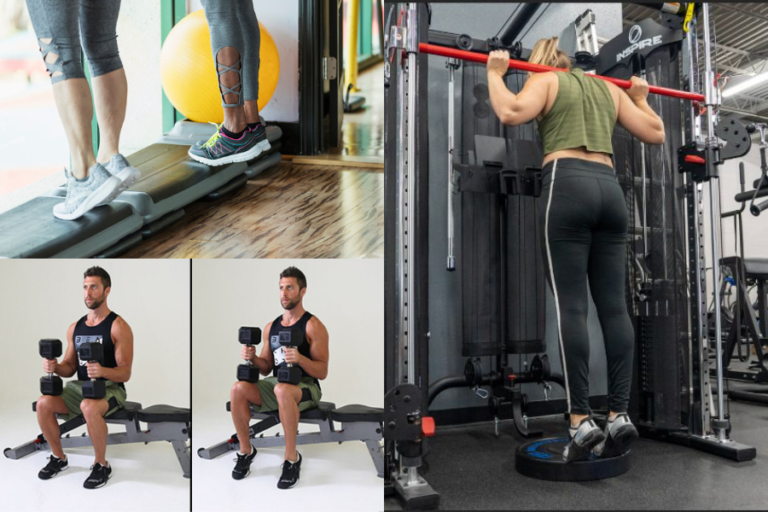
Standing calf raises
Standing calf raises primarily target the gastrocnemius. You can perform them on a machine, with a barbell, or using dumbbells in your hands.
- Stand with the balls of your feet on a step or raised surface if possible.
- Keep your legs nearly straight, with a soft knee bend.
- Drop your heels into a full stretch, then drive up as high as you can onto your toes.
- Pause for a one to two second squeeze at the top before lowering slowly.
For added detail, you can rotate foot position across sets: toes forward, slightly inward, and slightly outward. The Gymshark guide specifically suggests these angles during high rep sets to emphasize different parts of the gastrocnemius.
Seated calf raises
Seated calf raises shift the emphasis to the soleus by bending the knee. Because the soleus is heavily slow twitch, it is well suited to high rep work that challenges its endurance.
- Sit with your knees bent around 90 degrees.
- Place the balls of your feet on a block or step.
- Let your heels drop for a full stretch, then drive them up as high as you can.
- Squeeze at the top before lowering under control.
You can progress seated calf raises by increasing reps and sets, performing single leg variations, adding weight, or modestly increasing speed when you are strong enough to control it.
Other lower leg movements
For complete lower leg development and better performance in running and jumping, consider occasional work for the tibialis anterior (the muscle along the front of your shin) and hopping or pogo drills. High repetition hopping and calf raise protocols are commonly used in rehab settings to build calf endurance and support without overloading too early, especially for runners and field sport athletes.
Sample high rep calf workouts you can use
Here are practical ways to put all this together. Adjust volume based on your experience and how your calves recover.
Beginner friendly routine (2 days per week)
If you are just getting serious about calf training, start here:
Day 1
- Standing calf raises, 3 sets of 12 to 15 reps
- Seated calf raises, 3 sets of 15 to 20 reps
Day 2
- Standing calf raises, 3 sets of 20 to 25 reps
- Seated calf raises, 3 sets of 20 to 25 reps
Focus on full range of motion and a strong squeeze at the top of every rep. Increase reps within the target ranges first, then add small amounts of weight once all sets feel controlled.
Intermediate routine for endurance and definition (3 days per week)
Training calves only once per week is rarely enough to see meaningful change. A three day plan fits better with your goal of endurance and visible definition.
Day 1, heavier focus
- Standing calf raises, 4 sets of 8 to 12 reps
- Seated calf raises, 3 sets of 12 to 15 reps
Day 2, moderate focus
- Standing calf raises, 3 sets of 12 to 15 reps
- Seated calf raises, 3 sets of 15 to 20 reps
Day 3, high rep focus
- Standing calf raises, 4 sets of 20 to 30 reps
- Seated calf raises, 4 sets of 20 to 30 reps
This mix places your heavier work earlier in the week and saves the highest rep ranges for the last session, which helps manage fatigue while still providing that long lasting burn that builds endurance.
High frequency option (up to 5 to 6 days per week)
If your calves are a real weak point and you recover well, you can increase frequency to 3 to 6 sessions per week using minimum effective volumes. When you do this, rotating exercises is very helpful to avoid overloading the same structures every day.
For example, across a week you might alternate:
- Standing machine calf raises
- Leg press calf presses
- Stair or step raises with bodyweight
- Seated calf raises
By changing the angle and equipment from session to session, you reduce the risk of chronic irritation while still getting frequent high rep practice. Keep sets per session modest and watch how your joints feel. High frequency plus high reps can be powerful as long as recovery is respected.
Progression and recovery for long term gains
High rep calf workouts still follow the basic rules of progressive overload. To keep improving endurance and definition, you need to gradually ask more of your muscles over time without tipping into overuse.
A simple approach across a training phase might look like this:
- Pick a target rep range for each exercise, for example 20 to 30 reps.
- Start at the lower end with a weight you can control. When you hit the top of the range on all sets with good form, increase the weight slightly and drop back toward the lower end.
- Maintain roughly the same total number of sets each week while you are progressing load or reps. If progress stalls and you are recovering well, add one set here and there.
Stretching your calves between sets and immediately after training can also help. Gentle but full stretching supports mobility, may help with fascia expansion, and often enhances the muscle pump, which some lifters find helpful for recovery and growth.
Finally, pay attention to how your Achilles tendons and ankles feel. A dull burn in the muscles during high rep work is normal. Sharp or lingering joint pain is a sign to back off, reduce volume, or change exercises.
Putting it all together
To build endurance and definition with high rep calf workouts, you want a blend of smart programming and meticulous technique. Train your calves more than once a week, use both standing and seated variations, and include sessions in the 20 to 30 rep range alongside moderate and heavier work.
Most importantly, make every rep count. Use a full stretch, a hard squeeze, and a controlled tempo. With consistent effort and gradual progression, your calves can go from stubborn to standout, supporting everything from stronger lifts to longer runs.
About the Author